Fotoeins Fotografie

location bifurcation, place vs. home

Posts tagged ‘cemetery’

Juedischer Friedhof, Heiliger Sand, Jewish Cemetery, Holy Sand, Worms, Rheinland-Pfalz, Rhineland-Palatinate, Germany, fotoeins.com

Worms’ Holy Sand: The Rabbi and the Patron

From Worms to Rothenburg, and back to Worms.

Located near the entrance to Worms’ old Jewish cemetery are gravestones of two important figures in medieval Jewish-German history. The cemetery is also called “Holy Sand”1, and is one of many places of interest in the medieval ShUM league of Jewish cities. The gravestones for Rabbi Meir ben Baruch (centre) and Alexander ben Salomo (right) are shown in the picture below.

( Click here for more )

Berlin: the city’s oldest Jewish Cemetery

Der Jüdische Friedhof (Old Jewish Cemetery), Grosse Hamburger Strasse

In the past, I’ve often felt guilty for taking photographs at a cemetery, as if the act of opening and closing the camera’s shutter somehow “exposes and steals” the essence of people who are laid to rest. Only in the last few years have I overcome these feelings, as I now see cemeteries as beautiful places to visit and to witness frozen snapshots to individual lives over time. On this late-autumn afternoon, I stood in the middle of the garden, transported to a different place and a different time, surrounded by tranquility and living memories.

Große Hamburger Straße (or Greater Hamburg Street) was the key central road in what was once the Spandauer Vorstadt, which was the suburb or town at the foot of the former Berlin city gates. The road allowed for trade and movement from Berlin in the direction towards the nearby town of Spandau.

According to berlin.de, the area developed around the Hackesche Market and Courtyards:

Historically, development of the Höfe went hand in hand with the growth of Berlin as a thriving urban centre. The expansion started around 1700 from an outer suburb known as Spandauer Vorstadt, located outside the Spandau City gate which already had its own church, the Sophienkirche as early as 1712. Friedrich Wilhelm I built a new city wall here and the former suburb became a new urban district belonging to Berlin. Today’s Hackescher Markt takes its name from the market built here by a Spandau city officer, Count von Hacke.

The influx of Jewish migrants and the exiled French Huguenots gave the district the cosmopolitan diversity which it never lost. The first synagogue was built in this area and the first Jewish cemetery established on the Grosse Hamburger Strasse. Another name for the area, the Scheunenviertel (barn district) is associated today with up and coming art galleries and the more bohemian side of Berlin. The largest synagogue in Germany was built in nearby Oranienburger Strasse in 1866.

In use from 1672 to 1827, this is Berlin’s oldest cemetery for the Jewish community. Buried here is Moses Mendelssohn (1729-1786), philosopher, a founding father of the Jewish Enlightenment, and grandfather to the great composer Felix Mendelssohn. During the last stages of fighting in the Second World War, 2425 dead were buried here in 16 mass graves. With no clear boundaries separating those buried in the past from those buried during the war, the new memorial garden was constructed and restored in 2007-08 with all of the buried left undisturbed as they were.

The present location was also the site of the first nursing home in 1844 for the Jewish community in Berlin. The Gestapo transformed the home in 1942 to a collection and staging point for prisoners, and ordered the destruction of the entire site in 1943. 55000 Berlin Jews from infants to the elderly were deported and murdered in the concentration camps at Auschwitz and Theresienstadt.

( Click here for images and more )

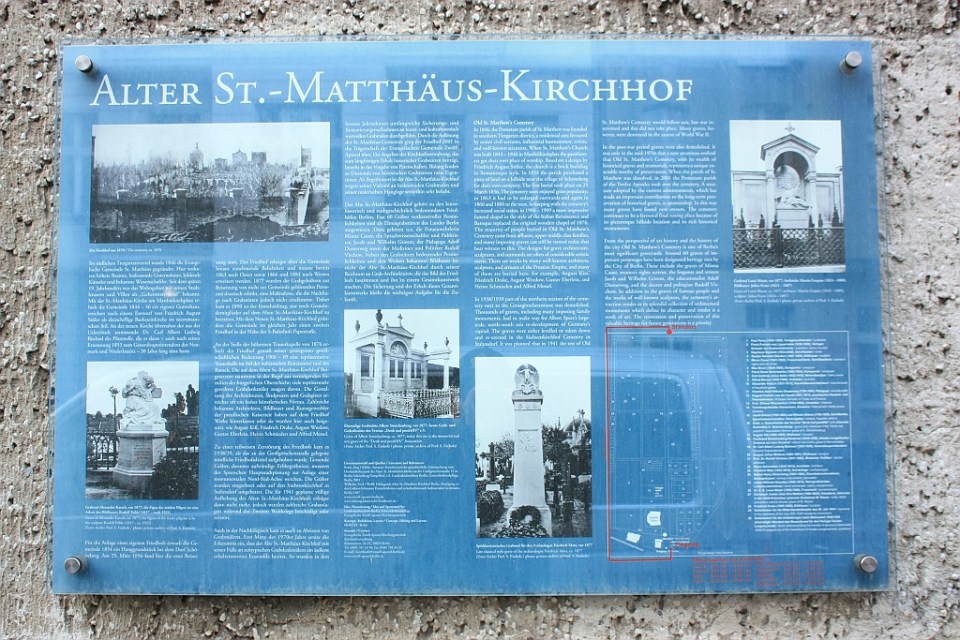
Alter St.-Matthäus-Kirchhof, Schöneberg, Berlin, Germany, fotoeins.com

My Berlin: literature & physics at Alter St. Matthäus cemetery

It’s a big thrill when travel merges with aspects of my childhood upbringing or aspects of my education. I’m fortunate to have had this experience in the German capital city of Berlin.

I had read that the Brüder Grimm (Grimm Brothers) were buried in Berlin Schöneberg. On a walk through the district, I arrived at the Alter St.-Matthäus-Kirchhof, or Old Saint Matthew Cemetery, near the Yorckstrasse train station.

( Click here for more )

My Stockholm: finding Greta Garbo in Skogskyrkogården

The Skogskyrkogården, or Woodland Cemetery, is located about 15 minutes by metro, south from central Stockholm in Sweden. For its unique design, aesthetic character, and expanse both vertically and horizontally, the forest cemetery was declared a UNESCO World Heritage Site in 1994.

I had read that Greta Garbo was buried here, and I wanted to find out for myself.

Skogskyrkogarden Stockholm

North entrance.

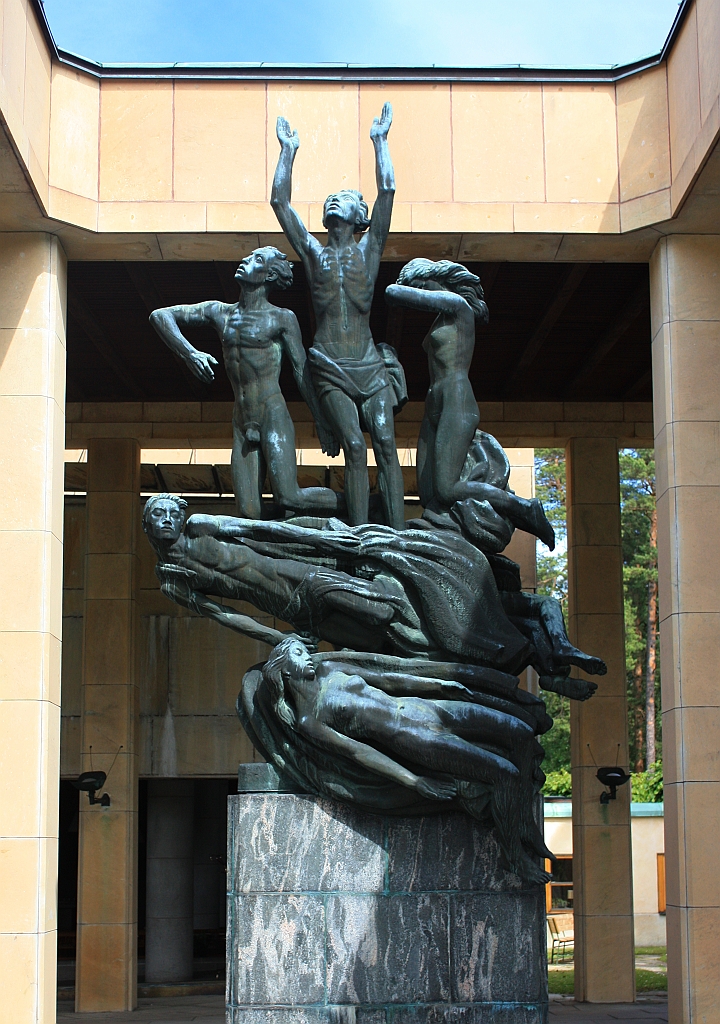
Resurrection Statue, Monument Hall

Resurrection Statue, by John Lundqvist (1930), in Monument Hall.
Skogskappellet, Woodland Chapel, Skogskyrkogarden, Woodland Cemetery, Stockholm, Sweden, fotoeins.com

Skogskappellet (Woodland Chapel), with golden copper “angel of death”.
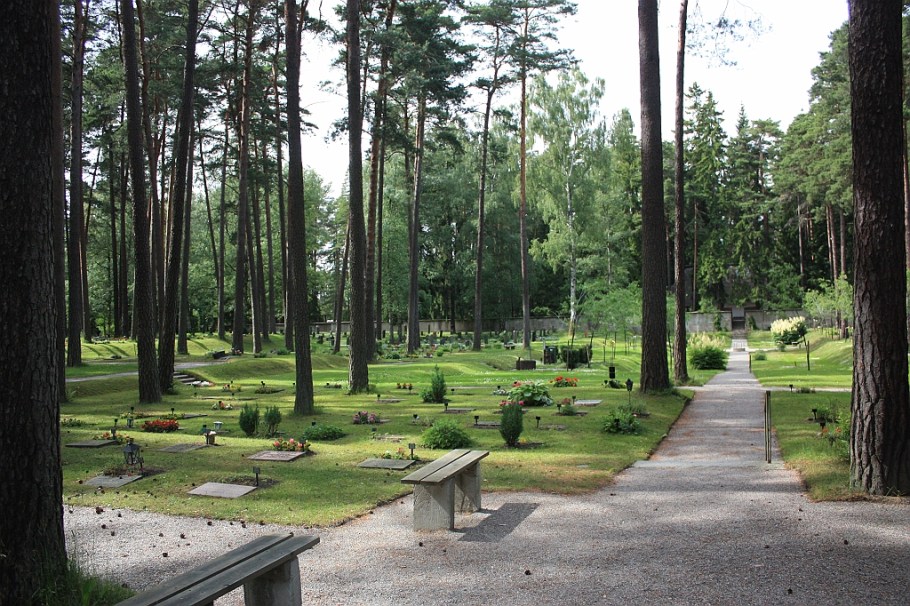
Skogskyrkogarden, Woodland Cemetery, Stockholm, Sweden, fotoeins.com

Skogskyrkogarden (Woodland Cemetery).
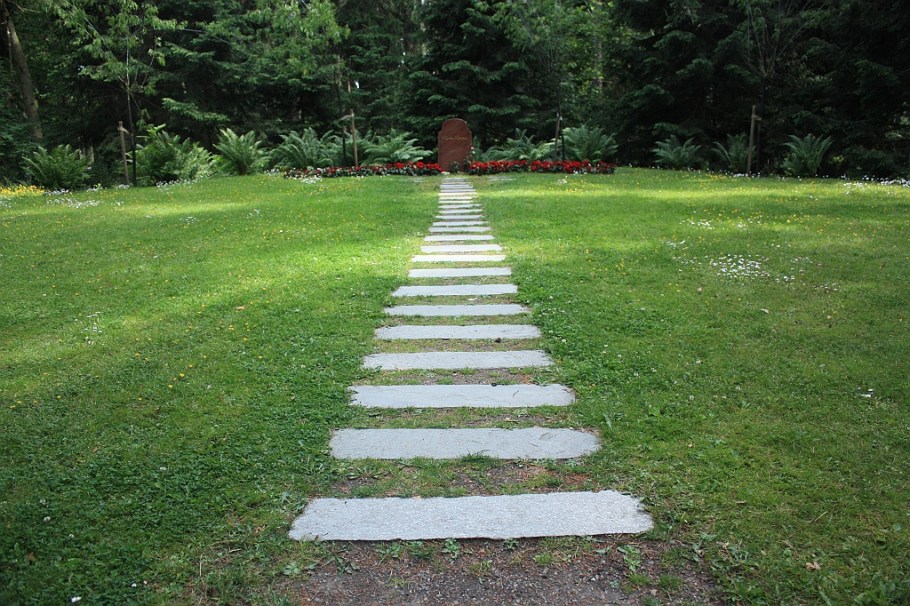
Skogskappellet, Woodland Chapel, Skogskyrkogarden, Woodland Cemetery, Stockholm, Sweden, fotoeins.com

Lead up to Greta Garbo’s grave.

Skogskyrkogarden Stockholm

Modest marker for Garbo’s final resting place.
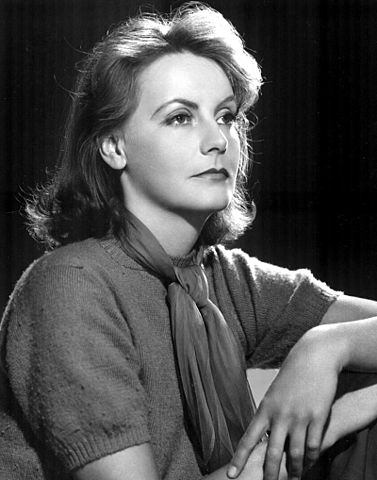
Greta Garbo

Born Greta Lovisa Gustafsson in Stockholm in 1905, Greta Garbo was discovered at the age of 17. She was honoured with four Academy Award nominations for her work which transitioned successfully from silent-films to “talkies” in what is now considered the “Golden Age” of filmmaking. Even now, she is considered one of the most beautiful women and one of the most important actresses ever to appear on the big screen. After only 27 films between 1924 and 1941, she retired to private life, away from celebrity spotlight. After her death in 1990 and subsequent legal issues, her cremated remains were buried in 1999 at SkogskyrkogÃ¥rden in the city where she was born.

In the 1955 biography “Garbo” by John Bainbridge, Garbo is quoted as saying:

I never said, ‘I want to be alone.’ I only said, ‘I want to be left alone.’ There is all the difference.

To reach the forest cemetery from Stockholm’s city centre, take the Tunnelbana green metro line 18 southbound in the direction “Farsta strand” to the stop called “SkogskyrkogÃ¥rden”. There is no charge or fee to enter SkogskyrkogÃ¥rden. Garbo’s grave is located south of the Skogskappellet (Woodland Chapel).


More from Stockholm

•   The colours of Gamla Stan, Stockholm’s Old Town
•   Say “Hej!” (and to food) at Lisa Elmqvist in Östermalm’s Saluhall market hall
•   Daytrip to Vaxholm in Stockholm’s archipelago

The publicity photo above of Greta Garbo is by Clarence Sinclair Bull for MGM in 1939 (Wiki). I made the remaining photos above on 25 June 2008. This post is published on Fotoeins Fotografie at fotoeins DOT com as http://wp.me/p1BIdT-vP.