Fotoeins Fotografie

location bifurcation, place vs. home

Posts tagged ‘cemetery’

25T49 Berlin Weißensee: Margot Friedländer

E48, B43.

The Jewish Cemetery in Berlin Weißensee is one of the largest in Europe. Opened in 1880, the cemetery remains active as the resting grounds for over 100-thousand people in an area covering about 40-hectares (99 acres).

But I’m here also to look for Margot Friedländer. Both survivors of the Holocaust, she and her husband emigrated to the United States in 1946. In 2010, she returned to her birth city of Berlin, where she spoke about her experiences to children at schools and at talks for the general public. She became a respected teacher and educator.


Cemetery entrance: Holocaust memorial in the foreground, mourning hall in the background.
The final spot for Anni Margot Friedländer.
She passed away on the day I arrived in Europe and Germany. Finding the location of her grave and learning the date of her passing struck me hard.
Grave of honour from the city-state of Berlin. The little pin at lower left: “nie wieder” (never again).
“Just a moment: the boss is on their way to greet you personally.”

I made all images above with an iPhone15 on 25 June 2025. This post composed within Jetpack for iOS appears on Fotoeins Fotografie at fotoeins DOT com.

New West actor Raymond Burr

Fraser Cemetery

As a boy whose early memories include the family’s small black-and-white television from the 1970s, I remember the tv show “Ironside.” Canadian-born Raymond Burr played the titular character of Robert Ironside, special consultant for the San Francisco police department. Years later in the mid- to late-1980s, Burr returned as Perry Mason, the lead from the 1960s weekly tv-drama revived as a popular series of made-for-tv movies. He died in 1993, buried with members of his family in Fraser Cemetery, at home in New Westminster, B.C.

Burr family grave at lower-centre – 9 Apr 2024 (iP15).
Raymond Burr (lower-right), with sister Geraldine, father William, and mother Minerva – 9 Apr 2024 (iP15).

In 1858, the British established New Westminster as first- and capital-city of the new colony of British Columbia. Fraser Cemetery accepted its first burials in 1869.


I made all images above with an iPhone15 on 9 April 2024. Composed entirely within Jetpack for iOS, this post appears on Fotoeins Fotografie at fotoeins DOT com as https://wp.me/p1BIdT-sjD.

My Berlin: Minkowski space in Heerstrasse cemetery

Waldfriedhof Heerstrasse (Heerstrasse forest cemetery)

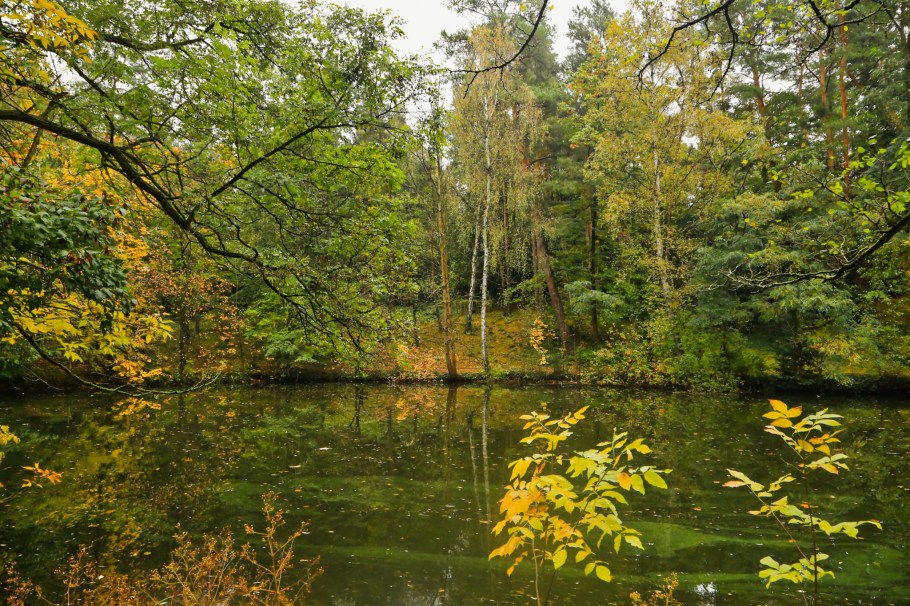
Is this a small park with plenty of trees, hilly terrain, and a small lake? Or is this simply a forest cemetery, a final resting spot for many prominent Berliners?

As part of an ongoing search for gravesites for physicists and mathematicians in Germany, I visited Berlin’s Friedhof Heerstrasse, near the city’s Olympic Stadium. Within the cemetery is Sausuhlensee lake, which settled into a former glacial gully, around which much of the cemetery came into being in 1924. Named after the early 20th-century Heerstrasse estate district whose residents were to be buried here, the cemetery stretches out over an area of almost 15 hectares (37 acres).

I found the grave for physicist Hermann Minkowski, but among the buried there are other “Promis” (prominent).

Friedhof Heerstrasse, Westend, Berlin, Germany, Deutschland, fotoeins.com

Forested park, forest cemetery.

Friedhof Heerstrasse, Westend, Berlin, Germany, Deutschland, fotoeins.com

The calm waters of Sausuhlensee lake on an autumn afternoon.


( Click here for images and more )

Vienna’s St. Marx Cemetery, Biedermeier style

Above/featured: Morning visit to the city’s Biedermeier cemetery – 20 May 2022.

In Vienna’s 3rd district, the St. Marx cemetery is the only surviving Biedermeier cemetery in the city. A visit now is a jump into the frozen past. The cemetery opened with its first burial in 1784. Closure of the city’s multiple neighbourhood cemeteries began in 1873 with the final burial at St. Marx taking place in 1874. Subsequent funerary functions were transferred to the newly constructed Zentralfriedhof located farther out from the city centre. The very leafy avenues and “leafy gate” are what’s left of the city’s only remaining 18th-century cemetery that is now open to the public as a city-administered park.

Why Biedermeier

Biedermeier in Vienna corresponds to a cultural period during the first half of the 19th-century marked by increased industrialization in rapidly urbanized areas and strict censorship with the elimination of dissenting political voices. Instead of looking outward to change, the artist and design community moved to safer spaces in nature or to their homes. While innovation might have given way to a modest yet graceful and functional style, Biedermeier architecture in its neoclassical spin provided inspiration for subsequent Art Nouveau (Jugendstil) and Secession movements. An important Viennese architect of the period was Josef Kornhäusel who designed many buildings in the city. Important music from this period was composed by, for example, Beethoven, Chopin, Liszt, Schubert, Schumann. One of the largest collections of Viennese Biedermeier art is in the Belvedere’s collection. St. Marx cemetery is a reflection of both city and age from the 19th-century.

St. Marxer Friedhof, St. Marx cemetery, Biedermeier cemetery, 3. Bezirk, Landstrasse, Wien, Vienna, Austria, Österreich, fotoeins.com

Cemetery entrance. Photo, 5 Jun 2023.

St. Marxer Friedhof, St. Marx cemetery, Biedermeier cemetery, 3. Bezirk, Landstrasse, Wien, Vienna, Austria, Österreich, fotoeins.com

Main gate. Photo, 20 May 2022.

St. Marxer Friedhof, St. Marx cemetery, Biedermeier cemetery, 3. Bezirk, Landstrasse, Wien, Vienna, Austria, Österreich, fotoeins.com

Address: Leberstrasse 6–8. Photo, 20 May 2022.

St. Marxer Friedhof, St. Marx cemetery, Biedermeier cemetery, 3. Bezirk, Landstrasse, Wien, Vienna, Austria, Österreich, fotoeins.com

Information stone with visiting hours by month. Photo, 20 May 2022.


( Click here for images and more )

My Prague: Olšany cemetery, search for Kafka & Palach

Above/featured: A quiet leafy avenue in Prague’s Olšany Cemetery.

I can’t spend all this time in the Czech capital city, and leave without paying any respects to two 20th-century personalities of Prague. Franz Kafka was an early 20th-century German-Czech writer (e.g., 1912 Die Verwandlung/Metamorphosis), whose writings became known to the world posthumously, thanks to friend and fellow writer Max Brod. In the 1960s, Jan Palach was an important historical figure of opposition who died in protest against the Communist regime.

I’m in the underground metro, heading east from the city centre towards Vinohrady and beyond to Olšany. The sun’s out on a crisp mid-autumn day, and while deciduous trees are left wanting for leaves, the latter have piled like carpets of colour on the cemetery grounds. I’m looking for the graves of Palach and Kafka who are buried in Olšanské hřbitovy (Olšany Cemetery) and Nový židovský hřbitov (New Jewish Cemetery), respectively.


( Click here for images and more )