Fotoeins Fotografie

location bifurcation, place vs. home

Posts tagged ‘Castle Road’

My Heidelberg: 43 Highlights from Home

Above/featured: From Philosophenweg: across the Neckar, over the Altstadt, and up to Königstuhl – 21 May 2016 (HL).

Heidelberg is “eine adoptierte Heimatstadt” (an adopted hometown). Some have called this place “scenic, natural, and spectacular”; some call it “boring, provincial, and extortionate”. I could be referring to Vancouver, but that’s a subject for another time.

I’ve long struggled with questions of place: what defines “home”? Can those definitions and qualities change with time? Do people have choice(s) and do they apply their choices in their search? Can people find meaning with “home”? Must “home” be restricted to only one place, or can different needs be met from different places?

Images can provide access to memories of having lived in a new country, experiencing the shock of the new, and settling into the mundane. I remember advice someone once gave me which became constant companion and reminder: that I was inhabiting a place at the same latitude as my birthplace, 8000 km in distance and 9 time zones apart on the other side of the planet, a place that’s seen its compact share of activity with flair and impact.

Most recall is naturally connected to sight. Occasionally, it’s a rush of the senses: the quick breeze on the skin, the ankle-spraining undulations of the cobblestone, how fog clings like a cold clammy cloak, the sing-song of birds among tall trees in the forest on the hill, the smell of grilled sausages in town by day, and the satisfying late-night noms of a spicy Dürüm Döner with a cool Ayran. And other times, human history leaps out and buries its claws, when the unthinkable must be acknowledged and understood in a synapsis of memory and senses.

In the autumn of 2001, I moved to Germany and Heidelberg: both sight unseen and without having learned any of the language. I stayed in town for a little under two years. What’s astonishing is I have no pictorial record of my time in Heidelberg, Germany, and Europe: I had no camera before the dawn of the smart-phone.

I have some great memories, even if time is casting long shadows. What I lost (no, gave away) was some part of me that actually has little to do with the “Schlager” hit song “Ich hab mein Herz in Heidelberg verloren“. It might be a piece of the heart, a part of the soul, or simply a scrap of good sense; but what it is precisely still remains undefined and shapeless. Finding solid answers about what I’ve surrendered might take years. And so, for the sake of clarity, I’ve returned many times since leaving town in 2003. A sharper focus comes through the post-departure blur whenever I step off the train in town.

I couldn’t have possibly known the experience of moving to and living in Heidelberg would be life-changing. Time so far has been kind, because it didn’t take long for me to adopt Heidelberg as “home”.

( Click here for images and much more )

street art, mural, Herakut, Metropolink, Heidelberg, Germany, fotoeins.com

My Heidelberg: Herakut street art for Metropolink

It’s amazing what gets discovered after going the wrong way.

I head straight for a full city-block before realizing my error, that I should’ve turned right about 5 minutes ago. I bow my head, and release a deep breath in frustration. I raise my head to the sky, when I catch sight of something out of the corner of my eye.

What’s that across the street?

I have to reach my destination which I know isn’t far.

But I am coming back here to get the shot.


( Click here for images and more )

Wochenmarkt, Saturday farmers market, Neuenheimer Markt, Markplatz, Neuenheim, Heidelberg, Germany, fotoeins.com

My Heidelberg: Saturday farmers’ market in Neuenheim

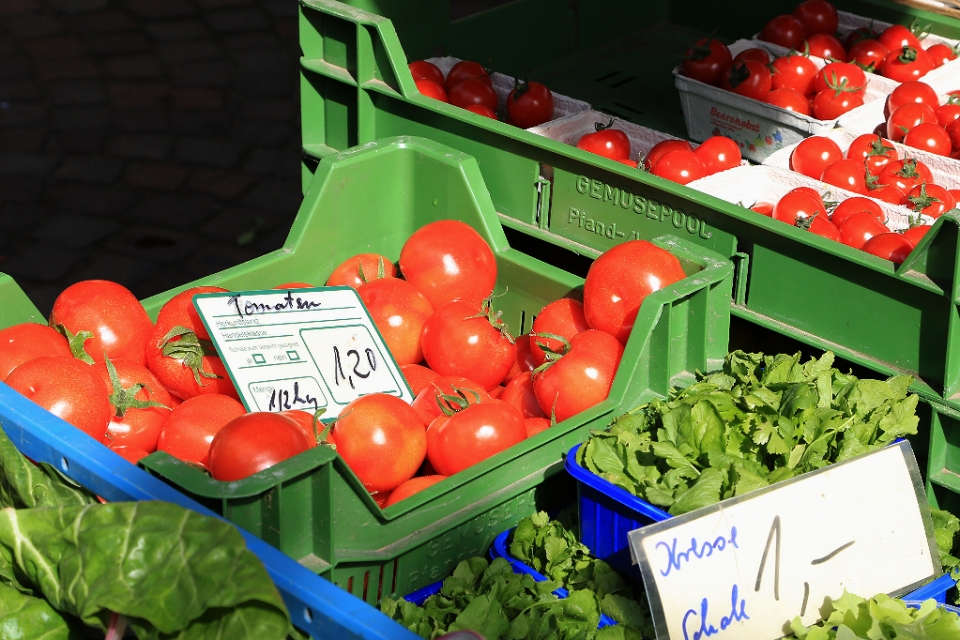
In Heidelberg, the farmers’ markets are held regularly throughout the week at a number of locations throughout the city and region. One of six Saturday markets takes place across the Neckar river in Neuenheim. Most visitors in town will visit the Saturday market in Heidelberg’s Marktplatz, which leaves the other five Saturday markets pretty much “clear and free” to residents. And as I arrive at the market square in Neuenheim, it’s clear I’m in the minority, literally and figuratively. This is not criticism and it’s not a negative, as I used to come here occasionally when I lived here. I say as much to the various vendors, when I buy a cup of coffee, some cherry tomatoes, a piece of cake, and three empanadas.

Fresh fruit and vegetables, grown locally and imported from around Europe. Fresh bread and baked goods from a regional bakery. Fresh herbs, grown locally; fresh flowers, grown locally. Honey harvested from bees at a regional apiary. “Empanadas Argentinas”, by a woman from Córdoba who’s lived in Germany for over ten years. And there are fresh cuts of meat, tubs of olives, and glorious varieties of cheese from around Europe.

It’s time to stop eating and leave, when the vendors begin to pack. Another market, another day.

When I leave Heidelberg, no small measure of wistful longing remains; these are my streets, and this is one of my markets.

( Click here for more )

Rothenburg ob der Tauber: medieval night glow

Many visitors to Rothenburg ob der Tauber are here for the day, and when day turns to night, you can have the place to yourself for the opportunity to view and photograph. And judging by these photographs, you may well ask yourself: where did everybody go?

A good place to start to get your bearings straight is the Marktplatz (Market Square; photo above and map below). While you wait for Hans Baumgartner to begin his Nightwatchman nightly walking tours (in English or German), you can look up the Ratstrinkstube (Councillors’ Tavern) for a modest retelling of the Meistertrunk legend. The following 90-second video shows how the figures for Mayor Nusch and General Tilly greet curious onlookers at the square at 8pm.


( Click here for images and more )

Rothenburg ob der Tauber: Jewish history since 1180 AD/CE

After their stop in town, most visitors depart Rothenburg ob der Tauber with memories of a romantic medieval town that seems almost frozen in time.

But a careful measured walk also produces a deeper examination of the town’s history with clear signs to an historical and centuries-old presence of Jews. A Jewish settlement goes back to at least 1180 AD/CE in written records with the appearance of the name of Samuel Biscopf, a Jew from Rothenburg ob der Tauber (“erste Erwähnung eines Rotenburger Juden”: [ℵ1], p. 136; [ℵ2], pp. 133-135).

The centuries are marked with a growing thriving Jewish community, persecution, violent death, explusion, and a return to life.

Summary Timeline:

•   1180 AD/CE, first mention of Jewish community in Rothenburg; 1st Jewish quarter and synagogue at present-day Kapellenplatz.
•   1250-1286, Rabbi Meir ben Baruch, teaching life and times in Rothenburg.
•   1298, Rintfleisch-Pogrom!: 450 Jews killed in Rothenburg; total 5000 Jews dead in Franconia.
•   1339, some of the first set of graves buried at the Jewish Cemetery, at present-day Schrannenplatz
•   1349, Pogrom! and persecution, Jews accused of poisoning wells with corpses due to the Black Death.
•   1370, Establishment of 2nd Jewish quarter, around Judengasse.
•   1404, 1st Synagogue converted to St. Mary’s Chapel.
•   1407, 2nd Synagogue constructed close to burial ground, at present-day Schrannenplatz.
•   1520, Theologian Johann Teuschlein incites anti-Jewish hysteria, forcing expulsion of all Jews from Rothenburg. No Jews allowed in the city for next 350 years; 2nd Synagogue and Jewish cemetery destroyed.
•   1861, all Jews allowed to settle anywhere in Bavaria.
•   1870-1875, Jews begin returning to the city.
•   1872, Equality granted among Jews and Christians, after the 1871 constitution of the new German Empire.
•   1888, Prayer hall (“3rd synagogue”) at present-day Herrngasse 21.
•   1875, 2nd Jewish cemetery at Würzburger Strasse and Wiesenstrasse.
•   1938, Rothenburg declared “free of Jews” on 22 October, as last remaining 17 Jews driven out, two and a half weeks before the Reichspogromnacht.
•   1942, 2nd cemetery desecrated and destroyed. Few, if any, descendants of early 20th-century community remain or known to be alive.

! The word “pogrom” is a late 19th- to early 20th-century Russian word (“погром”), derived from the verb “gromit” (громи́ть) meaning “to destroy with violence.” While “pogrom” is used generally to describe mob violence by one ethnic or religious group on another, the term is used in this post to describe attacks on the Jewish community.


( Click here for images and more )