Fotoeins Fotografie

location bifurcation, place vs. home

Posts tagged ‘Brigitte Kowanz’

25T77 “Light is what we see”: Brigitte Kowanz at Vienna Albertina

E76, V24.

Austrian artist Brigitte Kowanz (1957-2022) long held a fascination for light. Light isn’t simply the medium through which information propagates; rather, light itself is the tool and the mould for illumination, reflection, and even introspection. There’s a definite spirit of fun and “lightness” when she matches her fondness for Morse code with illumination sources.

In my view, there’s something in her light-based artworks which allude not only to her philosophy and worldview, but also, happily for me, to her clear interest for science. Her works also anticipate and explore timely themes including what it means to live in an information-rich society that fully embraces digital habitats and virtual spaces.

She’s quoted as saying (2017):

“Licht ist expansiv und flüchtig, es bleibt nie bei sich – Licht ist eine Lebensmetapher.”

(Light is expansive and elusive, it never remains the same – light is a metaphor for life.)

I discovered her work for the first time in 2018 on the roof of the Leopold Museum in Vienna’s MuseumQuartier. Over the years, I’ve been fortunate to come across more of her artwork installed throughout the city.

The Brigitte Kowanz retrospective, “Light is what we see”, is now on display at the Albertina from 18 July to 9 November 2025. In part, I arranged my 2025 time in Vienna to coincide with the final run of the Francesca Woodman exhibition *and* the start of the Brigitte Kowanz exhibition.


“Alphabet”, 1998/2010: neon, mirror. Letters A (right-centre) through Z are represented clockwise with each letter as illuminated Morse code. I may be out of the “game”, but this looks a lot like an accretion disk surrounding an astrophysical “black hole”.
“Echo Hall Flow Nein”, 2003/04: neon, mirror. Each word appears vertically, consecutively from left to right. The large number of internal reflections is another hallmark of her work, always asking the viewer to determine the placement of the original source.
“Morse Alphabet”, 1998: fluorescent tubes, plexiglass tubes, enamel paint. Each radial spoke contains a letter of the alphabet in illuminated Morse code. “A” begins at the top at around 12:02, moving clockwise to “Z” at 11:58.
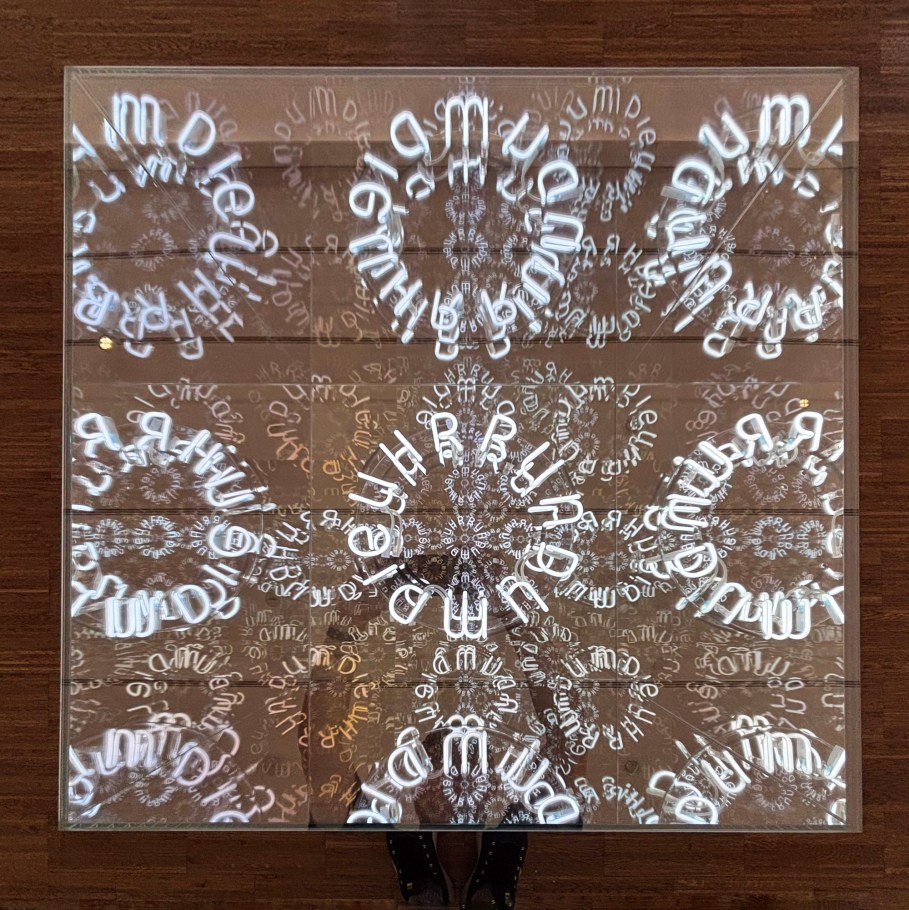
An example of one of her infinity boxes. “Rund um die Uhr” (around the clock), 2011: neon, mirror. The image is partly corrected for geometric distortion.
“asap omw imo tbh bif afaik irl idc idk iow hth fyi omg”, 2021: neon, aluminum, enamel paint. I had to look up a couple of these in the urban dictionary. NGL, but I feel old.
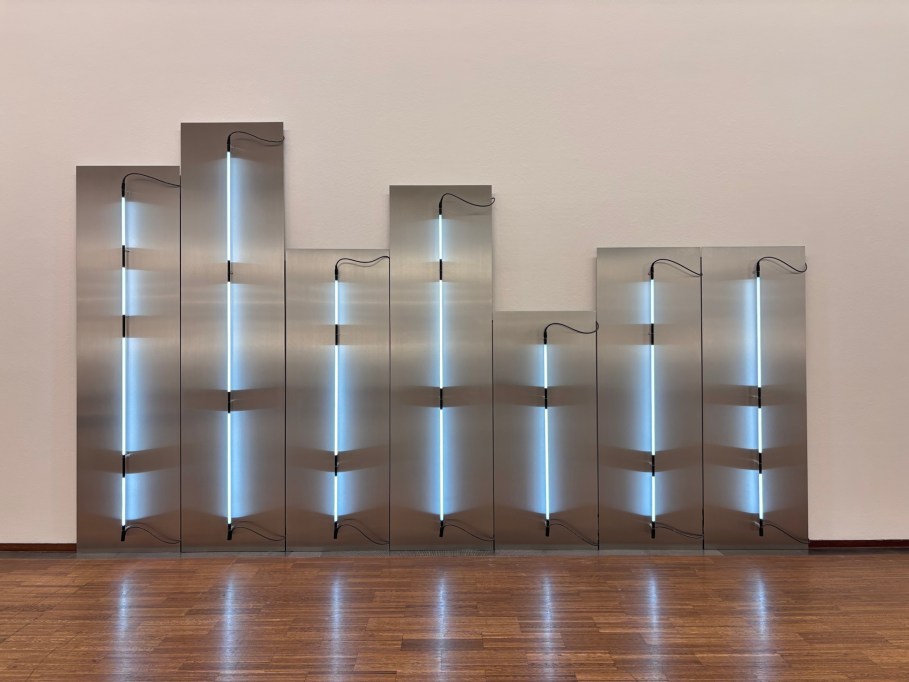
“Forward”, 2005: neon, stainless steel, enamel paint. Each letter is represented in Morse code by a vertical panel with an illuminated tube; “r” 3rd from the left & 2nd from the right.
One room in the exhibition area.
“Speed of Light sec/4m”, 1989/2007: neon, chrome steel. “0,000000013342563 second” (1.33E-8 sec or 13.3 nanoseconds) is the time required for light to travel 4 metres, which appears to be the actual length of this sculpture.
“light is what we see”, 1994/2019: glow lamps, power strips, plexiglass, stainless steel.
“Signature” (Kowanz), 2015: neon, mirror. That’s my bulbous head in the reflection.

I received neither support nor compensation for the present piece. I made all images above with an iPhone15 on 23 July 2025. This post composed within Jetpack for iOS appears on Fotoeins Fotografie at fotoeins DOT com.

24T66 Med.Uni.Wien: Freud, Semmelweis, Kowanz

E65 V32

Medicine is a part of the original founding of the University of Vienna in 1365. Over 6 centuries later in 2004, the university’s Faculty of Medicine created a separate Medical University of Vienna (MU Wien). Established in 1784, the Vienna General Hospital (Wien AKH) became home to the medical school, a centre for medical research, as well as supplying and supporting vital care for the city’s residents. Today, the campus of MU Wien lies adjacent to the campus of Wien AKH.

Certified in medicine, Dr. Sigmund Freud taught students and carried out medical research, before escaping the clutches of the Nazis to London in 1938. Dr. Ignaz Semmelweis recognized and instituted strict hygiene practices in obstetrics for the first time in the late 19th-century. From the late 20th into the early 21st-century, Viennese artist Brigitte Kowanz created “light sculptures” as part of her interest and practice of an ongoing conversation between art and science.


At the Medical University of Vienna is this Sigmund Freud Memorial: sculpture by Oscar Neman in 1936, and inaugurated in 2018 on the 80th anniversary year of Freud’s escape to London. Behind is the building for the university’s rectorate.
Upon leaving, Freud never returned to Vienna.
Near the Freud memorial are these dedications to Ignaz Semmelweis.
2018 memorial on the 200th birthday of Semmelweis.
2018 memorial statue, by Hungarian artist Peter Raab Párkányi.
His hand and finger points to the act of washing hands, a simple but effective hygiene practice.
Inside the building for the university’s rectorate (BT88) is the Jugendstilhörsaal lecture hall.
“Exchange,” by Brigitte Kowanz, 2008. The letters “e-x” in “exchange” begin at the upper-left, continuing clockwise.
Medizinische Universität Wien – Medical University of Vienna

I made all photos above with an iPhone15 on 12 Jul 2024. This post composed with Jetpack for iOS appears on Fotoeins Fotografie at fotoeins DOT com.

24T63 Vienna: one two three

E62 V29

I’m into my 5th and final week in Vienna. With the return of some summer heat and humidity, I start bright and early, but the pace is slower than usual to account for refreshment and cooling breaks. The title today reflects various dives into the city’s first three districts.


1. Innenstadt

“Bonbons”


2. Leopoldstadt

“No Sleep Till Leopoldstadt”, by Xan Padrón, 2024. Brooklyn x Leopoldstadt collaboration project

“Wollte nie dass du gehst: sorry. Hab immer an uns geglaubt.” / I never wanted you to go: sorry. I always believed in us.” (unrelated graffiti)

3. Landstrasse

“Morse Alphabet” neon sculpture by Brigitte Kowanz, for Österreichische Post, 2017.

A to Z, in Morse code from top to bottom.

I made all photos above with an iPhone15 on 9 Jul 2024. This post composed with Jetpack for iOS appears on Fotoeins Fotografie at fotoeins DOT com.

Vienna: Lichtzeichen testament to Jewish presence

Above/featured: Lichtzeichen number 10 (Stumperschul) in the city’s 6th district. Photo, 28 May 2022.

From a distance, the light seems suspended in mid-air.

Closing the distance widens my realization: it’s an illuminated sculpture that has a curved warped shape on top. That’s also when understanding narrows into sharp focus when I stand directly underneath: the shape “straightens” out, revealing itself as a Star of David.

Lichtzeichen Wien (LZ) consists of 26 structures in the Vienna region, marking former locations of synagogues, schools, temples, and prayer rooms destroyed by the Nazis in the pogrom of November 1938. During the night of 9–10 November 1938, the Nazi regime organized and carried out a systematic attack against the Jewish population in Germany and Austria. The rampage in Vienna continued for several days; most of the city’s synagogues, temples, and prayer-halls were destroyed.

Launched by the Jewish Museum Vienna and Austrian artist Brigitte Kowanz, an urban memorial project by joint collaboration of the Jewish Museum Vienna and the University of Applied Arts Vienna consists of identical columns, designed by artist Lukas Kaufmann. The commemorative project is called “Ot” (אות), which means “symbol” in Hebrew. Each “light column” sculpture stands about 5-metres high with a star of David, and includes the name of the former Jewish structure and an accompanying QR-code. Official unveiling of the memorial project occurred in 2018 on the 80th anniversary of the 1938 pogrom.

I visited and photographed all 26 Lichtzeichen locations in Vienna over a period of three summers in 2022, 2023, and 2024.


( Click here for images and more )

Salzburg Walk of Modern Art (2018)

Above: “Sphaera” by Stephan Balkenhol: Salzburg Kapitelplatz – 22 May 2018.

Salzburg is a well-known historical city in north-central Austria next to the border with Germany. For a different way of examining the city that goes beyond the history of the Habsburgs and the music of Mozart, the Walk of Modern Art allows visitors and residents to walk through parts of the city for a mix of historical and contemporary perspectives at street-level and from the cliffs above. The art pieces are placed throughout the city’s Old Town to coincide with key landmarks and sights. The city of Salzburg also provides information about the walk. UNESCO inscribed Salzburg’s Old Town as World Heritage Site in 1996.

Thankfully, there’s more to Salzburg than “The Sound of Music” ().


( Click here for images and more )