Fotoeins Fotografie

location bifurcation, place vs. home

Posts tagged ‘beruehmte Frauen’

Vienna: Stefanie Herkner’s homestyle cuisine

I’ve been thinking a lot about my father who died in 2014.

What he passed onto me are: an appreciation for authentic dining with a minimum of pretence, interests in geography and history, and an enthusiasm for highway drives and road trips. He also loved woodwork, gardening, and tinkering with the family car. By contrast, I like to dabble with memories and the act of memory.

I’ve also been thinking about how he would’ve viewed my experiences in Vienna.

In Vienna’s 4th district, cook and author Stefanie Herkner owns and operates her restaurant, Zur Herknerin, as a living memory of her father, Heinz, and her family’s Slovenian culinary heritage. Much of her story has appeared in a variety of publications: how her dad’s famous restaurant, Zum Herkner, helped spark and redefine contemporary Vienna cuisine; how she went to London to study art-and-culture management; how her parents tried to dissuade her from the restaurant industry; and how she returned home to Vienna and opened her own restaurant in mid-2013.

That’s the kind of story to pique my curiosity.

With a reservation for the opening slot at weeknight service, I arrive 15-minutes early to moderate street-traffic and a set of open doors. The space is light, airy, uncomplicated, and welcoming. A couple of servers and kitchen staff are out and about, preparing for the dinner rush. Captaining the ship is Frau Herkner, her voice a firm, steady, and encouraging guide. I chat briefly with her: I’ve flown over 8000 kilometres across the world to have a meal here, and that my love of diners and small restaurants comes from Dad, who worked many years in many diners as cook and line-cook.

What’s familiar on the dinner table to many in this part of the world is relatively new to me. My order is a delicious introduction to the family’s central European background.

Krautroulade mit Petersilerdäpfel und Rahm (Serbian-style stuffed cabbage roll): ground beef and pork fried with bacon, tomatoes, bell peppers and carrots, diced onions; that extra fat is always the flavour enhancer. The meat-and-rice mixture is stuffed into large cabbage leaves, rolled and gently simmered with garlic and bay leaves. Add perfectly cooked cut-up potatoes served with parsley, and served with a dollop of sour cream.

Almdudler-Radler: cold draft beer mixed with Almdudler, Austria’s national and herbal lemonade. The combination is refreshing on a warm early-summer day, and I think its slight sweet-and-bitter “bite” goes well with the savory Sarma.

Apfel-Strudel: phyllo pastry filled with chunks of regionally-grown apples, with cinnamon and nutmeg; light but substantive; more apple than pastry. The last polish is a Melange for a smooth finish.

To achieve her goal of delivering family favourites to customers, she emphasizes:

“Unsere Zutaten sind biologisch, saisonal, regional oder vom eigenen Hof.”
(Our ingredients come from products that are natural, seasonal, regional, or from our very own farm.)

Before leaving, I catch Frau Herkner’s attention one last time. I tell her how much I enjoy the food, and how my experience feels like an accepted invitation into her family home with, if our faith allows, the spirits of our respective fathers, present in the kitchen and at the table.

Food and ambience.
Nourishing and warmth.
A lot of heart and muscle memory.
A lot of family memory and history.
I think Dad would’ve liked this.

Because I really did; I wanted to believe.


( Click here for images )

Vienna: Dr. Olga Ehrenhaft-Steindler, trailblazer & women’s advocate

In examining the history of the University of Vienna, I discovered Olga Ehrenhaft-Steindler was the first woman to receive a doctoral degree in physics from the university in 1903. Who was she? How did she become the first? How did society of the time view the education of young women?

I’m starting a series on women who left their mark on Vienna and Austria, and some of the traces they left behind in the Austrian capital city. With educators, inventors, writers, and scientists, my serial includes: Dr. Marietta Blau; Marianne Hainisch; Hedwig Kiesler, a.k.a. Hedy Lamarr; Dr. Lise Meitner; Dr. Gabriele Possanner; Dr. Elise Richter; and Bertha von Suttner.


Who: Dr. Olga Ehrenhaft-Steindler: b/✵ 28 Oct 1879, d/✟ 21 Dec 1933.
PhD: 1st woman with doctoral degree in physics from University of Vienna, 1903.
Educator: Early 20th-century teacher & advocate for better access to education for young women.

In late 19th-century and early 20th-century Austria and Vienna, Olga Steindler was one of countless women who faced difficulties and challenges by young women who wanted to expand their education and improve employment, all of which were viewed by society at the time as undesirable. Feminism or anything similar did not exist.

Born and raised in Vienna, Olga Steindler departed her home for Prague to complete and pass her final high-school examinations in 1899, because young women were not permitted to do so within Austria at the time. She subsequently enrolled at the University of Vienna to study physics and mathematics within the Faculty of Philosophy. Only two years earlier in 1897 had the University of Vienna finally accepted the enrolment of women, although they were initially allowed only into the Faculty of Philosophy. In 1903, Steindler became the first woman to receive a Ph.D. in physics from the University of Vienna after successfully completing her research dissertation.

Completing qualifications for teaching at secondary (high) schools in the same year, she joined the “Athenäum” where she taught young women about experimental physics; she also taught at Vienna’s first girls’ secondary school established by Marianne Hainisch in the city’s 1st district. In 1907, she founded two new schools in Vienna: a girls’ public secondary school in the city’s 2nd district, and a business school for young women in the city’s 8th district. Steindler married her physicist colleague Dr. Felix Ehrenhaft in 1908; she became known as Dr. Olga Ehrenhaft-Steindler. She championed the cause for educating girls and young women, and creating new opportunities in science, business, and society at large. For her dedicated service to the public, Austria awarded her in 1931 the title of “Hofrat” as a new member of the imperial court advisory council, an honour uncommon among Austrian women at the time. At the age of 54, Dr. Olga Ehrenhaft-Steindler died in December 1933 from complications after having contracted pneumonia.


( Click here for images and more )

Frankurter Küche, Frankfurt kitchen, Margarete Schütte-Lihotzky, MAK Vienna, Vienna, Wien, Austria, Österreich, fotoeins.com

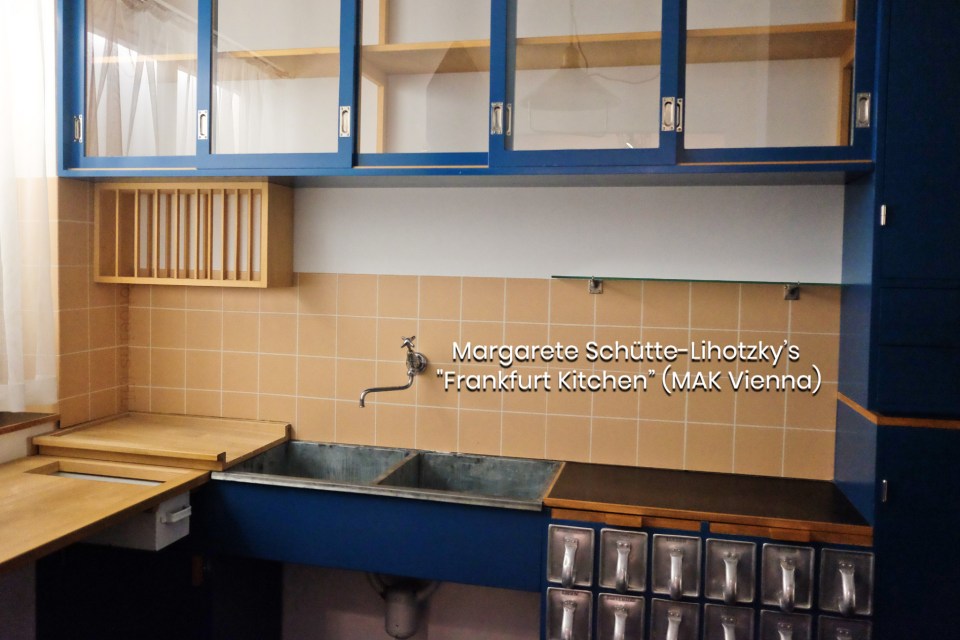
Vienna: Margarete Schütte-Lihotzky & the modern fitted kitchen

Who: Margarete Schütte-Lihotzky.
Key: 1st woman architect in Austria, designer of something we take entirely for granted.
Quote: “I developed the kitchen as an architect, not as a housewife.”

I always liked how cooking had well-defined endpoints: a desirable start, and a satisfying conclusion. I enjoy the process: the contemplation of “what to make,” the gathering of ingredients, the preparation, and naturally, the consumption. There might also be something to say about the duality of creation and annihilation …

That got me to thinking about kitchens as a critical unit of a home. Before the 20th-century, the wealthy could afford to have staffed kitchens; everybody else had access to no kitchen or an unsafe unhygienic kitchen in a building separate to their living quarters. The assumed universality of a kitchen within a home is a 20th-century concept and implementation that sought to overcome social and economic class. The design of a modern kitchen invites repeated patterns of movement and action around where cookware, utensils, condiments, glassware, etc. are stored and where the central focus of cooking activity takes place.

For everyone who spends any time in a kitchen, we have Margarete Schütte-Lihotzky (MSL) to thank.


( Click here for more )