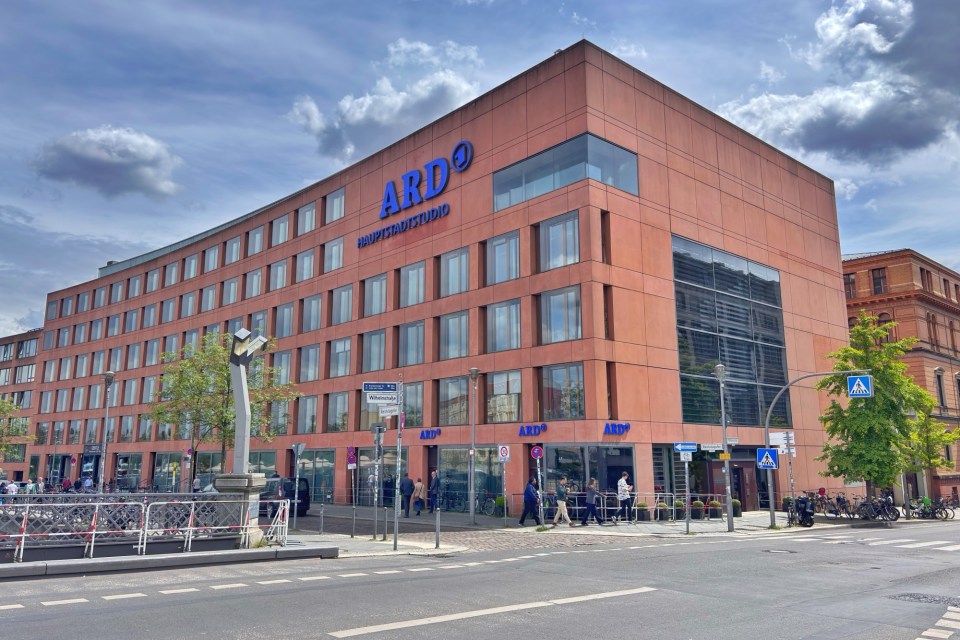
It’s channel 1: the national broadcaster ARD (*), known informally by many as “Das Erste” or “The First”. Their studios look grand, modern, and imposing, and hide a grand piece of history in physics.
Like most places of higher learning, they start modestly, and in Berlin’s case, the late-19th and early 20th-century at the University of Berlin (now: Humboldt University) burst at the seams with ideas flowing in the natural sciences and social sciences, at a time when the city itself welcomed openness and creativity.
Berlin is best known for its history, decades of extended trauma, its architecture, and a cultural centre with contemporary art and electronic music. I know Berlin as a place of world-changing science with renowned scientists, whose names massively stamped the last half of my undergraduate years.
(*) ARD: Arbeitsgemeinschaft der öffentlich-rechtlichen Rundfunkanstalten der Bundesrepublik Deutschland; translated as “Association of Public Broadcasting Corporations of the Federal Republic of Germany”. It’s something like Canada’s CBC, Australia’s ABC, or Great Britain’s BBC.
ARD Hauptstadtstudio
ARD (national channel no.1) radio- & tv-studios at Wilhelmstrasse next to Marshallbrücke. On the right side (west-facing wall) is a memorial plaque near the back corner, hidden behind the tree.
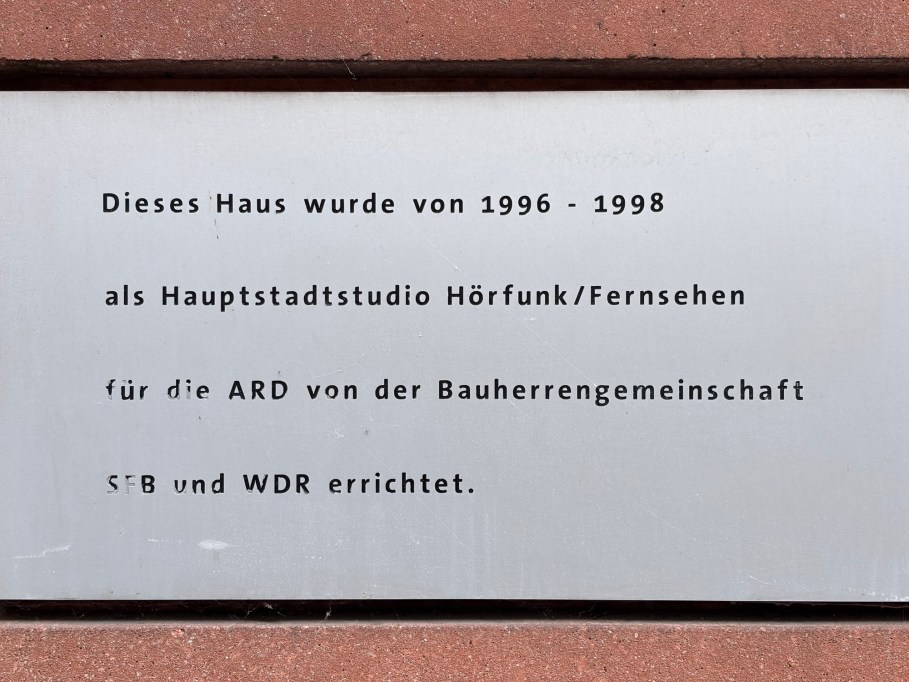
Left panel: From 1996 to 1998, the building owner association SFB & WDR led construction of the Berlin radio- & television-studios for the broadcaster ARD.
Right panel: Built for Hermann Helmholtz, the Physics Institute of the University of Berlin once stood at this spot from 1878 to 1945. Key physicists worked here, including James Franck, Gustav Hertz, Walther Nernst, Wilhelm Wien, Max Planck. In his institute lecture on 14 December 1900, Planck described the early principles of quantum theory.
Staatsbibliothek zu Berlin
“From 1914 to 1932, Albert Einstein worked here as a member of the Prussian Academy of Sciences.” State Library of Berlin is located at Unter den Linden 8.
The Einstein plaque appears at left in this image, next to the doors of the former Prussian Academy of Sciences. On 4 November 1915, Einstein presents his “field equations” for general relativity in a lecture to the Academy.
Humboldt University
Formerly the University of Berlin, today’s Humboldt University main building (next door to the State Library) greets visitors with a statue of physicist Hermann Helmholtz. Einstein also presented lectures about his developments in general relativity to the university’s physics institute.
Max Planck, who discovered ‘h’ the elementary quantum of action, taught in this building from 1889 to 1928. This memorial plaque is on the outer wall of the main building’s west wing. Planck is also honoured with a memorial statue in the main building’s front courtyard. Today, a massive German network of research institutes is named in his honour as the Max Planck Gesellschaft; I had the great privilege of spending 2 years at the Max Planck Institute for Astronomy in Heidelberg.
In 1931, American physicist Millikan was invited to Berlin. In this incredible image of a dinner-gathering in Berlin on 12 November 1931, seated from left to right, respectively, are: Walther Ernst, 1920 Nobel Prize in Chemistry; Albert Einstein, 1921 Nobel Prize in Physics; Max Planck, 1918 Nobel Prize in Physics; Robert Millikan, 1923 Nobel Prize in Physics; and Max von Laue, 1914 Nobel Prize in Physics.
I made all images above with an iPhone15 on 27 May 2025. This post composed within Jetpack for iOS appears on Fotoeins Fotografie at fotoeins DOT com.




 Fotoeins Fotografie