Fotoeins Fotografie

location bifurcation, place vs. home

Posts tagged ‘Berliner Mauer’

Conrad Schumann, Berlin Wall, Berliner Mauer, Mauerspringer, Florian Brauer, Michael Brauer, Edward Anders, Berlin, Deutschland, Germany, fotoeins.com

Fotoeins Friday, Berlin 2025 (1): The wall jumper

It’s the 15th of August 1961, as additional elements of the Berlin Wall went up next to a made-up barbed-wire fence marking the border of East and West Berlin. An East Berlin guard made up their mind to defect on the spot, and jumped over the fence safely into West Berlin. His name was Conrad Schumann, and news photographs of his jump made him famous. A sculpture in 2009 called “Mauerspringer” (wall jumper) captures that fateful moment; a large photograph of that very moment is on a wall nearby.

I made the image above on 16 May 2025 with a Fujifilm X70 fixed-lens prime and these settings: 1/500-sec, f/8, ISO2000, and 18.5/28mm focal length. This post appears on Fotoeins Fotografie at fotoeins DOT com as https://wp.me/p1BIdT-vsb.

25T39 Berlin Wall memorial to Günter Litfin

E38, B33.

The Gedenkstätte Günter Litfin consists of a former watchtower where Kieler Straße meets the Berlin-Spandau canal.

In 1961, 24-year old Günter Litfin lived in East Berlin, but worked in West Berlin. When a new wall went up on 13 August between the two Berlins, he chose to escape. But in the East, leaving was no longer an option, because new guards posted at the more-secure border had new orders: anyone trying to escape would be shot on sight without warning. On 24 August, Litfin attempted to swim across the canal from east to west, but died from gunshot wounds.

Günter Litfin is known as the 2nd person to die at the Berlin Wall, and the first victim shot dead by East German border guards.

Thanks to the efforts of his younger brother, a memorial was established by 1992 in a former East German watchtower near the location where Günter Litfin made his ill-fated escape attempt. The memorial is now managed by the Stiftung Berliner Mauer (Berlin Wall Foundation).

The Gedenkstätte Günter Litfin is free of charge, and open only on weekends (May-October) from 11am to 5pm. The nearest bus stops are Bundeswehrkrankenhaus (bus route 120) and Lydia-Rabinowitsch-Strasse (bus route 147).


The west end of Kieler Straße, where an East German watchtower is surrounded by apartment buildings. The signs also show that this is part of the Berliner Mauerweg (Berlin Wall Path).
Memorial to Günter Litfin. First person shot on 24 August 1961 – Humboldthafen/in Berlin Mitte – And to all victims of the Berlin Wall from 13 August 1961 to November 1989.
“If we forget history, it catches up with us.”
1st-level of the former watchtower.
Very steep stairs between levels.
Top-level of the former watchtower.
Present-day northwest view (through protective mesh) of the Berlin-Spandau ship canal.
In this old map with north up, the dark thick solid line represents the border between West Berlin (left) and East Berlin (right). At bottom is the old Lehrter train station (now Hauptbahnhof), and at top is Kieler Straße, at the location of the former watchtower. Note that the water in the canal was also East German territory.
Fully covered in German, English, French, & Russian.
Günter Litfin, 24, shot and killed for “illegal border crossing”.
From “West Berlin” on the other side of the canal. The former watchtower is at centre-right.

I made all images above with an iPhone15 on 15 June 2025. This post composed within Jetpack for iOS appears on Fotoeins Fotografie at fotoeins DOT com.

My Berlin: Bornholmer Strasse, first through the Wall

By today’s appearance, it’s easy to overlook the bridge at Bornholmer Strasse (also known as Bösebrücke) as an historic landmark. On the night of 9 November 1989, the Berlin Wall opened here first, at the Bornholmer Strasse bridge border-crossing between East Berlin and West Berlin.


( Click here for images and more )

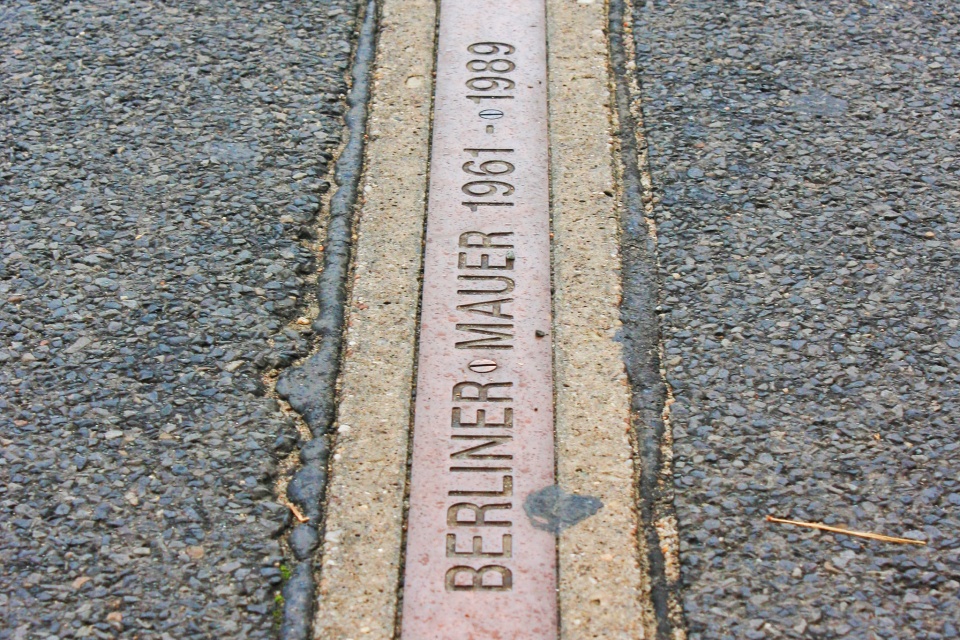
Pavement marker Niederkirchnerstrasse, between Martin-Gropius Bau & Topographie des Terrors, Berlin, Germany - 2. Okt. 2009

The Berlin Wall, 1961-1989

Some view East Germany (GDR/DDR) with great fondness, if it’s a comparison made between today with the “good old days.” I’m not interested in the “Ostalgie” (nostalgia for the former east). I’m interested in learning how a system in place does a gradual creep, takes over a country and her people. Before they realize what’s happening, their own government has locked them inside the borders to prevent them from leaving; get caught trying to escape near the border, and you’ll be shot for your trouble.

“No intention to build a wall …”

On 15 June 1961, when asked at a press conference if a wall would be erected between west and east Berlin, Walter Ulbricht, leader of the GDR’s only recognized political party, the Socialist Unity Party of Germany (Sozialistische Einheitspartei Deutschlands), answered:

“Die Bauarbeiter unserer Hauptstadt beschäftigen sich hauptsächlich mit Wohnungsbau, und ihre Arbeitskraft wird dafür voll eingesetzt. Niemand hat die Absicht, eine Mauer zu errichten.”

“Construction workers in our capital city are fully engaged in residential construction, and the labour force is deployed for that purpose. No one has any intention of putting up a wall.”

(Chronik der Mauer | YouTube )

Privately, Ulbricht had already been pushing hard to build a wall to stop the increasing number of people leaving East Germany for the West. Building a wall would also strengthen the (buffer) position of East Germany within the developing Soviet satellite-empire.

Two months later at midnight on August 13, work began quietly on a wall, and orders were given for additional troops to guard and “protect” the border. Berliners awoke at daybreak to a divided city.


( Click here for more )

Erna-Berger-Strasse, Berlin, Germany, fotoeins.com

My Berlin: a lonely watchtower stands in Mitte

I’m sure I would’ve immersed myself in European history and languages, had I not studied physics or astronomy. After two years of working in Germany, I developed a deep interest for language and her people. Even after having left the country in 2003, I’ve been fortunate to return once or twice each year.

I had read about one of the few remaining DDR-Wachtürme (East German Watchtowers) in Berlin. On a December afternoon, light snowfall in the German capital city seemed to slow both human and mechanized activity. I wandered slowly into Berlin Mitte to check out the location of an old East German watchtower that’s been listed as a historical monument since 2001.

( Click here for more )