Fotoeins Fotografie

location bifurcation, place vs. home

Posts tagged ‘Alsergrund’

25T79 VGH Michelbeuern: around Vienna General Hospital

E78, V26.

Where the 9th district meets the “inner belt”, the present-day location of Vienna’s Allgemeines Krankenhaus (General Hospital, VGH) with its two dark brown 22-floor towers has been a city fixture since the 1970s. VGH has almost 9-thousand on staff and, as teaching facility, an additional 8-thousand students at the Medizinische Universität Wien (Medical University of Vienna). After moving locations, the first site of VGH became the primary campus for the Universität Wien (University of Vienna).

Since 1987, VGH has its own metro/subway station “Michelbeuern – Allgemeines Krankenhaus” on the U6 U-Bahn line. The new U5 line in extending west to Hernals on the “outer belt” will include a brand new station at VGH.


MUW: Medizinische Universität Wien – AKH: Allgemeines Krankenhaus der Stadt Wien.
Bridge over tracks and Währing Belt Road, connecting the U6 station with the hospital (background).
Covered bridge concourse, facing west towards the station; VGH is behind me in this image.
To the north are “Revisionhallen” or halls for regular inspections. The working U6 tracks are at far-left, as a southbound U6 train approaches the station.
To the south is the U-Bahn Betriebsbahnhof Michelbeuern (service depot and facility at Michelbeuern).
U6 station Michelbeuern – Allgemeines Krankenhaus, with a partly obscured tower of VGH.

I made all images above with an iPhone15 on 25 July 2025. This post composed within Jetpack for iOS appears on Fotoeins Fotografie at fotoeins DOT com.

24T66 Med.Uni.Wien: Freud, Semmelweis, Kowanz

E65 V32

Medicine is a part of the original founding of the University of Vienna in 1365. Over 6 centuries later in 2004, the university’s Faculty of Medicine created a separate Medical University of Vienna (MU Wien). Established in 1784, the Vienna General Hospital (Wien AKH) became home to the medical school, a centre for medical research, as well as supplying and supporting vital care for the city’s residents. Today, the campus of MU Wien lies adjacent to the campus of Wien AKH.

Certified in medicine, Dr. Sigmund Freud taught students and carried out medical research, before escaping the clutches of the Nazis to London in 1938. Dr. Ignaz Semmelweis recognized and instituted strict hygiene practices in obstetrics for the first time in the late 19th-century. From the late 20th into the early 21st-century, Viennese artist Brigitte Kowanz created “light sculptures” as part of her interest and practice of an ongoing conversation between art and science.


At the Medical University of Vienna is this Sigmund Freud Memorial: sculpture by Oscar Neman in 1936, and inaugurated in 2018 on the 80th anniversary year of Freud’s escape to London. Behind is the building for the university’s rectorate.
Upon leaving, Freud never returned to Vienna.
Near the Freud memorial are these dedications to Ignaz Semmelweis.
2018 memorial on the 200th birthday of Semmelweis.
2018 memorial statue, by Hungarian artist Peter Raab Párkányi.
His hand and finger points to the act of washing hands, a simple but effective hygiene practice.
Inside the building for the university’s rectorate (BT88) is the Jugendstilhörsaal lecture hall.
“Exchange,” by Brigitte Kowanz, 2008. The letters “e-x” in “exchange” begin at the upper-left, continuing clockwise.
Medizinische Universität Wien – Medical University of Vienna

I made all photos above with an iPhone15 on 12 Jul 2024. This post composed with Jetpack for iOS appears on Fotoeins Fotografie at fotoeins DOT com.

Vienna: 9 spots in the 9th district

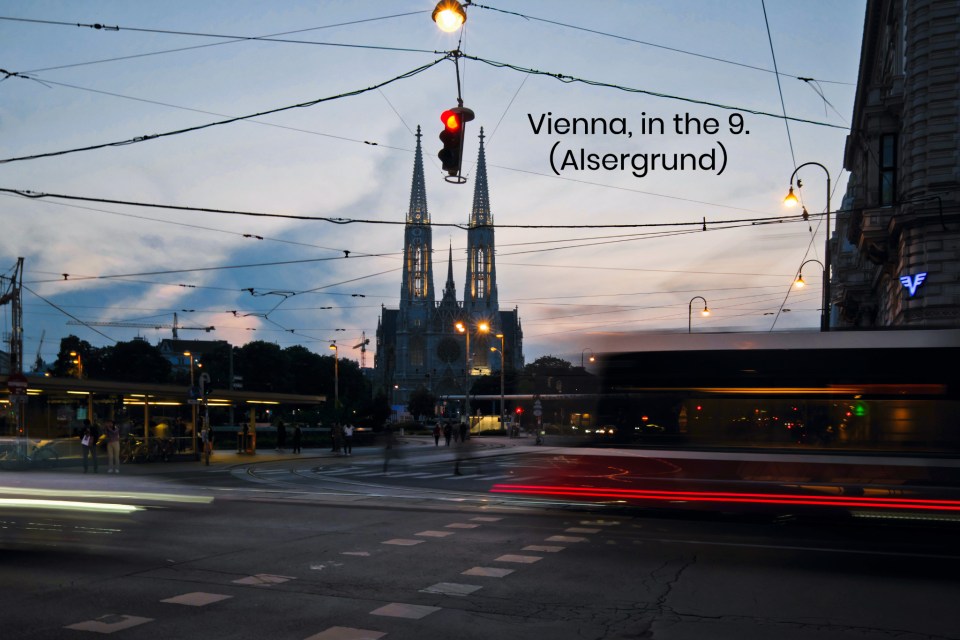
Above/featured: Votivkirche (Votive church) from Schottentor – 20 May 2023.

Two visits: two months spread over two years.
A thousand kilometres of walking.
Hundreds of historical spots and locations tracked, spotted, and photographed.

It makes sense that out of Vienna’s 23 city districts, I’ll frequent some more than others. The 1st district, or the Innere Stadt, is unavoidable, because that’s where most visitors to the city will congregate. The 2nd (Leopoldstadt) and the 6th (Mariahilf) are districts where I had separate month-long stays. But it’s the 9th district (Alsergrund) into which I wandered through countless times, including tracking my way to the 18th and 19th districts.

Out of many interesting little spots in Alsergrund, I’ve highlighted nine examples from a historical “mélange” of architecture, Jewish culture, medicine, music, and physics. If you’re wondering about the Votivkirche (Votive Church) in the image above, I’ll have more about the church in future posts about Ringstrasse (Ring Road) architecture as well as the architectural works by Heinrich Ferstel.


( Click here for images and more )