Fotoeins Fotografie

location bifurcation, place vs. home

Posts tagged ‘Allgaeuer Alpen’

Allgäu winter: Fellhorn in the German-Austrian Alps

Above: A group of skiers gather before their run near the Fellhorn summit.

As a product of the Canadian southwest, I’ve maintained a fascination with mountains. I don’t necessarily need to climb the mountains, but I’ve always been curious about the names of mountains, the reasons for their names, and the people who named them. I’m not always going to get answers, but if there’s a lift to take me to a view, I’m always game.

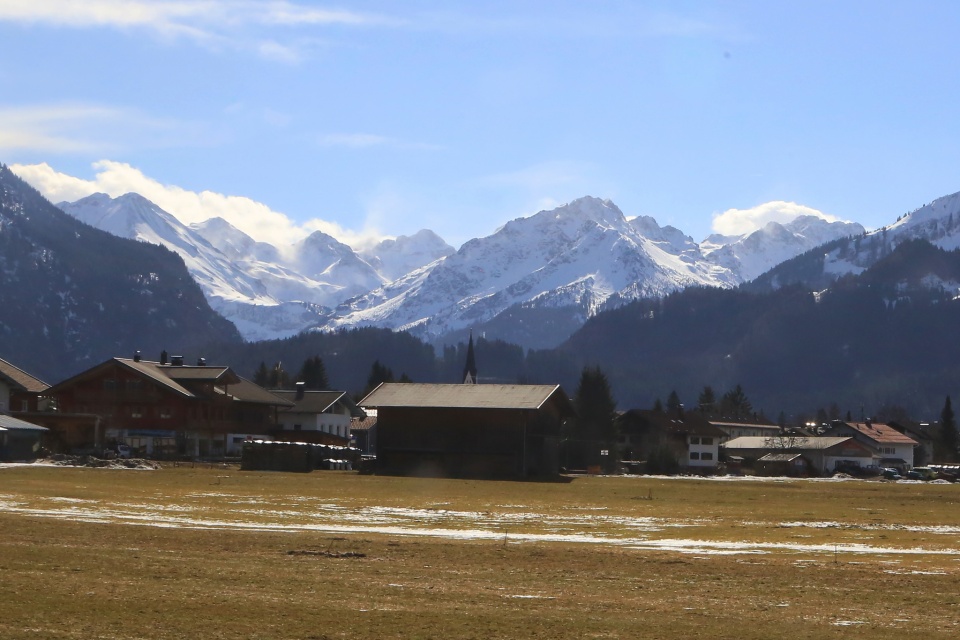
With an easy bus from Oberstdorf in the southwest corner of Germany, I’m headed 10 km south to Faistenoy for the gondola up to the summit of Fellhorn (2038 metres) among the Allgäu Alps. There’s a lot of snow up top with a depth of about 1.5 metres; skiing and snowboarding conditions look good in the Skigebiet Fellhorn-Kanzelwand (Fellhorn-Kanzelwand Ski Area). But what do I know? I don’t ski or snowboard, but the winter-afternoon light is decent on the smooth snowy landscape. I’m drawn to the information displays to learn more about Fellhorn and the mountains I’m seeing in the near 360-degree panorama. In the distance the flat-topped Hoher Ifen mountain looks like a multiple-layer cream-filled cake. I arrive quickly at a couple of conclusions: one, it’s fun to stand on a border between two countries at altitude, even if an international frontier is set somewhat arbitrarily; and two, I promise to return in the summertime to do a loop: return to Fellhorn, hike along the relatively flat ridge-line west, take the Kanzelwandbahn gondola down into Austria’s Kleinwalsertal, have a sip and nosh in one of the alpine towns, and return to Germany’s Oberstdorf on a local bus.


( Click here for images and more )

Zugspitze: spotting the Alps across 5 nations

“If I’m at the highest point in Germany, can I see Italy?”

Over the years, I’ve seen at various times the claim made about seeing Italy from the tallest mountain in Germany.

I’m startled by the winter morning sun, streaming through the window into my hotel room in Garmisch-Partenkirchen. I rise slowly from the bed, barely able to keep my eyes open. I shuffle across the room, and pull the small linen drapes aside. It’s blue everywhere, and there isn’t a cloud in the sky. My eyes are now wide open, heart pumping with excitement, because I know skies are gonna be clear up top. Later I learn forecast conditions for the Zugspitze summit are excellent: mostly sunny, visibility out to 160 kilometres (100 miles) with a high temperature of -8C/+18F. Cold, but very doable. It’s also why I have with me 70-300 glass for the long zooms.

Below I show photographs with sightlines and their corresponding average azimuths*: east-southeast (107 degrees), southeast (138 degrees), south (175 degrees), southwest (210 degrees), west-southwest (250 degrees). I label specific mountain peaks of interest in addition to the flag of the country where the mountain is located. In a few cases, mountains lie along the border between two nations in which case I provide two country flags. For the labeled peaks, I’ve also provided further information about mountain heights and sightline distances in the map below.

Spoiler alert: not only am I able to spot mountains in Italy, but also other peaks in Austria, Switzerland, and Liechtenstein.

* Azimuths are measured with north at 0 degrees, east at 90, south at 180, and west at 270 degrees.


( Click here for images and more )

Oberstdorf, Oberbayern, Upper Bavaria, Bavaria, Allgaeu Alps, Alps, Germany, fotoeins.com

Oberstdorf: Sunday Allgäu night auf Deutsch

Why multiple languages rock my world

With fewer than ten-thousand inhabitants, Oberstdorf in southern Bavaria is as its German name suggests: an “upper village” tucked in the Allgäu Alps near the German-Austrian border. Yet, the town feels busy and full with skiers, snowboarders, and winter hikers.

It’s Sunday night and I’m on the hunt for “schnitzel and spätzle.” With my eye already on a place, I arrive at 630pm to a full house. I don’t have a reservation (which is dumb in a small town), but a table of four is available (which is fortunate). The server offers me the table, with the condition I’ll be sharing the table if two people want places. “Alles klar,” I reply.

I order a standard half-litre Weizen beer, along with the required schnitzel-and-spätzle platter. An elderly couple is offered two places at my table; they take one glance in my direction, and they’re gone. The server wears a puzzled look, and I can only shrug. A second couple arrives ten minutes later, and as they approach my table with curiosity, I tell them “die Plätze sind noch frei” (the places are available). They express their thanks, and take their seats across from me. Those last five German words set a positive tone for the rest of the evening.

( Click here for more )