Fotoeins Fotografie

location bifurcation, place vs. home

Posts tagged ‘Albertina’

25T77 “Light is what we see”: Brigitte Kowanz at Vienna Albertina

E76, V24.

Austrian artist Brigitte Kowanz (1957-2022) long held a fascination for light. Light isn’t simply the medium through which information propagates; rather, light itself is the tool and the mould for illumination, reflection, and even introspection. There’s a definite spirit of fun and “lightness” when she matches her fondness for Morse code with illumination sources.

In my view, there’s something in her light-based artworks which allude not only to her philosophy and worldview, but also, happily for me, to her clear interest for science. Her works also anticipate and explore timely themes including what it means to live in an information-rich society that fully embraces digital habitats and virtual spaces.

She’s quoted as saying (2017):

“Licht ist expansiv und flüchtig, es bleibt nie bei sich – Licht ist eine Lebensmetapher.”

(Light is expansive and elusive, it never remains the same – light is a metaphor for life.)

I discovered her work for the first time in 2018 on the roof of the Leopold Museum in Vienna’s MuseumQuartier. Over the years, I’ve been fortunate to come across more of her artwork installed throughout the city.

The Brigitte Kowanz retrospective, “Light is what we see”, is now on display at the Albertina from 18 July to 9 November 2025. In part, I arranged my 2025 time in Vienna to coincide with the final run of the Francesca Woodman exhibition *and* the start of the Brigitte Kowanz exhibition.


“Alphabet”, 1998/2010: neon, mirror. Letters A (right-centre) through Z are represented clockwise with each letter as illuminated Morse code. I may be out of the “game”, but this looks a lot like an accretion disk surrounding an astrophysical “black hole”.
“Echo Hall Flow Nein”, 2003/04: neon, mirror. Each word appears vertically, consecutively from left to right. The large number of internal reflections is another hallmark of her work, always asking the viewer to determine the placement of the original source.
“Morse Alphabet”, 1998: fluorescent tubes, plexiglass tubes, enamel paint. Each radial spoke contains a letter of the alphabet in illuminated Morse code. “A” begins at the top at around 12:02, moving clockwise to “Z” at 11:58.
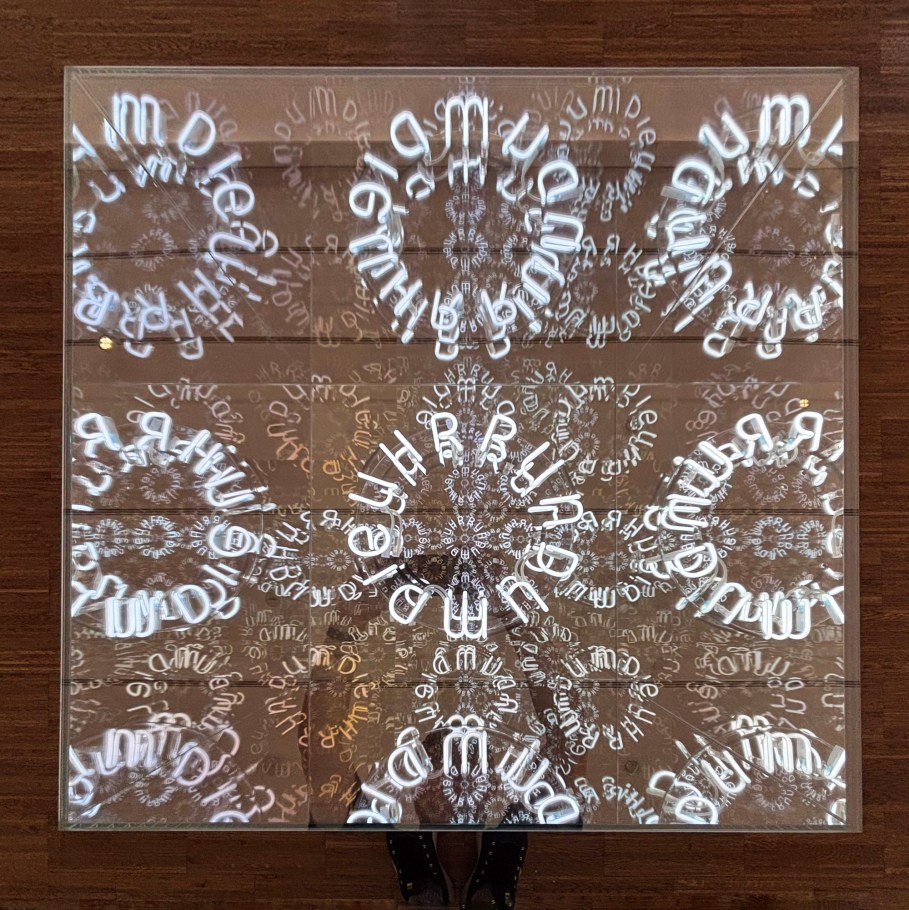
An example of one of her infinity boxes. “Rund um die Uhr” (around the clock), 2011: neon, mirror. The image is partly corrected for geometric distortion.
“asap omw imo tbh bif afaik irl idc idk iow hth fyi omg”, 2021: neon, aluminum, enamel paint. I had to look up a couple of these in the urban dictionary. NGL, but I feel old.
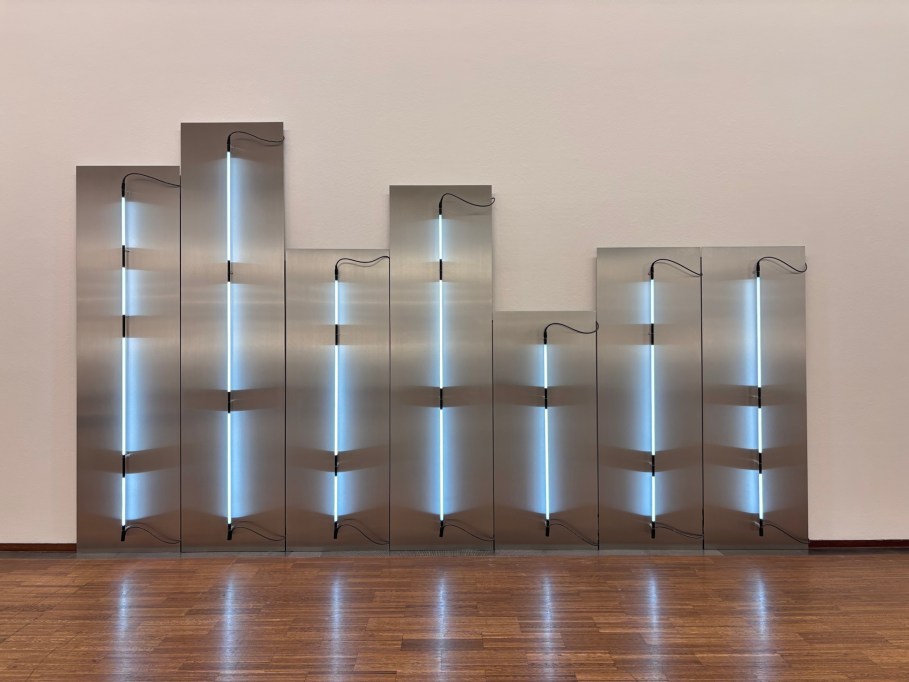
“Forward”, 2005: neon, stainless steel, enamel paint. Each letter is represented in Morse code by a vertical panel with an illuminated tube; “r” 3rd from the left & 2nd from the right.
One room in the exhibition area.
“Speed of Light sec/4m”, 1989/2007: neon, chrome steel. “0,000000013342563 second” (1.33E-8 sec or 13.3 nanoseconds) is the time required for light to travel 4 metres, which appears to be the actual length of this sculpture.
“light is what we see”, 1994/2019: glow lamps, power strips, plexiglass, stainless steel.
“Signature” (Kowanz), 2015: neon, mirror. That’s my bulbous head in the reflection.

I received neither support nor compensation for the present piece. I made all images above with an iPhone15 on 23 July 2025. This post composed within Jetpack for iOS appears on Fotoeins Fotografie at fotoeins DOT com.

25T56 Francesca Woodman at Vienna Albertina

E55, V03.

I arrived at the city in time, as a featured art exhibition was scheduled to end in less than a week. The first time I’d seen their work was in a gallery on Geary St. in San Francisco in 2011. The impact of having seen their images has long stayed with me. Almost 14 years later, I’m in Vienna’s Albertina for their 1st ever presentation of Francesca Woodman with over 100 of her photographs from the Verbund Collection.

Francesca Woodman (1958-1981) was an American-Italian artist who created an essential body of photographic work: expanding poetic ideas into the visual with the play of natural light and the use of external props (as if a stage-play); examining human beings’ relationships to the spaces we occupy; and asking questions about we view each other, particularly women. Her images provide a kind of electric charge, a sense of momentum and drive, and an overall energy that transitions frequently between the static and dynamic.

I’m a little sad she didn’t have a long life: what ideas, work, wisdom, and message could have come over the intervening years. I’m happy I found her work all those years ago, more so now that I’ve had some time to learn what she was trying to communicate and portray during those 9 special years of her life.


Albertina: on display on the 2nd floor. The Francesca Woodman exhibition ends Sunday, July 6.
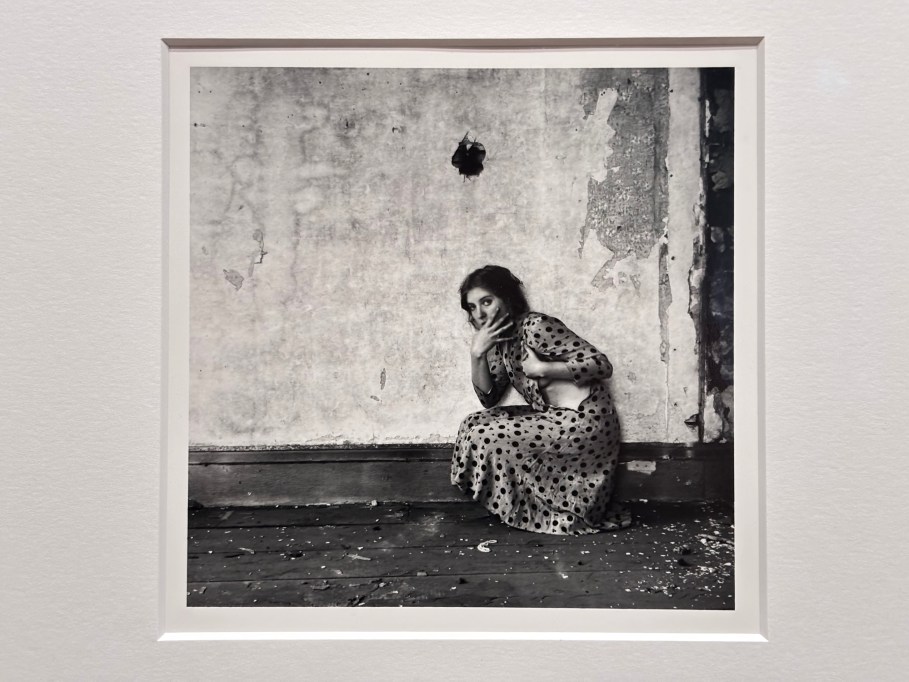
“From Polka Dots or Polka Dots”, from the Polka Dots series, 1976.
“House #3”, from the Abandoned House series, ca. 1975-1976.
Untitled, 1975-1976.
Untitled, 1976.
“Almost A Square”, ca. 1977.
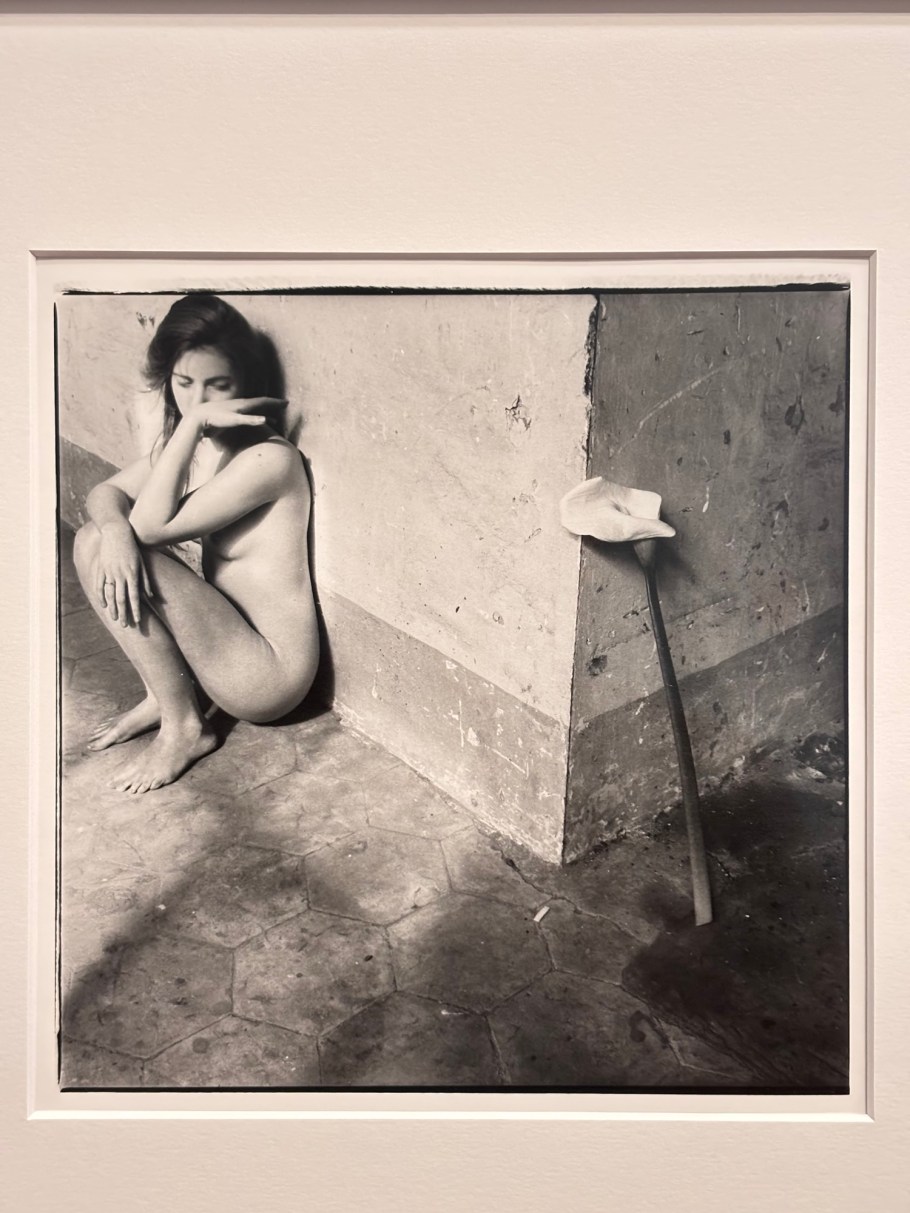
“Corner with Lily”, 1978.
Untitled, 1978.
Untitled, 1979.
Untitled, 1979. What’s special about this pair of images: “The artist holds the skeleton of a large leaf in front of her naked back. The stalk and veins of the leaf allude to her spine and ribs, respectively, with a formal correspondence to the structure in the wall, which has been exposed by the peeling plaster layer. There’s a reference to the shape of the leaf as well as her dress’ fern-print pattern. The props are unrelated, but the artist has created a chain of references among leaf, wall, dress pattern, and her body.”

I received neither support nor compensation for this content. I made all images above with an iPhone15 on 2 July 2025. This post composed within Jetpack for iOS appears on Fotoeins Fotografie at fotoeins DOT com.