Fotoeins Fotografie

location bifurcation, place vs. home

Posts tagged ‘1. Bezirk’

24T61 1st Sunday of the month, free art!

E60 V27

The first Sunday of the month means free entry for a number of museums, including many under the Wien Museum umbrella. With Secession as the temporary exhibition at Wien Museum Karlsplatz, I learned about different figures of the early 20th-century arts movement, which was not only in Vienna, but also sprung up in Berlin and Munich. Later, I meandered over to Wien Museum MUSA to discover the work by Vienna photographer Elfriede Mejchar.


“Secessionen”

“Pallas Athena”, by Gustav Klimt (Vienna Secession), 1898.
“… heads turn to meet her; steely eyed …”
“Houses on Montmartre,” by Maria Slavona, 1898.
Self-portrait, by Teresa Feodorowna Ries, 1902.
Self-portrait by Käthe Kollwitz, 1904. Full member of Berlin Secession, 1901. 1st woman artist elected to Berlin Secession board, 1912.
“Cherry Harvest”, by Dora Hitz, before 1905.
“Tilla Durieux as Circe”, Franz von Stuck, c. 1913.

Elfriede Mejchar (1924-2020)

In post-war Austria, Vienna photographer Melchar pointed at the ordinary and seemingly uncomplicated; and what Austria discovered instead was extraordinary and complex, and something the national scene had not seen as much about themselves. I think she raised important (existential) questions in the late post-war period about who Austrians thought they were, and who they wanted to be.

From 1950s series: “Light and Shade”.
Advertising column with Suchard poster, Vienna, 1950.
From 1967-1976 series: “Simmeringer Heide and Erdberger Mais”.
From 1989-1991 series: “Aether ad narcosim, Victor Alder Chemical Works, Vienna”.
From 1988-1991 series: “A Costume of Borrowed Identity”.
From 1979-1991 series: “Wienerberger Brick Kilns and Housing Estates, Vienna”.
“Amaryllis”, 1996.
From 2001-2007 series: “Nobody is perfect.”

I made all images above with an iPhone15 on 7 Jul 2024. This post composed with Jetpack for iOS appears on Fotoeins Fotografie at fotoeins DOT com.

24T55 Caryatids and columns

E54 V21

The word “caryatid” is described in the Oxford Reference as “carved female figure, usually clad in long robes, as an architectural support column; first used in Greece.” For architectural elements commonly found on buildings from the late 19th-century and early 20th-century, I’ve come across some caryatids, columns, and statues over the last couple of days in the Austrian capital city.


“Do not enter, or ELSE !” (Hofburg)
What’s the story? (Hofburg)
Josefsplatz 5: caryatids at Palais Pallavicini, formerly Palais Fries.
Graben 20: boy wearing a fez holding onto a coffee bowl, and the year, 1862, Julius Meinl was established.
Renngasse 7: caryatids.
Tuchlauben 1 / Bognergasse 1. The Chanel is a “somewhat recent arrival,” inserted between two caryatids.
Caryatid, left/west.
Caryatid, right/east.
A long look from above.

I made all photos inside Vienna’s 1st district with an iPhone15 on 30 Jun and 1 Jul 2024. This post composed with Jetpack for iOS appears on Fotoeins Fotografie at fotoeins DOT com.

24T53 Vienna Albertina: potent photography

Greg Crewdson Retrospective

I’m fascinated by these images, their concepts, and their elaborate construction. I remember being stopped in my tracks the first time I laid eyes on a couple of images from the “Twilight” series a number of years ago. It might be easy to compare these images with Jeff Wall’s thoughtful constructions which satisfy the description of “a moving series in a single frame.” Greg Crewdson’s images are also cinematic and dramatic, in both scope and scale, capturing elements of film-noir and the blockbuster. But there’s also provocation in theme, as he inserts seemingly unimportant details and asks the viewer some uncomfortable questions.

The following are a sampling of photographs from three of the four series currently on display at the Albertina in Vienna.

Read more

Vienna Ringstrasse & Architectural Historicism

Above/featured: Examples of the “Ringstraßenstil” historicism style at Maria Theresa Square, with Maria Theresa Monument at left and the Museum of Natural History at right. Photo, 15 May 2022 (X70).

•   Can a street alone define its surrounding architecture?
•   Do the buildings themselves establish the street’s visual impression?
•   Is Vienna (un)fairly defined by the Ringstrasse and the inner city?

The answers, as always, are a little complicated.

Like many, I’m also fond of Vienna’s Ringstrasse (Ring Road), as a kind of “hello” and re-introduction to the city after my first visit in 2002. At 5 kilometres in length, the Ringstrasse is one of the longest streets in Europe, longer than the nearly 2-km Champs-Élysées in Paris and longer than the 4.5-km Nevsky Prospekt in St. Petersburg. The boulevard is surrounded by Prachtbauten (buildings of splendour), constructed in the architectural style of “historicism,” a big nod to classic “forms” reflecting structural “functions”. The late-19th century “Ringstrassenstil” (Ring Road architectural style) continued the practiced habit of choosing a historical style which best identified with the purpose of the building. For example, the Neo-Baroque architectural style is represented in the Civic Theater; the Neo-Classical style in the Parliament and New Palace; the Neo-Gothic style in City Hall and the Votive Church; and the Neo-Renaissance style in the museums, palatial mansions, Opera House, and the University.

On Christmas Day 1857, the Wiener Zeitung newspaper published an imperial decree written 5 days earlier (on 20 December) by Habsburg emperor Franz Joseph I. He ordered the demolition of the inner-city wall and the subsequent creation of a circular boulevard, bordered by grand buildings and filled with green spaces. The large outward extension of the inner city changed and influenced the urban development of Vienna, still seen to this very day.

It is my will that the extension of the inner city of Vienna should proceed as soon as possible, providing for appropriate connections between the city and the suburbs as well as the embellishment of my imperial residence and capital. To this end, I authorise the removal of the walls and fortifications of the inner city as well as the ditches around it …

– Emperor Franz Joseph I: 20 Dec 1857, published 25 Dec 1857.

On 1 May 1865, Emperor Franz Josef unveiled the Ringstrasse in an official ceremony, even though large areas remained under construction. Ringstrasse structures included the religious and the secular, as well as the public and the private. The Ringstrasse symbolized the power of the imperial state, and the growth of a new arts and culture scene with the increasing popularity of coffee houses.

It’s also important to note the architectural impact made by the Jewish middle- and upper-class to integrate within the Habsburg empire. For example, the families Ephrussi, Epstein, and Todesco commissioned architect Theophil Hansen to construct palatial mansions as visible manifestations and partial realization of the dream of many Viennese Jews: assimilation into and emancipation within Viennese society. (Viennese journalist and political activist Theodor Herzl might have had a different opinion about that.)

For residents and long-term visitors today, it’s entirely possible to fit into the unintended shape and mentality of the “modern” city: that the inner-city wall was simply replaced by a different wall of “economic class”, that the architectural callback to historicism “freezes” the inner-city in time, and that like many, I can live, traverse, and work in the outer districts and avoid entering the inner city.

For short-term visitors today, the Ringstrasse buildings form a golden shiny “ring” around the “fingers” of the U1 and U3 metro lines traversing through the UNESCO World Heritage inscribed inner-city. For these visitors, all that’s needed for their limited time in Vienna is the inner city.


( Click here for images and more )

Vienna Judenplatz: centuries & memories of the Jewish community

Above/featured: Judenplatz at night. The Holocaust memorial is in the foreground at centre. In the background are “To the little trinity” at centre and Misrachi House (Museum Judenplatz) at right. Photo, 10 Jun 2022.

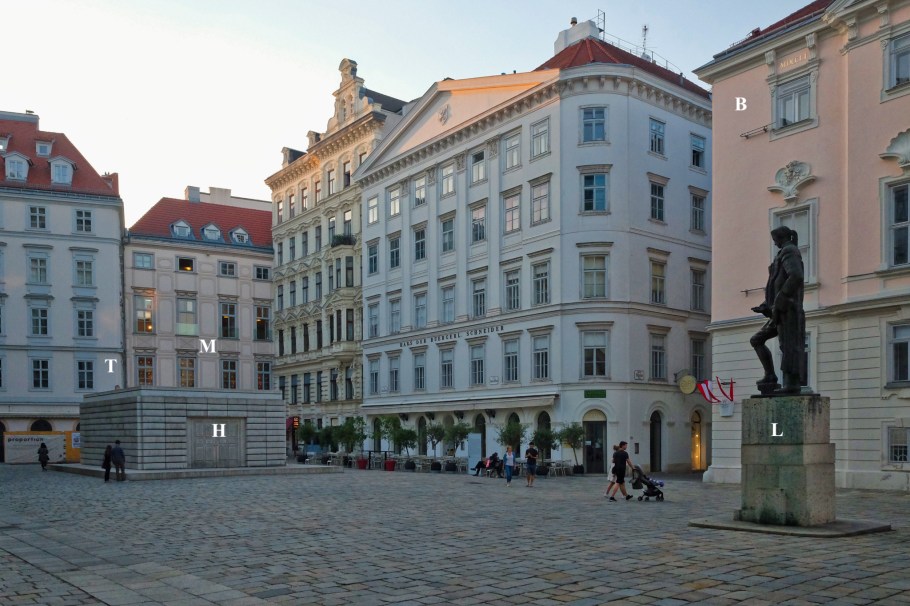
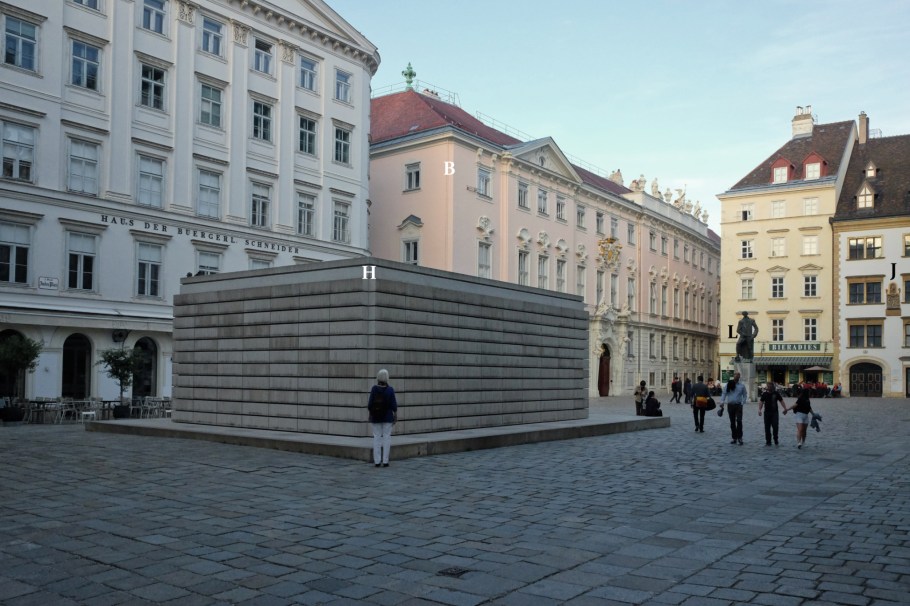
At Judenplatz are clear visual reminders of the city’s first Jewish community in medieval times.

The first Jewish community in Vienna settled around present-day Judenplatz in the Middle Ages with mention in written documents dated mid- to late-13th century AD/CE. Daily Jewish life thrived around the Or-Sarua Synagogue, the Jewish School, and the Mikveh ritual bath. The community along with the surrounding Jewish neighbourhood came to an end with the Pogrom of 1421. Catholic Habsburg Duke Albrecht II rolled out a decree (Wiener Geserah, Vienna Gesera) which legitimatized the expulsion, incarceration, torture, and murder of some 800 Jewish residents; accompanied by destruction and forced takeover of buildings and property.

Below I highlight remnants and traces to the medieval Jewish community at this square in central Vienna.

Judenplatz, Vienna, Wien, Oesterreich, Austria, fotoeins.com

Facing northwest: B, Bohemian Chancellery; H, Holocaust Memorial; L, Lessing monument; M, Misrachi House; T, To the little Trinity. Photo, 20 May 2018.

Judenplatz, Vienna, Wien, Oesterreich, Austria, fotoeins.com

Facing southeast: B, Bohemian Chancellery; J, Jordan House; H, Holocaust memorial; L, Lessing monument. Photo, 20 May 2018.


( Click here for images and more )