It’s overcast today which is slightly disappointing not to get a final bout of good light. But the illumination while gray will be fairly even. I’m sticking to the 1st district today and see what I can find in a meander and stroll. No surprise a month goes quickly, as well as over 90% of my planned time in Europe having elapsed.
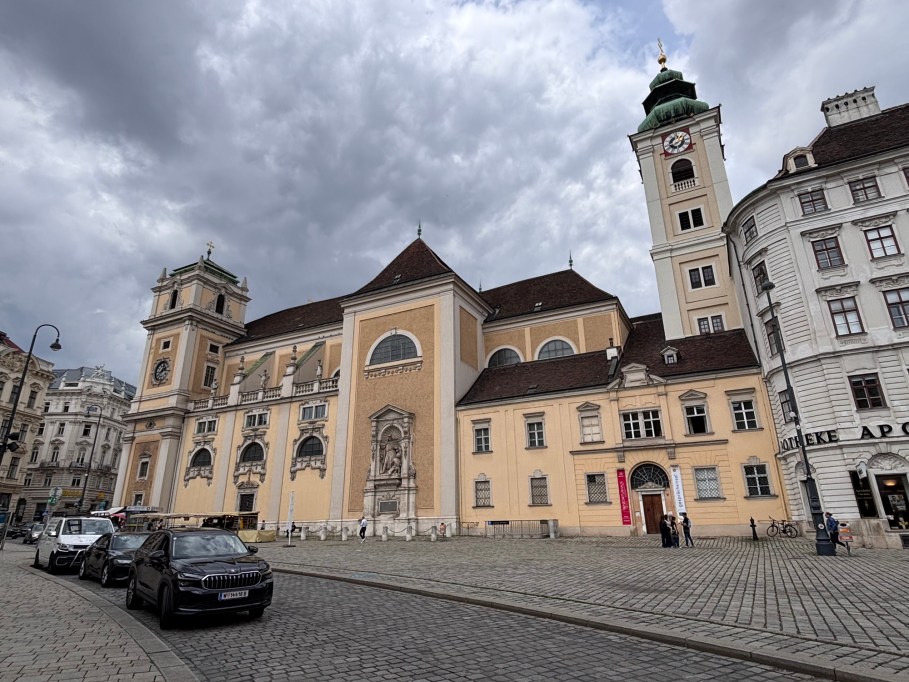
Schottenkirche (Scots Church & Foundation). There’s a Romanesque chapel with …
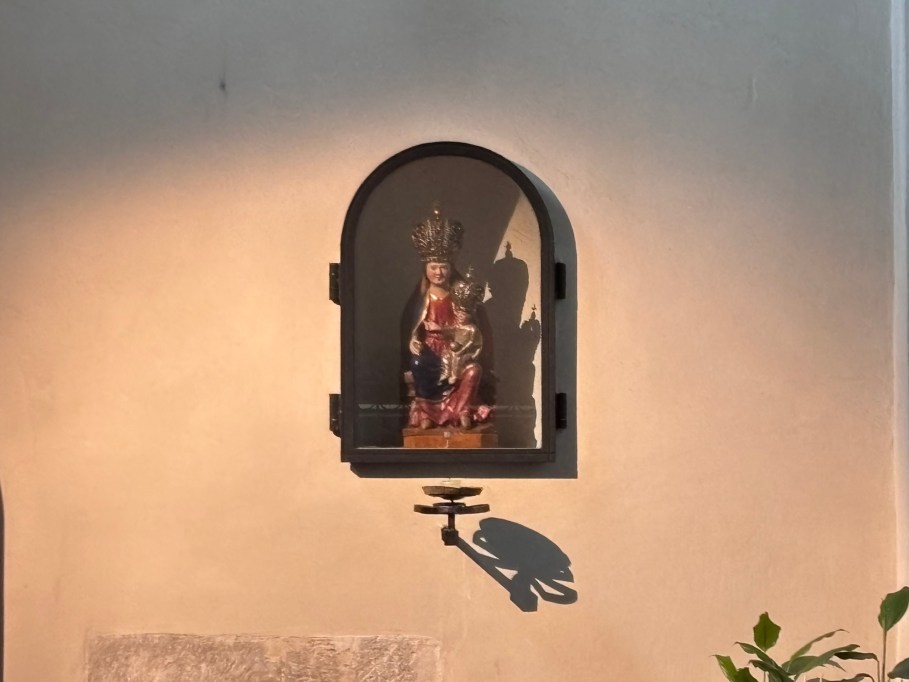
… one of the city’s oldest images of the Virgin Mary statue, c. 1250 CE.
Facing southeast from Freyung, towards the Austriabrunnen , Kunstforum, Park Hyatt, Stephansdom, Peterskirche.
Heidenschuss: c.1850 statue referring to a legend of a local baker who secretly dug tunnels below ground to expose the Ottoman Empire’s advanced lines of attack during their 1st Siege of Vienna in 1529.
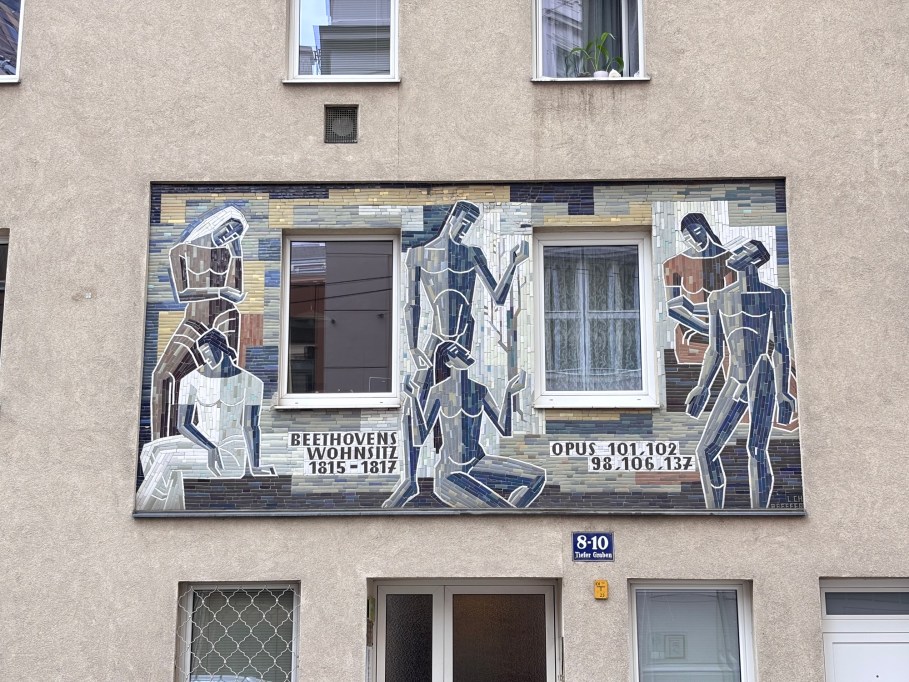
Above the door at Tiefer Graben 8-10: where Beethoven lived from 1815 to 1817 and worked on pieces Opus 98, 101, 102, 106, 137.
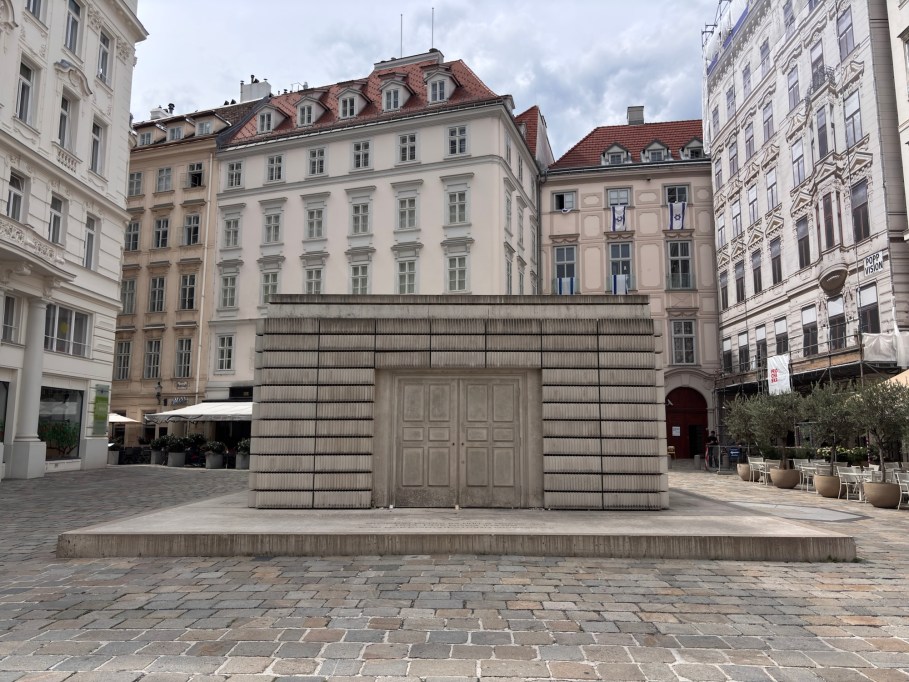
In 2000, the City of Vienna officially unveiled its memorial to Jewish victims of the Holocaust with a sculpture by British artist Rachel Whiteread. Situated at Judenplatz, the memorial takes on the form of an “inverted library” whose books are placed spine facing inwards.
The books are placed with their spines inwards. There’s a model concept in Wien Museum Karlsplatz.
Stephansplatz, Stephansdom, and the usual crowds in late-afternoon.
Weeks in advance of my arrival, I purchased online a 31-day ticket for 51€ from the Wiener Linien (WL) transport authority. With a registered account, the WL mobile app included my digital ticket shown above. At a conversion of 1€=$1.6CAD, the ticket comes out to $2.70 daily.
Except for the screenshot, I made all other images with an iPhone15 on 29 July 2025. This post composed within Jetpack for iOS appears on Fotoeins Fotografie at fotoeins DOT com.
Austrian artist Brigitte Kowanz (1957-2022) long held a fascination for light. Light isn’t simply the medium through which information propagates; rather, light itself is the tool and the mould for illumination, reflection, and even introspection. There’s a definite spirit of fun and “lightness” when she matches her fondness for Morse code with illumination sources.
In my view, there’s something in her light-based artworks which allude not only to her philosophy and worldview, but also, happily for me, to her clear interest for science. Her works also anticipate and explore timely themes including what it means to live in an information-rich society that fully embraces digital habitats and virtual spaces.
She’s quoted as saying (2017):
“Licht ist expansiv und flüchtig, es bleibt nie bei sich – Licht ist eine Lebensmetapher.”
(Light is expansive and elusive, it never remains the same – light is a metaphor for life.)
I discovered her work for the first time in 2018 on the roof of the Leopold Museum in Vienna’s MuseumQuartier. Over the years, I’ve been fortunate to come across more of her artwork installed throughout the city.
The Brigitte Kowanz retrospective, “Light is what we see”, is now on display at the Albertina from 18 July to 9 November 2025. In part, I arranged my 2025 time in Vienna to coincide with the final run of the Francesca Woodman exhibition *and* the start of the Brigitte Kowanz exhibition.
“Alphabet”, 1998/2010: neon, mirror. Letters A (right-centre) through Z are represented clockwise with each letter as illuminated Morse code. I may be out of the “game”, but this looks a lot like an accretion disk surrounding an astrophysical “black hole”.
“Echo Hall Flow Nein”, 2003/04: neon, mirror. Each word appears vertically, consecutively from left to right. The large number of internal reflections is another hallmark of her work, always asking the viewer to determine the placement of the original source.
“Morse Alphabet”, 1998: fluorescent tubes, plexiglass tubes, enamel paint. Each radial spoke contains a letter of the alphabet in illuminated Morse code. “A” begins at the top at around 12:02, moving clockwise to “Z” at 11:58.
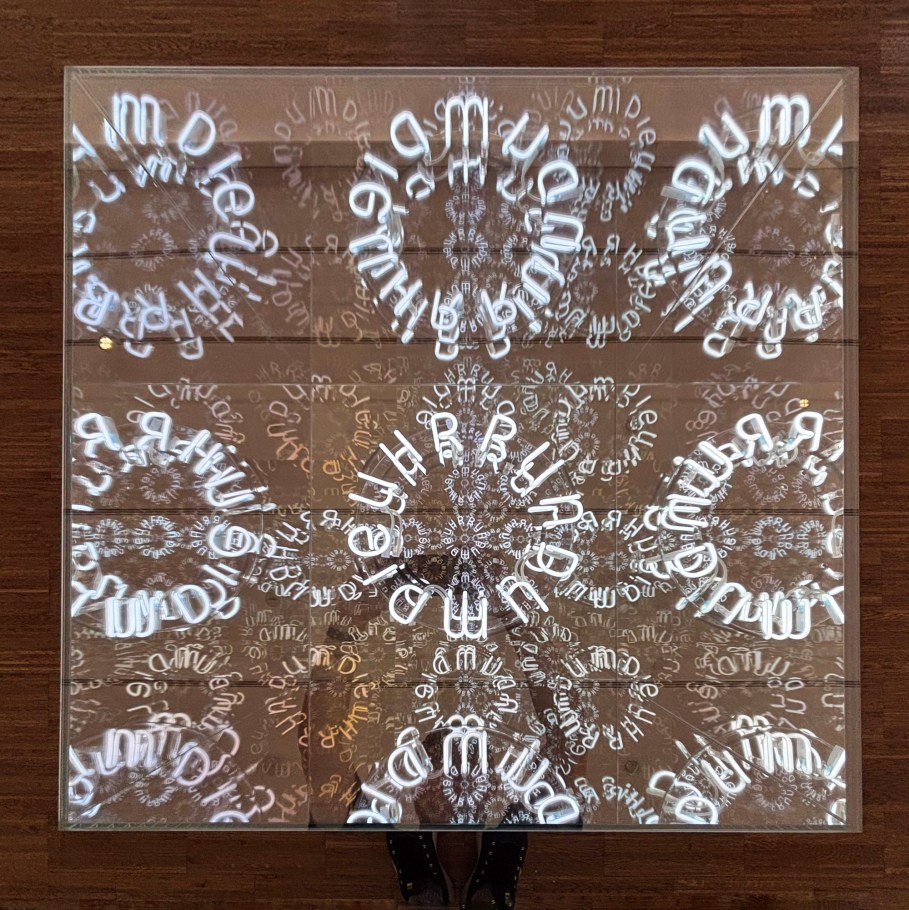
An example of one of her infinity boxes. “Rund um die Uhr” (around the clock), 2011: neon, mirror. The image is partly corrected for geometric distortion.
“asap omw imo tbh bif afaik irl idc idk iow hth fyi omg”, 2021: neon, aluminum, enamel paint. I had to look up a couple of these in the urban dictionary. NGL, but I feel old.
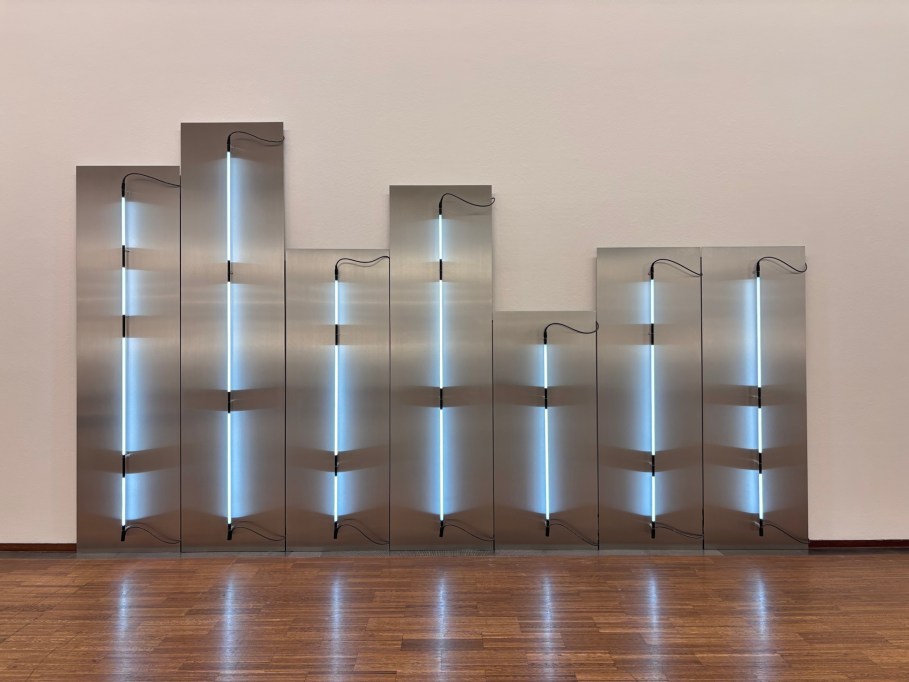
“Forward”, 2005: neon, stainless steel, enamel paint. Each letter is represented in Morse code by a vertical panel with an illuminated tube; “r” 3rd from the left & 2nd from the right.
One room in the exhibition area.
“Speed of Light sec/4m”, 1989/2007: neon, chrome steel. “0,000000013342563 second” (1.33E-8 sec or 13.3 nanoseconds) is the time required for light to travel 4 metres, which appears to be the actual length of this sculpture.
“light is what we see”, 1994/2019: glow lamps, power strips, plexiglass, stainless steel.
“Signature” (Kowanz), 2015: neon, mirror. That’s my bulbous head in the reflection.
I received neither support nor compensation for the present piece. I made all images above with an iPhone15 on 23 July 2025. This post composed within Jetpack for iOS appears on Fotoeins Fotografie at fotoeins DOT com.
It sounds macabre at the outset, and admittedly, the legend of the 1862 naming for the alley points to the mass elimination of medieval Templar Knights in 1312.
But those apparently nondescript entryways, if open, reveal much more: to residential blocks, several Pawlatschen (“stacked open balconies”), and a big quiet inner courtyard with a tree that’s apparently more than 250 years old. While the foundations of this complex go back to the 12th- to 13th-century, post-war restorations and preservation efforts retained the historical character of the buildings in Vienna’s oldest residential area.
Perhaps, the only thing “bleeding” is the source of funds required to maintain the appearance and everyday working nature of the apartments within.
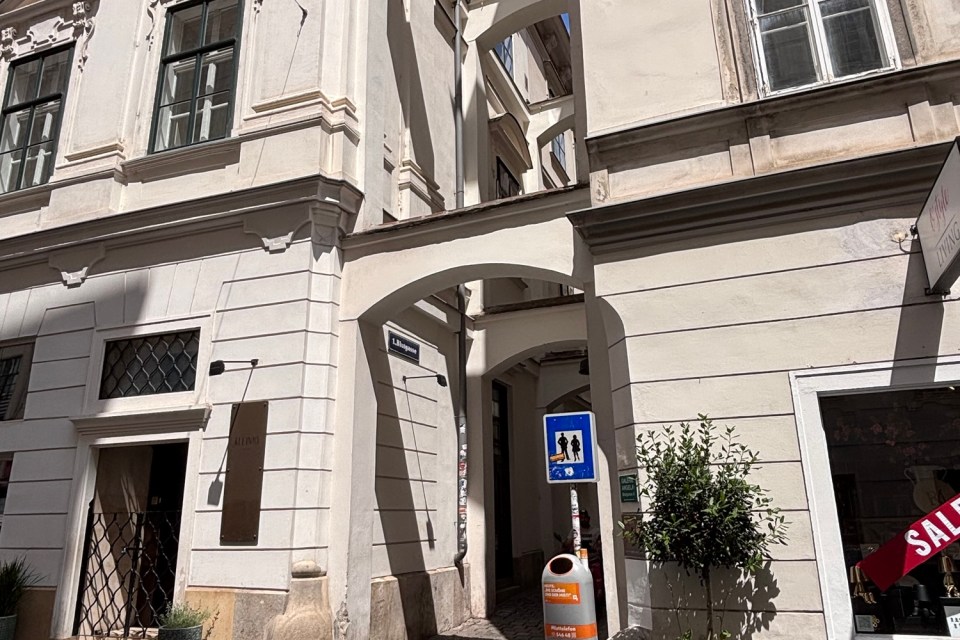
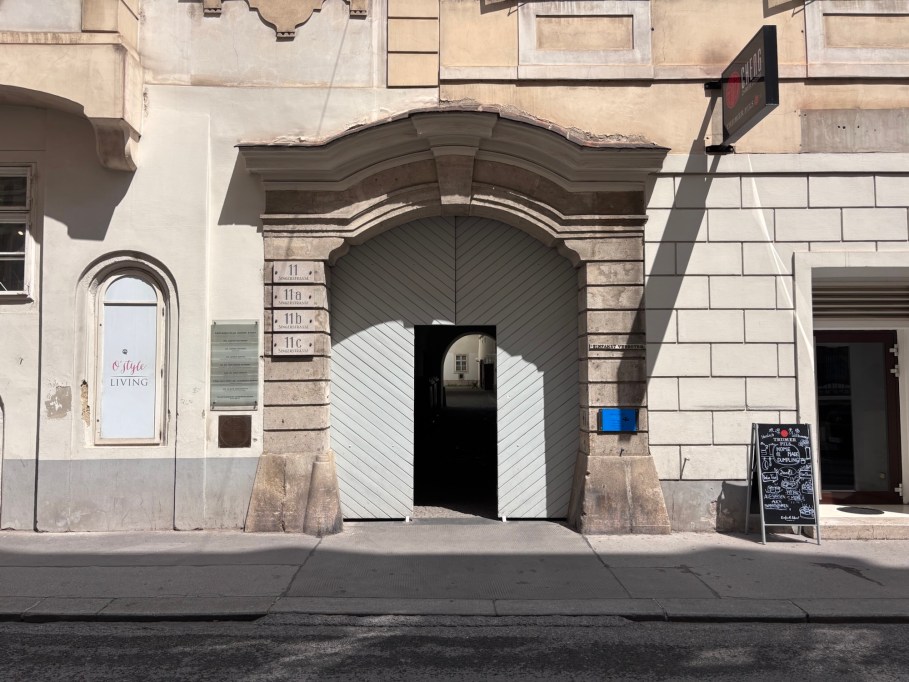
Entry into Singerstrasse 11, 11a, 11b, 11c.
The “seam” and open courtyard separating the blocks at left (Blutgasse 5, 7, 9) and the blocks at right (Singerstrasse 11a,b,c). The big plane tree at centre is apparently at least 250 years old.
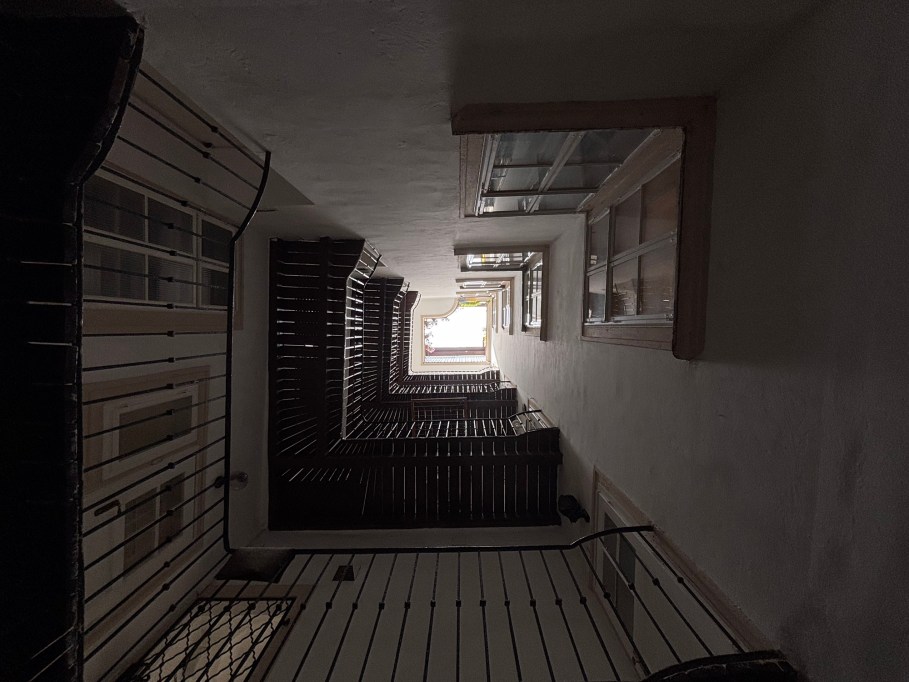
From the tree, up into the sky.
Facing Blutgasse 9 at centre, the general description seems apt: stacked *and* squeezed.
Blutgasse 9.
The apartments in Blutgasse 9.
Blutgasse 3: typical of Viennese “Pawlatschen” style of stacked open balconies. This individual structure is a Pawlatschenhof, a courtyard with stacked balconies.
I made all images above with an iPhone15 on 21 July 2025. This post composed within Jetpack for iOS appears on Fotoeins Fotografie at fotoeins DOT com.
By chance, the math happened to work out very well today. I wandered into three city districts for some “list clearing” activity. Here’s what I found, even with me ending up in the inner city.
15. Rudolfsheim-Fünfhaus
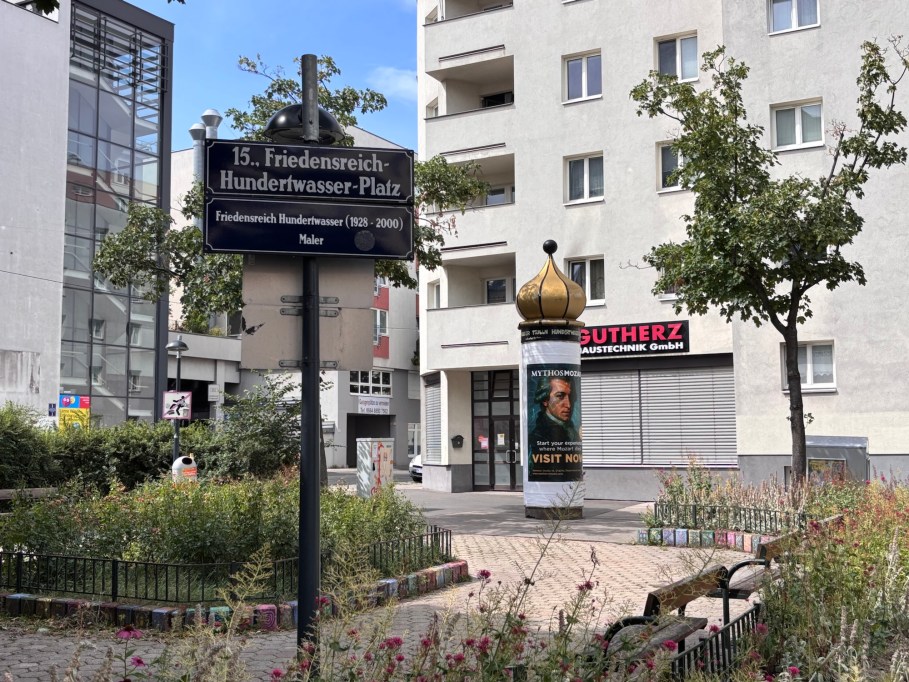
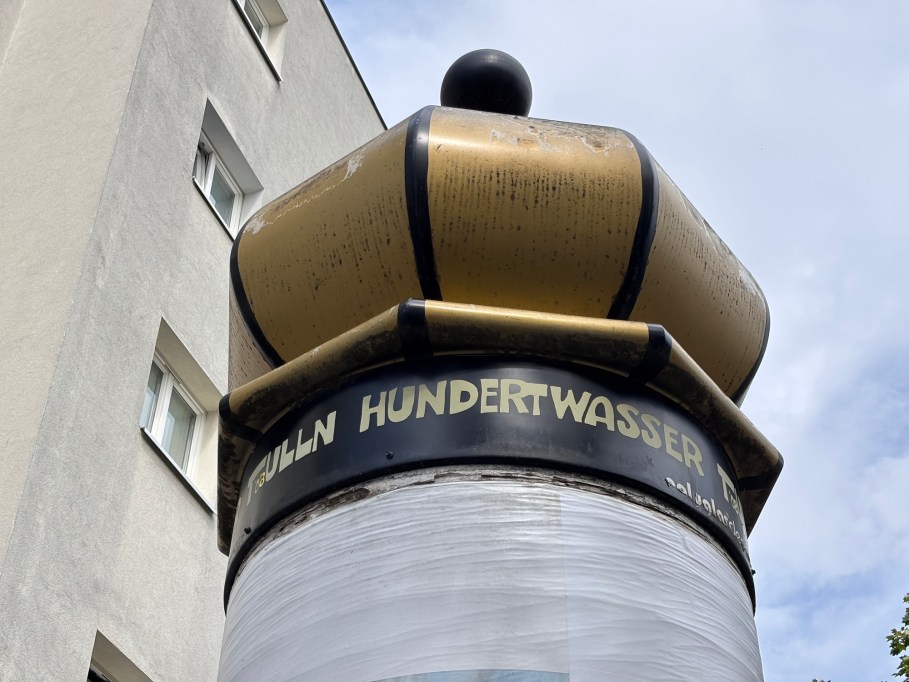
As a boy, Friedrich Stowasser lived in the area with his Jewish mother, Elsa. In 1938, they were forcibly moved out to a relative’s apartment in the 2nd district, where they survived until war’s end. That boy became the artist known as Friedensreich Hundertwasser (1928-2000), whose influence is visible as an “onion dome” on top of the advertising column in the background. The City of Vienna inaugurated the small plaza in his name in 2007.
Onion dome. Hundertwasser.
5. Margareten
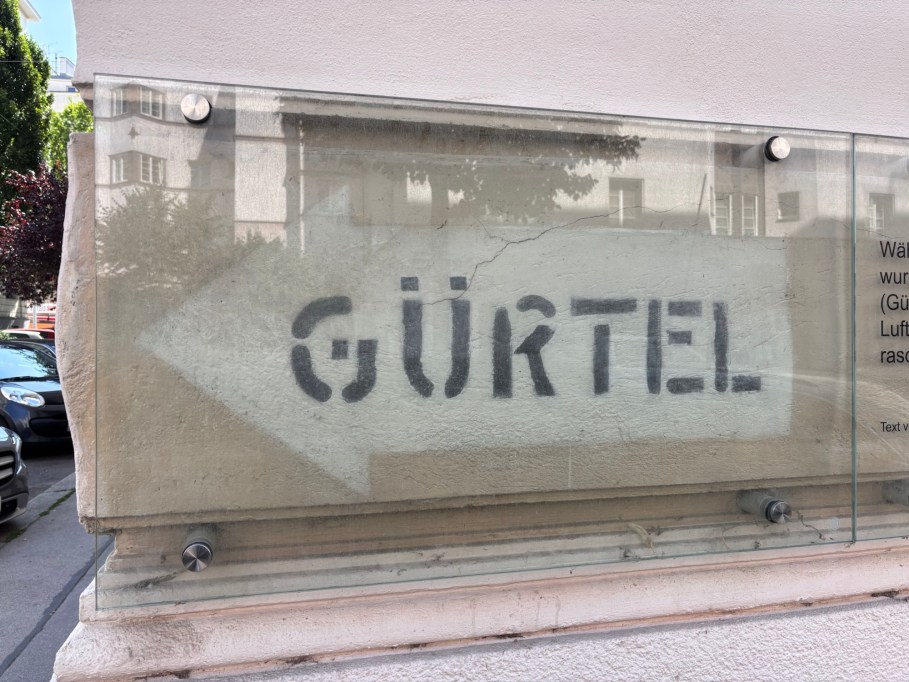
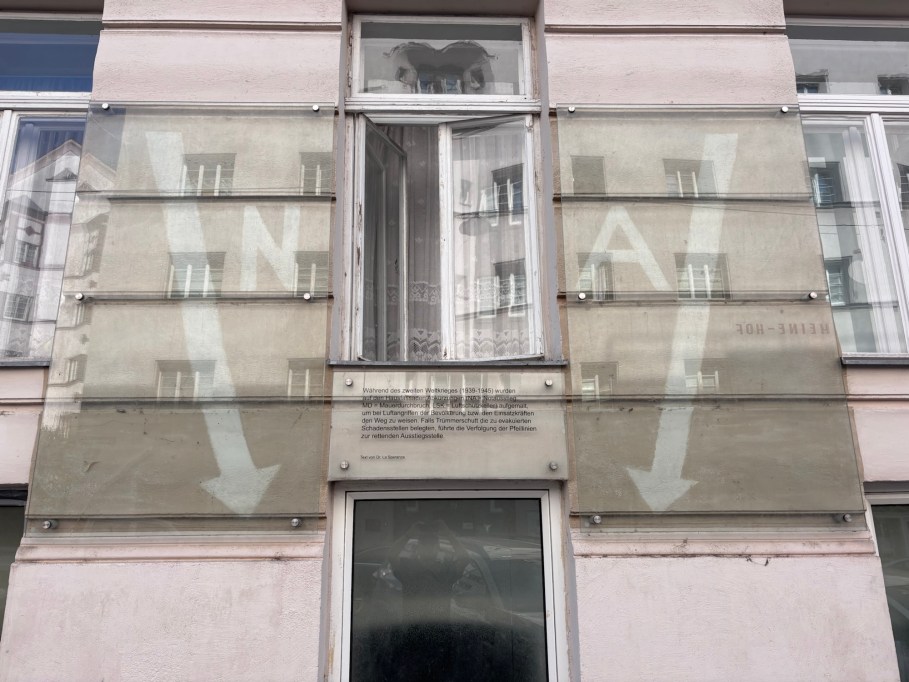
On the outside wall of the building at the corner of Leitgebgasse and Stöbergasse are three panels each protected by transparent plexiglass. Each panel is a visual record of what was required of residents during Allied air-raids in World War II.
The arrow shows the direction residents could go for additional shelter, pointing southeast towards Margaretengürtel (Margareten belt road).
The two arrows point to “NA” for Notausstieg, or emergency entry to an air-raid shelter below ground during World War II.
10. Favoriten
Ceramic mosaic of architect Eduard van der Nüll (1812-1868), by Fritz Rocca-Humpoletz (1894-1971). Van der Nüll and Sicardsburg designed Vienna’s Opera House whose public unveiling brought reviews so poor, they drove van der Nüll to despair and suicide.
Giant wall mural (2021), by Viennese artist nychos, at tram stop Knöllgasse. I saw this in June 2024, but to see this again in-person is neither chore nor burden at all.
1. Innere Stadt
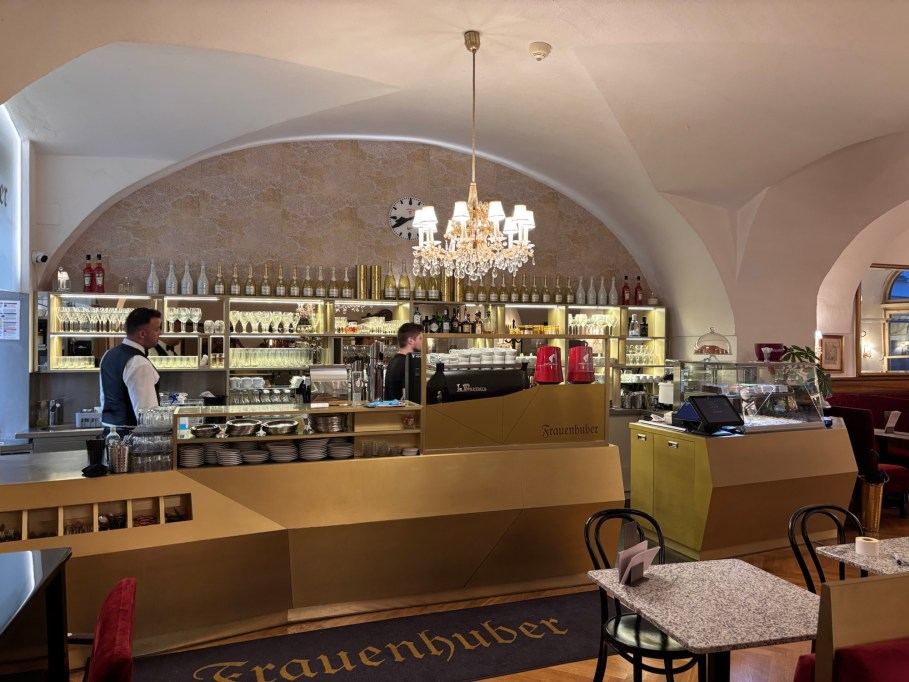
Inside the Frauenhuber café.
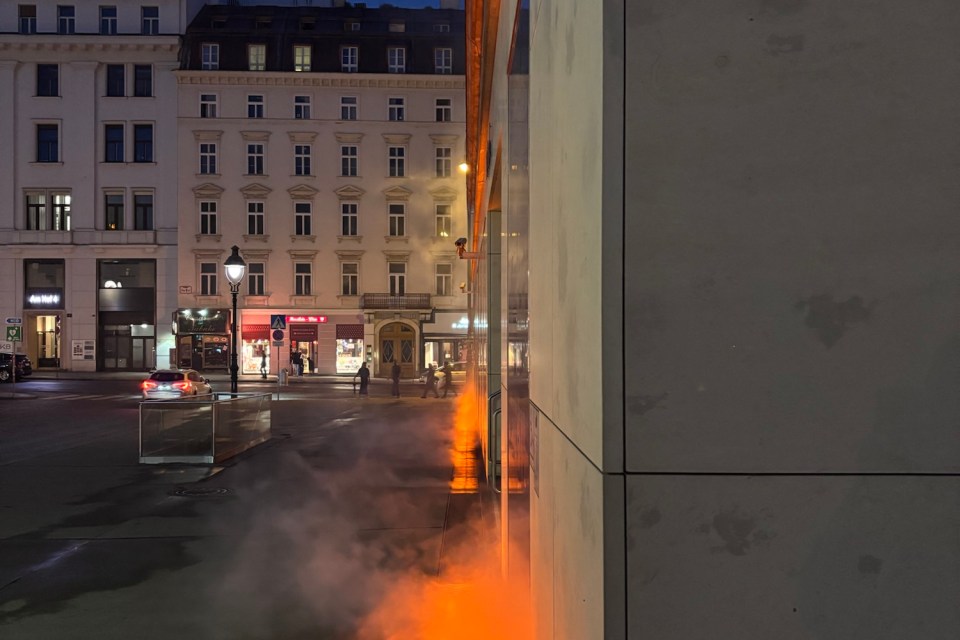
“Yellow Fog”, by artist Olafur Eliasson for Verbund whose headquarters are located at Am Hof. The dynamic sculpture is active only at dusk.
I made all images above with an iPhone15 on 16 July 2025. This post composed within Jetpack for iOS appears on Fotoeins Fotografie at fotoeins DOT com.
It’s a wonder there aren’t more accidental bumps into other people. Instead of heads down (on mobiles), everyone has their head up to soak in the glory, shimmer, and glow. Before raising their mobiles up for a picture or few …
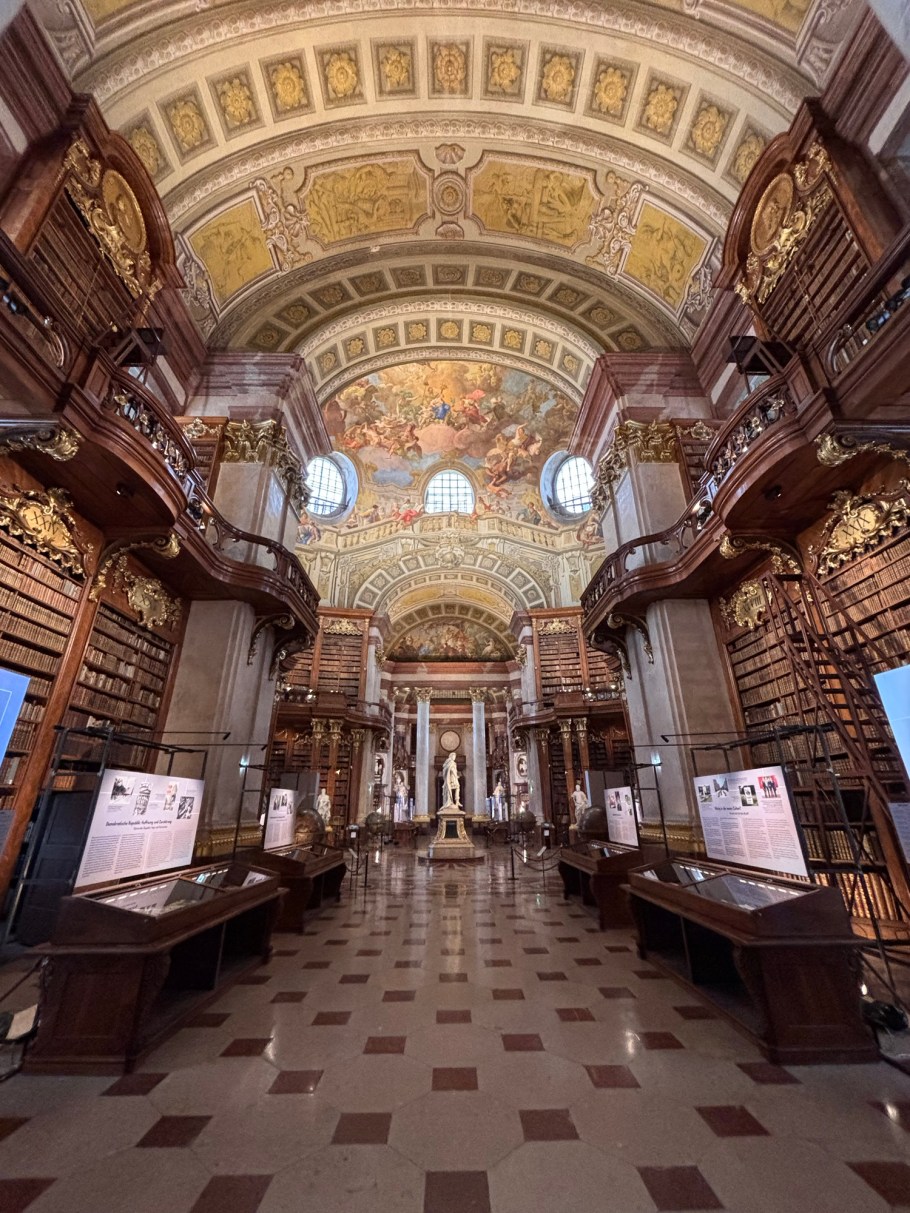
In the early 18th-century, Habsburg Emperor Charles IV ordered the construction in Vienna of an imperial court library in the Baroque style. First designed by Johann Bernard Fischer von Erlach, his son Johann Emanuel completed construction in 1726 with ceiling frescoes added in 1730 from Daniel Gran.
As a big part of the Austrian State Library (ÖNB), the present-day Prunksaal (State Hall) houses over 200-thousand books spanning three centuries from 1501 to 1850. The digitized collection is available to the public from the library’s website; check also for (seasonal) opening times and purchasing tickets in advance.
1st guest of the day, along the southeast-northwest length.
Emperor Charles VI: 1735 marble statue by Antonio Corradini.
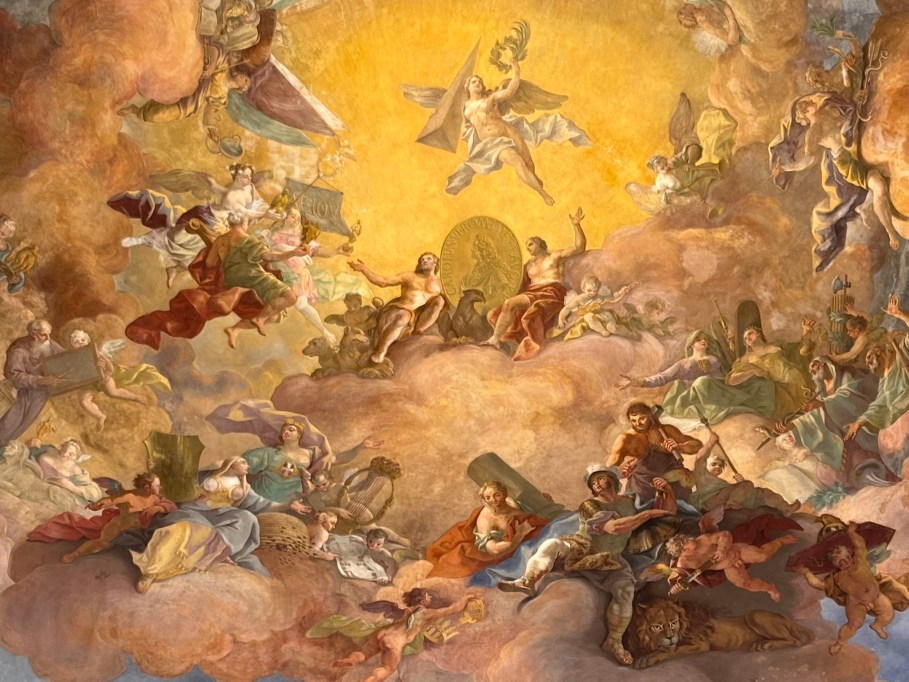
Directly above the statue of Charles IV is a ceiling fresco by Daniel Gran in the 30-metre high dome.
“… The fresco high up in the central dome shows the apotheosis of Charles IV: the divination and glorification as Emperor, as commissioner of the Library, and as patron of arts and sciences.” (ÖNB)
Lots of symbols, including obelisk/sunbeam, an imperial flag with “A.E.I.O.U.“, central “coin” celebrating Charles IV, personification of Vienna wearing a mural crown, a beehive with honey (“library containing sweet knowledge”).
Book alcove 7.
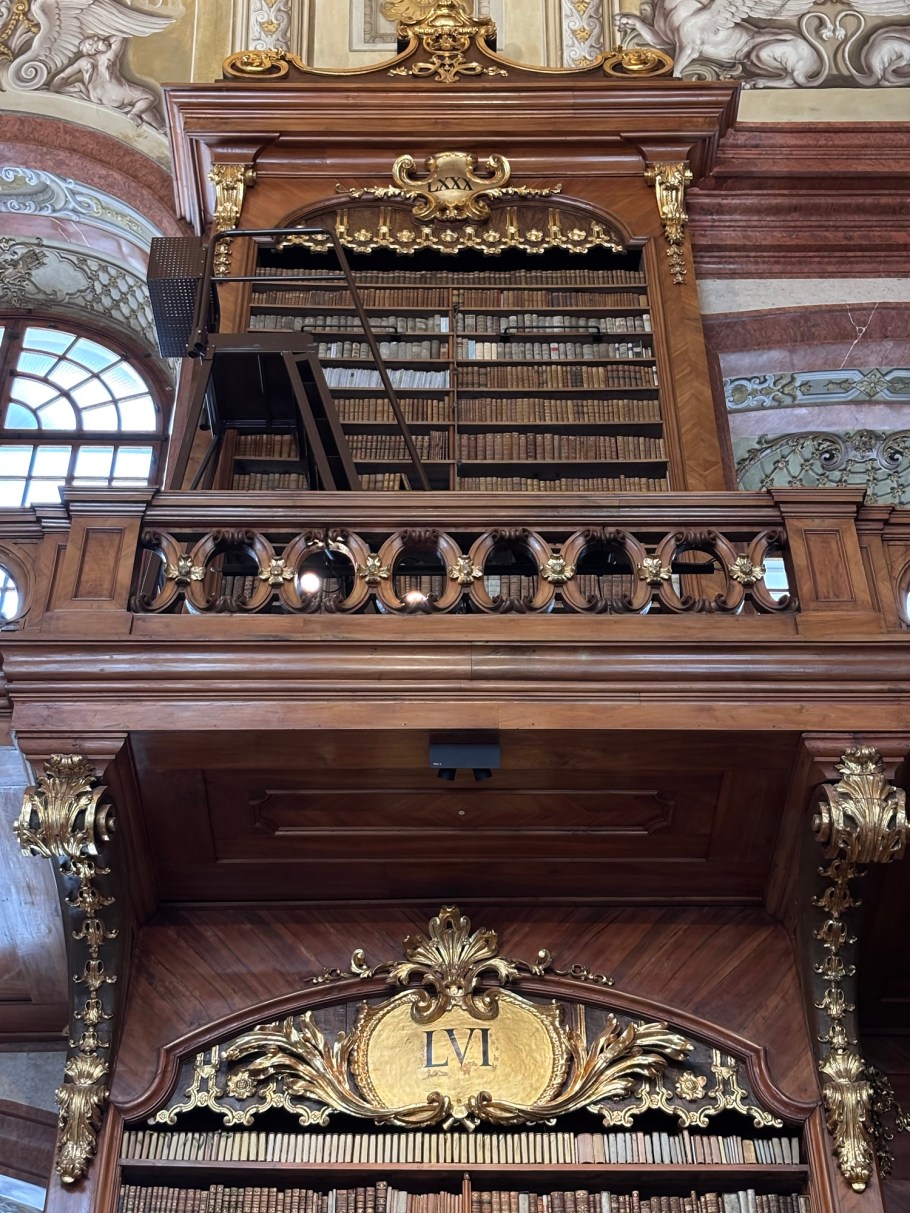
Book alcoves 80 (above) and 56 at the far end of the hall/library, next to the Peace wing (northwest).
Entrance wing to the library (southeast).
Building entrance from Josefsplatz.
I made all images above with an iPhone15 on 10 July 2025. This post composed within Jetpack for iOS appears on Fotoeins Fotografie at fotoeins DOT com.






















 Fotoeins Fotografie