Fotoeins Fotografie

location bifurcation, place vs. home

Posts from the ‘Travel Planning’ category

24T00 What’s in my carry-on

“Travel day zero”: nothing to check

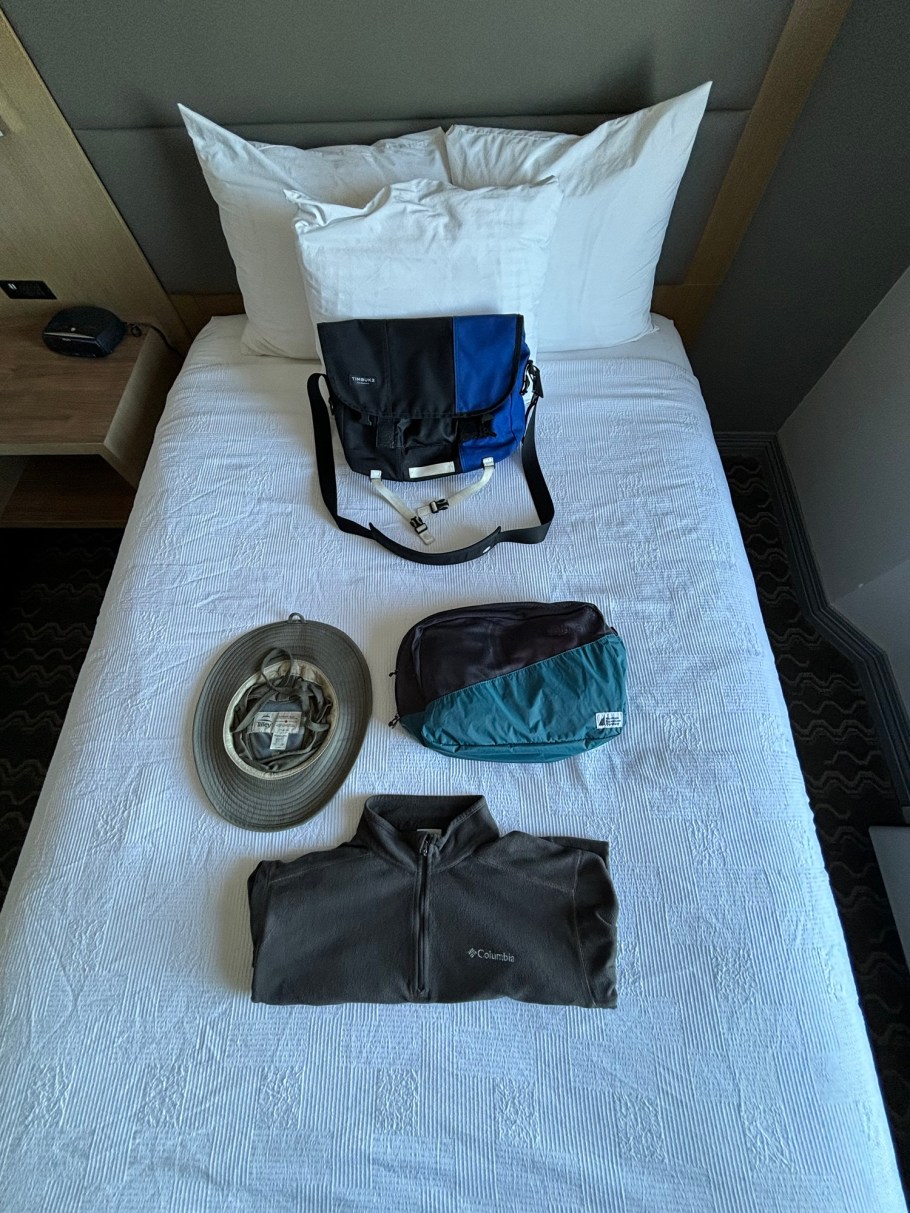
For 3 summer months, I have a medium-sized 21-Litre (21-L) Timbuk2 Classic Messenger bag in blue and black, and a 32-L Timbuk2 Command backpack in black, which are my “personal item” and “carry-on”, respectively, for all flights.

What’s in the Timbuk2 Classic Messenger bag

21-L messenger bag

  • Tilley Hiker’s Hat (with evaporative cooling insert)
  • Mountain Equipment Company MEC medium-sized mesh pouch, empty/flat.
  • Long-sleeved half-zip fleece

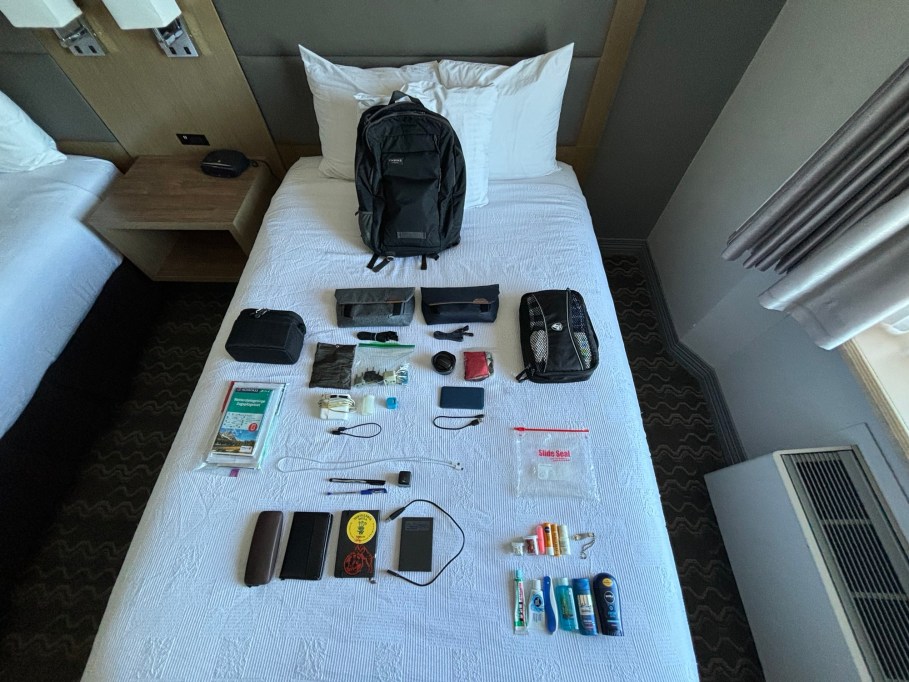
What’s in the backpack: example illustration for 2024.

32-L backpack

Many of the items described below are easy to replace at destination. But first to go into the bottom of the backpack is a pair of cargo shorts.

Above, at centre-left:

Tenba BYOB7 Camera Insert bag in black, carry-case for X70, extra SD-cards and batteries.

Above, at centre:

3-L Peak Design Field Pouch in charcoal grey, containing:

  • carrying strap for pouch
  • small soft pouch with wired earphones and small USB C-to-3.5mm audio jack
  • small freezer bag: type-C adapter plugs for Western Europe, USB-A & -C power-cube wall chargers (retractable prongs)
  • charger and charging cable for laptop
  • USB C-to-C cable, long
  • translucent film-roll cannister for coins: swap 🇨🇦 for 🇪🇺
  • a few pens
  • phone stand from my nieces, made at Fanning Woodshop in Peggy’s Cove NS

3-L Peak Design Field Pouch in midnight blue, containing:

  • carrying strap for pouch
  • WCL-X70 wide-lens with small rubber lens-hood
  • extra camera batteries
  • power bank with short USB cables (A-to-C, C-to-C)
  • USB micro-to-A cable for camera
  • SD card reader to USB-C cable

Shown below the pouches, stored elsewhere in the backpack:

  • sunnies 🕶️ in hardshell case
  • passport
  • Moleskine small hardcover lined-notebook
  • compact HDD with USB microB-to-C cable
Above, at centre-right
  • Heys medium-size packing cube in black; containing 3 t-shirts, 3 changes of underwear, 2 pairs short-socks, 1 pair long-socks
  • Small (<1-L) freezer bag containing:
    • “arts & crafts styled” pill-jars with OTC meds, ear plugs, sunscreen stick, lip balm, eyedrops, nail clipper, Mopiko ointment, toothpaste, collapsible toothbrush, small hotel-room bottles refilled with body wash (Nivea Cool Marine)
Total carry for 3 summer-months.

Still got clothes on me back

T-shirt, Henley quarter-buttoned pullover sweater, all-weather long-sleeve shirt, blue jeans, Merino wool socks, walking shoes.


Peak Design

Nods go to their versatile Field Pouch, their Leash strap on the X70, and their Everyday nylon-canvas polycarbonate case for the mobile 👍🏽


I made the images above with an iPhone15 on 7 May 2024. I received no support from any external organization for this post. This post composed within Jetpack for iOS appears on Fotoeins Fotografie at fotoeins DOT com as https://wp.me/p1BIdT-sts. Last edit: 14 April 2026.

Deutschland Ticket, for Canadian visitors (2024)

How-to buy guide, effective May to August 2024.

( Updote: On 18 September 2025, Bavarian state broadcaster BR24 reported the monthly price for the Deutschland-Ticket will go up by 5€ to 63€ , starting 1 January 2026. The price had already gone from 49€ to 58€ for the 2025 calendar year. My summer 2025 purchase went the same way as in 2024, whose details are described below. )

89 days within Europe includes by necessity substantial travel by train within Germany. I’ve already booked in advance a number of intercity express segments, but what about local transport and regional trains?

The “Deutschland Ticket” (D-Ticket) is a rail ticket for one person and costs 49€ per month on a rolling subscription. The ticket is generally valid for local transport (bus, tram, U-Bahn, S-Bahn, intracity ferry) and regional rail (RB, most RE, IRE), but not for long-distance IC and ICE routes. Intended primarily for commuters, visitors to Germany can also purchase these tickets.

It’s early-April 2024, and I’m about to buy the D-Ticket for 49€ for the entire month of May. The ticket’s “rolling subscription” means if I do nothing else before 10 May, I’ll also automatically purchase a D-Ticket for the month of June for 49€. I’ll need the D-Ticket for May, June, July, and August; but I can only buy one month at a time.

I choose Munich’s MVV-App, based on successes reported by other travellers. I’m only using the Munich app for ticket purchase, and I’m not planning to use public transport within Munich. To buy a D-Ticket, customers are neither limited by their choice of app/method, nor by the base/location where the app is based. My question is whether a Canadian-based credit card is an acceptable form of payment by the processing company in Germany for a German-based app.

Read more

Berlin: 8000-km jaunt home in the pandemic (2021)

Above/featured: S-Bahn station Messe Nord/ICC – 27 Nov 2021 (X70).

I’m going home to Berlin, for the 1st time in 4 years.

To travel at all, and to go international, is a big privilege; I’m grateful for the window of opportunity.

After a long gruelling emotional 2020 year taking care of an elderly parent at home with cancer and accompanying them safely to their final days, I’m desperate to get outta Vancouver for a break. But another 9 months pass before the largest roadblock to travel is dissolved. At the end of October 2021, the Canadian government releases a digital vaccination certificate suitable for domestic and international travel. Within a week, I have a set itinerary using credits from a cancelled trip.

The following describes plans and unconventional sights for Berlin, Germany over 11 days in the 2nd-half of November 2021. As case counts change and situations evolve at both ends, travellers must remain vigilant with extra preparation and adapt to changing policies, protocols, and requirements by different countries for visitors, ensuring safe and smooth travel, out and back. I go over all guidelines supplied by Germany’s Federal Foreign Office and the city state of Berlin.

I’m not going to lug my DSLR camera and extra glass for this quick trip. Instead, I’ll only use my 340-gram (12-ounce) compact fixed-lens camera. In all respects, it’s a big weight off my shoulders.


( Click here for more )

My Heidelberg: 40+ Highlights from Home

Above/featured: From Philosophenweg: across the Neckar, over the Altstadt, and up to Königstuhl – 21 May 2016 (HL).

Heidelberg is “eine adoptierte Heimatstadt” (an adopted hometown). Some have called this place “scenic, natural, and spectacular”; some call it “boring, provincial, and extortionate”. I could be referring to Vancouver, but that’s a subject for another time.

I’ve long struggled with questions of place: what defines “home”? Can those definitions and qualities change with time? Do people have choice(s) and do they apply their choices in their search? Can people find meaning with “home”? Must “home” be restricted to only one place, or can different needs be met from different places?

Images can provide access to memories of having lived in a new country, experiencing the shock of the new, and settling into the mundane. I remember advice someone once gave me which became constant companion and reminder: that I was inhabiting a place at the same latitude as my birthplace, 8000 km in distance and 9 time zones apart on the other side of the planet, a place that’s seen its compact share of activity with flair and impact.

Most recall is naturally connected to sight. Occasionally, it’s a rush of the senses: the quick breeze on the skin, the ankle-spraining undulations of the cobblestone, how fog clings like a cold clammy cloak, the sing-song of birds among tall trees in the forest on the hill, the smell of grilled sausages in town by day, and the satisfying late-night noms of a spicy Dürüm Döner with a cool Ayran. And other times, human history leaps out and buries its claws, when the unthinkable must be acknowledged and understood in a synapsis of memory and senses.

In the autumn of 2001, I moved to Germany and Heidelberg: both sight unseen and without having learned any of the language. I stayed in town for a little under two years. What’s astonishing is I have no pictorial record of my time in Heidelberg, Germany, and Europe: I had no camera before the dawn of the smart-phone.

I have some great memories, even if time is casting long shadows. What I lost (no, gave away) was some part of me that actually has little to do with the “Schlager” hit song “Ich hab mein Herz in Heidelberg verloren“. It might be a piece of the heart, a part of the soul, or simply a scrap of good sense; but what it is precisely still remains undefined and shapeless. Finding solid answers about what I’ve surrendered might take years. And so, for the sake of clarity, I’ve returned many times since leaving town in 2003. A sharper focus comes through the post-departure blur whenever I step off the train in town.

I couldn’t have possibly known the experience of moving to and living in Heidelberg would be life-changing. Time so far has been kind, because it didn’t take long for me to adopt Heidelberg as “home”.

( Click here for images and much more )

Martin Luther: tracing his steps in 16 German cities

Above/featured: “Luther war hier. (Luther was here.)” Eisleben, Germany. Photo, 27 Oct 2016.

In pre-teen years, I attended a Catholic elementary school by weekday, and a missions-oriented Protestant church by weekend. I already had multiple questions running around my pre-scientist brain, like electrons appearing and dissipating in a fuzzy halo. When various disparate elements began to settle with few satisfying answers, I left behind the churches and their respective religions. But one thing that’s remained is my love of history. History has never been boring, because I carry the past (as offspring of immigrants), and I’m determined to bring history’s lessons into the present.

Even in youth, I had to ask: why was one set of churches called “Protestant”? What was under protest? How did one man help spark a movement that would help merge and create a version of a language that continues today, that would bring accessible means to literacy for the public, and that would begin to change rule by religion to rule by law?


Martin Luther: Luder’ name at birth

From his birth in Eisleben; to formative years in Mansfeld, Magdeburg, and Erfurt; to the bulk of his working and teaching years in Wittenberg; to his death in Eisleben, Martin Luther set upon a course that helped change language, education, culture, religion, and governance. In many ways, Luther had much to thank Jan Hus for the latter’s efforts to reform the Catholic Church in Bohemia one hundred years earlier.

Every year on the 31st of October, a number of cities, regions, and federal states in Germany mark an important event in this movement. It’s widely understood Martin Luther walked up to the Castle Church in Wittenberg and pinned his 95 Theses to the church doors on 31 October 1517. Even if direct evidence Luther actually posted papers to the doors is debatable, what’s not is that 2017 marks the 500th anniversary of the Reformation in Germany.

Martin Luther, Reformation, German Reformation, Wittenberg, Marktplatz, Saxony-Anhalt, Sachsen-Anhalt, Germany, Deutschland, fotoeins.com

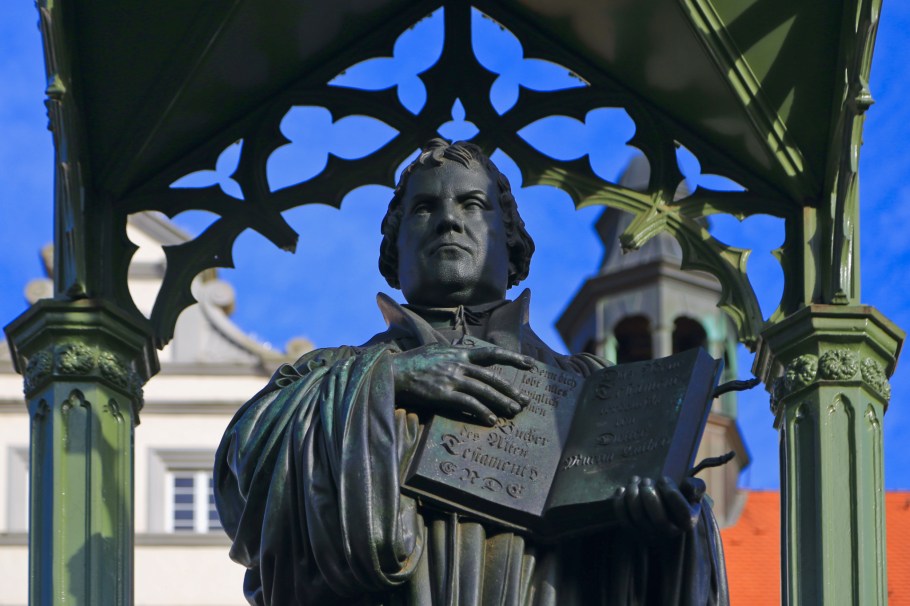
The illuminated Luther memorial stands tall in front of Wittenberg’s town hall at Market Square. As UNESCO World Heritage Site, the town hosts 4 sites: Luther House, Melanchthon House, St. Mary’s Town Church, and the Castle Church. 2017 is the 500th anniversary of Luther’s Reformation in Germany. Various German federal states, regions, and cities will mark the quincentenary throughout the year. Photo at Wittenberg Marktplatz on 30 Oct 2016.


( Click here for images and more )