Fotoeins Fotografie

location bifurcation, place vs. home

Posts from the ‘Photography’ category

Links to photography blogs, information, sites

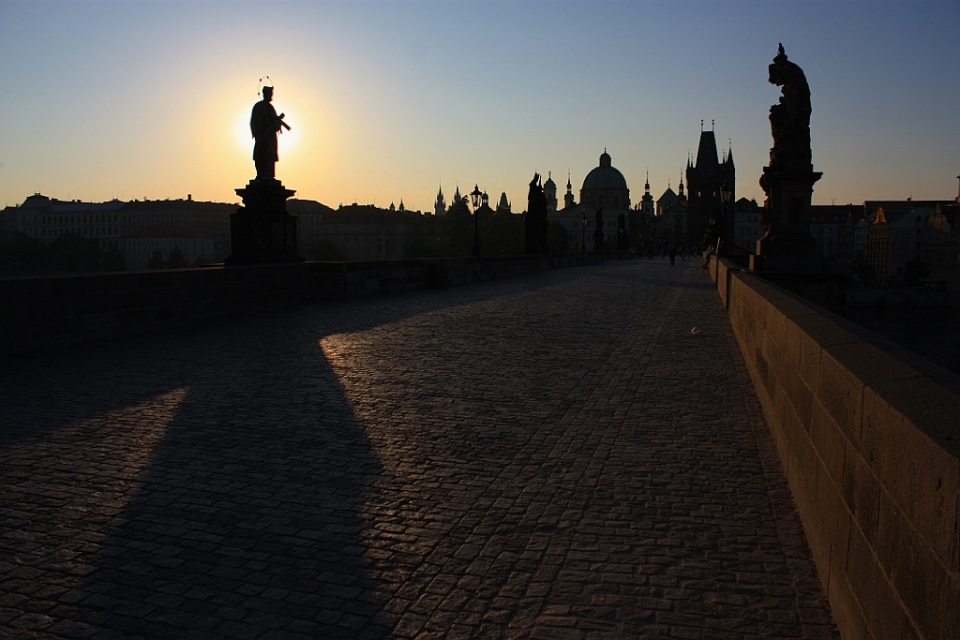
Karluv most, Charles Bridge, dawn, Prague, Czech Republic, UNESCO World Heritage Site, fotoeins.com

The shape of things to see and spot

Come here early enough, and it’s just a few early risers, dedicated runners, and well, me. There’s plenty of space to move around and change the angle of how I’m seeing things. Sure enough, there’s a bright circular halo surrounding the famous St. John of Nepomuk statue. With the rising sun in the background, the back-lit view has other bridge fixtures, some buildings, and the tall sharp dual spires of the Church of Our Lady Before Týn in silhouette. Image: 1/640s, f/8, ISO100, 18mm focal length (29mm full) with Canon EF-S 18-55mm f/3.5-5.6 IS II lens.


Shape” is a noun whose meaning is synonymous with:

form, appearance, configuration, formation, structure; figure, build, physique, body; contours, lines, outline, silhouette, profile.

It is one of the many “pieces” of good photography, and when the separate pieces come together, there’s something beautiful to behold, even perhaps, thought-provoking and inspiring.

I’m not going to pretend my photographs are absolute “championship” quality, but I know and understand my photographs are often worth a good long look. Here is a small selection of shapes I’ve seen from around the world with my trusty Canon EOS450D (XSi) camera (which has since given way to the 6D).

(Click here for more)

Nassau, The Bahamas, Caribbean Sea, North Atlantic Ocean, North America, fotoeins.com

Nassau, Bahamas: sea-to-sky blues at Junkanoo

The sand is snow white and soft to the touch. The skies are deep blue, and soothing on the eyes. The water is welcoming: its colours shimmer between aquamarine and turquoise, the waves lapping gently against the smooth shoreline.

That’s just my imagination – it’s all in my mind, right?

It should be so easy on the senses, but it seems too much to believe in the convergence at the same time. It seems unreal, best left to dreams from within the confines of a landlocked town.

But I slowly wake, and I open my eyes.

Disorientation gives way slowly to observation.

I feel the warm breeze against my skin, the soft sand between my toes. I breathe deeply to smell the salt in the sea air. I hear small ocean waves roll and dissipate on the beach. I can’t get enough of blues and greens.

I’m committing this to memory.

It’s time. Please hand over that rum for a sip, time for another snooze in this hammock. Perhaps there’ll be time for a short dip in the sea, before I go looking for some conch salad …

( Click here for images and more )

Fotoeins’ 13 Instants from 2013

It’s been an interesting year, as “interesting” came complete with their own highs and lows, across a variety of nations on three continents. Friends would say that’s simply par for the course to describe any length of time on travel. I ended my year-long around-the-world (RTW) trip in January, sought a new path in Sydney, Australia between March and June, and returned to Vancouver, Canada with a short stop in Europe for a writing course at the end of July. The following 13 moments in 2013 arrive courtesy from Berlin, Germany; Sydney, Australia; Vancouver, Canada; and Wellington, New Zealand.

( Click here for more )

Alter Synagogenplatz, Altstadt, Heidelberg, Baden-Württemberg, Germany, fotoeins.com

My Heidelberg: Synagogue Square and Pogromnacht

It happens every time without fail.

My spirit breaks a little more every time I see a memorial, another example of the depths to which our species have plumbed.

Does feeling this way make me weak? Or am I resembling a human being after all?

I often hear a common chorus:

history is hard, history is boring, why should I care?

I can’t decide what’s worse: the rise of the far-right or blatant willful ignorance.


A Mob of Broken Glass

From the evening of 9 November to the following morning of 10 November 1938, Kristallnacht (“the night of broken glass”) was a “pogrom”, a coordinated series of violent attacks by Nazis against the Jewish people and their property in Germany, Austria, and Czechoslavakia’s Sudetenland. Pogromnacht (or Reichspogromnacht) is a truer description; the “prettier sounding” Kristallnacht hides the brutality of “the night of (broken) crystal” referring to broken shattered glass from windows to synagogues, homes, and stores owned by Jews. Aside from a few who intervened, most stood aside and watched people and property burn.

The word “pogrom” is a late 19th- to early 20th-century Russian word (“погром”), derived from the verb “gromit” (громи́ть) meaning “to destroy with violence.” While “pogrom” is used generally to describe mob violence by one ethnic or religious group on another, the term is used in this post to describe attacks on the Jewish community.

The numbers across the country were appalling: at least 90 dead, hundreds injured, 30000 arrested and detained in concentration camps, up to 2000 synagogues burned, over 7000 Jewish businesses damaged or destroyed. With one more insult, the Jewish community was forced to pay for damage to their own property. The outbreak of coordinated actions against Jewish people marked the beginning of state-sanctioned violence. With the Pogromnacht, the state no longer hid their hate and escalated their savagery as a turning point directly leading to the Holocaust.

( Click here for more )

Melbourne, Australia, myRTW, fotoeins.com

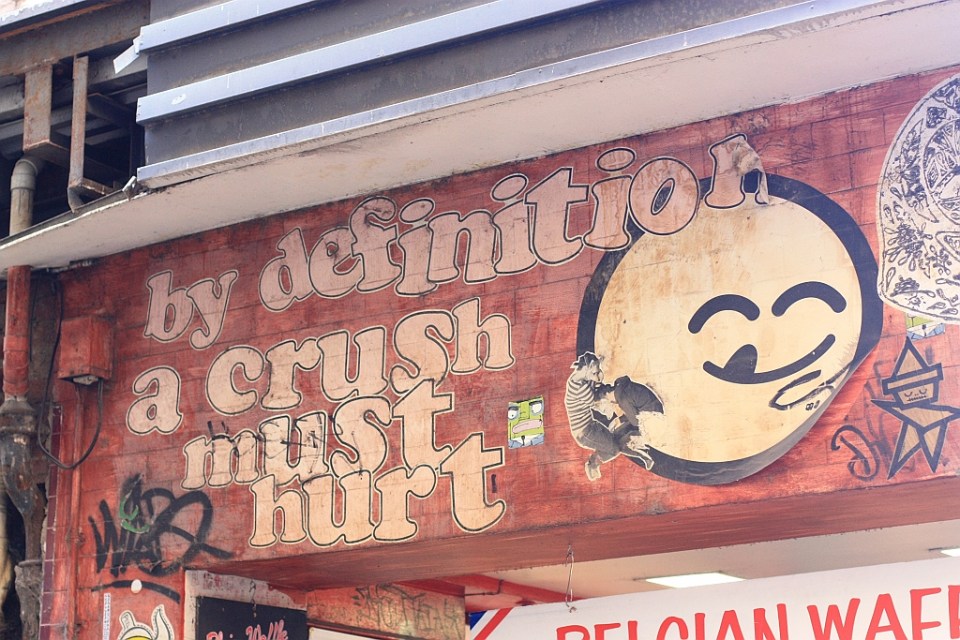
Navigating Melbourne’s lanes for street art

In an earlier post, I’ve shown some work on display as street art in Adelaide in South Australia.

Over a period of four days in Melbourne, I wandered through lanes and streets to look for some representative street art in the Victorian state capital, some works which spoke of the people who live there. Would it be the same kind of art and/or messages I’d seen earlier in Adelaide? As always, the set of artists and their respective work hold unique value in each of the cities.


( Click here for images and more )