Fotoeins Fotografie

location bifurcation, place vs. home

Posts from the ‘Photography’ category

Vienna Heiligenstadt: Beethoven’s despair, deafness, & 6th Symphony

Above/featured: Memorial statue in Vienna’s Heiligenstadt Park; more details below.

Composer Ludwig van Beethoven spent a total of 35 years in Vienna, from 1792 with his arrival from Bonn until his death in 1827. Every summer, he would leave Vienna to stay in a country- or farm-house in Heiligenstadt which at the time was rural; a stagecoach trip from the inner city required several hours. Today, urban development and expansion have reached and overtaken the once verdant fields right up to the flanks of the city’s northern heights.

By 1802, Beethoven’s hearing loss was almost complete. With his doctor’s recommendation, Beethoven had hoped time away from the noisy city would help recover some of his healing, but after the summer had passed, his initial fears had come true: his hearing would not return. In desperation, Beethoven wrote to his brother a letter, known as the “Heiligenstadt Testament“. He never sent the letter to his brother; the letter would only be discovered 25 years later with Beethoven’s personal effects, shortly after his death in 1827.

I’m tracing out some of Beethoven’s footsteps in Heiligenstadt wrapped inside the present-day city’s 19th district of Döbling. All locations can be visited comfortably on foot in a single day. The following description is part of a larger overview of my search for Beethoven in the Austrian capital city.


( Click here for images and more )

Vienna’s Art Nouveau highlights

Above/featured: A captive audience surrounds the Gustav Klimt painting “The Kiss” in Vienna’s Upper Belvedere. Photo, 19 May 2018 (X70).

If you’re paying attention, traces of the turn-of-the-century Viennese Art Nouveau (Wiener Jugendstil) art and design movement are visible throughout the Austrian capital city.

A painting.
A sculpture.
A building.
A clock.
A church.
A building mural.
A staircase, with railings and light fixtures.
The front facade of an apartment block.
The entrance pavilion to the municipal railway.
A decorative structure marking the exit/end of a river’s diverted route underneath the city.

I provide ten visual examples below, all of which are accessible with public transport.


( Click here for images and more )

Vienna: Holocaust Wall of Names Memorial

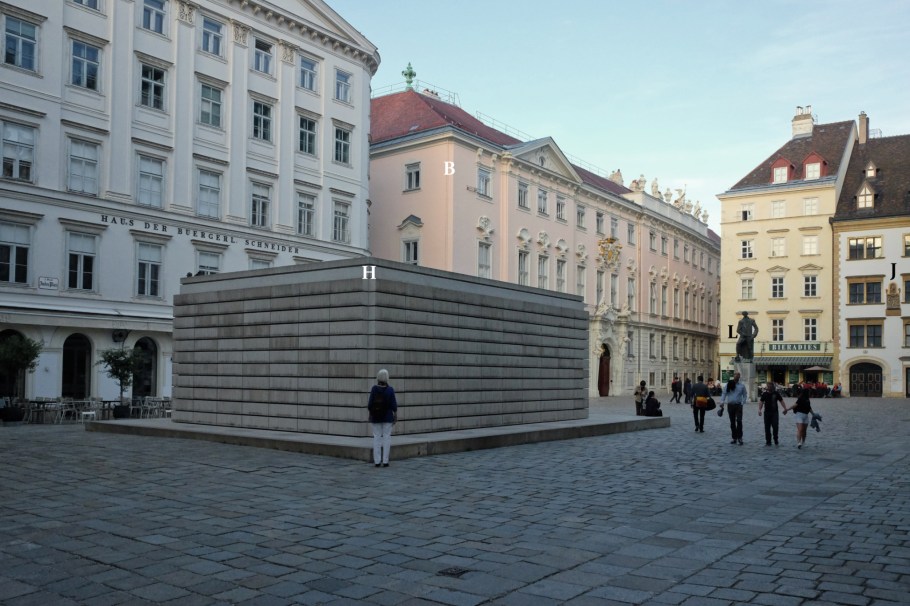
Above/featured: Shoah Namensmauern Gedenkstätte memorial site.

I drag my fingers gently down each stone block, across the fine indentations and the print of countless names.

I give quiet voice to each name I see.

In Vienna’s 9th district is a small green space, Ostarrichi Park, in front of the Österreichische Nationalbank (Austrian National Bank). The park is home to the Shoah Namensmauern Gedenkstätte (Holocaust Wall of Names Memorial), dedicated to over 64-thousand Austrian Jews murdered during the Nazi regime. Public inauguration of the memorial occurred on 9 November 2021 on the 83rd anniversary of the Pogromnacht.

The establishment and realization of the memorial has been a lifelong project for Vienna-born Holocaust survivor Kurt Yakov Tutter, who with his family fled to Belgium in 1930. Kurt and his younger sister, Rita, survived with the help of a Belgian family; their parents were deported and murdered in Auschwitz.

He made a new home in Toronto, Canada, where in 2000 he began working to create a memorial to murdered Austrian Jews. Funding from the national Austria state emphasized the enormous significance of the historical memorial; responsibility for continuing maintenance of the memorial is now shared by the Austria National Fund and the City of Vienna.

The names of over 64-thousand children, women, and men are engraved onto 160 giant granite slabs, arranged in the park space as an oval ring. Within the open and uncovered space, visitors to the memorial can walk briskly past each vertical block, but the air is thick with names.

•   Jewish Welcome Service
•   Austria National Fund for Victims of National Socialism
•   Austrian Holocaust Victims database, DÖW (Documentation Centre of Austrian Resistance)
•   Audio: Mr. Tutter speaks about Austria’s very late road to dealing with the past (Vergangenheitsbewältigung) and why he created the Wall of Names project.


( Click here for images and more )

Vienna: Aspang Station Deportation Memorial

“Well into the 1970s, the area around present-day Leon Zelman Park was the site of the Aspang Railway Station, which was built in 1880–1881 as a terminal for the regional Vienna-Aspang-Pitten rail line. Despite its relatively central location in the city’s 3rd district, the station served only regional rail traffic and was not very busy. These were likely reasons why after the “Anschluss” the Nazis chose this station for deportation transports.

Two transport trains departed in October 1939 with 1584 Jewish men deported to Nisko in the Lublin District of the General Governorate of occupied Poland as a failed attempt to create the Lublin reservation for expelled European Jews. Much larger deportations resumed from February 1941 to October 1942. 45451 Austrian-Jewish men and women were deported on a total of 45 transport trains to ghettos and extermination sites in (what are now) Czechia, Poland, Belarus, Lithuania, and Latvia.

In Vienna, the cynically-named Nazi ‘Zentralstelle für jüdische Auswanderung’ (Central Agency for Jewish Emigration) organized deportation efforts including forced captivity and assembly or collection points. Four internment stations were established in the city’s 2nd district where prisoners were abused and stripped of their possessions. For every transport, about one thousand people were driven to Aspang Station in uncovered trucks, in plain and open sight of the city’s population.

Of the 47035 Jewish men and women deported from Aspang Railway Station, only 1073 (2%) survived, according to the research by Austrian historian Jonny Moser, himself a survivor of the Holocaust/Shoah. In total, more than 65-thousand Austrian Jews fell victim; most of them began their road to their deaths at Aspang Station.”

•   Paraphrased from Kunst im öffentlichen Raum Wien (Art in public spaces Vienna).

After the war and Allied-occupation period, little was done to improve the station and its tracks. The station was closed in 1971 and the station building was demolished by 1977. The turn of the millennium provided momentum to both city and the national rail company for redevelopment of the area, including apartment blocks, green space, and a memorial. Today, the former railway station is Leon Zelman Park, named after Dr. Leon Zelman who established in 1980 the Jewish Welcome Service Vienna and led the organization until his passing in 2007. The inauguration of the deportation memorial occurred on 7 September 2017 with full opening to the public on the following day.


( Click here for images and more )

Kleinwasserkraftwerk Wehr 1, Neue Donau, 22. Bezirk, Donaustadt, Wien, Vienna, Austria, Österreich, fotoeins.com

22 for 22: Foto(ein)s for 2022

Above/featured: Vienna skyline from Kleinwasserkraftwerk Wehr I in early morning light. Photo, 7 Jun 2022.

For 2022, the act of looking forward and backward is dominated by a 4-week stay in the city of Vienna. In between the collected images is a reclaimed longing for the Austrian capital to which I was first introduced 20 years ago, but for which there was no camera and, sadly, no recorded pixels.

I’ve already described a set of images setting the urban scenes in Vienna from 2022. Below is an additional set of 22 images selected from a period of 35 days; the time interval represents only 10% of the year, but it appears to be a personally important “watershed moment” as well.


( Click here for images and more )