
Fotoeins Fotografie

location bifurcation, place vs. home

Posts from the ‘Expression’ category

Photography as personal expression

My Berlin: Schöneberg

Above/featured: Entrance to U-Bahnhof Rathaus Schöneberg.

It seems as universal as the common opinion about how cool and interesting Berlin is.

Both residents and visitors mention the same names in conversations throughout the city: Prenzlauer Berg, Mitte, Friedrichshain, Kreuzberg, Neukölln, and the hybrid “KreuzKölln”, even as Wedding and Lichtenberg begin weaving their way into the dialogue.

Of the neighbourhoods within the city’s Ring, what about Charlottenburg or Schöneberg? The answers often arrive as expected. Why would anyone visit there or live there? It’s boring! It’s too quiet! It’s dead! Lots of sniffy snobby dismissive exclamation points! That few choose the area is precisely why I’m in Schöneberg for three months at the tail end of my year-long around-the-world.

For many in Berlin, they’re living, working, and playing in areas where they’re close to the action and housing costs may on average be slightly cheaper. There’s something to be said about proximity and small “stumbling distances” after a night of drinking. For some, Schöneberg is too far, too expensive, too quiet, or all of the above. I don’t mind the 20-, 30-, or 45-minute travel times to places where friends eat, drink, or hang out.

It’s always a matter of choice for me to be in Schöneberg. There’s a comfortable stillness here that always sets me at ease, where I can tune out or turn down the noise, and find my calm. For a very special time, this area in Berlin, “der schöne Schöneberg,” is home.

( Click here for images and more )

Photo by geralt, on pixabay CC0

Photographers for International Women’s Day

On this International Women’s Day (8 March), I remind myself how photography is made and viewed differently from either the male or female perspective.

Please check out these photographers whose work I greatly admire. Much of the following is personal, brave, unflinching, and provocative.

I prefer (and highly recommend) looking at photography as prints, in galleries, or in photo-books. Having photos take on physical form provides a kind of tactile permanence which seems “more real” to me than a mouse-click or a screen swipe that are far too ephemeral for my liking. Have a look online; then, seek work by one or all of these women at an art gallery and/or a bookstore.

Im Camera Head Man - Ares Nguyen, Flickr CC2

The featured photo is by geralt (Pixabay) with the CC0 license. The last photo is by Ares Nguyen (Flickr) with the CC2 license. This post appears on Fotoeins Fotografie at fotoeins.com as http://wp.me/p1BIdT-6AG (edited 2016,2017,2018.)
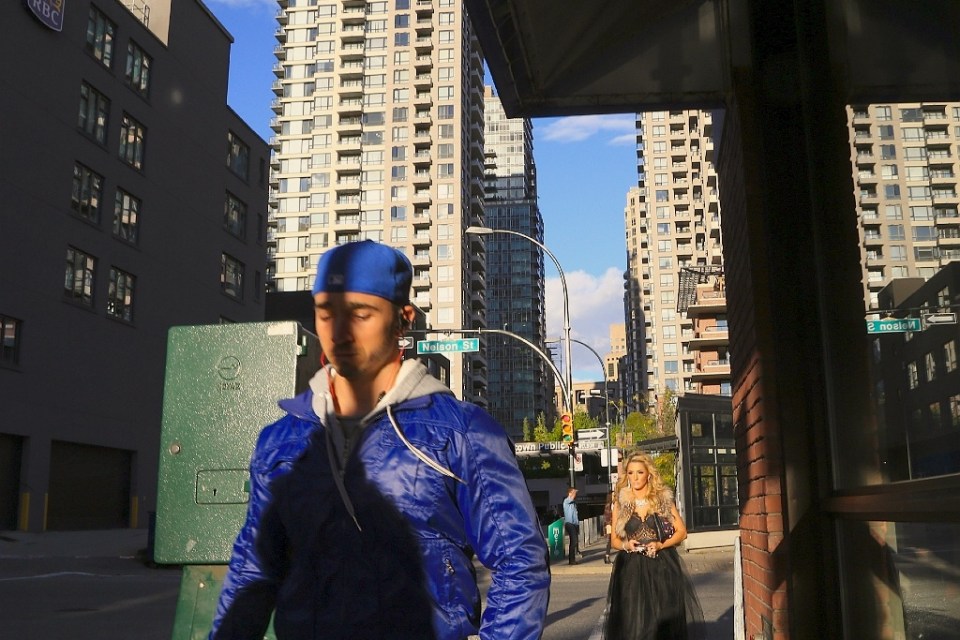
Yaletown, Vancouver, BC, Canada, 26 Oct 2014, fotoeins.com

What about now? How about now?

I think I’ve struck a nugget of gold.

I also believe the chances of finding it again might well be slim to none …

Jean François Paul de Gondi, Cardinal de Retz, wrote in the 17th-century:

Il n’y a rien dans ce monde qui n’ait un moment decisif. (There is nothing in this world that does not have a decisive moment.)

Photographer Henri Cartier-Bresson used this quote for the preface of his 1952 book “Images à la sauvette” (The Decisive Moment). That phrase has been described in great detail and (mis)interpreted over the years, undoubtedly adding only to the legend and his place in the history of photography. With his landmark photograph “Derrière la gare Saint-Lazare” (Paris 1932), Cartier-Bresson described moments like these as:

To me, photography is the simultaneous recognition, in a fraction of a second, of the significance of an event as well as of a precise organization of forms which give that event its proper expression. (Photographier: c’est dans un même instant et en une fraction de seconde reconnaître un fait et l’organisation rigoureuse de formes perçues visuellement qui expriment et signifient ce fait.)

What does any of this have to do with the photo above? Everything.

( Click here for more )

Fotoeins Fotograms 14 o' 2014 cover

Fotoeins’ Fotograms: 14 for 14, in 2014 (IG)

At the end of 2013, I listed my 13 instants for the year. I continue to be fascinated by how we look at the world in square format in contrast with 4-by-3 or 3-by-2 formats. It’s not exactly the throwback to a distant past with square photographic plates, but the same physical and photographic principles regarding central symmetry apply. Here are 14 ‘fotograms’ from 2014, including a new 6D, watching my father die, and a return ‘home’ to Deutschland.

( Click here for more )

My 3 Thermo Laws to Making Photographs

There are some certainties to making a photograph:

  • seeing or viewing the scene,
  • framing the scene in the camera,
  • clicking the shutter button to expose and capture the scene, and
  • admiring the image of the scene.

But make enough photographs, and three realities make themselves known. These arrive gradually, surprising you with their frequency and constancy. But you’ll eventually recognize the universal truths behind what it really means to make a photograph.

And this is where physics is a useful analogy, without the math.

Hot and Cold

When I was at university, one mandatory course was thermodynamics, the study of relationships between heat (thermal energy) and other forms of energy including mechanical, electrical, or chemical. It’s a way of understanding how heat transfer is described, and the various ways energy can be transformed or exchanged within a physical system.

What does this have anything to do with you? Thermodynamics is a driving factor behind weather in the atmosphere, water currents in the oceans, how refrigerators, heat exchangers, water kettles work, among other applications. Thermodynamics plays a role in our everyday lives.

In words, the Three Laws of Thermodynamics are:

  1. “Energy can be changed from one form to another, but energy cannot be created or destroyed. The total amount of energy and matter in the Universe remains constant.”
  2. “Entropy, a measure of a system’s energy that is unavailable for work, or of the degree of a system’s disorder, in the universe always increases. Heat does not by itself pass from a cooler to a hotter body.”
  3. “It is not possible to reach a temperature of absolute zero.”

The poet Allen Ginsberg created theorems, restating and applying the three laws of thermodynamics to “the game of life”:

  1. You can’t win.
  2. You can’t break even.
  3. You can’t get out of the game.

Bondi Beach, Sydney, Australia, fotoeins.com

My Three Laws to Making Photographs

I attempted to photograph large waves pounding the rocks at Sydney’s North Bondi. As I hunted for the “perfect crash,” I began to think a lot about thermodynamics. In a crazy wave of thought, I got down to my “Three Laws to Making Photographs”:

  1. If you want that shot, someone already made it to worldwide acclaim.
  2. That ideal shot is a fraction of a second too early or too late.
  3. You can’t resist the urge to try and try again.

It’s good to know I’ve put some of that physics training to good use, and I’ve been responsible in raising the “total entropy of the photographic universe” by a small amount, after amassing 75000 exposures with a single camera.

Now, if you’ll excuse me, it’s time I headed out to continue my futile search and photograph that elusive moment of pure clarity …

I made the photo above from Bondi Icebergs at South Bondi in Sydney, Australia on 3 June 2013. This post appears on Fotoeins Fotografie at fotoeins.com as https://wp.me/p1BIdT-3qx.


Minding the Physics

Nobel Prize winner Richard Feynman provides a beautiful treatment of thermodynamics in his renowned 1963 Physics Lectures, complete with the math.