Fotoeins Fotografie

location bifurcation, place vs. home

Posts from the ‘Canada’ category

Devonian Harbour Park, Vancouver, BC, Canada, fotoeins.com

Public art in Vancouver

Above/featured: Left: “Search”, by J. Seward Johnson Jr. (1975). Right: “Solo”, by Natalie McHaffie (1986). Devonian Harbour Park, 14 Jul 2021 (X70).

Based on what we see in person and online, the quickest version of street art may be defined by the variety of art appearing on side walls of buildings, big and small. Most will think about paint, graffiti, and murals, all of them in the here and now. But we shouldn’t forget any art that’s out on the streets and publicly accessible.

Below are a handful of examples of public art in the city of Vancouver; the following is a visual expression of my fondness for sculpture whose origins sweep back to the 1st-half of the 20th-century.

  • “A Tale of Two Children” by Ken Lum (2005)
  • “Golden Tree” by Douglas Coupland (2016); “Salish Gifts” by Susan Point (2015)
  • Lions by Charles Marega (1939)
  • “Reconciliation Pole” by 7idansuu / Edenshaw, James Hart (2017)
  • “Salmon” by Susan Point (1995)
  • “Saltwater City”, by Paul Wong (2020)
  • “Welcome Figure”, by Darren Yelton (2006)

( Click here for more images)

Strathcona, East Vancouver, Vancouver, BC, Canada, fotoeins.com

Ordinary rejects

Above/featured: Night glow on a black tub-chair at a bus stop – 7 Oct 2021.

The intersection between modernity and ordinary is extraordinary in its vast reach, covering all corners of the planet by land, sea, and air. Consider what we have in our homes, and how much or little of it will get recycled. We might pause to consider how a piece of furniture lives or is used by a family; how they must have once been excited to buy chairs, couches, and beds, only to throw them out when they were deemed surplus to requirements, how much is tossed out in a regular or periodic “clean out” and/or in the process of moving out from a residence.

Below are images of abandoned items, whose likely destination is the dump.

( Click here for more images)

My Fuji X70: Ektachrome 100SW (XTrans2 recipe)

Above/featured:False Creek east, from Cambie Bridge – 12 Jul 2021.

A variety of film simulations in the form of recipes with different settings are applicable to Fujifilm cameras to create uniquely historical and/or vintage look to images. Fortunately, a number of recipes are available to apply onto Fuji cameras with X-Trans II sensors.

That’s where my Fuji X70 has entered the fun fray. Previously, I showed examples of images made with the Kodachrome 64 recipe, simulating images made with the Kodak analog colour film produced from the mid-1970s to its final run in 2009.

I wanted to try another film-simulation recipe: the Ektachrome 100SW (SW for ‘saturated warm’) described by Ritchie Roesch in Fuji X Weekly. Historically, the Kodak company produced the ‘Ektachrome’ line of colour transparency or slide films. From its introduction in 1996 to its termination in 2002, the ‘Ektachrome 100SW’ film with increased ISO sensitivity produced images with deeper colours and warmer colour balance.

At locations throughout metropolitan Vancouver over a period of four weeks in July and August 2021, here are images below straight-out-of-the-camera (SOOC) with the following settings:

  • ‘Velvia’ built-in film-sim
  • Dynamic Range: DR200
  • Highlight: +2 (High)
  • Shadow: +1 (Medium-High)
  • Color: -1 (Medium-Low)
  • Sharpness: 0 (Medium)
  • Noise Reduction: -2 (Low)
  • White Balance: Auto; +1 Red, -2 Blue
  • ISO: Auto up to 3200 (or fixed to 1000)

All recipes sorted by specific sensor are found here.


( Click here for images )

My Fuji X70: Kodachrome64 (XTrans2 recipe)

Above/featured: South portal, Lions Gate Bridge – 25 Jun 2021.

I wrote about how the Fujifilm X70 fixed-lens prime has been great for my photography. Fujifim prides itself on good to faithful reproductions of film simulations (film-sims). For the most part, I’ve used the default or “Standard” setting, equivalent to the “Provia” film-sim which is one of 11 film-sims built into the X70.

I learned about other film-sims, particularly those applicable to the older X-Trans II sensor that’s in my X70 camera. I’ve been interested in digital reproductions of “old” colour slide film, and seeing how images over a variety of subject matter appear with a film-sim that looks a little more like “old school film”. Ritchie Roesch describes in Fuji X Weekly the differences between the Kodachrome II and Kodachrome 64 film-sims; the former resembling the look of Kodak film from the 1960s to the mid-1970s and the latter echoing the final version of the film-type from the mid-1970s to 2009. Roesch provides additional historical context to the development of Kodachrome film here.

Here I’ve used the Kodachrome 64 film-sim recipe with the following settings:

  • ‘Classic Chrome’ built-in film-sim
  • Dynamic Range: DR400
  • Highlight: +2 (High)
  • Shadow: +1 (Medium-High)
  • Color: 0 (Medium)
  • Sharpness: 0 (Medium)
  • Noise Reduction: -2 (Low)
  • White Balance: Daylight; 0 Red, -3 Blue
  • ISO: Auto up to 3200 (or fixed to 1000)

All recipes sorted by specific sensor are found here.


( Click here for images )

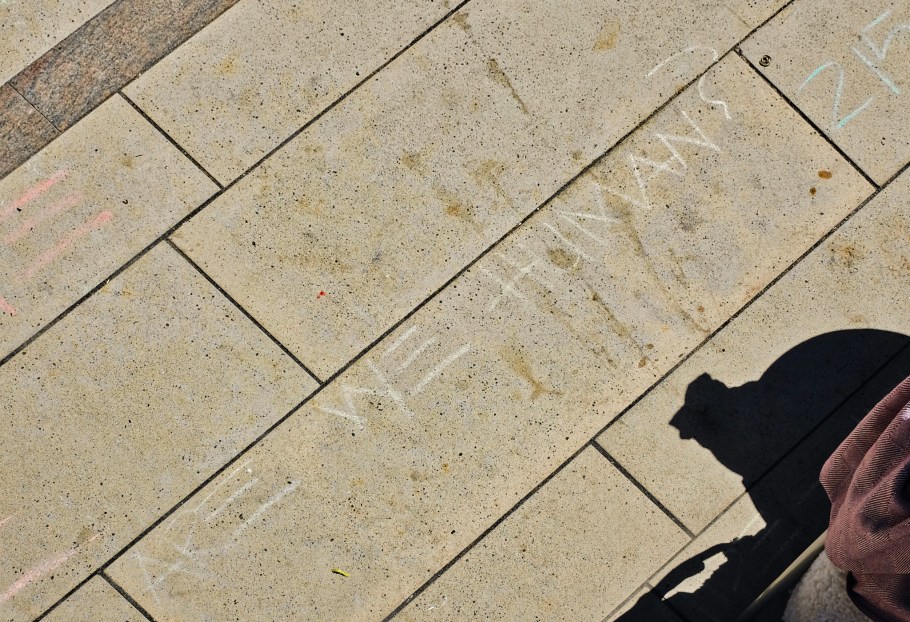
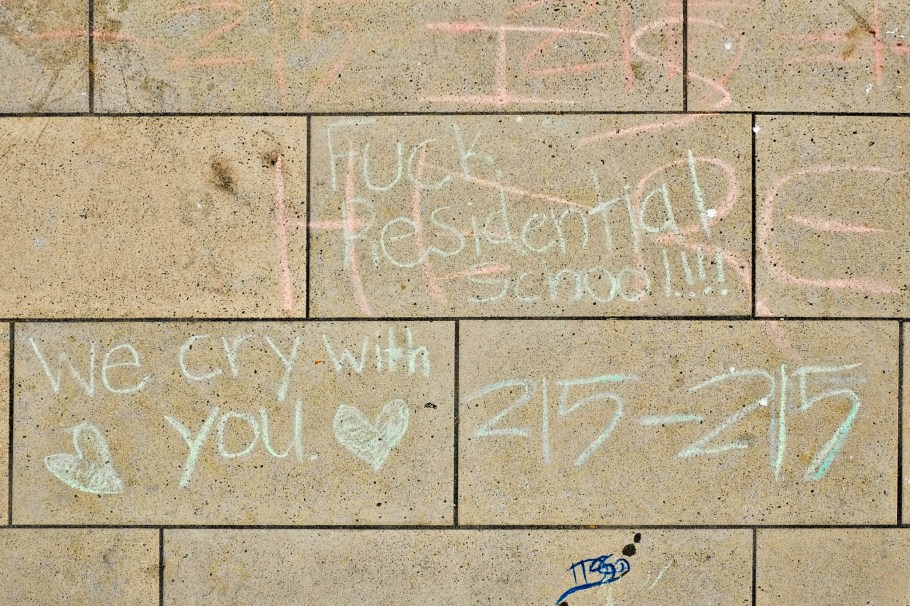
Memorial for the Kamloops Residential School, Robson Square, Vancouver, BC, Canada, fotoeins.com

Vancouver: Memorial for the Kamloops Residential School

In late-May 2021, the Tk’emlúps te Secwépemc First Nation announced the discovery of 215 children buried in a mass grave at a former residential school near Kamloops, British Columbia; ground-penetrating radar was used to locate the remains.

During a period of 160 years, the Government of Canada in concert with churches constructed residential schools in a state-sponsored process of “aggressive assimilation” to make children of Indigenous people “less aboriginal and more white” with instruction in English and Christianity in order to erase the children’s traditions and cultural ties.

More than 150-thousand children were sent to some 130 residential schools across Canada between 1830s and the 1990s. Forcibly removed from their homes and parents, children of Indigenous peoples were forced into the schools where they faced neglect and physical and sexual abuse. Physical records indicate a total of over 4000 children deaths; the actual number is very likely much higher. Many children were not buried properly, parents were not notified about what happened to their children: many children who were forced into residential schools never returned home. For years, survivors have told their stories about what happened inside those schools: there is every expectation more mass graves and more children will be found.

The systematic removal of indigenous children from their families disrupted, divided, and destroyed living generations of indigenous families, robbing people of their respective culture and language and the wealth of lived experiences shared between generations. According to the terms and definitions laid out in the 1948 United Nations’ Convention, Canada committed genocide against their Indigenous Peoples. The destructive effects of white colonialism upon Indigenous Peoples in the country is not only historical but continues today with inequity, intransigence, obstruction and obfuscation, and injustice.

A makeshift memorial was quickly created at the steps of the Vancouver Art Gallery at Robson Square. It’s worth noting the Art Gallery is presently housed in the former provincial court house which opened in 1911 and would have served as a “legal” instrument of white- and settler-colonialism. That this National Historic Site is the location of an improvised tribute to the loss of life and dignity caused by state-sponsored acts of genocide is an enormous juxtaposition.

June is National Indigenous History Month in Canada.
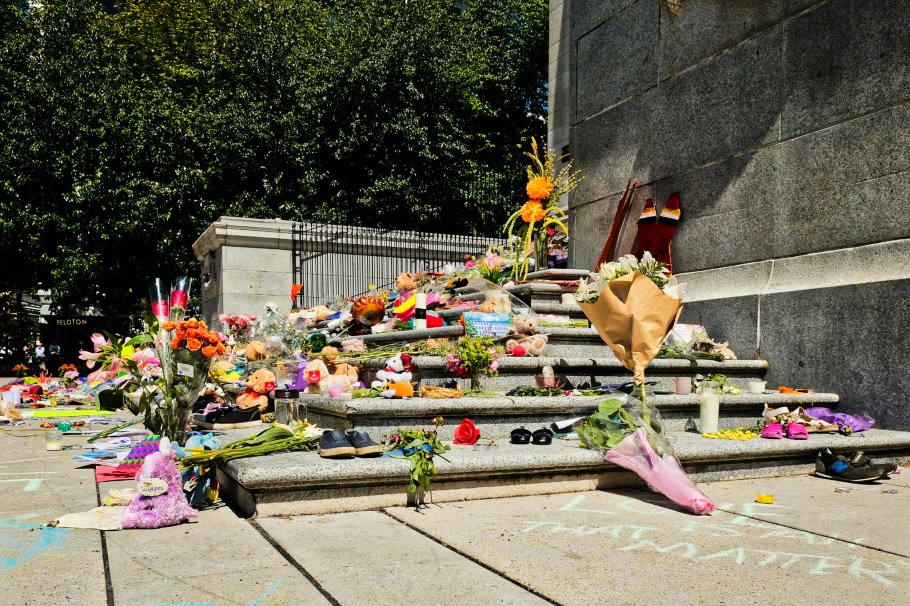

Memorial for the Kamloops Residential School, Robson Square, Vancouver, BC, Canada, fotoeins.com Memorial for the Kamloops Residential School, Robson Square, Vancouver, BC, Canada, fotoeins.com
Memorial for the Kamloops Residential School, Robson Square, Vancouver, BC, Canada, fotoeins.com

“Are we human?”

Memorial for the Kamloops Residential School, Robson Square, Vancouver, BC, Canada, fotoeins.com

“Bring our children home.”

Memorial for the Kamloops Residential School, Robson Square, Vancouver, BC, Canada, fotoeins.com

As a resident of Vancouver, I’m a guest on unceded traditional territory and land of the Coast Salish First Nations: Sḵwx̱wú7mesh (Squamish), Stó:lō and Səl̓ílwətaʔ/Selilwitulh (Tsleil-Waututh), and xʷməθkʷəy̓əm (Musqueam). I made all images above on 1 June 2021 with a Fujifilm X70 fixed-lens prime. This post appears on Fotoeins Fotografie at fotoeins DOT com as https://wp.me/p1BIdT-l2C.