Fotoeins Fotografie

location bifurcation, place vs. home

Posts from the ‘Europe’ category

Salzburg city views from Mönchsberg

In Salzburg, I’m motivated by a search for Mozart and for signs of modernity. I’ve already examined part of the city through its art: what more can Salzburg offer?

Excellent views of the city and surroundings.

The Mönchberg hill on which the Hohensalzburg fortress sits provides many viewpoints over the city. You can walk along the entire length of Mönchberg for varying perspectives, or you can approach a number of the viewpoints separately.

I ascended and traversed the hill on foot from southeast to northeast, beginning from Kapitelplatz to the viewpoints just north of the Museum der Moderne. I returned to the Old Town below with the MönchsbergAufzug elevator which is a part of Salzburg’s public transport.


( Click here for images and more )

Palacio de Cibeles, Fuente de Cibeles, Plaza de Cibeles, Paseo del Prado, Madrid, Spain, España, fotoeins.com

Madrid: Paseo del Prado, new UNESCO WHS

Congratulations to Madrid and Spain!

In the Spanish capital city, the Paseo del Prado and the adjacent Parque del Retiro were inscribed together as a new UNESCO World Heritage Site on 25 July 2021. The Paseo del Prado is a wide tree-lined boulevard populated with big fountains, beautiful architecture, and buildings dedicated to scientific research and to collections of world-class art. As prototype to the Hispanic “alameda” found throughout Latin America towns and cities, Paseo del Prado is an display of vision and desire for an idyllic society within the (former) Spanish Empire.


Palacio de Cibeles, Fuente de Cibeles, Plaza de Cibeles, Paseo del Prado, Madrid, Spain, España, fotoeins.com

Plaza de Cibeles: Palacio de Cibeles (palace 1919); Fuente de Cibeles (fountain 1780, moved 1895).

Banco de España, Plaza de Cibeles, Paseo del Prado, Madrid, Spain, España, fotoeins.com

Plaza de Cibeles: Banco de España (1891).

Palacio de Linares, Casa América, Plaza de Cibeles, Paseo del Prado, Madrid, Spain, España, fotoeins.com

Plaza de Cibeles: Palacio de Linares (1877), host to Casa América.

Museo Nacional del Prado, Diego de Velázquez, Aniceto Marinas, Paseo del Prado, Madrid, Spain, España, fotoeins.com

Diego de Velázquez statue (1899) by sculptor Aniceto Marinas, in front of the Prado Museum (1819).


I made all images above on 9 May 2009 with a Canon EOS450D (Rebel XSi). This post appears on Fotoeins Fotografie at fotoeins DOT com as https://wp.me/p1BIdT-lhx.
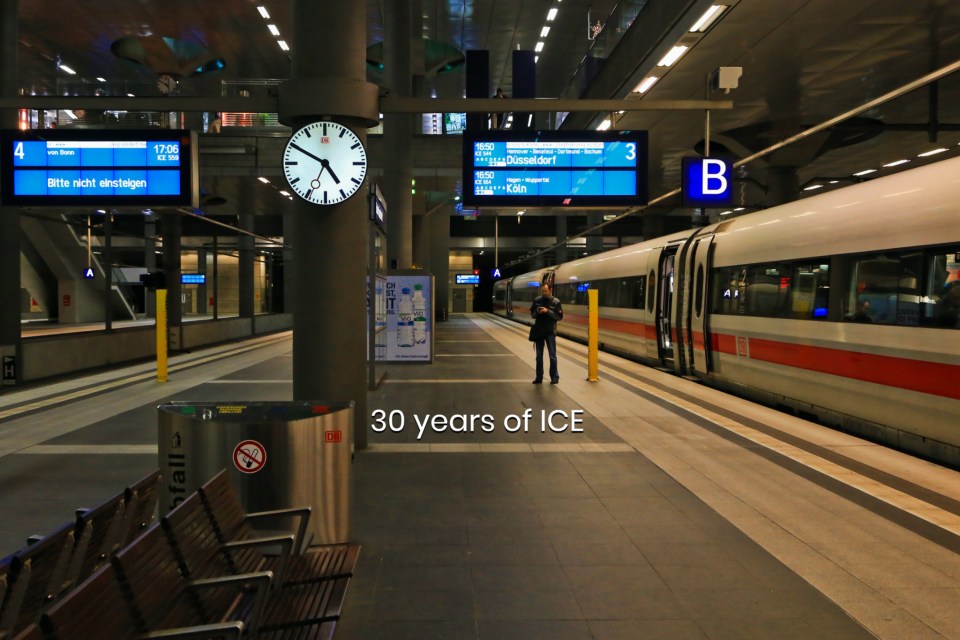
Berlin Hauptbahnhof, B Hbf, Berlin, Germany, Deutschland, fotoeins.com

Germany: 30 years of ICE on the rails (2021)

Above/featured: Berlin Hauptbahnhof – 9 Dec 2015 (6D1). Departing from track 3 is ICE 554 to Köln (front-half) and ICE 544 to Düsseldorf (back-half); trains split in the town of Hamm.

June 2021 marks the 30th anniversary of high-speed Intercity Express (ICE) service on German rail.

In the 1991 vs. 2021 comparison graphic provided by Deutsche Bahn, I’ve marked in green the ICE routes upon which I’ve made dozens of trips since late-2001 (when I moved to Heidelberg). Even after leaving in 2003, frequent annual trips back to Germany meant spending a lot of time planted on express trains across the country. Arriving in Europe mostly meant flying into Frankfurt am Main airport, from which I’d travel:

  • Frankfurt to Berlin, via Kassel
  • Frankfurt to Heidelberg, via Mannheim
  • Frankfurt to Köln
  • Frankfurt to Munich, via Stuttgart
  • Berlin to Frankfurt, via Kassel
  • Berlin to Köln, via Hannover
  • Köln to Berlin, via Hannover
  • Köln to Frankfurt
  • Munich to Frankfurt, via Stuttgart

Over the last few years, the express stretch between Erfurt and Halle/Leipzig has vastly improved the Berlin-Frankfurt and Berlin-Munich routes, cutting the one-way travel time for each route by about one hour. Except for the Erfurt-Halle/Leipzig stretch, I’ve travelled on every “Stundentakt” ICE route (thick red/green in the graphic below).

Intercity Express, Deutsche Bahn, German Rail, Germany, Deutschland

ICE coverage, including recent work on the Erfurt-Halle/Leipzig stretch; graphic courtesy of Deutsche Bahn. My “dozens on ICE” are marked in green; red filled circles indicate cities I frequented the most (B, F, HD, K, M).

Intercity Express, train fleet, Deutsche Bahn, German Rail, Germany, Deutschland

The ICE fleet of trains include vehicles with maximum speeds of over 300 km/h; graphic courtesy of Deutsche Bahn.

Frankfurt am Main Hauptbahnhof, F Hbf, Frankfurt am Main, Hesse, Hessen, Germany, Deutschland, fotoeins.com

Morning ICE 5 service from Frankfurt am Main to Basel; how to read this train station signage – 20 May 2016 (6D1).

Hackerbrücke, München, Munich, Bavaria, Bayern, Germany, Deutschland.

Morning light at Munich’s Hackerbrücke station. Foreground: westbound metallic-white ICE train just departing the city’s central station, traveling right to left. Background: red DB regional train approaching central station, from left to right. Photo on 23 Feb 2017 (6D1).

I made three images above with a Canon EOS6D mark1 (6D1). This post appears on Fotoeins Fotografie at fotoeins DOT com as https://wp.me/p1BIdT-l60.

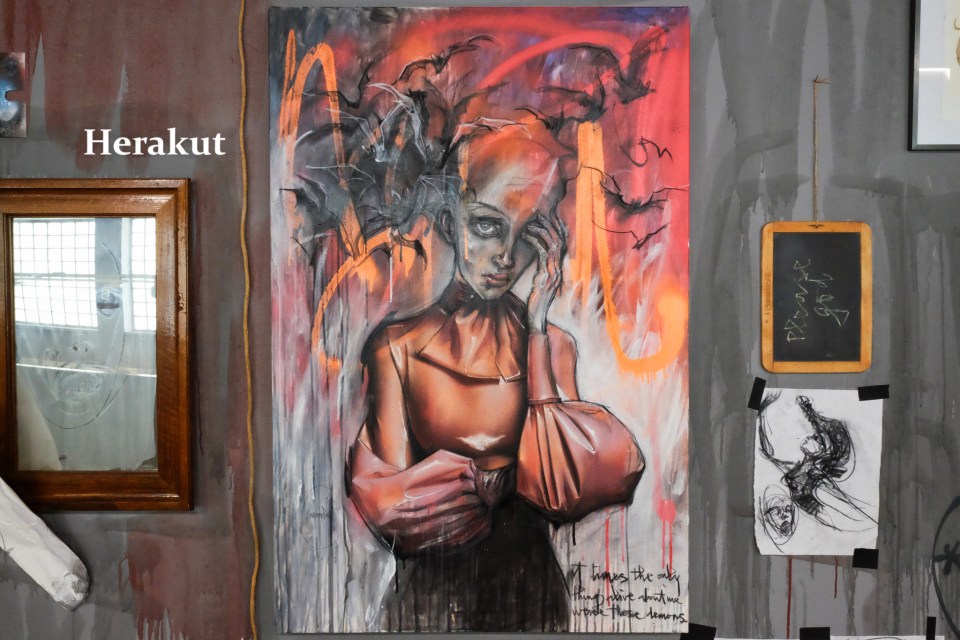
herakut, Museum of Urban and Contemporary Art, MUCA, Munich, Muenchen, Bayern, Bavaria, Germany, Deutschland, fotoeins.com

Herakut: big wall art around Germany

Above/featured: “At times the only thing alive about me were those demons.” MUCA Munich – 31 May 2018 (X70).

One of my favourite artists is Herakut, a German duo whose street murals have appeared in Europe and around the world since 2004. Hera (Jasmin Siddiqui) and Akut (Falk Lehmann) use walls and big spaces for their big art with a signature look that includes expressive faces and big eyes, lots of photo-like details, and sharp typography. Their work explores issues such as physical and emotional isolation, maternal relationships, gender and racial equality, and all the things we think and feel lurking inside. But I think their compositions also include long notes and pauses which allow and incorporate vivid fantasy and playful whimsy.

Examples shown below include Wittenberg 2016, Heidelberg 2017, Berlin 2017, Munich 2018, Berlin 2021, Frankfurt am Main 2024.

( Click here for more )

My Prague: Olšany cemetery, search for Kafka & Palach

Above/featured: A quiet leafy avenue in Prague’s Olšany Cemetery.

I can’t spend all this time in the Czech capital city, and leave without paying any respects to two 20th-century personalities of Prague. Franz Kafka was an early 20th-century German-Czech writer (e.g., 1912 Die Verwandlung/Metamorphosis), whose writings became known to the world posthumously, thanks to friend and fellow writer Max Brod. In the 1960s, Jan Palach was an important historical figure of opposition who died in protest against the Communist regime.

I’m in the underground metro, heading east from the city centre towards Vinohrady and beyond to Olšany. The sun’s out on a crisp mid-autumn day, and while deciduous trees are left wanting for leaves, the latter have piled like carpets of colour on the cemetery grounds. I’m looking for the graves of Palach and Kafka who are buried in Olšanské hřbitovy (Olšany Cemetery) and Nový židovský hřbitov (New Jewish Cemetery), respectively.


( Click here for images and more )