Fotoeins Fotografie

location bifurcation, place vs. home

Posts from the ‘Germany’ category

Friedriche Revolution, Peaceful Revolution, Leipzig, Saxony, Sachsen, Germany, Deutschland, fotoeins.com

Leipzig’s Stasi Corner: Die Runde Ecke

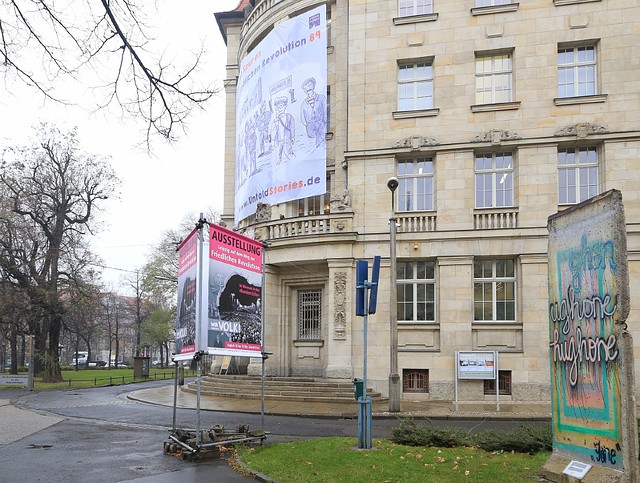
Above/featured: Leipzig’s 1989 Peaceful Revolution. Photo on 4 Dec 2014.

Before arriving at the Runde Ecke, I didn’t know I’d be visiting on the very day, 25 years to the day the building was occupied by peaceful protestors. Then again, the atrium seemed to contain lingering echoes and shouts from those very same protestors: “Wir sind das Volk! Krumme Ecke, Schreckenshaus, wann wird ein Museum daraus?” (We are the people! Crooked corner, horror house, when will this become a museum?)

Walking through the ground floor museum, there’s a stale dank smell, known as the “East German” smell. The secret cameras, the recording devices. This is where Stasi employees worked, where people were kept in Stasi prisons below. No expense was spared to monitor and collect the sights, sounds, and scents of the East German people: what they said; what, how, and where they went about their daily lives.

Blood, sweat and tears, for very different reasons.

In Leipzig, Germany, the building that’s known as the Round Corner sounds innocuous. For many, the “Runde Ecke” is synonymous with the secret police or Stasi, short for “Staatssicherheit,” representing East Germany’s Ministry of State Security.

In the early 20th-century, the building housed the headquarters to the Alten Leipziger Feuerversicherung fire-insurance company. The building was rumoured to have housed Nazi Gestapo during the Second World War, before American occupation forces moved in for a short time in 1945. The Soviet military moved in shortly thereafter, followed by the Soviet NKVD secret service and K5, predecessor to the Stasi. With the establishment of the East German State Security in 1950, the building housed the local district Stasi headquarters until 1989.

1989 is significant for the building’s historical importance to both Leipzig and Germany, and key to the story of that year’s “peaceful revolution”. The “day of decision” and non-violent demonstrations on 9 October 1989 led to the downfall of the local government. Weeks of Monday demonstrations made the building a focal point for anger and outrage. Much still needed addressing after the fall of the Wall on 9 November 1989. On 4 December 1989, protestors outside the Stasi headquarters demanded access to their files, eventually storming and taking over the building, and saving countless files from destruction.

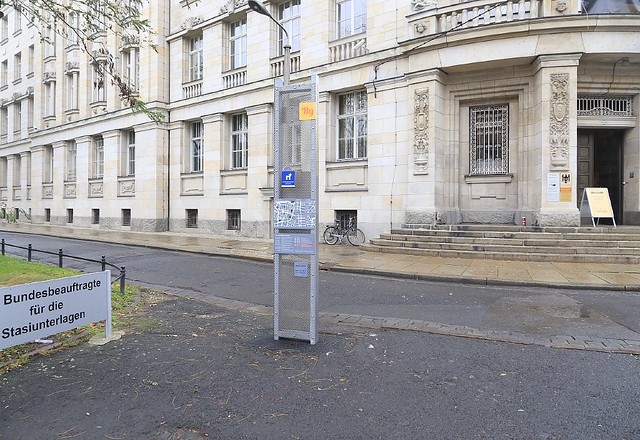
The Runde Ecke is now home to a museum to preserve knowledge about the activities of the Stasi, and is also home to a branch office of the Federal Commissioner for Stasi Files (BStU) to ensure files are properly archived and available for research, and to ensure files remain accessible for inspection to anyone who inquires.

Runde Ecke, Friedriche Revolution, Peaceful Revolution, Leipzig, Saxony, Sachsen, Germany, Deutschland, fotoeins.com

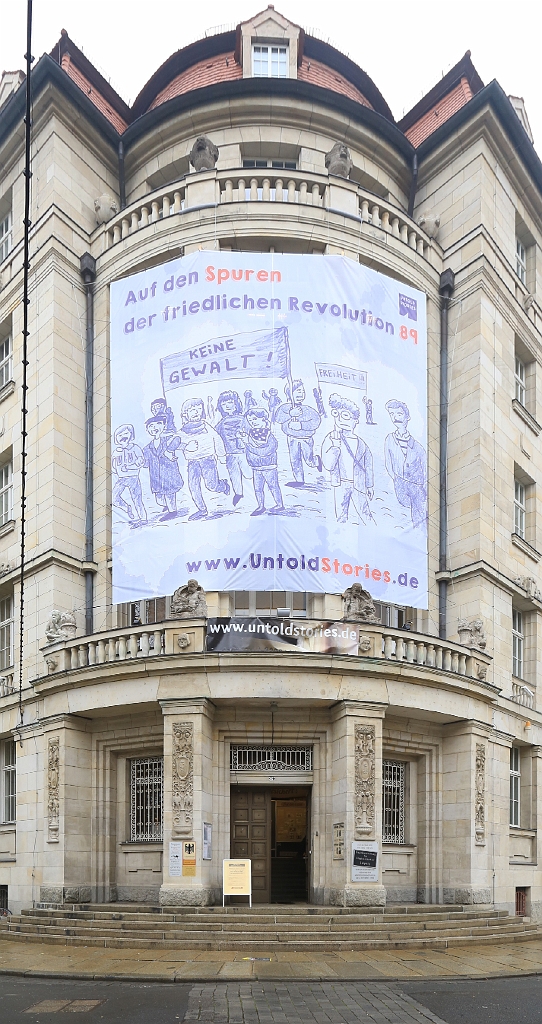
This building housed the district administration offices of the Ministry for State Security between 1950 and 1989. During the Monday Demonstrations, protestors arrived and subsequently occupied the building on 4 December 1989. Photo on 4 Dec 2014.
Runde Ecke, Leipzig, fotoeins.com

The building’s rounded corner: “on the path of the Peaceful Revolution”

Runde Ecke, Leipzig, fotoeins.com

Bundesbeauftragte für die Stasiunterlagen | Federal Commissioner for the Stasi Files

Runde Ecke, Leipzig, fotoeins.com

“Wir sind das Volk!” (We are the people!) | Berlin Wall fragment

Runde Ecke, Leipzig, fotoeins.com

Museum in the Round Corner, with permanent exhibition “Stasi: Power and Banality”

Runde Ecke, Leipzig, fotoeins.com

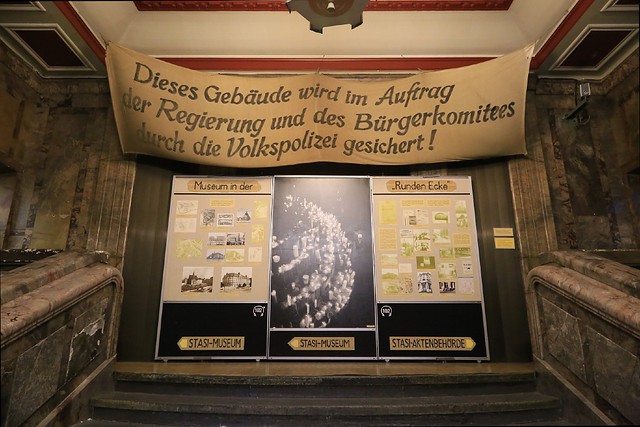
Building atirum: “This building is secured by the People’s Police on behalf of the government and citizen committees!” To the left is the Stasi Museum; to the right is the Stasi-Aktienbehörde, the public authority responsible for Stasi files.

Runde Ecke, Leipzig, fotoeins.com

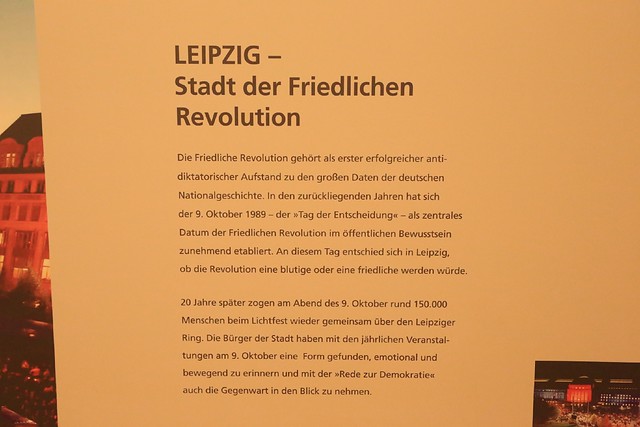
Leipzig – city of the peaceful revolution

“As a successful public uprising, The Peaceful Revolution is notable as an important event in Germany’s history. Over time, 9 October 1989 has established itself as a key date in the public eye as “a day of decision” when events of that very day could have turned bloody or remained peaceful. Twenty years later on the evening of 9 October 2009, about 150 thousand people gathered to mark the occasion on the Leipziger Ring for the Lights Festival. Yearly events on and around 9 October have taken shape as reminders about the steps and sacrifices people undertook for a more open present-day government.”


Open daily between 10am and 6pm, there is no charge to enter the Stasi museum in the Runde Ecke; most of the exhibition descriptions are in German. Photography is not allowed within the museum.

I made the photos above on 4 December 2014, the 25th anniversary of the peaceful takeover of Runde Ecke. Thanks to Leipzig Tourismus und Marketing GmbH (LTM) and InterCityHotel Leipzig for their support and hospitality. Access to public transport was kindly provided by LTM and the MDV Mitteldeutscher Verkehrsverbund regional transport authority. This post appears on Fotoeins Fotografies at fotoeins DOT com at http://wp.me/p1BIdT-6p4.

Cafe Burkardt, Heidelberger Altstadt, Germany, fotoeins.com

My Heidelberg: Cafe Burkardt in the Old Town

I’m often “home” in Heidelberg to visit friends who are in the city to work for the university or one of the many institutes in town. An important component for any visit to Heidelberg is Untere Strasse in the Altstadt (Lower Street in the Old Town). The narrow cobblestone street includes cafes, pubs, and shops with a neighbourhood feel attracting not only university students for “pub crawls” but also city residents for their favourite hangout spots.

( Click here for more )

Fotoeins Fotograms 14 o' 2014 cover

Fotoeins’ Fotograms: 14 for 14, in 2014 (IG)

At the end of 2013, I listed my 13 instants for the year. I continue to be fascinated by how we look at the world in square format in contrast with 4-by-3 or 3-by-2 formats. It’s not exactly the throwback to a distant past with square photographic plates, but the same physical and photographic principles regarding central symmetry apply. Here are 14 ‘fotograms’ from 2014, including a new 6D, watching my father die, and a return ‘home’ to Deutschland.

( Click here for more )

Weihnachten, Backwaren, Cafe Gundel, Karlsplatz, Hauptstrasse 212, Heidelberg, Germany, fotoeins.com

My Heidelberg: Café Gundel’s Christmas cakes & cookies (Weihnachtsgebäck)

Short sensory list

•   Sights of the Weihnachtsmarkt: bright lights; Christmas pyramid; red and yellow stars; unveiling of the Backwaren (backed goods) made especially for the holiday season.

•   Sounds of the Christmas market: the klang of full mugs distributed and empty ones collected, shouts of laughter from conversations scattered throughout the area.

•   Smells and tastes of the Christmas market: candied almonds, cashews, and peanuts; roasted chestnuts; balls of fried dough with powdered sugar; mugs of hot mulled wine, available in several fruit flavours; grilled bratwurst; fried potato pancakes with apple sauce.

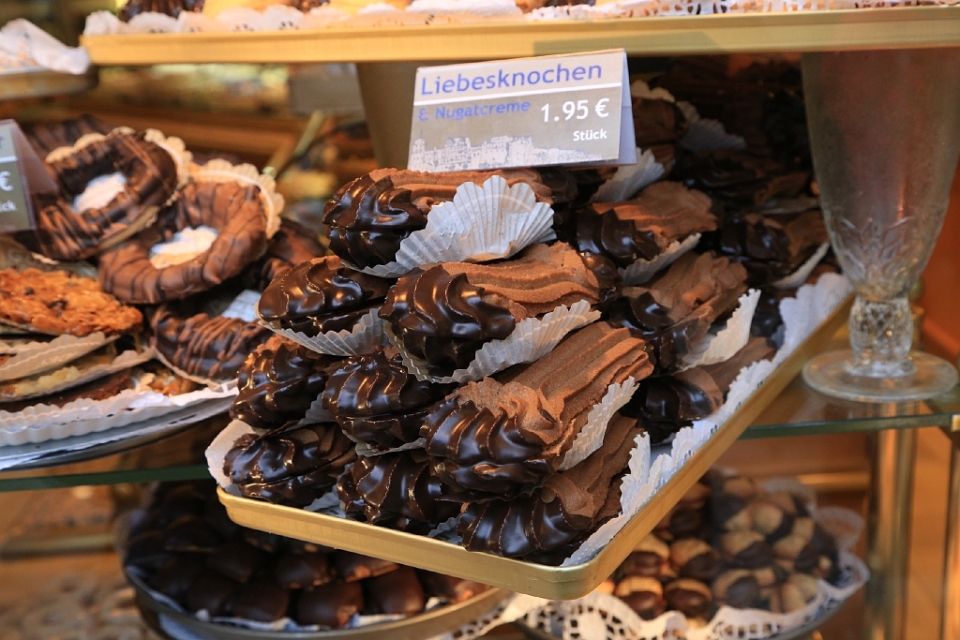
When the Christmas season brings out special baked goods, it’s time to pay attention. In Heidelberg, my favourite café in the university town doesn’t hold back as photos of the “Backwaren” (baked goods) show. There’s something for everybody at Café Gundel.

And on it goes: small lifetimes can be spent, seeing, smelling, and sampling the entire collection.

A short exchange

Noch einen Wunsch?

Something more?“, asks the lady behind the counter when I’ve ordered a few of this and a few more of that.

Das war’s. Komm ich wieder morgen …

That’s all. I’ll come back tomorrow …” I reply, with the sound of hope and promise in my voice. I’m sure she’s heard it all before. And yet, she humours me with a smile and a chuckle.

“Wir sind noch für Sie da …”

We’ll still be here …


( Click here for images and more )

Anatomiegarten, Hauptstrasse, Heidelberg, Germany

My Heidelberg: science at Anatomiegarten with Bunsen & Kirchhoff

It sounds like an unusual pairing, for science and Christmas to come together in a place called Anatomiegarten, or Anatomy Garden, in the German university town of Heidelberg.

During the Christmas season, the Anatomiegarten is host to one of the key Christmas market locations along Heidelberg’s main street (Hauptstrasse). Prominent are two names from a historical and scientific perspective: Bunsen and Kirchhoff.

( Click here for images and more )