Fotoeins Fotografie

location bifurcation, place vs. home

Posts from the ‘Czech Republic’ category

My Prague: the night watch

With visits to the city numbering well into the double digits, Prague started me on a different path, and eventually, to a change in my life.

According to legend, the city’s name, Praha, is derived from the Czech word, “práh” for “threshold” or “steps”. With the city’s geographic location within the European continent, it’s hard to recount the chronicles of Central Europe without mentioning Praha. History and significance permeates the city in the cobbled stonework, centuries of architecture, and stories of struggle and change.

I believe the city is one step of many on my journey and transition from my past as research scientist to a future that remains under continuous construction. Prague has been and continues to be an important part of this process. I’ve fallen in love with Praha – she means a lot to me.

As day passes to night, many parts of the city become quiet and empty, with only the yellow glow of the street lamps for company. Many are taught not to go into areas unknown, poorly lit, or vacant.

But I know Praha enough to see her differently.

I’ve done the legwork by day, scouting out and noting various locations around the city, and imagining their appearance in the dark. With a newly crafted road map in my head, I stand in the hotel lobby. I close my eyes in a mental walkthrough of my map, breathing deeply, slowly. I open my eyes again and step out into the night, guided by the lights of Staré Město, and across the Vltava over to Mal´ Strana.

I’m on the “night watch” with Rembrandt’s painting high in mind. The city and its streets don’t care who we are or from where we come. They lie still, in wait around the next corner.

In this place I’m always on the verge of something new; it’s a set of new ideas, much of them extraordinary, romantic, and meaningful. The meanings signify truth on a personal level for those willing to listen and heed the signs.

Prague never lets go of you … this little mother has claws.
— Franz Kafka (1883-1924).

( Click here for images and more )

David Cerny, Quo Vadis?, sculpture, German Embassy, Prague, Praha, Czech Republic, fotoeins.com

My Prague: historic balcony for GDR refugees

That’s one very famous balcony.

The balcony on the second floor facing the back gardens doesn’t look particularly special. But here in the Czech capital city of Prague there’s an important connection between that building’s balcony and events leading to the fall of the Wall. This building is also the German Embassy, and it’s where Hans-Dietrich Genscher looked over the crowds from the balcony and made a famous speech in 1989.

( Click here for images and more )

My Prague: Na hrad! To the castle!

I love Prague’s little streets, and I’ve always photographed her streets at night. On an evening walk through Prague’s Little Quarter, I came across this street lamp and a sign directing people to the Prague Castle (Pražský hrad).

I saw my “50-50” light-dark composition, and I brought my camera to bear on the scene. Another moment went by, and I thought of the call “na hrad!

Thunovska and Zamecka, Mala Strana, Praha, Czech Republic

“Na hrad!” (To the castle!)

Towards the final days of Communism in November 1989, protestors from around the country gathered at Wenceslas Square in Prague, shouting “Havel, na hrad!” (Havel, to the castle). The events of the “Velvet Revolution” led to peaceful dissolution of one-party rule, and writer Vaclav Havel became leader of a “new world”, a post-communist and democratic Czechoslovakia nation.

2014 marks the 25th anniversary of The Velvet Revolution. 2018 will mark the 25th anniversary of The Velvet Divorce, a peaceful and amicable separation of Czechoslovakia into the Czech Republic and the Slovak Republic.

I made the photo shown above, at the corner of Thunovská and Zámecká in Prague’s Malá Strana on 30 July 2013. This post appears on Fotoeins Fotopress at fotoeins.com as http://wp.me/p1BIdT-4XQ.


5 more Prague posts on Fotoeins Fotopress

•   “Praha, miluju tě | I love you, Prague”
•   5 of the Best Spots to View Prague at Night
•   “Love story number 1”
•   The colours of fall in Praha
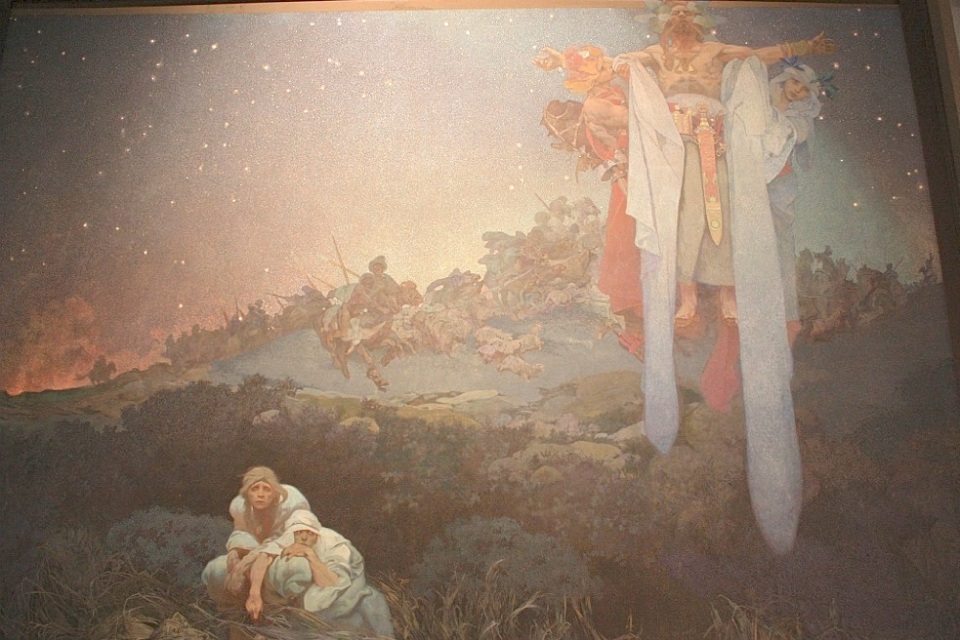
•   Alfons Mucha’s “The Slav Epic” Returns to Prague

Karluv most, Charles Bridge, summer dawn, Prague, Praha, Prag, Czech Republic, UNESCO World Heritage Site, fotoeins.com

Praho, miluju tě | I love you, Prague

“Foreward”

With visits numbering well into double digits, my affection for the Czech capital city of Prague remains undiminished, even in the midst of surging summer or winter crowds. When I’ve been in danger of being swamped, I veer off to a side street or quiet park; I’ll also wait for the relative solitude of nightfall or dawn. The magic is knowing I haven’t strayed very far from the big sights.

How I ended up chasing dreams over cobblestone streets, past the thousand spires and ornate facades, and across centuries of European art and history, has exceeded the limits of my imagination.

( Click here for more )

450D: 75000th photo in Kutná Hora, Czech Republic

3 August 2013.

With the weeklong travel-writing course in Prague completed, my new friends and I embark on a daytrip from the Czech capital city to Kutná Hora, some 70 kilometres to the southeast; here’s how we planned and made the trip by train.

I’m pleased and relieved my five-year old Canon EOS450D (XSi) camera continues to “hang on” during my return visit to the Czech Republic. I keep “flipping” or “rolling over” the four-digit image number counter; I’m in the tens of thousands, undoubtedly a big number for camera exposures or shots.

The “kostnice” or Ossuary, also known as the “Bone Church”, in Kutná Hora is all at once a surreal, unsettling, and fascinating experience. With ossuary defined as “a container, space, or room into which bones of dead people are placed where available burial space is scarce”, bone heaps from an estimated 40,000 skeletons were put into methodical use as ornaments inside the church. The decorative arrangement of bones began in the 16th-century, and what appears now has been in place since the end of the 19th-century. Moreover, a document from their information office states:

” … it (this place) is not a celebration of death, but it symbolizes the equality of people in front of the throne of God.”

While the following photographs mark an impressive milestone of the 75000th exposure on a single camera, I have to think the images are an ominous prediction about how little time my camera has left.

Kostnice, kostnice Sedlec, Ossuary, Beinhaus, Bone Church, Kutna Hora

Kostnice, kostnice Sedlec, Ossuary, Beinhaus, Bone Church, Kutna Hora

Previous rollovers :

•   15000th photo with the 450D/XSi in Berlin, Germany
•   25000th photo with the 450D/XSi in Vancouver, Canada
•   50000th photo with the 450D/XSi in Berlin, Germany
•   60000th photo with the 450D/XSi in Vancouver, Canada
•   70000th photo with the 450D/XSi in Sydney, Australia

I made the photos above on 3 August 2013. This post appears on Fotoeins Fotopress at fotoeins.com.