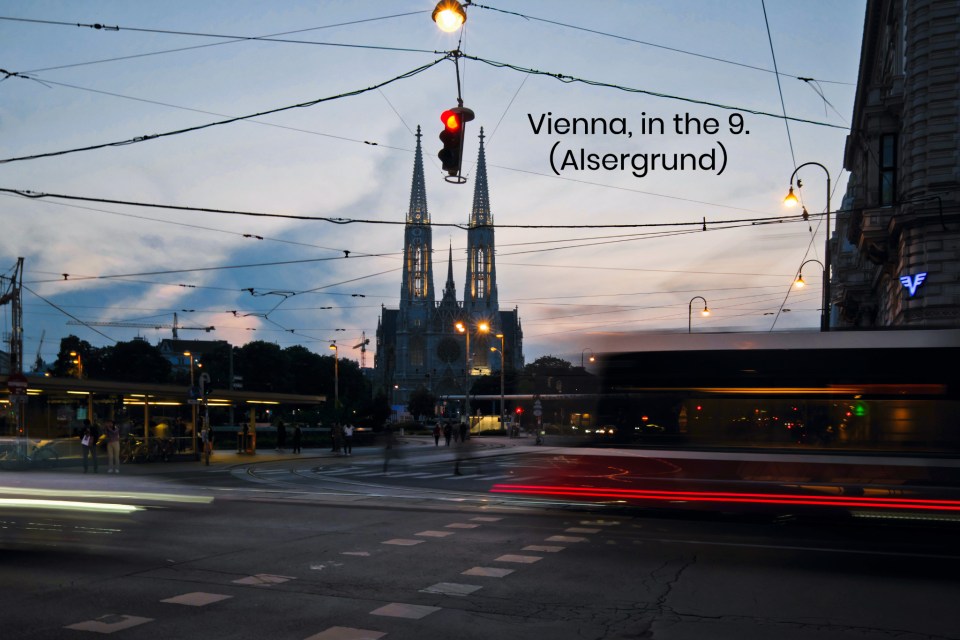
I’ve a lot to do by day that I often forget about good conditions at sunset and beyond into dusk. Waiting out the time a little longer beyond 9pm can be rewarding, especially because it’s summertime in Vienna.
I’ve written briefly about the Künstlerhaus and the Musikverein in my overview of “architectural historicism” on Vienna’s Ringstraße (Ring Road).
Musikverein (T. Hansen, 1870): home of the Vienna Philharmonic, and the annual New Year’s Day concert.
Left to right, respectively: NEST, a trio atop Palais Lützow, Musikverein.
Künstlerhaus (A. Weber, 1868): home to the Albertina Modern.
Neue Staatsoper (NEST) im Künstlerhaus / New State Opera in the old Artists’ House).
Also notably marked by a white ‘U’ in a blue cube, this is the “Künstlerhaus, Musikverein” entry/exit from Karlsplatz U-Bahn junction station for lines U1, U2, and U4.
I made all images above with an iPhone15 on 10 July 2025. This post composed within Jetpack for iOS appears on Fotoeins Fotografie at fotoeins DOT com.
It’s a wonder there aren’t more accidental bumps into other people. Instead of heads down (on mobiles), everyone has their head up to soak in the glory, shimmer, and glow. Before raising their mobiles up for a picture or few …
In the early 18th-century, Habsburg Emperor Charles IV ordered the construction in Vienna of an imperial court library in the Baroque style. First designed by Johann Bernard Fischer von Erlach, his son Johann Emanuel completed construction in 1726 with ceiling frescoes added in 1730 from Daniel Gran.
As a big part of the Austrian State Library (ÖNB), the present-day Prunksaal (State Hall) houses over 200-thousand books spanning three centuries from 1501 to 1850. The digitized collection is available to the public from the library’s website; check also for (seasonal) opening times and purchasing tickets in advance.
1st guest of the day, along the southeast-northwest length.
Emperor Charles VI: 1735 marble statue by Antonio Corradini.
Directly above the statue of Charles IV is a ceiling fresco by Daniel Gran in the 30-metre high dome.
“… The fresco high up in the central dome shows the apotheosis of Charles IV: the divination and glorification as Emperor, as commissioner of the Library, and as patron of arts and sciences.” (ÖNB)
Lots of symbols, including obelisk/sunbeam, an imperial flag with “A.E.I.O.U.“, central “coin” celebrating Charles IV, personification of Vienna wearing a mural crown, a beehive with honey (“library containing sweet knowledge”).
Book alcove 7.
Book alcoves 80 (above) and 56 at the far end of the hall/library, next to the Peace wing (northwest).
Entrance wing to the library (southeast).
Building entrance from Josefsplatz.
I made all images above with an iPhone15 on 10 July 2025. This post composed within Jetpack for iOS appears on Fotoeins Fotografie at fotoeins DOT com.
Salmannsdorf is tucked away in the northwest corner of the Austrian capital city. It only seems “far” when a bus route reaches its final stop; fact is the terminus for bus 35A is only 8 km northwest from the city centre.
First mentioned in an official document in 1279, the small village of wine growers began next to the Krottenbach creek and surrounded by hills. The name “Salmannsdorf” is likely derived from the personal name Salman or Salmann, or from the professional name of the “Salmann” who was a trustee or scribe of the land register called the “Salbuch”; literally, he of the Sal, or the Sal-man(n). By 1938, the village had been fully absorbed into the city of Vienna’s 19th district.
In a compact area, I’ve gathered:
a cross dedicated to victims of the French Napoleonic occupation 1809
where Franz Schubert composed “Das Dörfchen” (The Little Village) in 1821
Johann Strauss II (JS2) spent boyhood summers at his maternal grandfather’s house, where JS2 wrote at age 6 his 1st attempt at waltz “Erster Gedanke”
Franzosenkreuz (French cross), in front of Salmannsdorfer Straße 32.
French cross: memorial to the victims of the 1809 Napoleonic campaign and French occupation.
The slope up Dreimarksteingasse with a plaque at building address 6 (right).
Memorial plaque: Franz Schubert composed “Das Dörfchen” at this location in 1821.
Dreimarksteingasse 13, facing northwest. There’s a plaque on the outer wall of the bright yellow barn-like structure (upper right). Johann Strauss Sr. And his family spent summers here from 1829 to 1832.
Johann Strauss Jr. at age 6 composed his 1st waltz at this location; this is memorialized by the plaque on the wall. “Hier hat ein großer Musikant / Der ‘Meister Strauß’ war er benannt / Den ersten Walzer komponiert / Und dadurch dieses Haus geziert.”
Dreimarksteingasse 13, facing south.
Across from the Strauss’ summer residence is the village church whose names include Dreimarkstein Chapel and Saint Sebastian’s Chapel. The small church dates back to the late 18th-century.
Near the top of Dreimarksteingasse with the village chapel at left and the yellow building (once occupied by the Strauss family) at right.
I made all images above with an iPhone15 on 9 July 2025. This post composed within Jetpack for iOS appears on Fotoeins Fotografie at fotoeins DOT com.
In Vienna’s Museum of Science and Technology, I get to nerd out over things like cameras, calculators, radios, televisions, and telephones: all of which are now contained in some compact form within a mobile “smart” phone. Much of the history for the development of gadgets large and small is both long and fascinating.
But there’s also regulation of the Danube river, fresh- & waste-water management, computers & data management, bookmaking & block-type, print-making & lithography, tools & equipment “at home”, national radio & television broadcasting, telegraph & telephony, power generation, engines & automobiles, aircraft & airports, industrial-scale smelting, elevators & funiculars, transport signals, hygiene practices, et cetera, et cetera.
No surprise, really, that it’s a wae difficult to see everything available in the museum’s general collection inside a single visit.
TMW: Technisches Museum Wien.
Ebene 4 (4th level).
Ebene 3 (3rd level).
Typewriter: one of the earliest prototypes, by Peter Mitterhofer in Partschins (Italy) in 1864.
Top view: one of the earliest typewriter prototypes, by Peter Mitterhofer in Partschins (Italy) in 1864.
Arithmetic (mathematics) book from Johann Hemeling, printed in 1678 by Johann Görlin in Frankfurt, Germany. At right is an example of compound interest of 5-percent applied annually over 20 years on a principal of 10 million; that is, 10^7 * 1.05^20 =26532977.
Hewlett-Packard HP-35 electronic pocket scientific-calculator: USA, 1972.
Texas Instruments SR-40 electronic pocket scientific-calculator: USA, 1975.
Rolleiflex reflex camera with cut film adapter: Franke & Heidecke, Braunschweig (Germany), around 1929.
Front view, Leica I 35mm-camera: Ernst Leitz GmbH in Wetzlar (Germany), 1930. The word “Leica” is constructed from “Leitz” and “camera”.
Top view, Leica I 35mm-camera: Ernst Leitz GmbH in Wetzlar (Germany), 1930.
Front view, Leica IIIa 35mm-camera: Ernst Leitz GmbH in Wetzlar (Germany), 1938.
Top view, Leica IIIa 35mm-camera: Ernst Leitz GmbH in Wetzlar (Germany), 1938.
Left: Western Union, internal memo, 1876. Right: purple Telekom/Magenta telephone booth with a large digital screen and webcam.
Würfeluhr (Viennese cube-clock), 1930 to 1960s. This style of city clock can be found throughout the city of Vienna.
On Ebene 1 (level 1), the public can make their own thermograms: images in the thermal infrared at wavelengths around 10 microns. Red to orange are the warmest temperatures.
The hope is real: to live long and prosper (in the thermal infrared) with my trusty X70 (in the optical/visual). Thankfully, my glasses and camera remain “cool”.
I received neither support nor compensation for this piece. Except for the final two frames, I made all remaining images with an iPhone15 on 8 July 2025. This post composed within Jetpack for iOS appears on Fotoeins Fotografie at fotoeins DOT com.
No, I’m not “declaring”, nor am I “bowled all-out” 🏏
… and India scored over one-thousand runs against England at Edgbaston …
Two-thirds of my time in Europe has rapidly come and gone. By this point, I promise myself to take more time for self-reflection and express more appreciation into the universe. But what’ll happen is I’ll likely “rush” myself in the final 1/3rd with a more punishing pace.
Today’s weather was a little strange but welcoming. Steady rain-showers and cool-below-20C in the morning broke by mid-afternoon to sun and the temps back up to +23C, a far cry from the heat last week.
Wien Museum Karlsplatz is closed Mondays, but on this Monday afternoon, the light is very good.
U4 station Stadtpark (“city park”).
South entrance to the city’s Stadtpark.
U2 station Schottentor: on the right is a train departing south to Karlsplatz.
U2 station Schottentor: what faces commuters going up and down the escalators is “Einen Augenblick Zeit” (just a moment), a 1994 installation by Austrian artist Hofstetter Kurt. Transmitting an eyeful also helpfully includes the current time.
U2 station Schottentor, also known as Universität for the nearby University of Vienna. Wall adverts: “Listen to each Oida” / “I love you but don’t touch my pizza.”
Passing through Wien-Mitte/Landstrasse in early-evening, I stopped off at Thalia, a chain of bookstores based in Germany. They also carry books in multiple languages, and their English-language section is very decent. These three titles grabbed my eyeball, thereby loosening the wallet. “Mapmatics” combines my love of maps and mathematics. “Nuclear War: A Scenario” is a what-if chain of events. “Prequel” is about how early 20th-century Nazism had crossed west over the Atlantic in their undisguised attempt to soften American public opinion and delay or stop any possible American military intervention.
I made all images above with an iPhone15 on 7 July 2025. This post composed within Jetpack for iOS appears on Fotoeins Fotografie at fotoeins DOT com.