Fotoeins Fotografie

location bifurcation, place vs. home

Posts from the ‘Women’ category

“Iconic Black Women”, by Seattle artist Hiawatha D

(Best you view these images NOT on a tiny mobile screen, but from your desktop or laptop.)

As part of an ongoing journey to learn more about Seattle’s black community and their ongoing story, I visited the city’s Northwest African American Museum (NAAMNW) in March 2020. The museum’s permanent collection casts a spotlight on black migration within the United States, and the contributions by blacks to the nation and to the American Pacific Northwest. Also timely was the simultaneous visit of the NHL’s Black Hockey History mobile museum as part of their 14-city tour throughout North America.

I was especially moved by the museum’s special exhibition “Iconic Black Women: Ain’t I A Woman“, by Hiawatha D, an artist based in Seattle. His work and paintings highlight his story as a black man and black artist in America. His series of paintings “Iconic Black Women” shines a positive light on black women throughout past and contemporary American history: the important places they’ve occupied, and the important contributions they’ve made to human rights, music, literature, and sport. On sight of the paintings, the context, clothing, and body language may be immediately familiar. But many of the people painted don’t have faces, which allows viewers, especially young women, to see themselves in these figures, sparking and strengthening a connection between viewer and iconic black women.

I would love to see another name added to this list of iconic black women: African-Canadian Viola Desmond.

In 1940s Nova Scotia, Viola was a successful black businesswoman in the city of Halifax. In 1946, Viola Desmond was jailed, convicted, and fined for refusing to leave a whites-only area of a movie theatre. She fought unsuccessfully to have the conviction overturned. In 2010, the Lieutenant Governor of Nova Scotia, Mayann Francis (1st black person to serve in that post), posthumously pardoned Viola Desmond, removing her conviction from the historical record. In honour of her struggle, the Canadian Mint put Viola Desmond onto the face of Canada’s 10-dollar bill in 2018; she is the first black person and first Canadian woman to appear on Canadian currency in active circulation.


( Click here to see images )

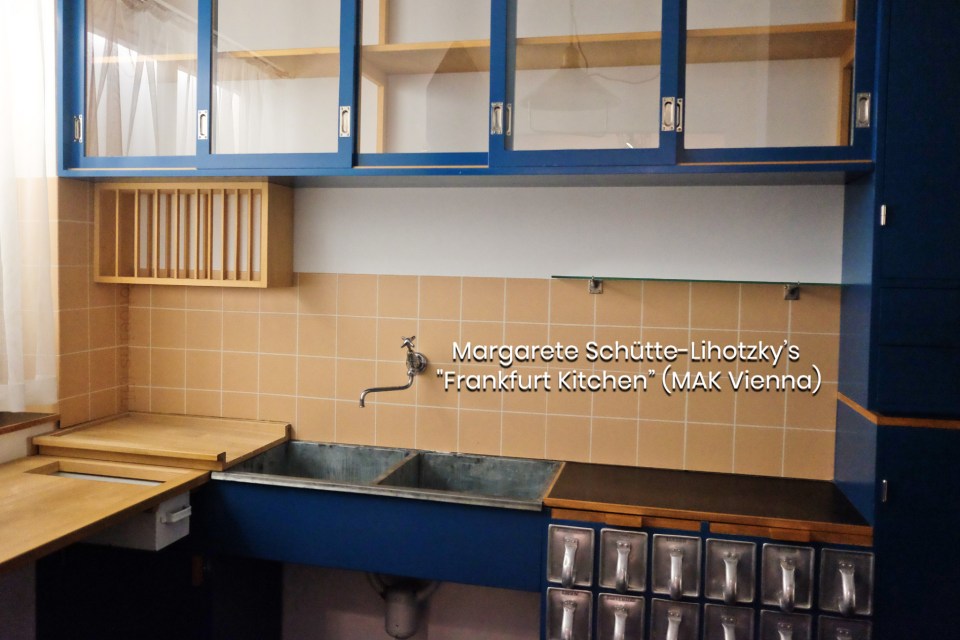
Frankurter Küche, Frankfurt kitchen, Margarete Schütte-Lihotzky, MAK Vienna, Vienna, Wien, Austria, Österreich, fotoeins.com

Vienna: Margarete Schütte-Lihotzky & the modern fitted kitchen

Who: Margarete Schütte-Lihotzky.
Key: 1st woman architect in Austria, designer of something we take entirely for granted.
Quote: “I developed the kitchen as an architect, not as a housewife.”

I always liked how cooking had well-defined endpoints: a desirable start, and a satisfying conclusion. I enjoy the process: the contemplation of “what to make,” the gathering of ingredients, the preparation, and naturally, the consumption. There might also be something to say about the duality of creation and annihilation …

That got me to thinking about kitchens as a critical unit of a home. Before the 20th-century, the wealthy could afford to have staffed kitchens; everybody else had access to no kitchen or an unsafe unhygienic kitchen in a building separate to their living quarters. The assumed universality of a kitchen within a home is a 20th-century concept and implementation that sought to overcome social and economic class. The design of a modern kitchen invites repeated patterns of movement and action around where cookware, utensils, condiments, glassware, etc. are stored and where the central focus of cooking activity takes place.

For everyone who spends any time in a kitchen, we have Margarete Schütte-Lihotzky (MSL) to thank.


( Click here for more )

1-day drive, US: Georgia O’Keeffe country

Above/featured: Ghost Ranch: Chimney Rock is in shadow at centre-right. Photo location: 36.31882 North, 106.48006 West.

This is the start of a series on day trips and drives from our time in the American Southwest. The following takes place entirely within travel day 7, within New Mexico between Santa Fe and Abiquiú.

Georgia O’Keeffe (1887-1986) is known as one of the best known modern American artists. Born in Wisconsin and educated in Chicago, her art came to light in New York City where her name and work became prominent. While teaching in Texas, she visited New Mexico for the first time in 1917. She fell in love with the landscape of New Mexico on subsequent visits in the early 1930s, and in 1949 she moved to the Abiquiú area where she would live for the rest of her life.

As fans of her art, we’re taking the day to drive up from Santa Fe to the town of Abiquiú. We wanted to see Georgia O’Keeffe country: the landscapes from which she drew inspiration, and the land that nurtured her spirit and fuelled her creativity.

Before our guided tour of O’Keeffe’s Abiquiú home, we stop at the Purple Adobe Lavender Farm next door to have a look. We like it so much we return after the guided tour to the farm’s café for a snack. We then make the short drive northwest onto the Ghost Ranch property to check out the ancestral lands of the Navajo Apache and Tewa pueblos. O’Keeffe recognized the importance some of that history, as she related in an 1967 interview for the Los Angeles Times’ “West” magazine:

When I think of death I only regret that I will not be able to see this beautiful country anymore, unless the Indians are right and my spirit will walk here after I’m gone.

On our return drive to Santa Fe, the sun sets over our section of the Southern Rocky Mountains, and I swear the late-afternoon breeze whispers the spirits of the Chama river, Georgia O’Keeffe, and all the souls who’ve inhabited the area.

( Click here for images and more )