Fotoeins Fotografie

location bifurcation, place vs. home

Posts from the ‘Science’ category

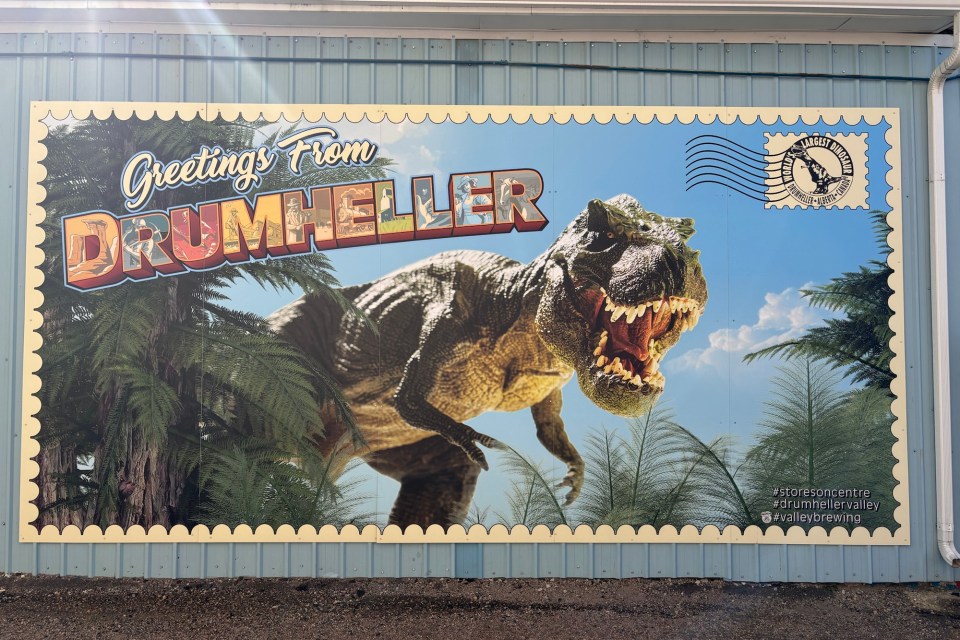
Drumheller AB: badlands, dinosaurs, oh my!

(Relatively short drive from Calgary)

In south-central Alberta, a leisurely 1.5 to 2 hour drive northeast from Calgary takes me past trucks, farm equipment, drilling rigs; through undulating hills and open fields of grain.

Population at a touch under 9-thousand, the city straddles the gentle flow of the Red Deer River. I’m led here by the notable attractions, and integrated over a couple of days here, they do not disappoint.

“Welcome to Drumheller”: sign and pullout next to highway AB-9, on approach into town from the south. Photo, 25 Sep 2024.
Read more

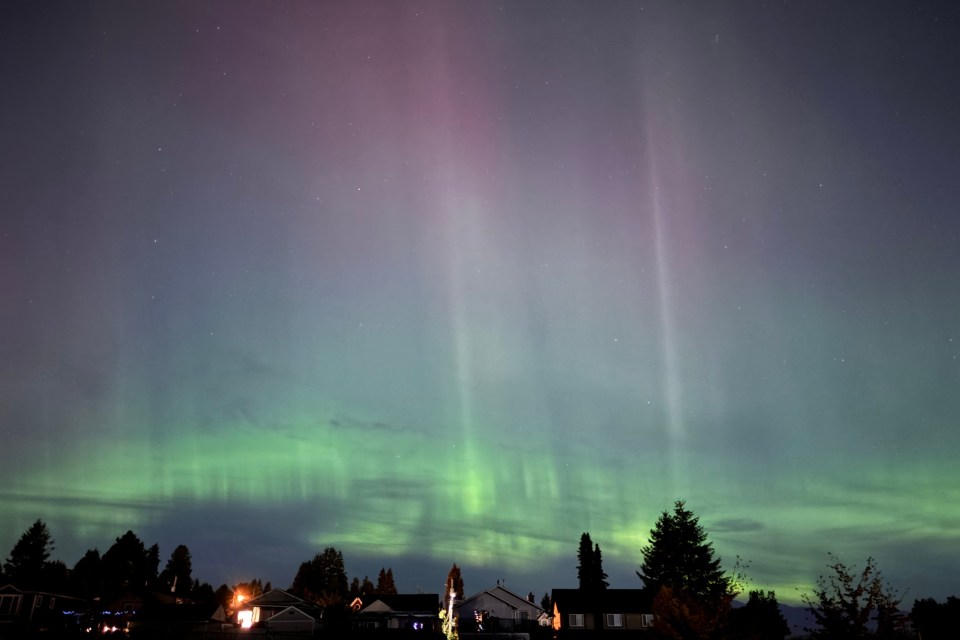
Aurora borealis, 49°N: 11 Oct 2024

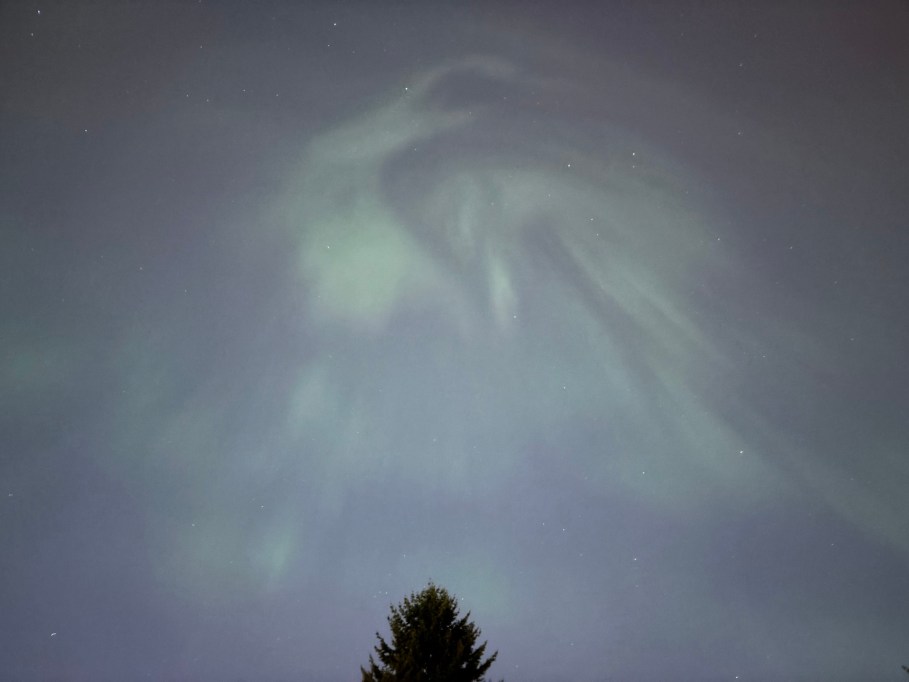
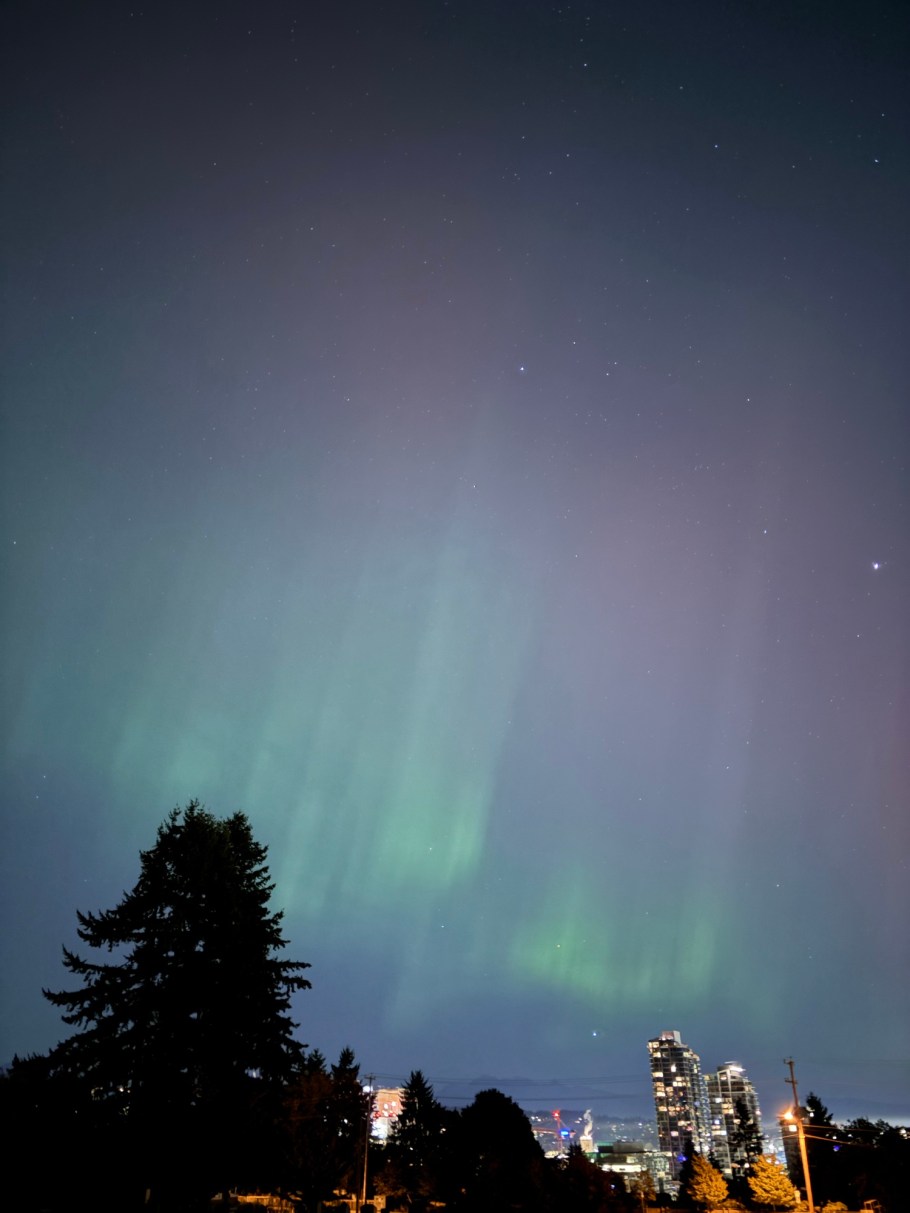
Northern lights over New West

Notices quickly went out, even saw alerts from scientists whom I follow on social media. Big solar storm detected, big aurora display expected.

The colours: reds & blue-greens for oxygen & nitrogen, respectively.

Structure: pillars, curtains, wavy strands.

Location: New Westminster, BC 🇨🇦 ; 49.2° North, 122.9° West.

Time: from about 12am to 1am PDT (7 to 8h UTC), on 11 October 2024.


Northwest horizon, 0003h PDT. Visible: Vega (Lyra), Draco, Ursa Minor.
Northwest horizon, 0004h PDT.
East horizon, 0010h PDT. Visible: Jupiter, Aldebaran (Taurus), Pleiades, Cetus, Orion.
Overhead “radiant”, 0016h PDT.
Northeast horizon, 0027h PDT. Visible:
East horizon (towards the Port Mann Bridge), 0030h PDT.
Northeast horizon, 0039h PDT.
Northern horizon, 0045h PDT.

I made all photos above with an iPhone15 on 11 Oct 2024. This post composed with Jetpack for iOS appears on Fotoeins Fotografie at fotoeins DOT com.

Vienna: Ludwig Boltzmann was here

The name is a large presence, particularly to many in science.

To others, the name might have little significance as any other name, like Helmut Grossuhrmacher. OK, I made that name up.

A name I didn’t make up is Ludwig Boltzmann, whose contributions to science are fundamental in an understanding of heat- or thermal-physics, thermodynamics, and statistical mechanics. After several years of undergraduate- and graduate-level physics, Boltzmann is one of many names imprinted into memory, firmly established in the left-side of my brain.


Boltzmann highlights

•   b/✵ 20 February 1844 – d/✟ 5 September 1906.
•   Born and raised in Vienna, Boltzmann enroled at age 19 in the University of Vienna to study mathematics and physics.
•   Supervised by Josef Stefan, Boltzmann completed his doctoral dissertation “Über die mechanische Bedeutung des zweiten Hauptsatzes der mechanischen Wärmetheorie” (On the mechanical significance of the 2nd Law of Thermodynamics) in 1866 at the age of 22.
•   1869–1873: University of Graz, with visits to Heidelberg and Berlin.
•   1873–1876: University of Vienna.
•   1876–1890: University of Graz.
•   1890–1894: (Ludwig Maximilian) University of Munich.
•   1894–1900: after Josef Stefan’s retirement, Boltzmann returns as professor of mathematics and physics at University of Vienna.
•   1900–1902: Leipzig University.
•   1902–1906: University of Vienna; he also teaches physics, mathematics, and philosophy.
•   Doctoral students Boltzmann supervised and advised included: Paul Ehrenfest, Lise Meitner, Stefan Meyer, Walther Nernst.
•   Speaking tour of the United States in 1905, including his stay that summer in Berkeley at the University of California. Evident from his trip report, Reise eines deutschen Professors ins Eldorado, is his sense of humour.

Time has been kind to Vienna, a city filled with notable personalities in arts, architecture, music, and science. Throughout its cemeteries, the city has assigned “graves of honour” (Ehrengrab) for many, including Boltzmann. Finding his final spot was one of many favourite moments in 2018. However, Boltzmann’s significance to the University of Vienna, to the physics world, and to time I spent in physics persuaded me to create a short (walking-)tour of Vienna to highlight some of his traces and memorialization in the city.


( Click here for more )

My Berlin: Minkowski space in Heerstrasse cemetery

Waldfriedhof Heerstrasse (Heerstrasse forest cemetery)

Is this a small park with plenty of trees, hilly terrain, and a small lake? Or is this simply a forest cemetery, a final resting spot for many prominent Berliners?

As part of an ongoing search for gravesites for physicists and mathematicians in Germany, I visited Berlin’s Friedhof Heerstrasse, near the city’s Olympic Stadium. Within the cemetery is Sausuhlensee lake, which settled into a former glacial gully, around which much of the cemetery came into being in 1924. Named after the early 20th-century Heerstrasse estate district whose residents were to be buried here, the cemetery stretches out over an area of almost 15 hectares (37 acres).

I found the grave for physicist Hermann Minkowski, but among the buried there are other “Promis” (prominent).

Friedhof Heerstrasse, Westend, Berlin, Germany, Deutschland, fotoeins.com

Forested park, forest cemetery.

Friedhof Heerstrasse, Westend, Berlin, Germany, Deutschland, fotoeins.com

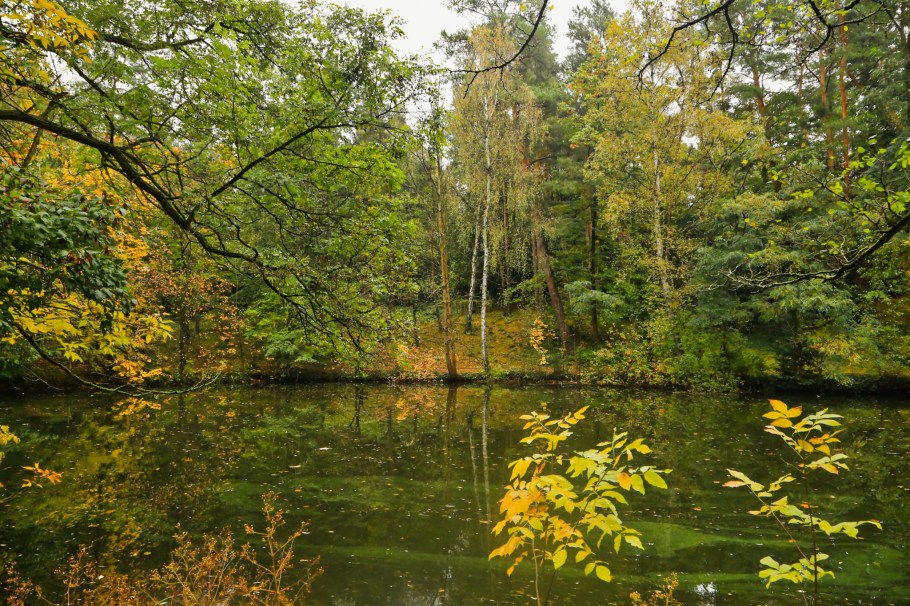
The calm waters of Sausuhlensee lake on an autumn afternoon.


( Click here for images and more )

Schottentor, Votivkirche, 9. Bezirk, Alsergrund, Wien, Vienna, Austria, Österreich, fotoeins.com

Vienna: 9 spots in the 9th district

Above/featured: Votivkirche (Votive church) from Schottentor. Photo, 20 May 2023.

Two visits: two months spread over two years.
A thousand kilometres of walking.
Hundreds of historical spots and locations tracked, spotted, and photographed.

It makes sense that out of Vienna’s 23 city districts, I’ll frequent some more than others. The 1st district, or the Innere Stadt, is unavoidable, because that’s where most visitors to the city will congregate. The 2nd (Leopoldstadt) and the 6th (Mariahilf) are districts where I had separate month-long stays. But it’s the 9th district (Alsergrund) into which I wandered through countless times, including tracking my way to the 18th and 19th districts.

Out of many interesting little spots in Alsergrund, I’ve highlighted nine examples from a historical “mélange” of architecture, Jewish culture, medicine, music, and physics. If you’re wondering about the Votivkirche (Votive Church) in the image above, I’ll have more about the church in future posts about Ringstrasse (Ring Road) architecture as well as the architectural works by Heinrich Ferstel.


( Click here for images and more )