Fotoeins Fotografie

location bifurcation, place vs. home

Posts from the ‘Culture’ category

“Science is an integral part of culture. It’s not this foreign thing, done by an arcane priesthood. It’s one of the glories of the human intellectual tradition.” – S.J. Gould.

Aurora borealis, 49°N: 11 Oct 2024

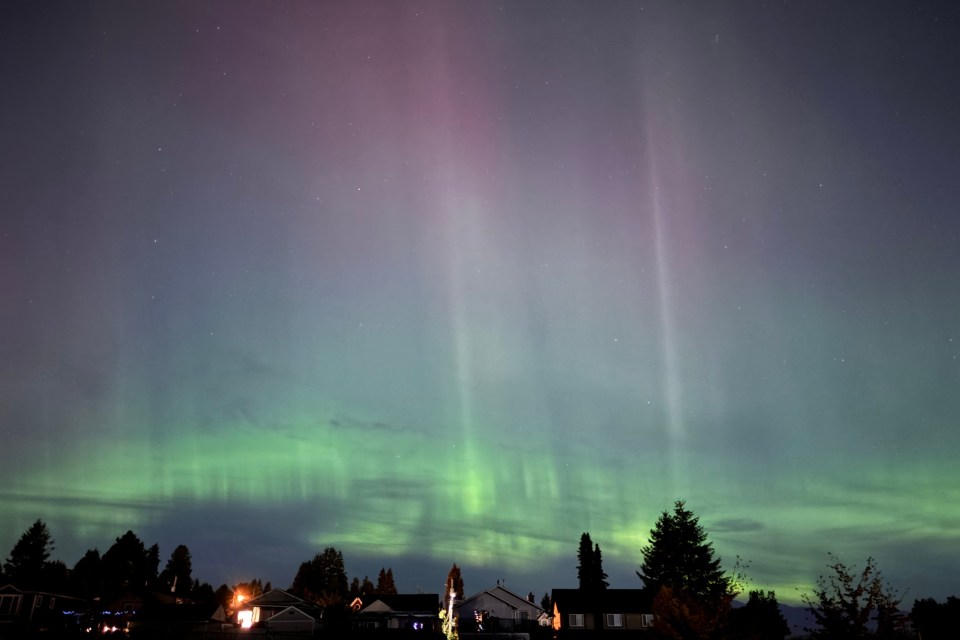
Northern lights over New West

Notices quickly went out, even saw alerts from scientists whom I follow on social media. Big solar storm detected, big aurora display expected.

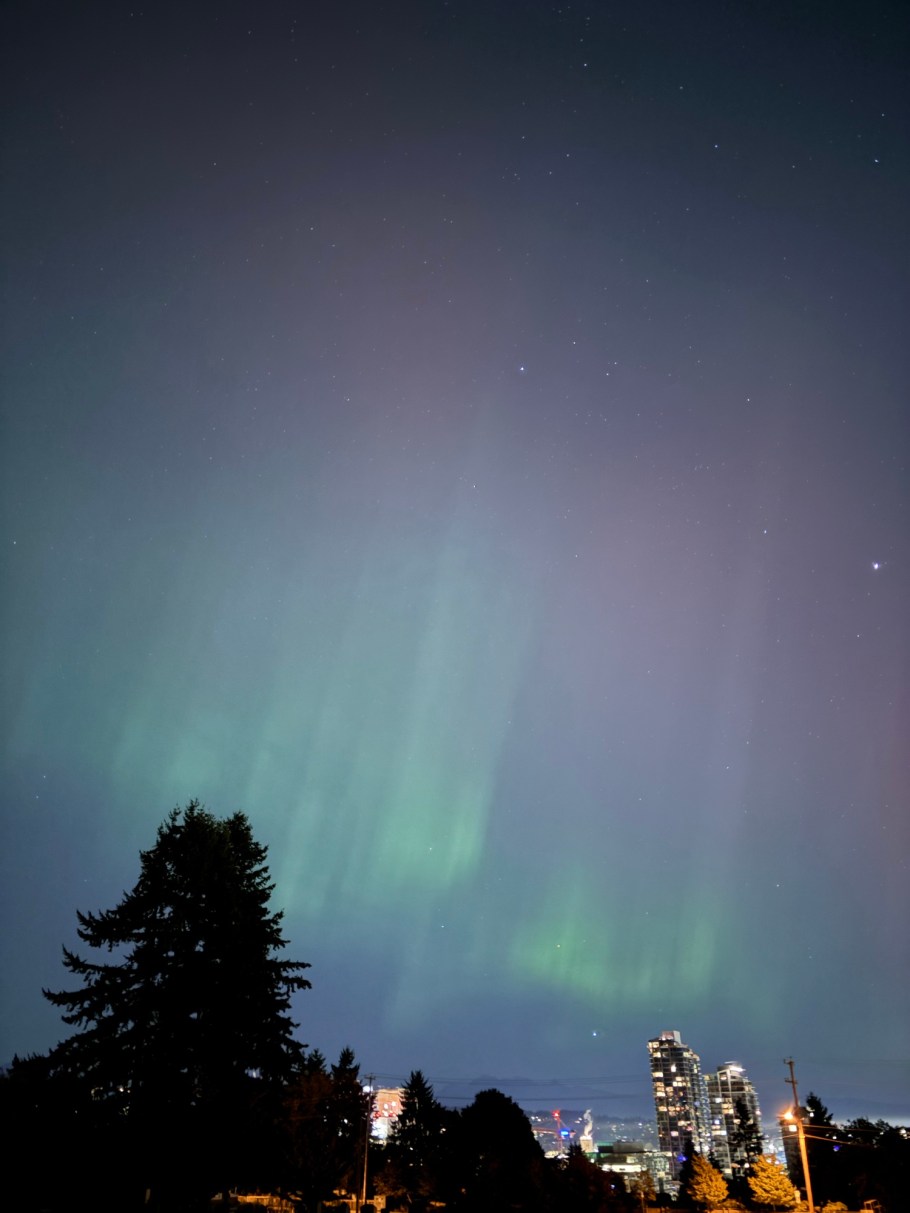
The colours: reds & blue-greens for oxygen & nitrogen, respectively.

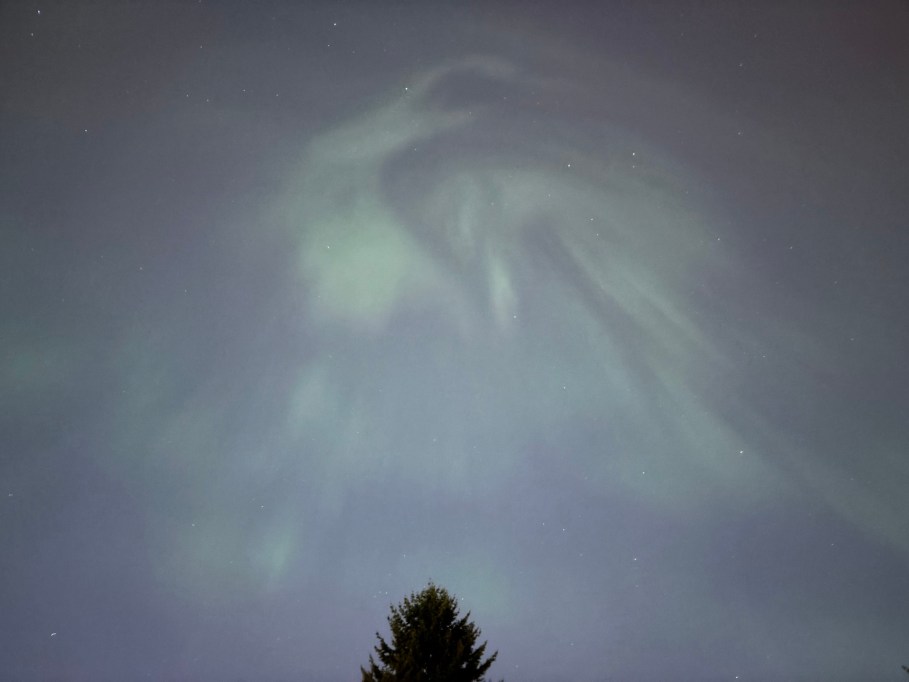
Structure: pillars, curtains, wavy strands.

Location: New Westminster, BC 🇨🇦 ; 49.2° North, 122.9° West.

Time: from about 12am to 1am PDT (7 to 8h UTC), on 11 October 2024.


Northwest horizon, 0003h PDT. Visible: Vega (Lyra), Draco, Ursa Minor.
Northwest horizon, 0004h PDT.
East horizon, 0010h PDT. Visible: Jupiter, Aldebaran (Taurus), Pleiades, Cetus, Orion.
Overhead “radiant”, 0016h PDT.
Northeast horizon, 0027h PDT. Visible:
East horizon (towards the Port Mann Bridge), 0030h PDT.
Northeast horizon, 0039h PDT.
Northern horizon, 0045h PDT.

I made all photos above with an iPhone15 on 11 Oct 2024. This post composed with Jetpack for iOS appears on Fotoeins Fotografie at fotoeins DOT com.

Calgary: it’s only 50 years

It’s been a while

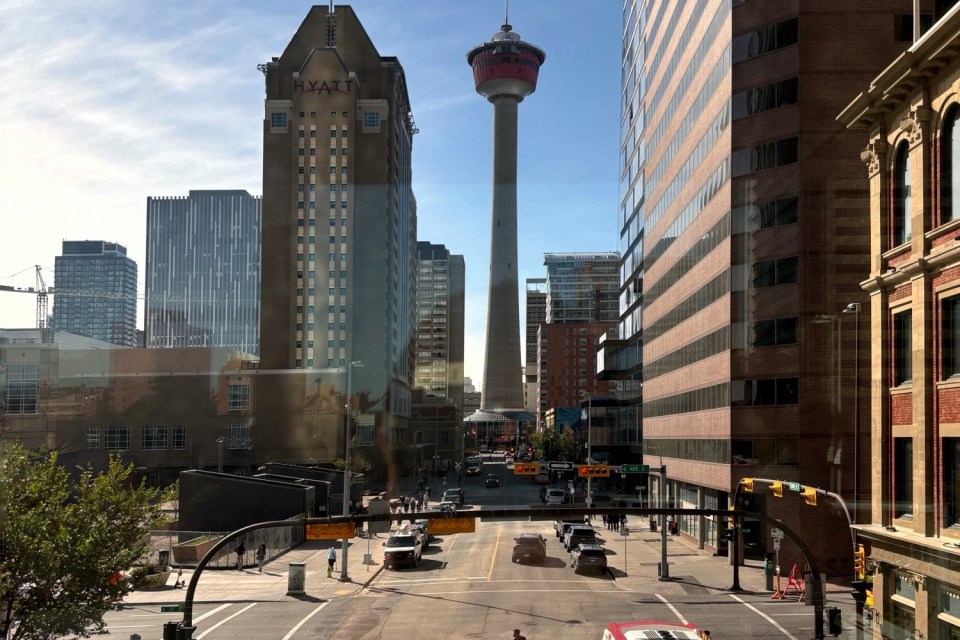
The last time I saw my aunt J in person was in Vancouver for Dad’s funeral ten years ago. The last time I set foot inside aunt J’s home in Calgary was in 1976, which by now is a mere hop for a 50-year anniversary.

My mum’s big sister is celebrating her 100th birthday this month, and many members of the extended family from across North America are gathering in Alberta’s most populous city for a momentous celebration.

My photographic traces of a late-summer morning and afternoon wandering the city centre is on display, “outlined” by various pieces of art and architecture.

Read more

Stuttgart’s Gerda Taro

Travel day 76, Euro day 75.

I’m in Stuttgart for a few days, and I rediscover photographer Gerda Taro was born in the city. I’d already read some history of photography, including the Spanish Civil War and Gerda Taro as the first woman to photograph and publish images about open conflict. I’ve gone looking for some traces in the city of her birth, as a quick and spontaneous mini-project in the midst of 90 consecutive days in Europe.


Memorial, near Olgaeck

Near the bus and tram stop Olgaeck is Gerda Taro Plaza, in memory of the young woman photographer who was born “Gerta Pohorylle” in Stuttgart and who once lived with her family in the area. At the plaza is a 2014 memorial dedicated to Taro; the text on all nine panels is entirely in German.

Named for photographer Gerda Taro (1910-1937), the plaza was unveiled by the city in 2008, and redesigned in 2014 with the installation of the memorial.
“O”. Gerda Taro, a pioneer in war photography.
“R”. The 1920s: Jazz, Theater, and the Stuttgart Kickers.
“A”. Leipzig: distributing leaflets against Hitler.
“T”. Exile in Paris: meeting André Friedmann, and the creation of Gerda Taro and Robert Capa. There is no Capa without Taro.
“A”. The Spanish Civil War, 1936-1939.
“D”. Barricades, armed women, equitable distribution of land.
“R”. The camera as witness: misery and terror from bombs.
“E”. Getting up close, for the world at large.
“G”. The first woman war-photographer killed on location. Documenting Spain’s civil war with her camera, Gerda Taro was accidentally run over by a tank and died from her injuries in a hospital near Madrid on 26 July 1937. She was buried in a marked grave in Paris’ Cimetière du Père-Lachaise.
Republican militia women training on the beach outside Barcelona, Spain: photo by Gerda Taro, August 1936. Provided by Ur Cameras on Flickr via Creative Commons.

Family home

Not far from Gerda-Taro-Plaza, I found the Pohorylle family’s former home, based on this poignant essay. I didn’t see any Gedenktafel (memorial plaque) or any Stolpersteine (stumbling stones) in the pavement, at or in front of either building 170 or 170A. In 1929, when Gerta was 19 years old, the Pohorylle family moved from Stuttgart to Leipzig.

Obstructed view of the former Pohorylle family house (in light orange), as seen from passage off Cottastrasse.
Gate to path access for building address Alexanderstrasse 170A.
Former Pohorylle family house, at Alexanderstrasse 170A.

Taro, short bio

Born Gerta Pohorylle, 1910 in Stuttgart, Germany; died 1937 in El Escorial, Spain.

“… Studied in Leipzig starting in 1929. Emigrated to Paris in 1933. In 1935 began working with the photographer André Friedmann, later known as Robert Capa. In 1935-1936 worked for the Alliance Photo Agency. Shortly after the outbreak of the Spanish Civil War in the summer of 1936, she and Capa went to Spain; other photography assignments in Spain followed in early 1937. She was fatally wounded at the Brunete front in July 1937 and was the first female war correspondent killed in action.”

Source: “Women War Photographers: from Lee Miller to Anja Niedringhaus” (Munich: Prestel, 2019), p. 218.


I made all photos above with an iPhone15 on 22 Jul 2024. I received no support from an external organization. This post composed with Jetpack for iOS appears on Fotoeins Fotografie at fotoeins DOT com.

New West actor Raymond Burr

Fraser Cemetery

As a boy whose early memories include the family’s small black-and-white television from the 1970s, I remember the tv show “Ironside.” Canadian-born Raymond Burr played the titular character of Robert Ironside, special consultant for the San Francisco police department. Years later in the mid- to late-1980s, Burr returned as Perry Mason, the lead from the 1960s weekly tv-drama revived as a popular series of made-for-tv movies. He died in 1993, buried with members of his family in Fraser Cemetery, at home in New Westminster, B.C.

Burr family grave at lower-centre – 9 Apr 2024 (iP15).
Raymond Burr (lower-right), with sister Geraldine, father William, and mother Minerva – 9 Apr 2024 (iP15).

In 1858, the British established New Westminster as first- and capital-city of the new colony of British Columbia. Fraser Cemetery accepted its first burials in 1869.


I made all images above with an iPhone15 on 9 April 2024. Composed entirely within Jetpack for iOS, this post appears on Fotoeins Fotografie at fotoeins DOT com as https://wp.me/p1BIdT-sjD.

My Vienna: Ludwig Boltzmann was here

The name is a large presence, particularly to many in science.

To others, the name might have little significance as any other name, like Helmut Grossuhrmacher. OK, I made that name up.

A name I didn’t make up is Ludwig Boltzmann, whose contributions to science are fundamental in an understanding of heat- or thermal-physics, thermodynamics, and statistical mechanics. After several years of undergraduate- and graduate-level physics, Boltzmann is one of many names imprinted into memory, firmly established in the left-side of my brain.


Boltzmann highlights

•   b/✵ 20 February 1844 – d/✟ 5 September 1906.
•   Born and raised in Vienna, Boltzmann enroled at age 19 in the University of Vienna to study mathematics and physics.
•   Supervised by Josef Stefan, Boltzmann completed his doctoral dissertation “Über die mechanische Bedeutung des zweiten Hauptsatzes der mechanischen Wärmetheorie” (On the mechanical significance of the 2nd Law of Thermodynamics) in 1866 at the age of 22.
•   1869–1873: University of Graz, with visits to Heidelberg and Berlin.
•   1873–1876: University of Vienna.
•   1876–1890: University of Graz.
•   1890–1894: (Ludwig Maximilian) University of Munich.
•   1894–1900: after Josef Stefan’s retirement, Boltzmann returns as professor of mathematics and physics at University of Vienna.
•   1900–1902: Leipzig University.
•   1902–1906: University of Vienna; he also teaches physics, mathematics, and philosophy.
•   Doctoral students Boltzmann supervised and advised included: Paul Ehrenfest, Lise Meitner, Stefan Meyer, Walther Nernst.
•   Speaking tour of the United States in 1905, including his stay that summer in Berkeley at the University of California. Evident from his trip report, Reise eines deutschen Professors ins Eldorado, is his sense of humour.

Time has been kind to Vienna, a city filled with notable personalities in arts, architecture, music, and science. Throughout its cemeteries, the city has assigned “graves of honour” (Ehrengrab) for many, including Boltzmann. Finding his final spot was one of many favourite moments in 2018. However, Boltzmann’s significance to the University of Vienna, to the physics world, and to time I spent in physics persuaded me to create a short (walking-)tour of Vienna to highlight some of his traces and memorialization in the city.


( Click here for more )