Posts from the ‘Culture’ category
“Science is an integral part of culture. It’s not this foreign thing, done by an arcane priesthood. It’s one of the glories of the human intellectual tradition.” – S.J. Gould.
Above/featured: South view from Sydney Harbour towards the CBD – 12 Apr 2013 (450D).
Standing prominently above Sydney’s Bennelong Point, the white shelled structure serves as an icon for city and country.
The Sydney Opera House is made up of three groups of interlocking “vaulted shells” housing two primary concert auditorium spaces. The shell-like structures sit upon a large platform, encompassed on the outside by stepped terraces as staging or assembly areas for visitors.
On 20 October 1973, Queen Elizabeth II formally opened The Opera House. In the decades since, the building has become an icon for city and country. The building endures as a “landmark” and “ambassador” for both city and country. Immediately telling are the roof’s white shells, looking like wind-blown sails at a distance in the harbour.
( Click here for images and more )
-33.856784
151.215297
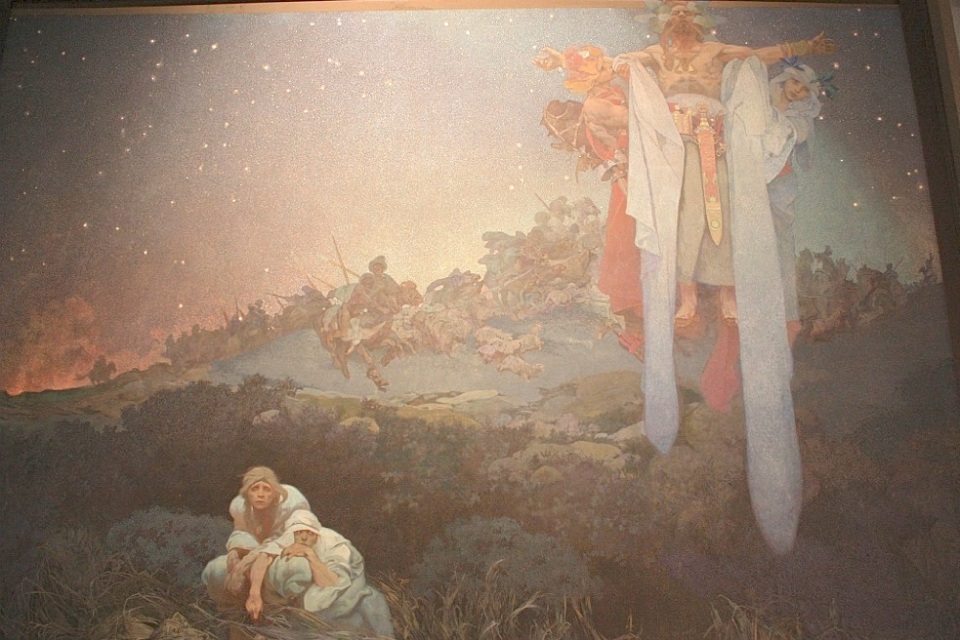
One of the greatest and most important works of Czech art from the early 20th-century was on display in the Trade Fair Palace (Veletržní Palac) in Prague until 2021.
All 20 paintings of “The Slav Epic” (Slovanská epopej) by Alfons Mucha can be viewed in the Czech capital city for the first time in over 80 years. For admirers of Mucha, Art Nouveau and history, the work is easier to reach than ever before and should not be missed.
Mucha’s The Slav Epic is a series of paintings on large canvas, which he completed in 1926. The paintings tell the story and mythology of the Slav peoples, with Mucha imagining the entire work as a commemorative piece to the Czech nation. Each painting spans several metres in both height and width, and stands tall even in a spacious exhibition hall. In every painting, grand scenes and landscapes are shown in a mixture of restrained colours, important figures, and careful details.
From 2021 to 2026, “The Slav Epic” makes its home in Moravia’s Moravsky Krumlov. Beyond 2026, the paintings are supposed to return to Prague for a longer 25-year stay.
( Click here for images and more )
50.101972
14.432945
(last edited: 19 Jul 2019.)
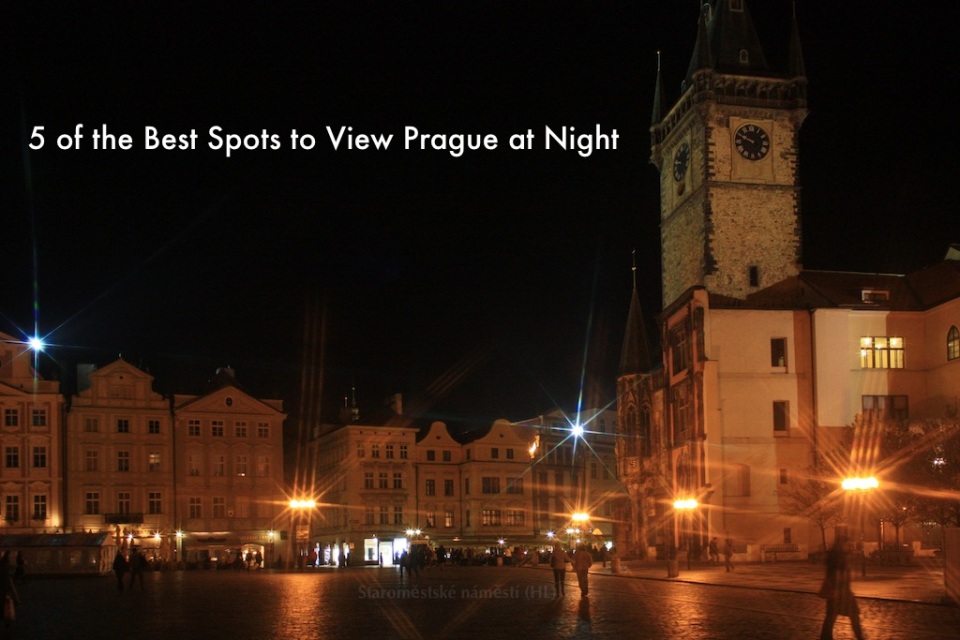
Prague is very attractive by day, but the Czech capital city is also beautiful at night.
By day, visitors are out and about, moving from one attraction to another. At night, sounds from pub crawls and pre-wedding parties seem to fill the air.
A closer look reveals a romantic side to the city with silent streets and half-empty plazas. A yellow glow settles like a warm and welcoming halo, softening the sharp lines of centuries-old architecture, and smoothing over cobbled stones embedded in old neighbourhood streets.
It’s easy to forget a significant part of central Prague is a UNESCO World Heritage Site, but the following five locations to view the city at night provide great reminders. Don’t ignore the illuminated city after dark, which is still very safe, and don’t forget to bring your camera when journeying out at night.
( Click here for images and more )
50.075538
14.437800
Visiting Denmark in the summertime means there are many hours of daylight, providing more opportunities to explore. A daytrip train from Copenhagen north to Helsingør takes you through the Danish lowlands next to the sea, but the goal here is a visit to Kronborg Slot (Kronborg Castle).
Does the place, Helsingør, sound familiar?
How about the Anglicized version of the name – Elsinore?
Elsinore is the setting for one of William Shakespeare’s most famous plays, “Hamlet”.
Since its designation in 2000, Kronborg Slot (Kronborg Castle) in Helsingør, Denmark is a UNESCO World Heritage Site, and is commonly known as “Hamlet’s castle.”
( Click here for images and more )
56.030787
12.592127
Since 2009, the annual VIVID Sydney festival lights up the city with vibrant colour and imaginative displays. Between 24 May and 10 June, the 2013 version has over 60 light projections on display around Sydney Cove, Walsh Bay, and Darling Harbour.
VIVID Sydney is an important annual wintertime cultural event bringing together light installations, live music, photography, design, creative ideas, and people in one of the largest festivals in the southern hemisphere. With the central display on the sails of the Opera House, the Spinifex Group put their unique spin to “Lighting the Sails.” Also, for the first time, the Sydney Harbour Bridge gets the VIVID treatment.
I’m fortunate to have photographed a variety of installations over six evenings 24, 26, 28, 30 May; and 3 June 2013. This post appears on Fotoeins Fotopress at fotoeins.com as https://wp.me/p1BIdT-3qf.
( Click here for images and more )
-33.867487
151.206990

 Fotoeins Fotografie