Fotoeins Fotografie

location bifurcation, place vs. home

Posts from the ‘Culture’ category

“Science is an integral part of culture. It’s not this foreign thing, done by an arcane priesthood. It’s one of the glories of the human intellectual tradition.” – S.J. Gould.

Auerbachs Keller, Leipzig, Germany, fotoeins.com

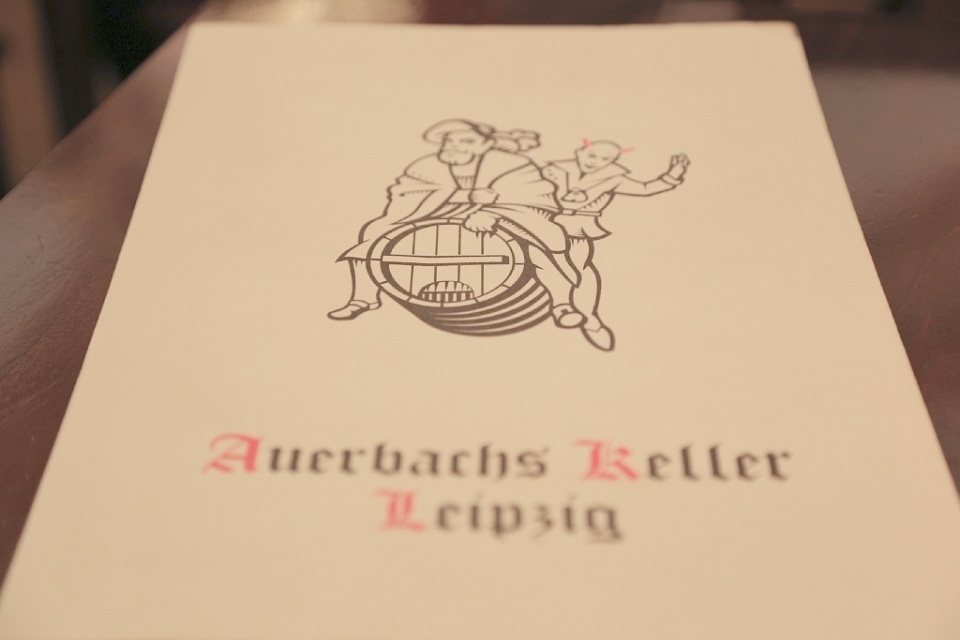
Leipzig’s Auerbachs Keller: devilishly comfortable

Goethe’s Faust meets Saxon comfort

If I didn’t know any better, I’d think I was giving away my soul for a good warm Saxon meal.

In the city of Leipzig, Germany, the name and influence of Johann Wolfgang von Goethe doesn’t stray far from conversation. Three more words are at the tip of the tongue: Faust. Pact. Devil.

Near the city’s central square at Markt, the Mädler-Passage beckons with bright lights and the promises of goods and riches within the shopping arcade. At the arcade’s north entrance, all are greeted by statues representing figures from “Faust”, the most famous published work by Goethe.

Signs to Auerbach’s Cellar lead downstairs on either side of the main passage. One thought remains as I walk into the basement. Am I sealing my own deal with the devil, setting foot in the Cellar’s chambers to sign away my freedom for some food, drink, and hospitality?

I’m sure the evening won’t be that dramatic. But the moment I walk in the door, I’m in the midst of culinary and literary tradition spanning many centuries.


( Click here for more )

Cafe Burkardt, Heidelberger Altstadt, Germany, fotoeins.com

My Heidelberg: Cafe Burkardt in the Old Town

I’m often “home” in Heidelberg to visit friends who are in the city to work for the university or one of the many institutes in town. An important component for any visit to Heidelberg is Untere Strasse in the Altstadt (Lower Street in the Old Town). The narrow cobblestone street includes cafes, pubs, and shops with a neighbourhood feel attracting not only university students for “pub crawls” but also city residents for their favourite hangout spots.

( Click here for more )

Weihnachten, Backwaren, Cafe Gundel, Karlsplatz, Hauptstrasse 212, Heidelberg, Germany, fotoeins.com

My Heidelberg: Café Gundel’s Christmas cakes & cookies (Weihnachtsgebäck)

Short sensory list

•   Sights of the Weihnachtsmarkt: bright lights; Christmas pyramid; red and yellow stars; unveiling of the Backwaren (backed goods) made especially for the holiday season.

•   Sounds of the Christmas market: the klang of full mugs distributed and empty ones collected, shouts of laughter from conversations scattered throughout the area.

•   Smells and tastes of the Christmas market: candied almonds, cashews, and peanuts; roasted chestnuts; balls of fried dough with powdered sugar; mugs of hot mulled wine, available in several fruit flavours; grilled bratwurst; fried potato pancakes with apple sauce.

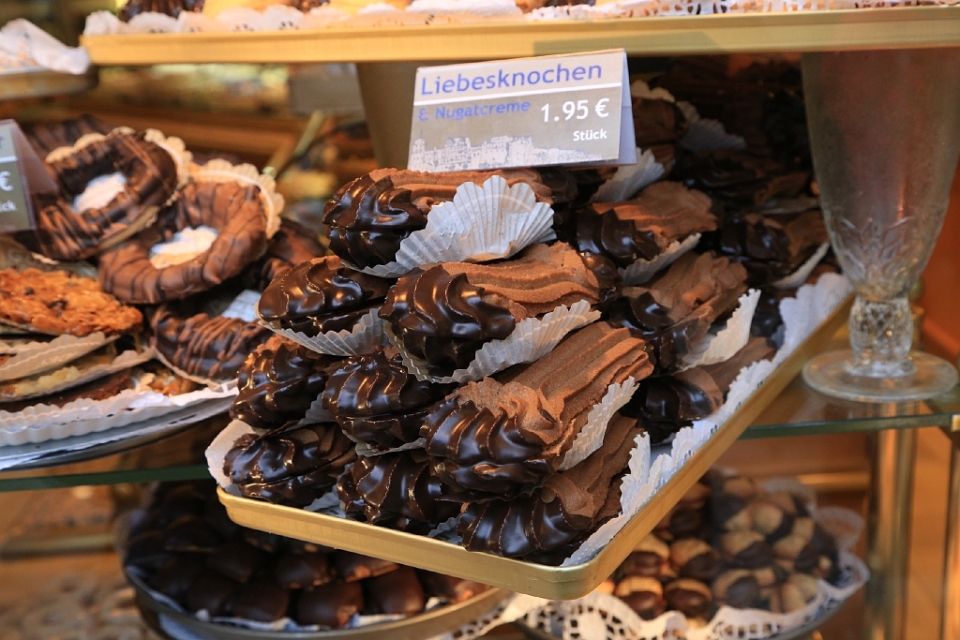
When the Christmas season brings out special baked goods, it’s time to pay attention. In Heidelberg, my favourite café in the university town doesn’t hold back as photos of the “Backwaren” (baked goods) show. There’s something for everybody at Café Gundel.

And on it goes: small lifetimes can be spent, seeing, smelling, and sampling the entire collection.

A short exchange

Noch einen Wunsch?

Something more?“, asks the lady behind the counter when I’ve ordered a few of this and a few more of that.

Das war’s. Komm ich wieder morgen …

That’s all. I’ll come back tomorrow …” I reply, with the sound of hope and promise in my voice. I’m sure she’s heard it all before. And yet, she humours me with a smile and a chuckle.

“Wir sind noch für Sie da …”

We’ll still be here …


( Click here for images and more )

Anatomiegarten, Hauptstrasse, Heidelberg, Germany

My Heidelberg: science at Anatomiegarten with Bunsen & Kirchhoff

It sounds like an unusual pairing, for science and Christmas to come together in a place called Anatomiegarten, or Anatomy Garden, in the German university town of Heidelberg.

During the Christmas season, the Anatomiegarten is host to one of the key Christmas market locations along Heidelberg’s main street (Hauptstrasse). Prominent are two names from a historical and scientific perspective: Bunsen and Kirchhoff.

( Click here for images and more )

My 3 Thermo Laws to Making Photographs

There are some certainties to making a photograph:

  • seeing or viewing the scene,
  • framing the scene in the camera,
  • clicking the shutter button to expose and capture the scene, and
  • admiring the image of the scene.

But make enough photographs, and three realities make themselves known. These arrive gradually, surprising you with their frequency and constancy. But you’ll eventually recognize the universal truths behind what it really means to make a photograph.

And this is where physics is a useful analogy, without the math.

Hot and Cold

When I was at university, one mandatory course was thermodynamics, the study of relationships between heat (thermal energy) and other forms of energy including mechanical, electrical, or chemical. It’s a way of understanding how heat transfer is described, and the various ways energy can be transformed or exchanged within a physical system.

What does this have anything to do with you? Thermodynamics is a driving factor behind weather in the atmosphere, water currents in the oceans, how refrigerators, heat exchangers, water kettles work, among other applications. Thermodynamics plays a role in our everyday lives.

In words, the Three Laws of Thermodynamics are:

  1. “Energy can be changed from one form to another, but energy cannot be created or destroyed. The total amount of energy and matter in the Universe remains constant.”
  2. “Entropy, a measure of a system’s energy that is unavailable for work, or of the degree of a system’s disorder, in the universe always increases. Heat does not by itself pass from a cooler to a hotter body.”
  3. “It is not possible to reach a temperature of absolute zero.”

The poet Allen Ginsberg created theorems, restating and applying the three laws of thermodynamics to “the game of life”:

  1. You can’t win.
  2. You can’t break even.
  3. You can’t get out of the game.

Bondi Beach, Sydney, Australia, fotoeins.com

My Three Laws to Making Photographs

I attempted to photograph large waves pounding the rocks at Sydney’s North Bondi. As I hunted for the “perfect crash,” I began to think a lot about thermodynamics. In a crazy wave of thought, I got down to my “Three Laws to Making Photographs”:

  1. If you want that shot, someone already made it to worldwide acclaim.
  2. That ideal shot is a fraction of a second too early or too late.
  3. You can’t resist the urge to try and try again.

It’s good to know I’ve put some of that physics training to good use, and I’ve been responsible in raising the “total entropy of the photographic universe” by a small amount, after amassing 75000 exposures with a single camera.

Now, if you’ll excuse me, it’s time I headed out to continue my futile search and photograph that elusive moment of pure clarity …

I made the photo above from Bondi Icebergs at South Bondi in Sydney, Australia on 3 June 2013. This post appears on Fotoeins Fotografie at fotoeins.com as https://wp.me/p1BIdT-3qx.


Minding the Physics

Nobel Prize winner Richard Feynman provides a beautiful treatment of thermodynamics in his renowned 1963 Physics Lectures, complete with the math.