Posts from the ‘Culture’ category
“Science is an integral part of culture. It’s not this foreign thing, done by an arcane priesthood. It’s one of the glories of the human intellectual tradition.” – S.J. Gould.
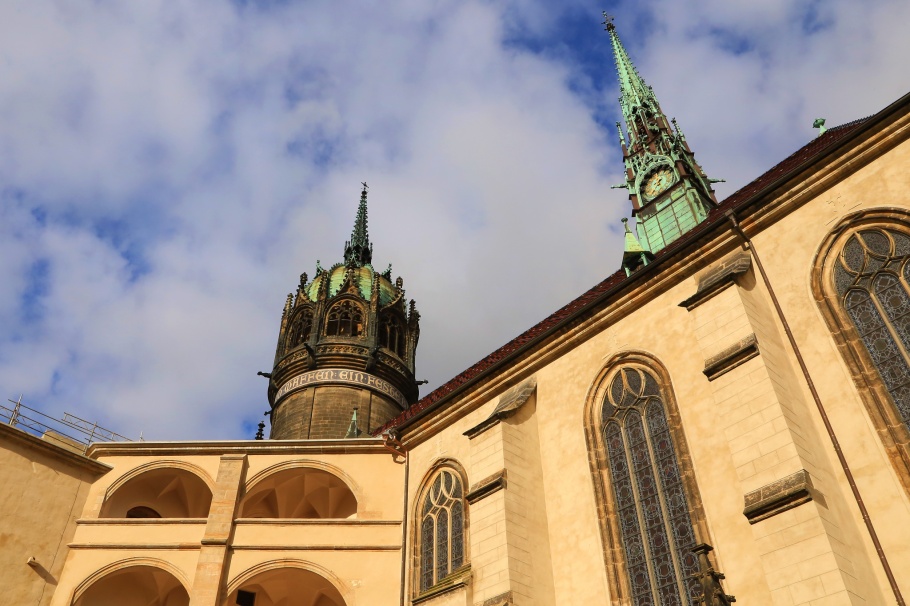
In the east German town of Wittenberg, the Schlosskirche (Castle- or All Saints’-Church) is one of four sites as part of the town’s status as UNESCO World Heritage Site since 1996.
Elector Frederick III of Ernestine Saxony (1463-1525, also known as Frederick the Wise, Friederich der Weise) became the first patron of the Protestant Reformation with his support and defence of Martin Luther. On the site of the original city castle, Frederick the Wise authorized in 1489-1490 a renaissance palace with the entire north wing occupied by the Castle Church. The church was consecrated and inaugurated in 1503 as the castle and university church “Allerheiligen” (All Saints); Martin Luther taught theology as professor at the neighbouring university. The first Protestant service at the Castle Church was held in 1524-1525.
A significant portion of the church including the original wooden doors was burned and destroyed in 1760 during Europe’s Seven Years’ War (1754-1763). The 1770 replacement church was subsequently destroyed in the conflict against France’s Napoleon which ended with the town under Prussian control in 1815. With support and backing by Emperor Wilhelm II, a full renovation of the church took place between 1885 and 1892 with the west tower taking the form and shape we see today (see also below). The graves for Martin Luther, contemporary colleague and fellow reformer Philipp Melanchthon, and Frederick the Wise are inside the church. After three years of renovation and restoration work in time for the Reformation quincentenary in 2017, the Castle Church was reopened in the autumn of 2016.
( Click here for images and more )
51.866260
12.638210
Above: “Amants” (1895), poster for actress Sarah Bernhardt and her Théâtre de la Renaissance in Paris. Museum für Kunst und Gewerbe Hamburg – 5 Dec 2015 (HL).
One of my favourite artists from the Art Nouveau period is Czech artist Alfons Mucha (“MOOTZ’kha”). He loved strong women, or at the very least, he loved drawing and painting images of strong women, from the unique perspectives of a professional nature (above, Sarah Bernhardt) and a personal nature (below, “The Slav Epic”). I also associate Mucha with Prague, and it’s fitting the Mucha Museum prominently features his 1911 painting of “Princess Hyacinth.”

“Princezna Hyacinta” (Princess Hyacinth, 1911). Mucha Museum, 31 July 2013 (HL).
I made all of the photos above in July 2013 and December 2015. This post appears on Fotoeins Fotopress at fotoeins.com as http://wp.me/p1BIdT-8S5.
50.084352
14.427581
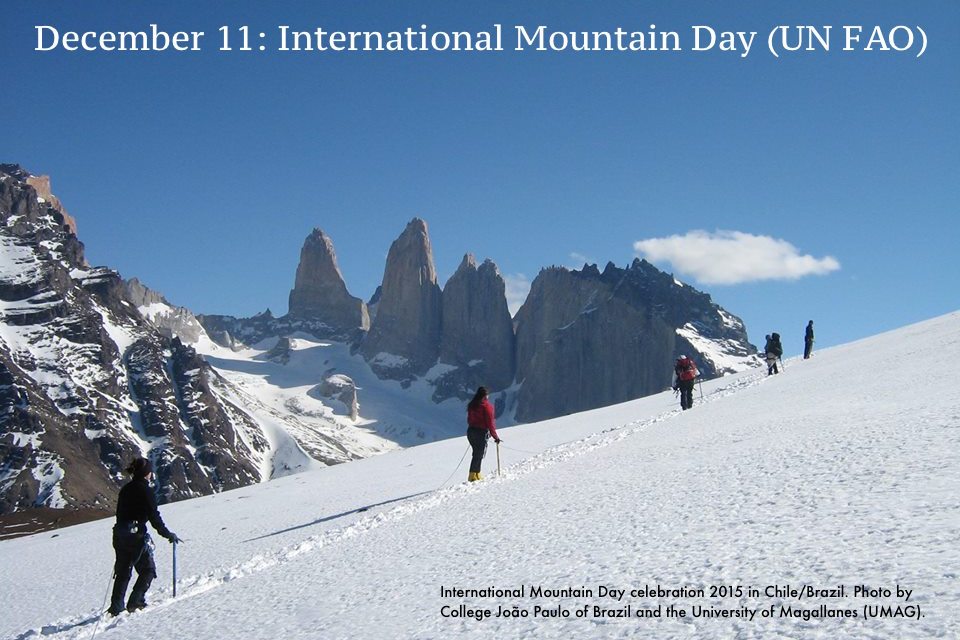
Since 2003, December 11 is International Mountain Day as designated by the United Nations General Assembly. Annually, the Food and Agriculture Organization of the United Nations (FAO) observes the day:
… to create awareness about the importance of mountains to life, to highlight the opportunities and constraints in mountain development and to build alliances that will bring positive change to mountain peoples and environments around the world.
• Mountains cover almost one-quarter (22 percent) of the Earth’s surface.
• Mountains host about 50 percent of the world’s biodiversity hotspots.
• Up to 80 percent of the world’s freshwater supply comes from mountains.
• One in eight people (13 percent) around the world lives in the mountains.
• Mountain tourism accounts for almost 20 percent of the worldwide tourism industry.
The following provides a glimpse to the mountain environments around the world and to the challenging conditions our ancestors would have faced and endured.
( Click here for images and more )
(October 2016)
As motivation to trace Martin Luther’s footsteps for the 500th anniversary of the Reformation in 2017 and to learn more about the impact of the Bauhaus art and design movement for the centenary in 2019, I embarked on a press-trip in the autumn 2016 to the German federal state of Saxony-Anhalt.
(( The description of this trip would be a continuation of a consecutive annual streak going back to 2001. I’ve set foot inside Germany at least once every year since 2001. I’d already claimed another consecutive year with a short stint at “home” in the HD earlier in the spring, but autumn in-country* solidly confirmed a 16th consecutive year in the country. ))
( Click here for more )
51.950265
11.692274
Above: Fraser River, east from Port Mann Bridge, between Coquitlam and Surrey, BC (HL).
The fourth Sunday in September is World Rivers Day. The University of Oxford’s Dictionaries defines ‘river‘ as:
“a large natural stream of water flowing in a channel to the sea, a lake, or another river.”
A river has always been water supply and demand: daily use and consumption; farming and agriculture; and where the waste goes, often back into the same supply. A river has always been about transport: trade and delivery of goods; shuttling people between places; and with people travelling, the exchange of language and culture. Throughout history, the establishment of towns and cities and the subsequent development of rivers have been about a mix of urban and rural elements, and about the relationship and interactions between people and their waterways.
( Click here for images and more )




 Fotoeins Fotografie