Fotoeins Fotografie

location bifurcation, place vs. home

Posts from the ‘Arts’ category

Dessau: The Bauhaus Building, UNESCO WHS

21st-century Modernity, from 1919 on

The chair or couch on which you sit.
The table on which you’re resting your mobile or pad.
The desk on which your laptop or desktop resides.
The light fixture on your desk or above your head.
The windows in your room, your house, or in the cafΓ© where you’re reading this.

The “universal” idea of living in a house or apartment with the furnishings we all take for granted from bathroom to bedroom and kitchen to living room is a relatively young idea by historical standards. It’s easy to imagine a time where only the rich upper-class could afford and were allowed to have and live in heated furnished residences, and the poor lower-class lived in unheated homes under damp dirty squalid conditions. Past designs with its heavy stone, porcelain, and ornate decorative components gave way to steel, glass, lightness of space, to favouring function over form. Simpler designs were meant to provide universal access: to the home, and to the essentials which furnished the home.

( Click here for images and more )

Martin Luther: tracing his steps in 16 German cities

Above/featured: “Luther war hier. (Luther was here.)” Eisleben, Germany. Photo, 27 Oct 2016.

In pre-teen years, I attended a Catholic elementary school by weekday, and a missions-oriented Protestant church by weekend. I already had multiple questions running around my pre-scientist brain, like electrons appearing and dissipating in a fuzzy halo. When various disparate elements began to settle with few satisfying answers, I left behind the churches and their respective religions. But one thing that’s remained is my love of history. History has never been boring, because I carry the past (as offspring of immigrants), and I’m determined to bring history’s lessons into the present.

Even in youth, I had to ask: why was one set of churches called “Protestant”? What was under protest? How did one man help spark a movement that would help merge and create a version of a language that continues today, that would bring accessible means to literacy for the public, and that would begin to change rule by religion to rule by law?


Martin Luther: Luder’ name at birth

From his birth in Eisleben; to formative years in Mansfeld, Magdeburg, and Erfurt; to the bulk of his working and teaching years in Wittenberg; to his death in Eisleben, Martin Luther set upon a course that helped change language, education, culture, religion, and governance. In many ways, Luther had much to thank Jan Hus for the latter’s efforts to reform the Catholic Church in Bohemia one hundred years earlier.

Every year on the 31st of October, a number of cities, regions, and federal states in Germany mark an important event in this movement. It’s widely understood Martin Luther walked up to the Castle Church in Wittenberg and pinned his 95 Theses to the church doors on 31 October 1517. Even if direct evidence Luther actually posted papers to the doors is debatable, what’s not is that 2017 marks the 500th anniversary of the Reformation in Germany.

Martin Luther, Reformation, German Reformation, Wittenberg, Marktplatz, Saxony-Anhalt, Sachsen-Anhalt, Germany, Deutschland, fotoeins.com

The illuminated Luther memorial stands tall in front of Wittenberg’s town hall at Market Square. As UNESCO World Heritage Site, the town hosts 4 sites: Luther House, Melanchthon House, St. Mary’s Town Church, and the Castle Church. 2017 is the 500th anniversary of Luther’s Reformation in Germany. Various German federal states, regions, and cities will mark the quincentenary throughout the year. Photo at Wittenberg Marktplatz on 30 Oct 2016.


( Click here for images and more )

Alfons Mucha, Art Nouveau, Jugendstil, Museum fuer Kunst und Gewerbe, Hamburg, Germany, fotoeins.com

My Prague: Alfons Mucha & Slavic Art Nouveau

Above: “Amants” (1895), poster for actress Sarah Bernhardt and her Théâtre de la Renaissance in Paris. Museum für Kunst und Gewerbe Hamburg – 5 Dec 2015 (HL).

One of my favourite artists from the Art Nouveau period is Czech artist Alfons Mucha (“MOOTZ’kha”). He loved strong women, or at the very least, he loved drawing and painting images of strong women, from the unique perspectives of a professional nature (above, Sarah Bernhardt) and a personal nature (below, “The Slav Epic”). I also associate Mucha with Prague, and it’s fitting the Mucha Museum prominently features his 1911 painting of “Princess Hyacinth.”

The meeting at Krizky, The Slav Epic, Alfons Mucha, Narodni Galerie, National Gallery, Prague, Czech Republic, fotoeins.com

Part of “The Meeting at KΕ™Γ­ΕΎky” (from “The Slav Epic”, 1916). National Gallery Prague – 30 July 2013 (HL).

Princess Hyacinth, Alfons Mucha, Mucha Museum, Praha, Prague, Czech Republic, fotoeins.com

Princezna Hyacinta” (Princess Hyacinth, 1911). Mucha Museum, 31 July 2013 (HL).


I made all of the photos above in July 2013 and December 2015. This post appears on Fotoeins Fotopress at fotoeins.com as http://wp.me/p1BIdT-8S5.

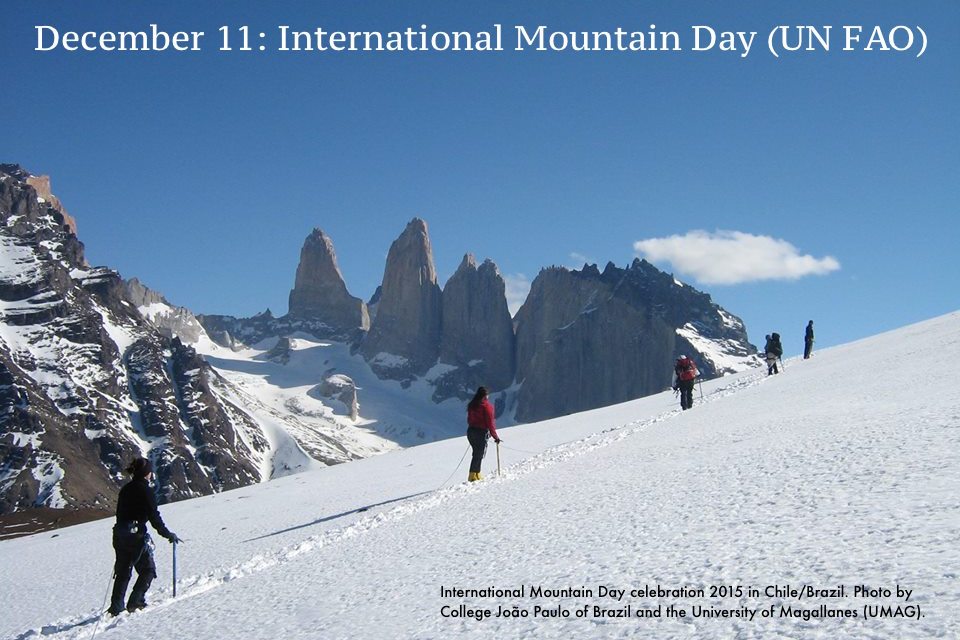
UN FAO International Mountain Day. International Mountain Day celebration 2015 in Chile/Brazil: photo by College JoΓ£o Paulo of Brazil and the University of Magallanes (UMAG).

11 December: International Mountain Day

Since 2003, December 11 is International Mountain Day as designated by the United Nations General Assembly. Annually, the Food and Agriculture Organization of the United Nations (FAO) observes the day:

… to create awareness about the importance of mountains to life, to highlight the opportunities and constraints in mountain development and to build alliances that will bring positive change to mountain peoples and environments around the world.

•   Mountains cover almost one-quarter (22 percent) of the Earth’s surface.
•   Mountains host about 50 percent of the world’s biodiversity hotspots.
•   Up to 80 percent of the world’s freshwater supply comes from mountains.
•   One in eight people (13 percent) around the world lives in the mountains.
•   Mountain tourism accounts for almost 20 percent of the worldwide tourism industry.

The following provides a glimpse to the mountain environments around the world and to the challenging conditions our ancestors would have faced and endured.


( Click here for images and more )

Wittenberger Marktplatz, Rathaus, Lutherdenkmal, Stadtkirche Sankt Marien, Marktplatz, Lutherstadt Wittenberg, Sachsen-Anhalt, Wittenberg, Saxony-Anhalt, Germany, Deutschland, UNESCO, World Heritage Site, Welterbe, Weltkulturerbe, fotoeins.com

The Saxony-Anhalt 5: Luther & Bauhaus

(October 2016)

As motivation to trace Martin Luther’s footsteps for the 500th anniversary of the Reformation in 2017 and to learn more about the impact of the Bauhaus art and design movement for the centenary in 2019, I embarked on a press-trip in the autumn 2016 to the German federal state of Saxony-Anhalt.

(( The description of this trip would be a continuation of a consecutive annual streak going back to 2001. I’ve set foot inside Germany at least once every year since 2001. I’d already claimed another consecutive year with a short stint at “home” in the HD earlier in the spring, but autumn in-country* solidly confirmed a 16th consecutive year in the country. ))


( Click here for more )