Fotoeins Fotografie

location bifurcation, place vs. home
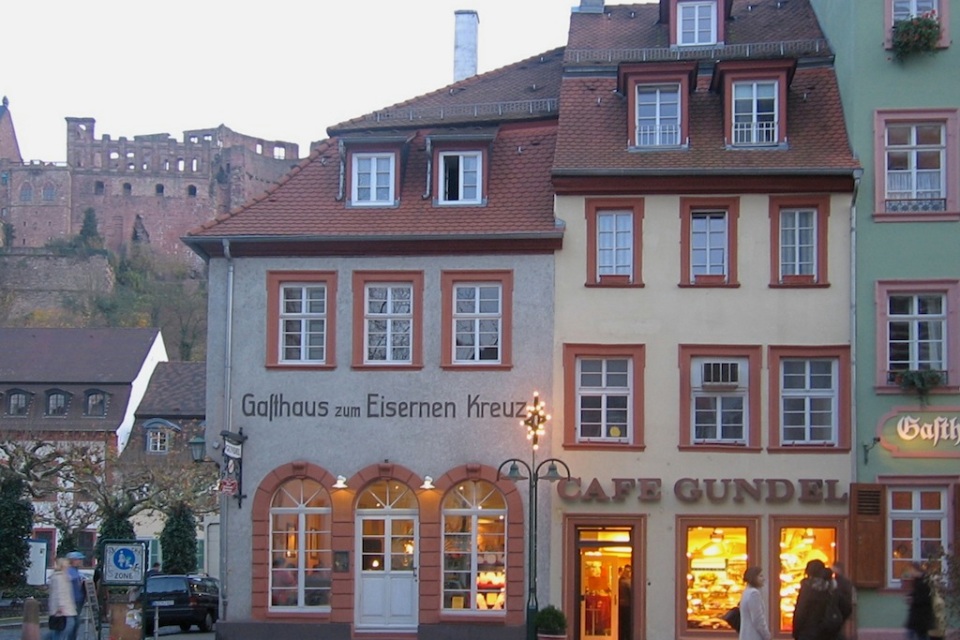
Alter Synagogenplatz, Altstadt, Heidelberg, Baden-Württemberg, Germany, fotoeins.com

My Heidelberg: Synagogue Square and Pogromnacht

It happens every time without fail.

My spirit breaks a little more every time I see a memorial, another example of the depths to which our species have plumbed.

Does feeling this way make me weak? Or am I resembling a human being after all?

I often hear a common chorus:

history is hard, history is boring, why should I care?

I can’t decide what’s worse: the rise of the far-right or blatant willful ignorance.


A Mob of Broken Glass

From the evening of 9 November to the following morning of 10 November 1938, Kristallnacht (“the night of broken glass”) was a “pogrom”, a coordinated series of violent attacks by Nazis against the Jewish people and their property in Germany, Austria, and Czechoslavakia’s Sudetenland. Pogromnacht (or Reichspogromnacht) is a truer description; the “prettier sounding” Kristallnacht hides the brutality of “the night of (broken) crystal” referring to broken shattered glass from windows to synagogues, homes, and stores owned by Jews. Aside from a few who intervened, most stood aside and watched people and property burn.

The word “pogrom” is a late 19th- to early 20th-century Russian word (“погром”), derived from the verb “gromit” (громи́ть) meaning “to destroy with violence.” While “pogrom” is used generally to describe mob violence by one ethnic or religious group on another, the term is used in this post to describe attacks on the Jewish community.

The numbers across the country were appalling: at least 90 dead, hundreds injured, 30000 arrested and detained in concentration camps, up to 2000 synagogues burned, over 7000 Jewish businesses damaged or destroyed. With one more insult, the Jewish community was forced to pay for damage to their own property. The outbreak of coordinated actions against Jewish people marked the beginning of state-sanctioned violence. With the Pogromnacht, the state no longer hid their hate and escalated their savagery as a turning point directly leading to the Holocaust.

( Click here for more )

Melbourne, Australia, myRTW, fotoeins.com

Navigating Melbourne’s lanes for street art

In an earlier post, I’ve shown some work on display as street art in Adelaide in South Australia.

Over a period of four days in Melbourne, I wandered through lanes and streets to look for some representative street art in the Victorian state capital, some works which spoke of the people who live there. Would it be the same kind of art and/or messages I’d seen earlier in Adelaide? As always, the set of artists and their respective work hold unique value in each of the cities.


( Click here for images and more )

Sydney: happy 52 to the Opera House (2025)

Above/featured: South view from Sydney Harbour towards the CBD – 12 Apr 2013 (450D).

Standing prominently above Sydney’s Bennelong Point, the white shelled structure serves as an icon for city and country.

The Sydney Opera House is made up of three groups of interlocking “vaulted shells” housing two primary concert auditorium spaces. The shell-like structures sit upon a large platform, encompassed on the outside by stepped terraces as staging or assembly areas for visitors.

On 20 October 1973, Queen Elizabeth II formally opened The Opera House. In the decades since, the building has become an icon for city and country. The building endures as a “landmark” and “ambassador” for both city and country. Immediately telling are the roof’s white shells, looking like wind-blown sails at a distance in the harbour.

( Click here for images and more )

Ocean Beach, San Francisco, CA, USA, fotoeins.com

Dear Anita

September 2013.

Dear Anita,

It’s been a month since you left.

Every day, I look and check online for some sign that you’re gone. If I can’t find that notice somewhere, it won’t seem real, that instead I’ve fallen prey to some cosmic joke, and you’ll turn up somewhere alive, safe and sound.

There’s been a continuous jumble and tumble of bubbles in my head, but if I don’t put them down somewhere, I fear they would disappear into the aether. With words streaming from one screen to the next, will they ever reach you? Will these thoughts, ideas, and regrets find their way to you?

When you left, a number of promises set off with you.

The promise, however slight or tenuous, of meeting one day, and I could properly say hello and thank you for your help and support.

The promise, mingling with the memories of having met your fellow travelers and friends, of having them tell you how much they missed you.

The promise, among well-organized plans, of visiting places you always wanted to see.

And when you were about to fall, I promise we would’ve been there to catch you. The promise, though ready as we were, we could not fulfill or prevail.

How did not I know about what was happening? Why didn’t I see your tweets or read your blog? What more could we have done?

Swimming in guilt, the feeling has subsided to a dull ache that’s wishing for an outlet and release. I’ve been holding my hands out, arms held high, waiting for something to happen. But when questions finally arrive, I know it’s too late again: supplication and submission sink slowly, returning to the sea.

Everyone has responsibility for their own lives, but that truism seems to fall short of what’s necessary in our so-called collective. After all, haven’t we always been saying a place to rest and to call “home” isn’t completely out of line some of the time?

Once things go awry I suppose one waits an eternity to yell bloody fire in a crowded building, but thing is, we don’t do that sort of thing around here. Among friends and family, one endures alone and apart, a stranger and survivor of purgatory among the unholy trinity of shame, secrecy, and blame. In the rabbit hole, things rarely add up, and there’s not a lot to see but the rest of the way down.

I’ve heard the calling of the knives; I know they’ve been lurking in the corner for the last thirty years. Countless hours, grinding days and weeks, the weary months, and jailbound years must claim a price, and what’s true in the past remains unchanged in the present. If I’m not careful, a carefully constructed box opens to unleash despair; it’ll return to hunt and to haunt, like a long-lost friend.

But for reasons I cannot explain, there is still some undiminished capacity for hope that hasn’t fully gone. I’m still here; we’re still here. It’s easy thinking to believe the light was extinguished. I guess I’d fooled myself into hiding among the shadows.

Moving on seems cold and unfeeling, something like an ugly dirty obscenity. The process of creating as before in your absence seems oddly wrong, but I’m certain you’d want us all to continue. I’m sure you wouldn’t have wanted it any other way.

Fact is you’ll always be remembered as being part of a group, whose members are joined by the algebra of uniting different people by a common interest. It’s easy to forget there are simple rules of making a connection, even brief, among all of the mathematics of our individual problems, equations, and solutions.

I want you to know you were never alone. It’s up to us now to accept the simplicity of that truth. Every person who’s passed into our lives in some way must take their rightful place; no one can dismiss the effect a person has on others.

Since I started traveling extensively in the last twenty years, I’ve never liked saying goodbye. I’m not about to start, even now.

I’ll see you when I see you.

Sincerely,
Henry.


I made the photo at Ocean Beach in San Francisco on 18 March 2012. This letter-post appears on Fotoeins Fotopress at fotoeins.com as http://wp.me/p1BIdT-3QT.

Embalse Puclaro, Puclaro, Rio Elqui, Elqui river, Region de Coquimbo, La Serena, Chile, fotoeins.com

My Chile: Elqui River, Puclaro Dam

Above/featured: Upstream and east to Andes – 9 August 2008.

27 September has been earmarked by the United Nations World Tourism Organization (UNWTO) as “World Tourism Day”. The following is a tweet by the United Nations for World Tourism Day in 2013.

The Elqui River in north-central Chile begins in the mountains of the lower Andes, and flows west to the Pacific along the southern edge of the Atacama desert through the towns of Vicuña and La Serena. The average annual total rainfall in La Serena is 10 to 13 cm (4 to 5 inches), less than one-tenth of the total for Vancouver, Canada.

The Elqui was dammed by 1999 to control water usage by farms in the lower valley and by pisco vinyards in the upper valley; however, construction of the dam displaced people in small low-lying towns on both sides of the river. Behind the dam in the Embalse or reservoir Puclaro (photo above), the water level has declined with lower annual snowfall in the mountains above and higher usage by farms and the increasing population below. The price for water continues to rise due to competition from mines, farms, and the growing population. Numerous research visits and five years living in La Serena emphasized the contrast of the importance of water to people’s lives in the region with the dominant presence of the neighbouring Atacama.


Embalse Puclaro, Puclaro, Rio Elqui, Elqui river, Region de Coquimbo, La Serena, Chile, fotoeins.com

Rio Elqui, downstream and west from the Embalse Puclaro – 9 Aug 2008.

Embalse Puclaro, Puclaro, Rio Elqui, Elqui river, Region de Coquimbo, La Serena, Chile, fotoeins.com

Retaining wall – 13 Sep 2009.

Embalse Puclaro, Puclaro, Rio Elqui, Elqui river, Region de Coquimbo, La Serena, Chile, fotoeins.com

Flags for the upcoming Fiestas Patrias national holiday – 13 Sep 2009.

Embalse Puclaro, Puclaro, Rio Elqui, Elqui river, Region de Coquimbo, La Serena, Chile, fotoeins.com

View east into the Andes – 13 Sep 2009.


I made all photos above with a Canon EOS450D/Rebel XSi on 9 Aug 2008 and 13 Sept 2009. This post appears on Fotoeins Fotografie at fotoeins DOT com as http://wp.me/p1BIdT-3PS.