Vienna Ringstrasse & Architectural Historicism
Above/featured: Examples of the “Ringstraßenstil” historicism style at Maria Theresa Square, with Maria Theresa Monument at left and the Museum of Natural History at right. Photo, 15 May 2022 (X70).
• Can a street alone define its surrounding architecture?
• Do the buildings themselves establish the street’s visual impression?
• Is Vienna (un)fairly defined by the Ringstrasse and the inner city?
The answers, as always, are a little complicated.
Like many, I’m also fond of Vienna’s Ringstrasse (Ring Road), as a kind of “hello” and re-introduction to the city after my first visit in 2002. At 5 kilometres in length, the Ringstrasse is one of the longest streets in Europe, longer than the nearly 2-km Champs-Élysées in Paris and longer than the 4.5-km Nevsky Prospekt in St. Petersburg. The boulevard is surrounded by Prachtbauten (buildings of splendour), constructed in the architectural style of “historicism,” a big nod to classic “forms” reflecting structural “functions”. The late-19th century “Ringstrassenstil” (Ring Road architectural style) continued the practiced habit of choosing a historical style which best identified with the purpose of the building. For example, the Neo-Baroque architectural style is represented in the Civic Theater; the Neo-Classical style in the Parliament and New Palace; the Neo-Gothic style in City Hall and the Votive Church; and the Neo-Renaissance style in the museums, palatial mansions, Opera House, and the University.
On Christmas Day 1857, the Wiener Zeitung newspaper published an imperial decree written 5 days earlier (on 20 December) by Habsburg emperor Franz Joseph I. He ordered the demolition of the inner-city wall and the subsequent creation of a circular boulevard, bordered by grand buildings and filled with green spaces. The large outward extension of the inner city changed and influenced the urban development of Vienna, still seen to this very day.
It is my will that the extension of the inner city of Vienna should proceed as soon as possible, providing for appropriate connections between the city and the suburbs as well as the embellishment of my imperial residence and capital. To this end, I authorise the removal of the walls and fortifications of the inner city as well as the ditches around it …– Emperor Franz Joseph I: 20 Dec 1857, published 25 Dec 1857.
On 1 May 1865, Emperor Franz Josef unveiled the Ringstrasse in an official ceremony, even though large areas remained under construction. Ringstrasse structures included the religious and the secular, as well as the public and the private. The Ringstrasse symbolized the power of the imperial state, and the growth of a new arts and culture scene with the increasing popularity of coffee houses.
It’s also important to note the architectural impact made by the Jewish middle- and upper-class to integrate within the Habsburg empire. For example, the families Ephrussi, Epstein, and Todesco commissioned architect Theophil Hansen to construct palatial mansions as visible manifestations and partial realization of the dream of many Viennese Jews: assimilation into and emancipation within Viennese society. (Viennese journalist and political activist Theodor Herzl might have had a different opinion about that.)
For residents and long-term visitors today, it’s entirely possible to fit into the unintended shape and mentality of the “modern” city: that the inner-city wall was simply replaced by a different wall of “economic class”, that the architectural callback to historicism “freezes” the inner-city in time, and that like many, I can live, traverse, and work in the outer districts and avoid entering the inner city.
For short-term visitors today, the Ringstrasse buildings form a golden shiny “ring” around the “fingers” of the U1 and U3 metro lines traversing through the UNESCO World Heritage inscribed inner-city. For these visitors, all that’s needed for their limited time in Vienna is the inner city.
22 examples on the Ring
The Ringstrasse forms a part of the architectural ensemble in the identification and recognition of Vienna’s inner city as historical centre and as UNESCO World Heritage Site. I highlight 22 structures on the Ringstrasse; the list is neither comprehensive nor exhaustive, and assembled entirely from personal interest. With construction dates beginning in 1858 to about 1890, these structures stand on ground once occupied by the inner-city wall or by the open defensive fields (“glacis”) in front of the wall.
- Akademie der bildenden Künste (Academy of Fine Arts)
- Akademisches Gymnasium (Academic high school)
- Alte Börse (Old Stock Exchange)
- Burgtheater (Civic Theater)
- Künstlerhaus (Artists’ House)
- Kunsthistorisches Museum (KHM, Museum of Art History)
- Maria-Theresien-Denkmal (Maria Theresa Monument)
- Museum für angewandte Kunst (MAK, Museum of Applied Art)
- Musikverein (Music Society of Vienna)
- Naturhistorisches Museum (NHM, Museum of Natural History)
- Neue Burg (New Palace)
- Palais Ephrussi
- Palais Epstein
- Palais Todesco
- Parlament (Parliament)
- Rathaus (City Hall)
- Rossauer Kaserne (Rossau Barracks)
- Schwarzenberg-Denkmal (Schwarzenberg Memorial)
- Staatsoper (Opera House)
- Stadtpark (City Park)
- Universität (University)
- Votivkirche (Votive Church)
• Vienna inner city: the Glacis, 1858
• Structures by architect
• Structures by architectural style
• Sources
Tram (streetcar) routes 1 and 2 carry both resident and visitor around the Ringstrasse, and offer an inexpensive way of travelling among examples of Ringstrasse architecture and gathering a visual overview of Vienna’s inner city. A recommended informal tour or circuit with public transport begins at stop Oper-Karlsplatz, boarding tram 2 (“Friedrich-Engels-Platz”), travelling counterclockwise along the eastern section of the ring, disembarking from tram 2 at stop Schwedenplatz, switching to tram 1 (“Stefan-Fadinger-Platz”), and returning along the western section of the ring to stop Oper-Karlsplatz. A complete journey on the Ring takes about 30 to 40 minutes.
1. Akademie der bildenden Künste
• Academy of Fine Arts.
• Architect: Theophil Hansen.
• Style: Neo-Renaissance (Italian).
• Inauguration: 1877
The building is home to Austria’s oldest state/public arts school. The academy’s many students/alumni include: Heinrich Ferstel, Ernst Fuchs, Josef Hoffmann, Hans Hollein, Friedensreich Hundertwasser, Katarina Ivanović, Max Kurzweil, Franz Xaver Messerschmidt, Koloman Moser, Eduard van der Nüll, Joseph Maria Olbrich, Jože Plečnik, Egon Schiele, Otto Wagner, Ferdinand Georg Waldmüller, Robert Weigl, Erwin Wurm. The academy’s Paintings Gallery (Gemädegalerie) is open to the public, home to a collection of over 1500 painted works going back to the 14th-century, including Bosch’s triptych “The Last Judgement.”

Academy of Fine Arts in morning light – 15 May 2022 (X70).
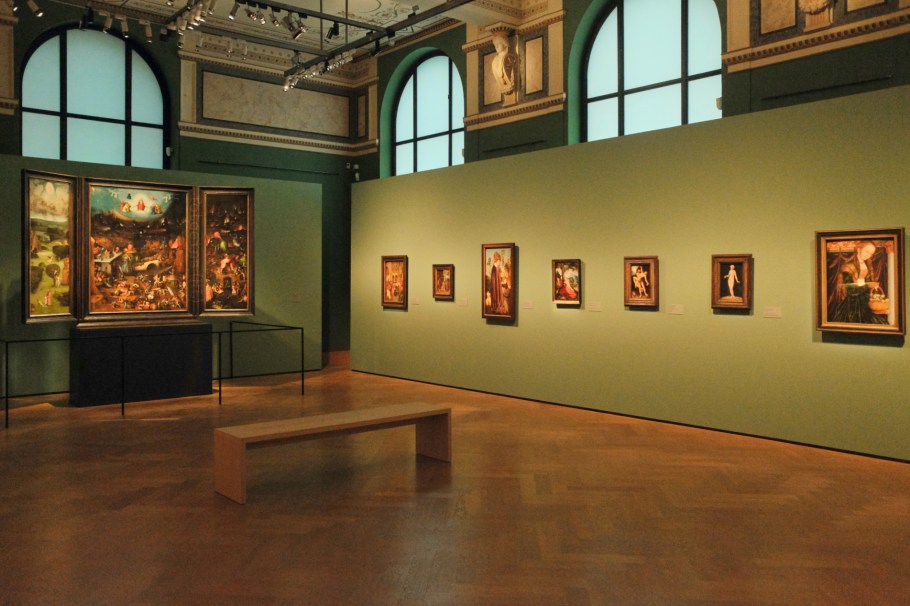
Within the Academy of Fine Arts is the Gemäldegalerie (Picture Gallery), whose collection includes Hieronymus Bosch’s “The Last Judgement”, shown here at left. Photo, 7 Jun 2023 (X70).
2. Akademisches Gymnasium
• Academic high school.
• Architect: Friedrich Wilhelm Schmidt.
• Style: Neo-Gothic brick.
• Inauguration: 1866.
The city’s oldest high school was initially established by the Jesuits in 1553. Today, the academic secondary-school is non-denominational and tuition-free; demand for enrollment spaces is high. Among the school’s alumni in recent history are Hugo Hofmannsthal, Walter Kohn, Tomáš Garrigue Masaryk, Lise Meitner, Johann Nestroy, Elise Richter, Arthur Schnitzler, Erwin Schrödinger, Franz Schubert, Otto Wagner.
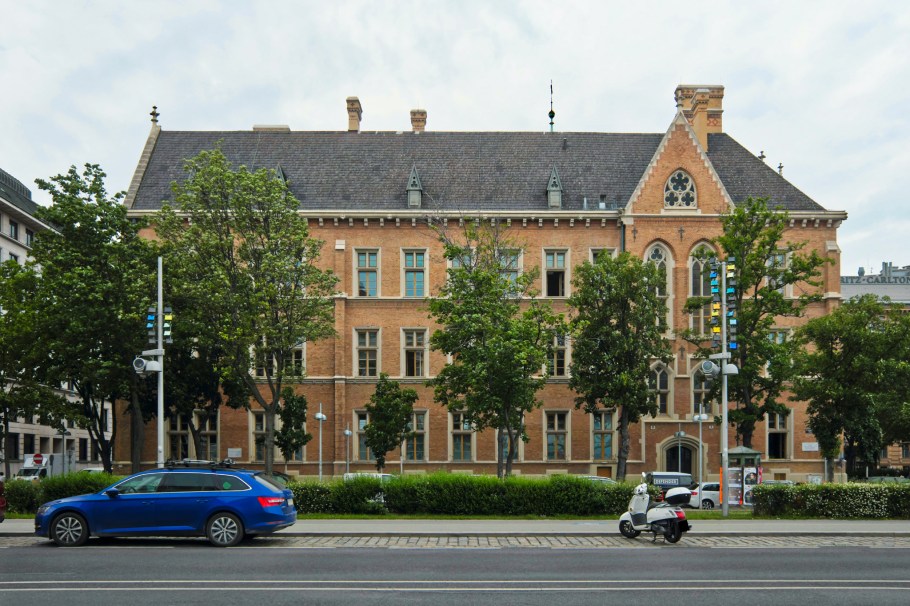
Facing northwest on Lothringerstrasse. Photo, 24 May 2022 (X70).
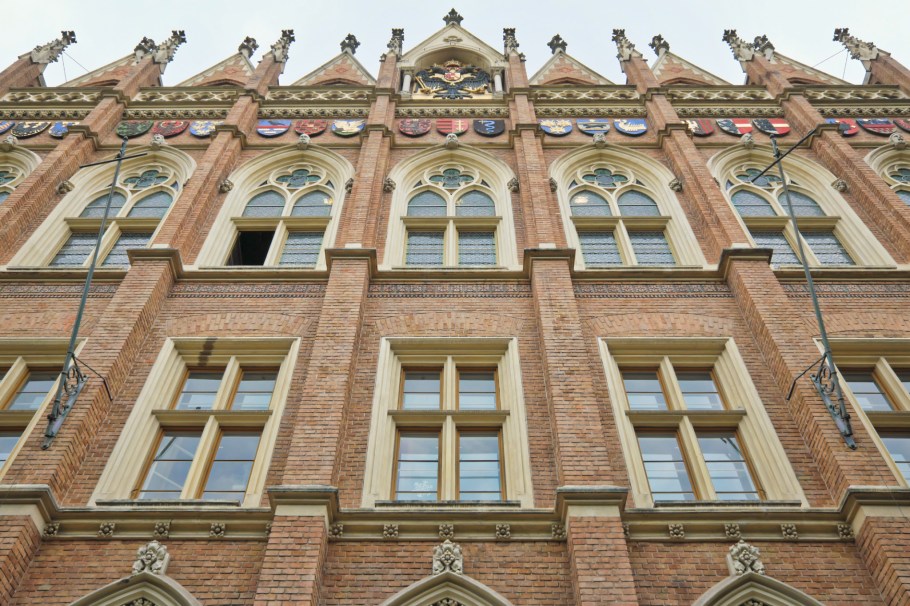
Front facade from Beethovenplatz. Photo, 24 May 2022 (X70).
3. Alte Börse
• Old Stock Exchange.
• Architect: Theophil Hansen.
• Style: Neo-Renaissance.
• Inauguration: 1877.
The Vienna Stock Exchange operated out of this building until 2001 with the move to the Palais Caprara-Geymüller. Today, the Old Stock Exchange building is home to event- and office-space, including the following tenants: Accenture, Austrian Bankers’ Association, Lederleitner, Regus, Symantec Austria, Thomson Reuters.
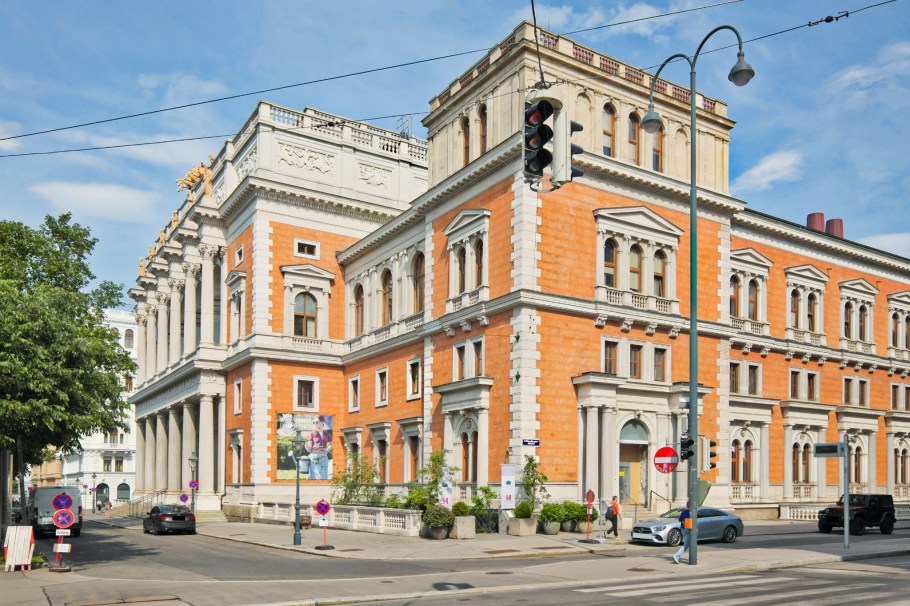
In afternoon illumination, the Old Stock Exchange is home to office space. Photo, 2 Jun 2023 (X70).
4. Burgtheater
• Civic Theater.
• Architects: Gottfried Semper (ground plan), Karl Hasenauer (facade, interior).
• Style: Neo-Baroque.
• Inauguration: 1888.
The Burgtheater is home to Austria’s national theater, and is considered as one of the most important German-language theaters in the world.
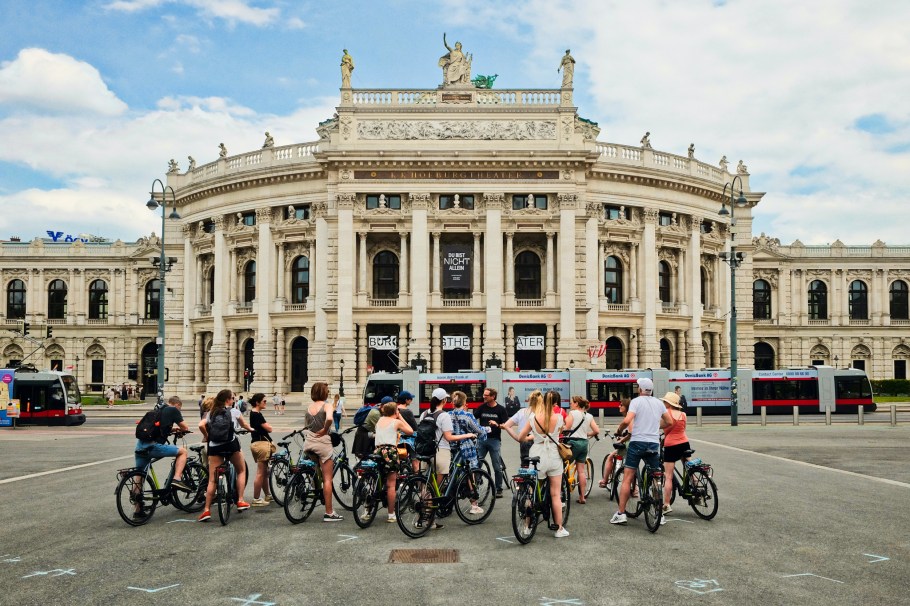
A group of bicyclists on a guided city tour stop at Rathauspark. Photo, 5 Jun 2022 (X70).

Front facade in afternoon light, including signage for the imperial-royal imperial court theater (k.k. Hofburgtheater) and many statues by Austrian sculptor Viktor Tilgner of playwright- and theater-greats including Lessing, Goethe, and Schiller. At the top is a plaque dedicated to Kaiser Franz Joseph I upon the building’s completion in 1888. Photo, 28 May 2023 (X70).
5. Künstlerhaus
• Artists’ House.
• Architect: August Weber.
• Style: Italian Renaissance.
• Inauguration: 1868.
With the founding in 1861 of “Genossenschaft der bildenden Künstler Wiens” (Vienna Fine Arts Cooperative), the collective was responsible for one of the first structures built by artists in Europe. The Artists’ House has been home to the Albertina Modern since 2020.

Front facade of the Albertina Modern, formerly known as the Künstlerhaus. Photo, 15 May 2023 (X70).
6. Kunsthistorisches Museum (KHM)
• Museum of Art History.
• Architects: Karl Hasenauer, Gottfried Semper.
• Style: Neo-Renaissance.
• Inauguration: 1891.
The KHM and NHM (see below) were designed as “twin” constructions. As part of the planned grand “Kaiserforum” extension to the Hofburg, only the KHM, NHM, and Neue Burg were completed in full. Inside the KHM (The Museum of Art History), experiencing the massive collection of art is akin to walking through a centuries-old treasures cabinet. My favourites include works by: Arcimboldo (“Summer”); Bruegel/Brueghel (“Hunters in the Snow”); Titian (“Bravo”); and Vermeer (“The Art of Painting”).
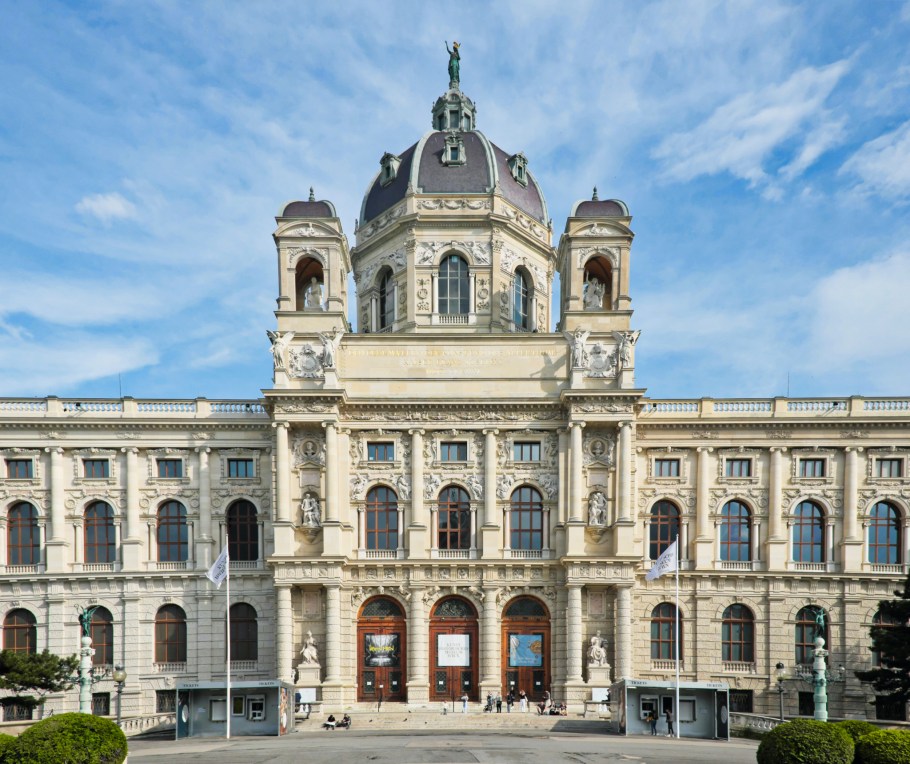
The Museum of Art History: the front face in afternoon light. Photo, 17 May 2022 (X70).
7. Maria-Theresien-Denkmal
• Maria Theresa Monument.
• Architects: Karl Hasenauer, Caspar Zumbusch.
• Style: Historicism.
• Inauguration: 1888.
At the centre of a wide plaza bookended by the Museums of Art and Natural History is a memorial dedicated to Empress Maria Theresa, the only woman ever to rule the Habsburg empire. The memorial was designed and built by Karl Hasenauer with sculptures by Caspar Zumbusch; inauguration to the public took place on 13 May 1888. The memorial, the two imperial museums, and the accompanying Maria Theresa Square were the only completed portions of the “Kaiserforum” expansion project by Semper and Hasenauer.
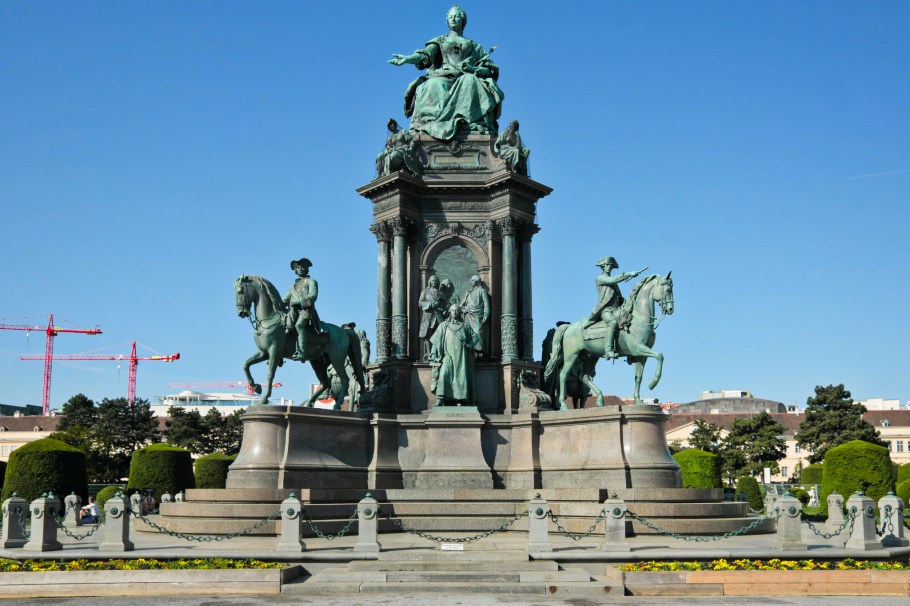
Southwest view towards the Museumsquartier. Empress Maria Theresa faces the Burgtor and Hofburg. Photo in morning light on 15 May 2022 (X70).

In her left hand, Empress Maria Theresa holds a sceptre and the 1713 Pragmatic Sanction issued by her father Holy Roman Emperor Charles VI. The imperial proclamation allowed his eldest daughter to rule the empire, because women were not allowed to rule as head of state. This image is a big crop of the previous image above.
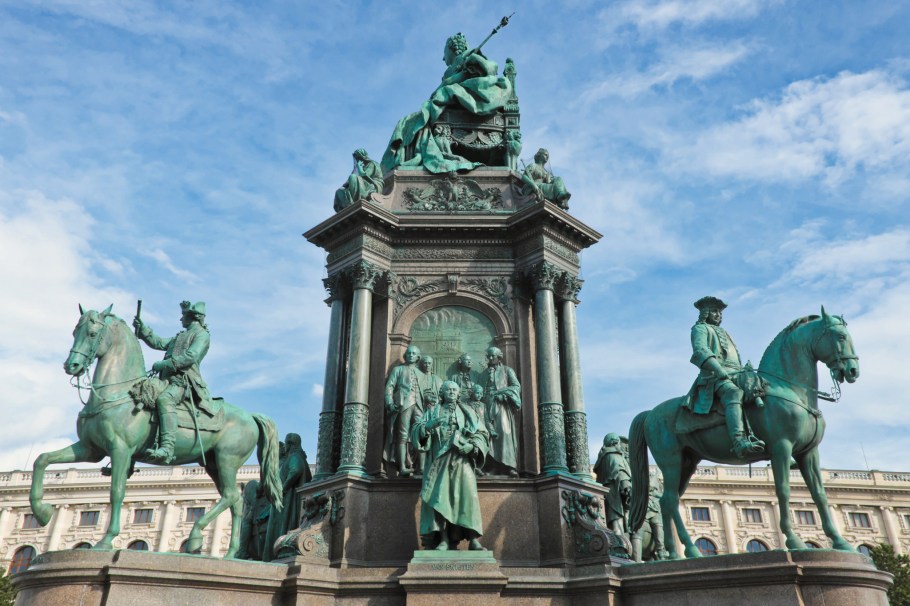
Facing southeast, with the Museum of Art History in the background. Photo in afternoon light on 17 May 2022 (X70).
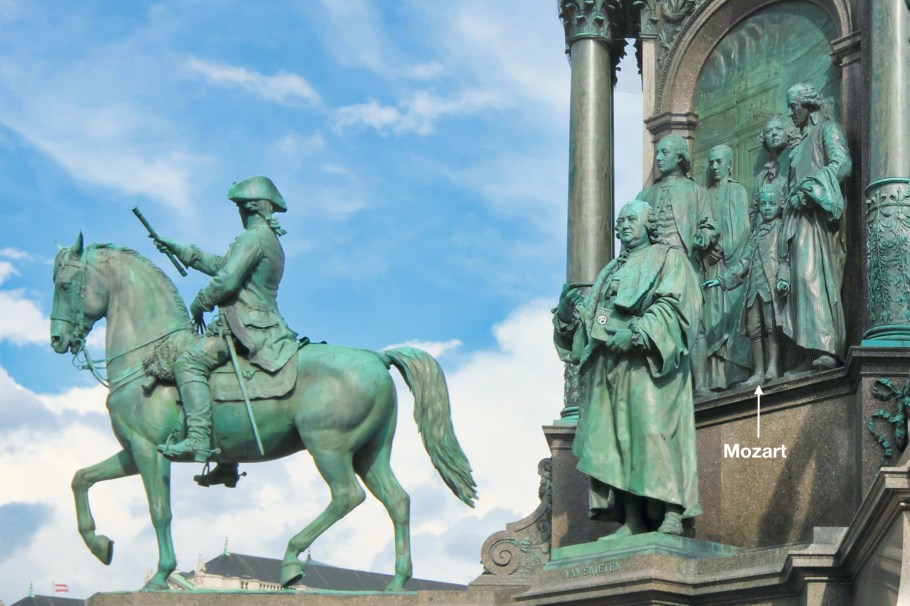
Facing east; at right is the Arts section of the memorial column with young Wolfgang Amadeus Mozart and his mentor Joseph Haydn to the right. Photo, 17 May 2022 (X70).
8. Museum für angewandte Kunst (MAK)
• Museum of Applied Arts.
• Architect: Heinrich Ferstel.
• Style: Neo-Renaissance (Florentine/Tuscan).
• Inauguration: 1871, as Imperial-Royal Austria Museum for Art & Industry.
The MAK is also home to the largest collection of works by the Wiener Werkstätte (“Vienna Workshop”), an early 20th-century arts and design collective created out of the Secession and Art Nouveau movements. The name of Viennese architect, artist, and designer Josef Hoffmann is all over the collection.

Facing east from Stubentor: the Museum of Applied Arts. Photo, 13 Jun 2023 (X70).

The MAK in late-afternoon light. Photo, 13 Jun 2023 (X70).
9. Musikverein
• Music Society (of Vienna).
• Architect: Theophil Hansen.
• Style: Neo-Classical.
• Inauguration: 1870.
In the Great Hall of the Musikverein, the annual New Year’s Day concert is performed by the Vienna Philharmonic. The “Neujahrskonzert der Wiener Philharmoniker” event in 2023 is described here.

Musikverein in afternoon light. Photo, 2 Jul 2025 (P15).
10. Naturhistorisches Museum (NHM)
• Museum of Natural History.
• Architects: Karl Hasenauer, Gottfried Semper.
• Style: Neo-Renaissance.
• Inauguration: 1889.
The NHM and KHM (see above) were designed as “twin” constructions. As part of the planned grand “Kaiserforum” extension to the Hofburg, only the KHM, NHM, and Neue Burg were completed in full. The NHM (Museum of Natural History) operates as museum and research facility, containing a large inventory of natural artifacts first collected together by the Habsburgs in 1750.
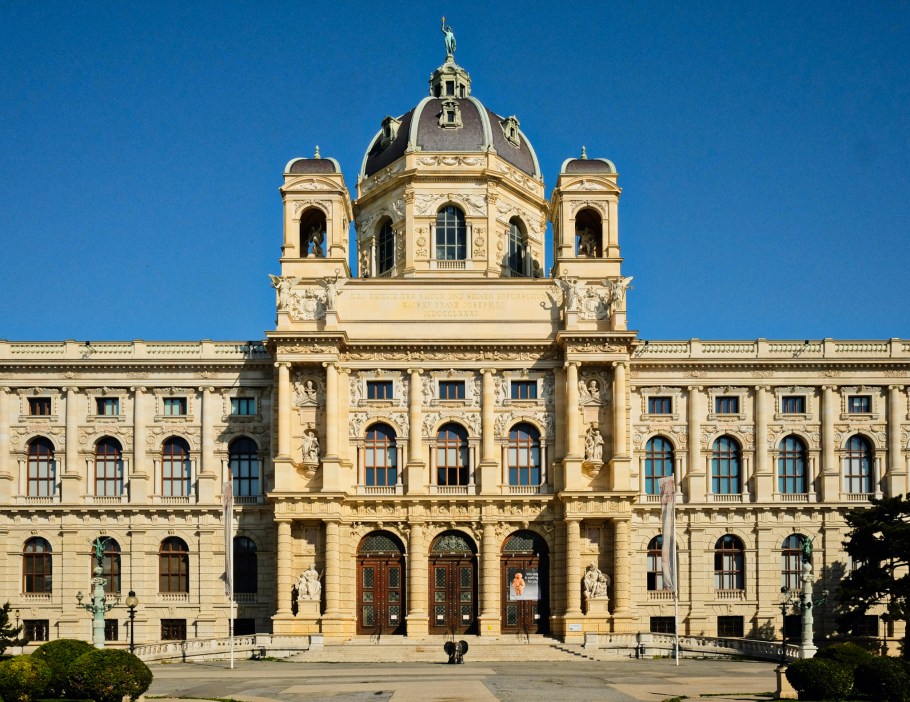
The Museum of Natural History’s front facade in morning light. In front of the museum’s steps is a 1996 bronze sculpture of a small elephant created by Austrian artist Gottfried Kumpf. Photo, 15 May 2022 (X70).
11. Neue Burg (Hofburg)
• New Palace.
• Architects: Karl Hasenauer, Gottfried Semper.
• Style: Neo-Classical.
• Inauguration: 1871.
In existence since the 13th century, the Imperial Castle (Hofburg) in the late 19th-century saw designs for an enormous expansion project designed by Semper and Hasenauer and facing the new Ringstrasse. Only a small portion of the “Kaiserforum” was realized, including the Neue Burg (New Palace) and the two imperial museums of art- and natural-history (KHM & NHM). Unfortunately, the once peaceful working relationship between Semper and Hasenauer deteriorated, as Hasenauer tried to claim sole credit with a miscalculated letter putting himself in generous light. Semper’s son, Manfred, assembled proof from the exchange of letters, and delivered a scathing rebuttal that damaged Hasenauer’s reputation in Austria (Mallgrave 1996).
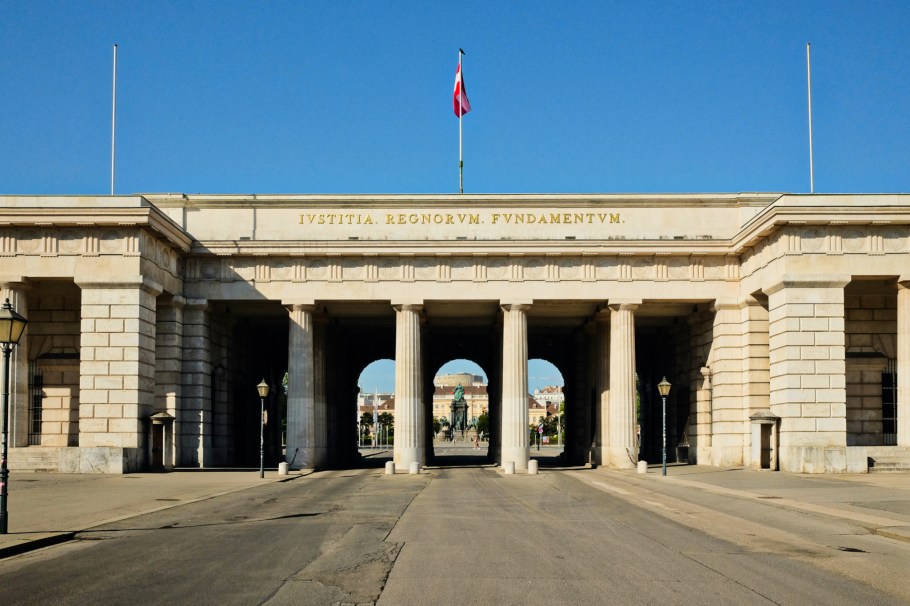
Äusseres Burgtor (Outer Palace Gate): facing “inwards” to Heldenplatz is the inscription “Iustitia. Regnorum. Fundamentum.” (Justice is the foundation of imperial rule.), the motto for Emperor Franz I. Photo, 15 May 2022 (X70).
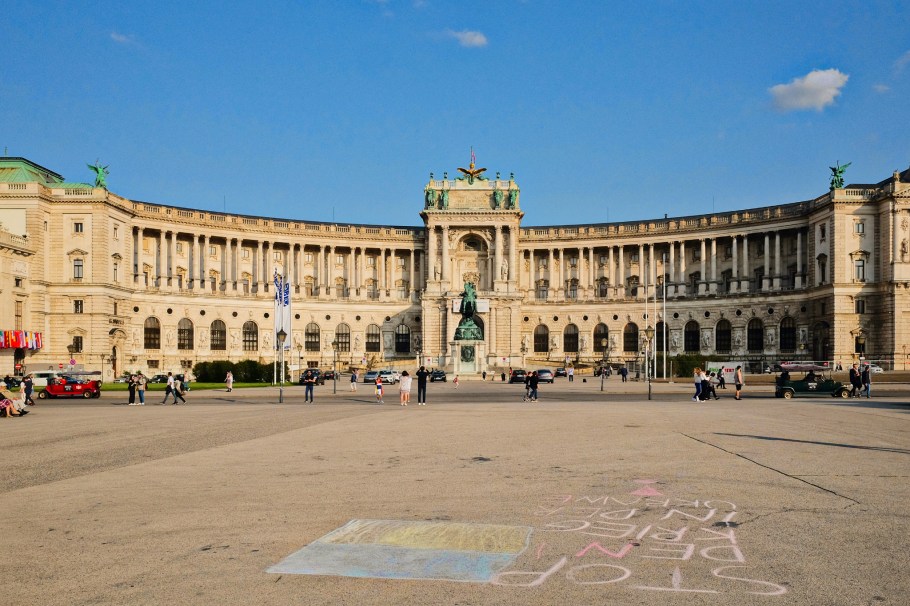
Facing southeast from Heldenplatz, the Neue Burg is home to the Ephesos Museum, the Weltmuseum, the House of Austrian History, and the Austrian National Library’s Papyrus Collection. Photo, 28 May 2023 (X70).
12. Palais Ephrussi
• Ephrussi palace.
• Architect: Theophil Hansen.
• Style: Neo-Renaissance.
• Inauguration: 1872–1873.
For the Ephrussis, the building is about a banking family, expulsion and loss, difficult efforts to seek justice and compensation, and a limited return of historical keepsakes to the city. Edmund De Waal’s 2001 family memoir “The Hare With Amber Eyes” opened the city’s and world’s eyes to the plight of the Ephrussi family. The De Waal family donated the remainder of the Ephrussi family archive to Vienna’s Jewish Museum in early 2018, marking a return of an important piece of Jewish history to the city. Today,
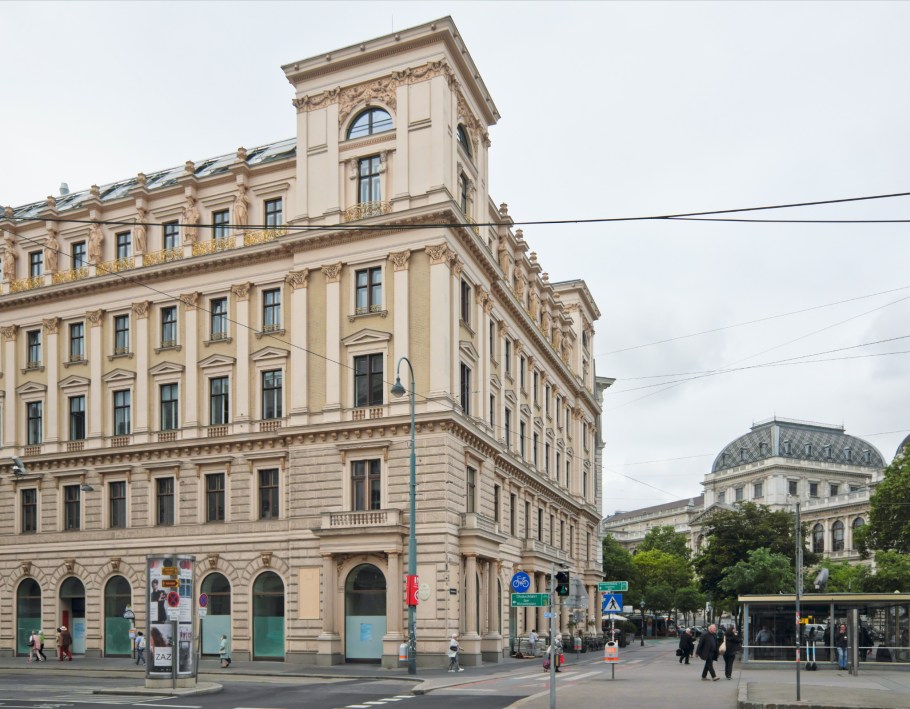
At left is the Palais Ephrussi, with the University of Vienna’s main building in the background. Photo, 25 May 2022 (X70).
13. Palais Epstein
• Epstein palace, for the Epstein family.
• Architects: Theophil Hansen, Otto Wagner.
• Style: Neo-Renaissance.
• Inauguration: 1868–1871.
The Austrian national parliament uses the renovated building for supplementary office and ministerial space, and offers to the public free guided tours of the building’s interior. The Epstein family commissioned architect Otto Wagner to build an additional summer palace in nearby Baden bei Wien in 1867.

Palais Epstein in morning light, from Burgring facing northwest. Photo, 15 May 2022 (X70).
14. Palais Todesco
• Todesco palace.
• Architects: Ludwig Förster (building), Theophil Hansen (interior design).
• Style: Neo-Renaissance.
• Inauguration: 1861–1864.
Today, the building is home to Gerstner K.u.K. Hofzuckerbäcker cake shop and restaurant. Members of the Todesco family are buried in the city’s Währing Jewish cemetery (Jüdischer Friedhof Währing).

Palais Todesco, across from the Opera House. Photo, 13 May 2023 (X70).
15. Parlament
• National Parliament.
• Architect: Theophil Hansen.
• Style: Neo-Classical (Greek revival).
• Inauguration: 1883.
The Parliament Building is home to the bicameral legislature of the Federal Republic of Austria, which consists of the National Council (Nationalrat) and Federal Council (Bundesrat). The Parliament reopened its premises in 2023 after extensive renovations lasting several years.
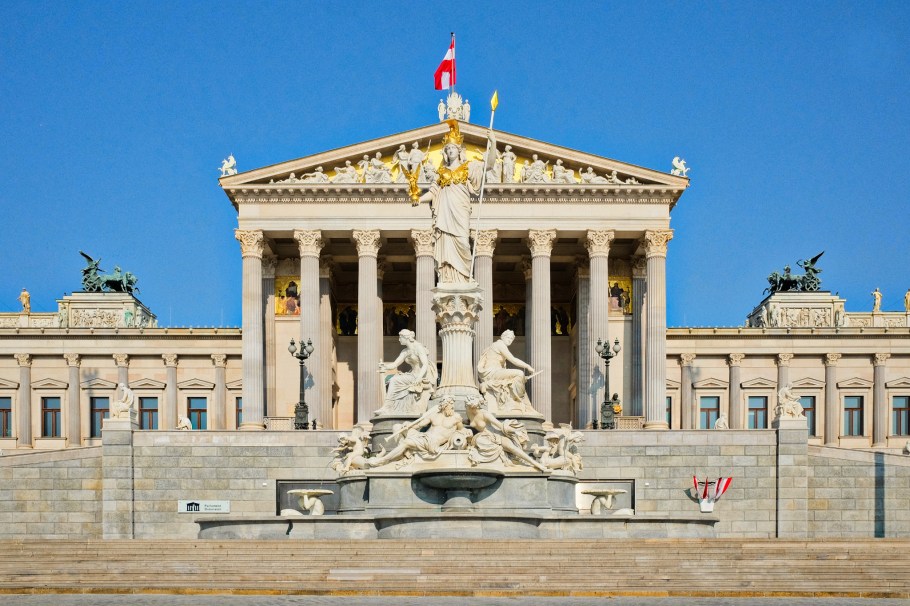
The Pallas-Athena fountain (T. Hansen & C. Kundmann) and the Parliament building in the foreground and background, respectively, as viewed in morning light from Dr. Karl Renner-Ring. Photo, 28 May 2023 (X70).
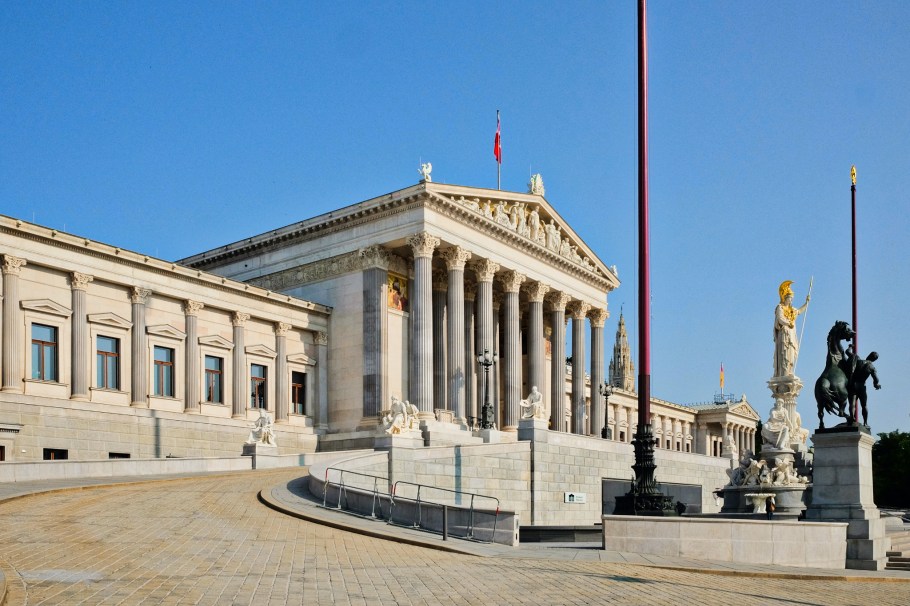
Parliament’s south ramp, with the Rathaus appearing behind at right-centre. Photo, 28 May 2023 (X70).
16. Rathaus
• City Hall.
• Architect: Friedrich Wilhelm Schmidt.
• Style: Neo-Gothic (Flemish, Gothic revival).
• Inauguration: 1883.
There’s no question City Hall stands as a living (and, perhaps, “old-fashioned”) architectural monument; guided tours of the building’s interior are available to the public. The square in front of City Hall is used as concert and special-events venue in the summer, and as a Christmas market and skating rink in the festive season.
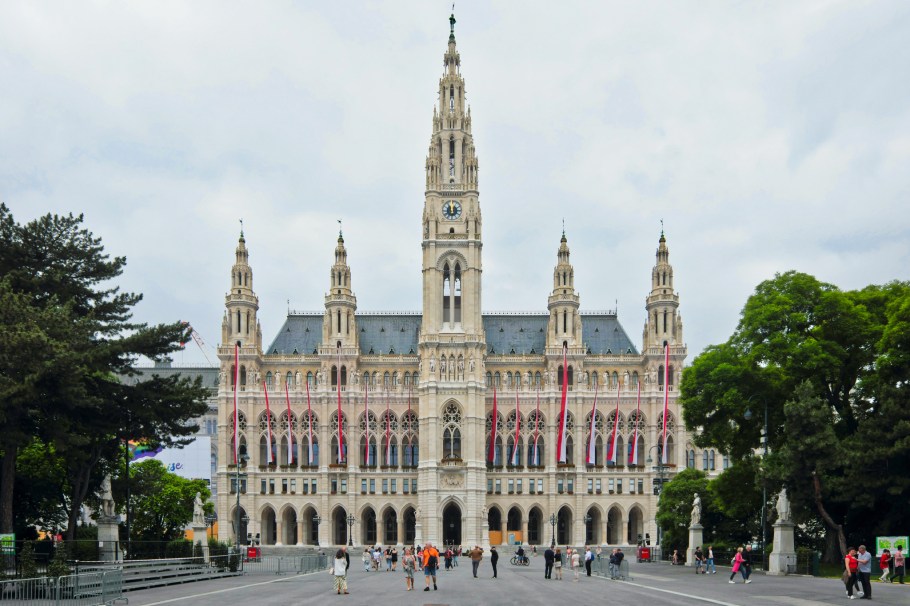
Open look of the square in front of City Hall, from Rathauspark. Photo, 10 Jun 2023 (X70).
17. Rossauer Kaserne
• Rossau Barracks; originally called Kronprinz-Rudolph-Kaserne.
• Architects/planners: Colonel Karl Pilhal, Major Karl Mark.
• Style: Windsor; romantic historicism.
• Inauguration: 1870.
Still smarting from events of the 1848 revolution and unhappy with the loss of the inner-city wall, the imperial military demanded as concession the construction of additional barracks around the city, including the Rossau Barracks at the northwest corner of the inner city. In fact, the unusually large width of the Ringstrasse was recommended by the military to quell future protest actions: minimize the effect of improvised barricades and improve the speed by which forces could mobilize from position to position. Renamed as the Bernardis-Schmid-Kaserne in 2020, the building today is the headquarters of Austria’s Ministry of Defence.
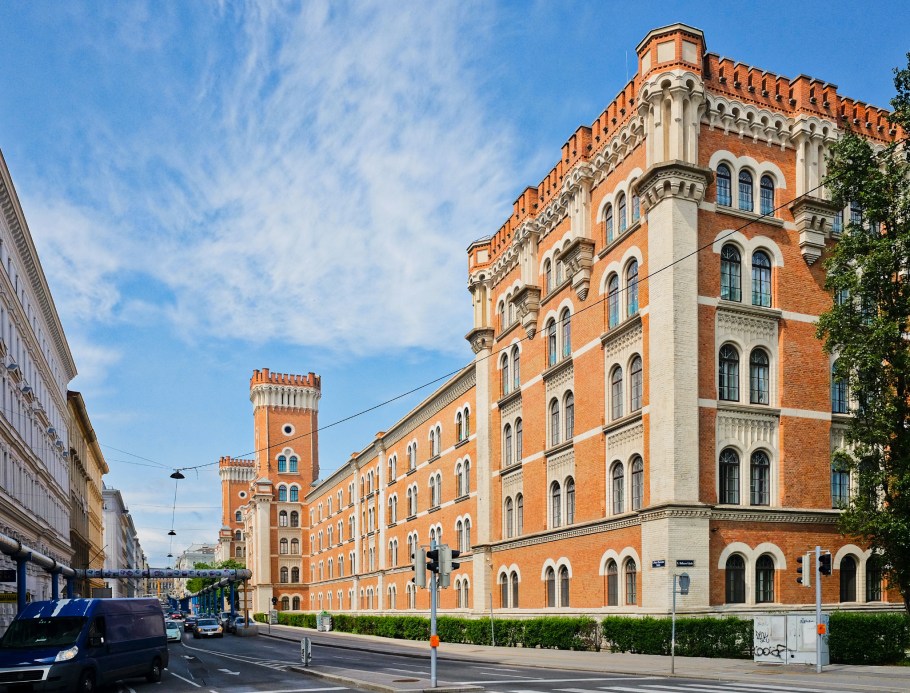
Southwest, from Augartenbrücke. Photo, 24 May 2023 (X70).
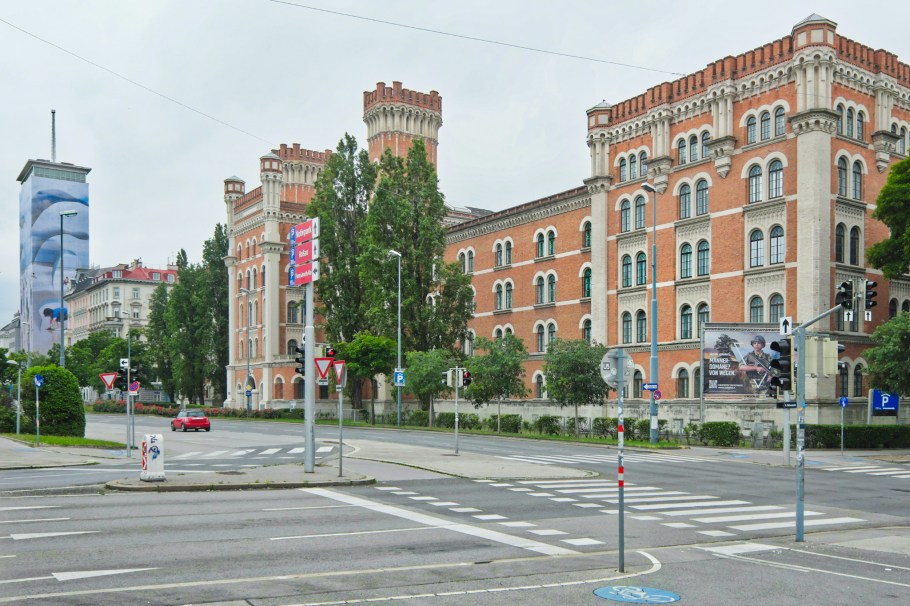
Southeast from Rossauer Brücke: Ringturm at left, and the barracks at right. Photo, 11 Jun 2023 (X70).
18. Schwarzenberg-Denkmal
• Schwarzenberg rider memorial (Reiterdenkmal des Fürsten Schwarzenberg).
• Sculptor: Ernst Julius Hähnel.
• Inauguration: 1867.
The monument and accompanying square honour the name of Austrian Prince Karl Philipp von Schwarzenberg who commanded Grand Coalition forces in opposing and defeating Napoleon’s French army at the Battle of the Nations at Leipzig in 1813.
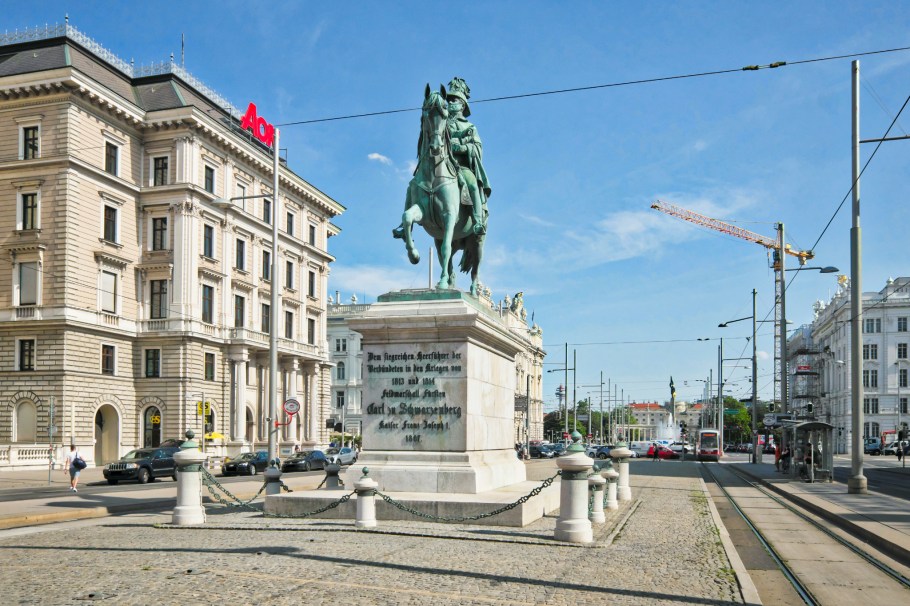
Facing south at Schwarzenbergplatz with the Schwarzenberg memorial in the foreground. To the right in the background is the Hochstrahlbrunnen fountain and Palais Schwarzenberg. Photo, 20 May 2022 (X70).
19. Staatsoper
• State Opera House (formerly “Hofsoper” or Imperial Court Opera).
• Architects: Eduard van der Nüll & August Sicard Sicardsburg.
• Style: Neo-Renaissance (French).
• Inauguration: 1869.
What seems adored today didn’t receive glowing reviews at the start. During construction, criticism from the public and press had amounted to describing the building as a “sunken chest”. Both architects died before the building’s inauguration: van der Nüll’s grave is in the central cemetery, and Sicardsburg is buried in Grinzing cemetery. Today, the Staatsoper building is a city landmark and home to the Vienna State Opera’s orchestra as well as the Vienna State Ballet.

Opera House’s south facade from Opernring and tram stop “Oper Karlsplatz”. At top-centre is a dedication to Emperor Franz Joseph the First: “Kaiser Franz Joseph I, 1869.” Photo, 2 Jul 2025 (P15).
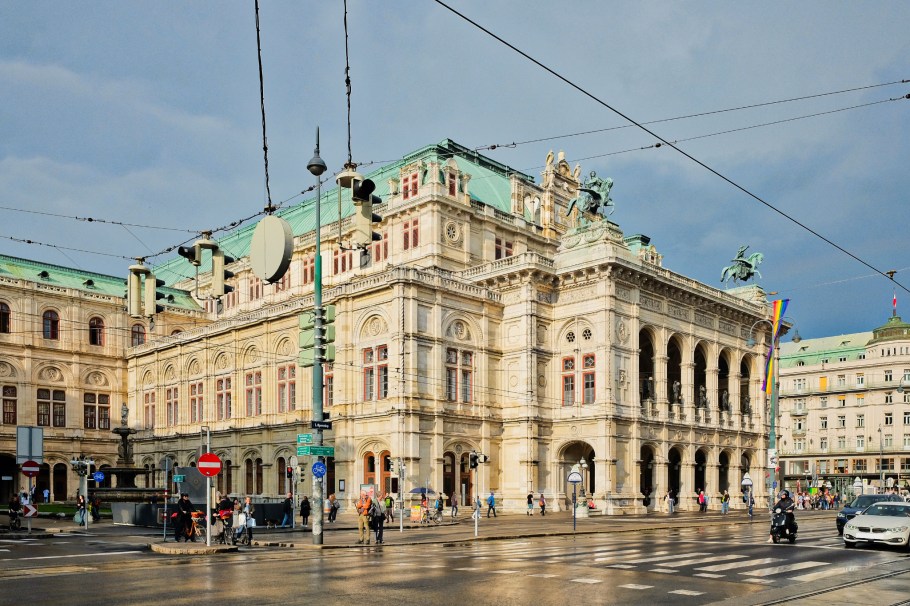
Afternoon light, post-thunderstorm. Photo, 7 Jun 2023 (X70).

View at dusk of the Opera House from the surviving remnant of the Augustinerbastei (Augustine bastion). Photo, 21 Jun 2024 (X70).
20. Stadtpark
• City Park.
• Design: Joseph Selleny, Dr. Rudolf Siebeck.
• Style: English-style landscape.
• Inauguration: 1862; Kursalon building by Johann Garben, inaugurated 1867.
Part of the idea regarding construction over the “glacis” was the addition of green space to be embraced and used by the city’s public. Moreover, this area was the last stage of the “regulation” of the Wien river on its last approach to converging with the Danube downstream. Today, the English-style garden city park occupies almost 10 hecatres (24 acres) with lots of grassy fields and knolls on which Viennese will picnic, chill, and relax.
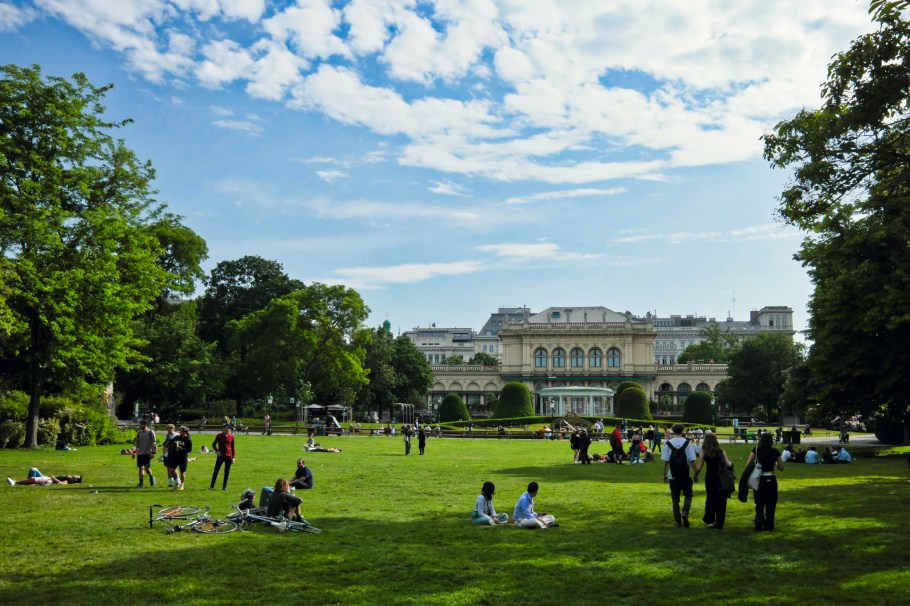
Southwest to the Kursalon (1867, Johann Garben); at left is the 1921 gilded Johann Strauss Jr. memorial by Edmund Hellmer. Photo, 23 May 2022 (X70).
21. Universität
• University of Vienna, main building.
• Architect: Heinrich Ferstel.
• Style: Neo-Renaissance (Renaissance revival).
• Inauguration: 1884.
Established in 1365 by Austria Duke Rudolph IV, the University of Vienna is associated with 16 Nobel Prize winners (as of 2023). Today, the university is spread throughout the city and host to 15 academic faculties and 5 centres of research, study, and teaching; and is home to almost 11-thousand staff and about 90-thousand students. A highlight of the main building is the Arkadenhof (arcade courtyard) with statues and memorials to many of the university’s past professors; only recently has more attention been paid to honouring more women, including Lise Meitner and Elise Richter.
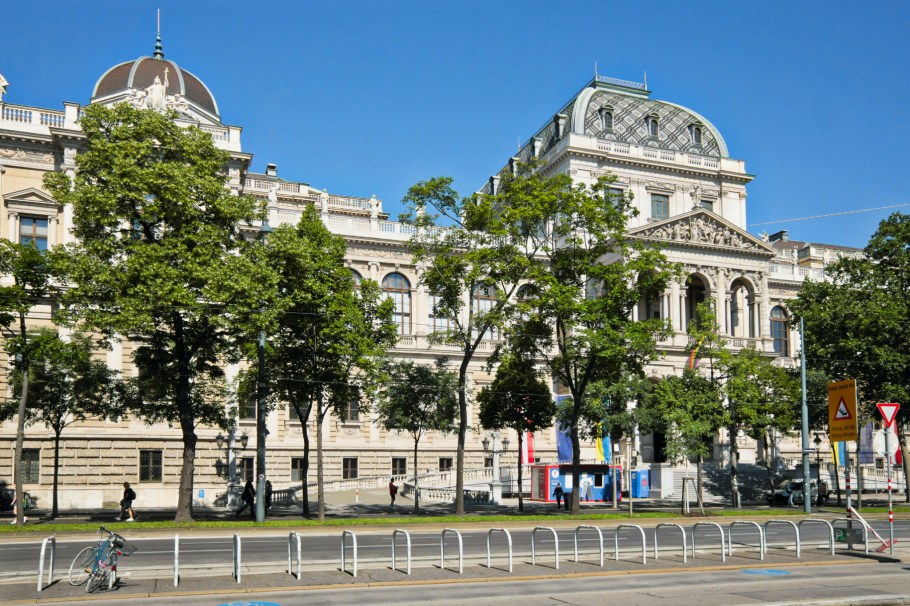
The south face of the main university building in morning light, from Universitätsring. The north or “back” side of the university building faces Ferstel’s Votive Church. Photo, 11 Jun 2022 (X70).
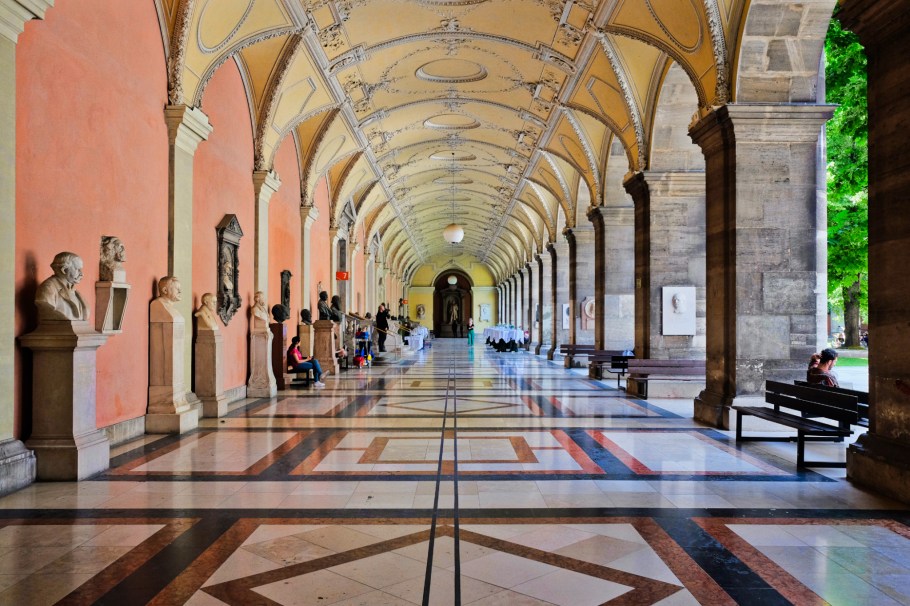
Inside the university building’s Arkadenhof (arcade courtyard) with monument statues and plaques to previous staff members of the university. Photo, 2 Jun 2023 (X70).
22. Votivkirche
• Votive Church.
• Architect: Heinrich Ferstel.
• Style: Neo-Gothic (French).
• Inauguration: 1879.
After Habsburg Emperor Franz Joseph survived an unsuccessful assassination attempt in 1853, his brother, Archduke Maximilian, appealed to the public for funds at large to build a church in gratitude. 27-year-old Heinrich Ferstel won the architectural competition for the church design in 1855; project construction began in 1856 and completed in 1879. At the time of their respective inaugurations, Ferstel’s Votive Church and Ferstel’s University building (see above) would have directly faced each other.
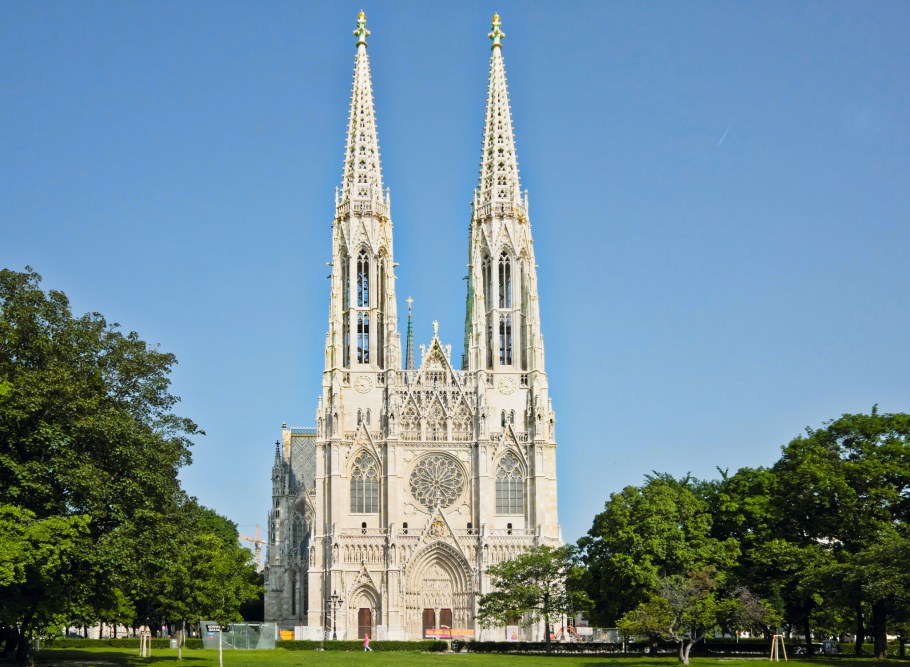
The grand church in morning light, from Sigmund Freud Park. Photo, 28 May 2023 (X70).
Vienna inner city: the Glacis, 1858
Shown below in the 1858 map of Vienna are the inner city, inner city wall, and the open “glacis” fields in front of the city wall. The map shows how the city appeared shortly after Emperor Karl Joseph I issued orders to demolish the defensive wall and to begin construction of the “Ringstrasse” boulevard. I’ve placed locations of Ringstrasse structures from above onto the following 1858 map, with the aid of historical city maps from the City of Vienna’s Wien Kulturgut portal.
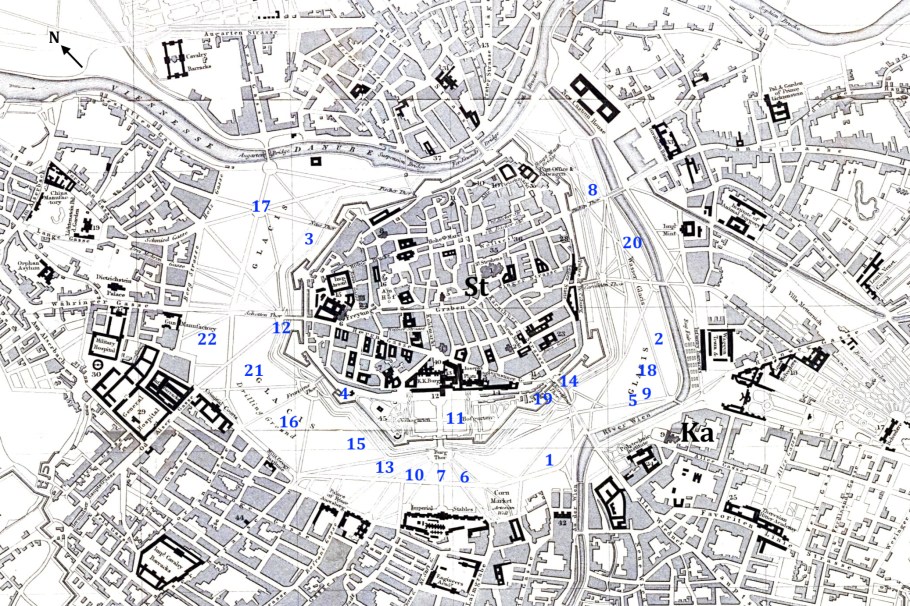
1858 city map showing the inner-city wall, fortifications, and the “glacis” clearing outside the wall. Blue numbers identify post-1858 structures as listed above. Stephansdom (St. Stephen’s cathedral) and Karlskirche (St. Charles’ church) are identified on the map as “St” at centre and “Ka” at lower-right, respectively. North is to the upper left. Map excerpt from Wikipedia; from J & C Walker Sailp; London: John Murray, 1858.
By architect/artist
- H. Ferstel: Museum für angewandte Kunst, Universität, Votivkirche
- L. Förster: Palais Todesco
- J. Garben: Kursalon (Stadtpark)
- E. J. Hähnel: Schwarzenberg-Denkmal (sculpture)
- T. Hansen: Akademie der bildenden Künste; Alte Börse; Musikverein; Palais Ephrussi, Epstein, & Todesco; Parlament
- K. Hasenauer: Burgtheater, Kunsthistorisches Museum, Maria-Theresien-Denkmal, Neue Burg, Naturhistorisches Museum
- K. Mark (Major): Rossauer Kaserne
- E. van der Nüll: Staatsoper
- K. Pilhal (Colonel): Rossauer Kaserne
- F. W. Schmidt: Akademisches Gymnasium, Rathaus
- J. Selleny: Stadtpark
- G. Semper: Burgtheater, Kunsthistorisches Museum, Neue Burg, Naturhistorisches Museum
- A. S. Sicardsburg: Staatsoper
- R. Siebeck: Stadtpark
- O. Wagner: Palais Epstein
- A. Weber: Künstlerhaus
- C. Zumbusch: Maria-Theresien-Denkmal
By architectural style
- English landscape: Stadtpark.
- Historicism: Maria-Theresien-Denkmal, Rossauer Kaserne.
- Neo-Baroque: Burgtheater.
- Neo-Classical: Musikverein, Neue Burg, Parlament.
- Neo-Gothic: Akademisches Gymnasium, Rathaus, Votivkirche.
- Neo-Renaissance: Akademie der bildenden Künste; Alte Börse; Künstlerhaus; Kunsthistorisches Museum; Museum für angewandte Kunst; Naturhistorisches Museum; Palais Ephrussi, Epstein, & Todesco; Staatsoper; Universität.
Sources
• Koerner, J. L., The Ringstrasse at 150 years, 2016, The Burlington Magazine, vol. 158, no. 1354, pp. 26–31; available from Koerner’s Vienna Project at Harvard University: Vienna Interior → Ring Street: <https://viennaproject.fas.harvard.edu/vienna-interior> [accessed Jan 2026].
• Mallgrave, H. F., Gottfried Semper: Architect of the 19th Century (New Haven: Yale University Press, 1996), pp. 309–353.
• Parsons, N., Vienna: A Cultural History (Oxford: Oxford University Press, 2009).
• Pippal, M., A Short History of Art in Vienna (Munich: C.H.Beck, 2001).
• Prokop, U., Zum Jüdischen Erbe in der Wiener Architektur: Der Beitrag jüdischer ArchitektInnen am Wiener Baugeschehen 1868–1938 (Wien: Böhlau Verlag, 2016). Available from Open Access: <https://library.oapen.org/handle/20.500.12657/32362> [accessed Jan 2026].
• Sarnitz, A. (ed.), Architecture in Vienna (Wien: Springer-Verlag, 1998).
• Schorske, C. E., Fin-de-Siècle Vienna: Politics and Culture (New York: Alfred A. Knopf, 1980).
• Smith, D.J.D., Only In Vienna: Guide to Unique Locations, Hidden Corners, and Unusual Objects, 4th edition, (Only In Guides/The Urban Explorer; New York: Simon & Schuster, 2015).
• Stadt Wien Kulturgut: Architektur → Gebäudeinformationen; Historische Stadtpläne → Stadtplan 1858. Available at <https://www.wien.gv.at/kulturportal/public/> [accessed Jan 2026].
• Van den Broeck, C., Bold Ventures: Thirteen Tales of Architectural Tragedy, translated from Dutch by D. McKay (New York: Other Press, 2022).
• Vergo, P., Art in Vienna, 1898–1918: Klimt, Kokoschka, Schiele, and their Contemporaries (Ithaca: Cornell University, 1981).
• Wehdorn, M., Vienna: A Guide to the UNESCO World Heritage Sites (Wien: Springer-Verlag, 2004).
• Winkler, T., Vienna’s Ringstrasse: A Spatial Manifestation of Sociopolitical Values, 2021, Journal of Planning History, vol. 20, pp. 269–286. Available from academia.edu: <https://www.academia.edu/43730565/Viennas_Ringstrasse_A_Spatial_Manifestation_of_Sociopolitical_Values > [accessed Jan 2026].
I made all photos above in the summers of 2022, 2023, 2024, and 2025, with a Fujifilm X70 fixed-lens prime (X70) and an iPhone15 (P15). This post appears on Fotoeins Fotografie at fotoeins DOT com as https://wp.me/p1BIdT-mqp. Last edit: 3 Jan 2026.
 Fotoeins Fotografie
12 Responses to “Vienna Ringstrasse & Architectural Historicism”
[…] 1883. • One of many architects contributing to the development of Vienna’s “Ringstrasse.” • 1843–1847: student at Imperial & Royal Polytechnic Institute. […]
LikeLike
[…] 13 Jul 1813 – d/✟ 17 Feb 1891. • Danish architect, naturalized Austrian; Ringstrasse architect • Theophil Hansen: group 14A, number […]
LikeLike
[…] part of a huge wave of construction along the city’s new Ringstrasse (ring road), the University of Vienna’s primary building designed by architect Heinrich Ferstel in the […]
LikeLike
[…] the University of Vienna’s main building on the Ringstrasse, the courtyard arcade inside is home to many memorial plaques and statues in honour of the […]
LikeLike
[…] written about a distinct phase in the architectural evolution of late 19th-century Vienna. The Ringstraße, or Ring Road, brought to the city a flurry of new buildings after the demolition of the former […]
LikeLike
[…] building of the university (Hauptgebäude), built by Heinrich Ferstel on the Ringstraße; inaugurated 1884. Erwin Schrödinger, atomic & nuclear physics; 1933 Nobel Prize in physics. […]
LikeLike
[…] Vienna architect Theophil Hansen in the neo-classical Greek style and inaugurated next to the Ringstraße in […]
LikeLike
[…] Austrian Parliament Building (4 PM) […]
LikeLike
[…] hundreds of kilometres. Efforts to immerse myself in various types of the city’s art and architecture have been accompanied by the sounds of brass horns and sweeping strings in a back-and-forth […]
LikeLike
[…] I’ve written briefly about the Künstlerhaus and the Musikverein in my overview of “architectural historicism” on Vienna’s Ringstraße (Ring Road). […]
LikeLike
[…] is in charge of the Austria-Hungary dual monarchy. He’s ordered and overseen big changes to the city landscape in Vienna. Problem is his wife Empress Elisabeth (Sisi) isn’t taking any liking to the city. To sweeten the […]
LikeLike
[…] Architectural partnership with Eduard van der Nüll, in particular the Arsenal and the Staatsoper. • August Sicardsburg family mausoleum, dated 1853: group MA, number […]
LikeLike