Vienna: Dr. Olga Ehrenhaft-Steindler, trailblazer & women’s advocate
In examining the history of the University of Vienna, I discovered Olga Ehrenhaft-Steindler was the first woman to receive a doctoral degree in physics from the university in 1903. Who was she? How did she become the first? How did society of the time view the education of young women?
I’m starting a series on women who left their mark on Vienna and Austria, and some of the traces they left behind in the Austrian capital city. With educators, inventors, writers, and scientists, my serial includes: Dr. Marietta Blau; Marianne Hainisch; Hedwig Kiesler, a.k.a. Hedy Lamarr; Dr. Lise Meitner; Dr. Gabriele Possanner; Dr. Elise Richter; and Bertha von Suttner.
Who: Dr. Olga Ehrenhaft-Steindler: b/✵ 28 Oct 1879, d/✟ 21 Dec 1933.
PhD: 1st woman with doctoral degree in physics from University of Vienna, 1903.
Educator: Early 20th-century teacher & advocate for better access to education for young women.
In late 19th-century and early 20th-century Austria and Vienna, Olga Steindler was one of countless women who faced difficulties and challenges by young women who wanted to expand their education and improve employment, all of which were viewed by society at the time as undesirable. Feminism or anything similar did not exist.
Born and raised in Vienna, Olga Steindler departed her home for Prague to complete and pass her final high-school examinations in 1899, because young women were not permitted to do so within Austria at the time. She subsequently enrolled at the University of Vienna to study physics and mathematics within the Faculty of Philosophy. Only two years earlier in 1897 had the University of Vienna finally accepted the enrolment of women, although they were initially allowed only into the Faculty of Philosophy. In 1903, Steindler became the first woman to receive a Ph.D. in physics from the University of Vienna after successfully completing her research dissertation.
Completing qualifications for teaching at secondary (high) schools in the same year, she joined the “Athenäum” where she taught young women about experimental physics; she also taught at Vienna’s first girls’ secondary school established by Marianne Hainisch in the city’s 1st district. In 1907, she founded two new schools in Vienna: a girls’ public secondary school in the city’s 2nd district, and a business school for young women in the city’s 8th district. Steindler married her physicist colleague Dr. Felix Ehrenhaft in 1908; she became known as Dr. Olga Ehrenhaft-Steindler. She championed the cause for educating girls and young women, and creating new opportunities in science, business, and society at large. For her dedicated service to the public, Austria awarded her in 1931 the title of “Hofrat” as a new member of the imperial court advisory council, an honour uncommon among Austrian women at the time. At the age of 54, Dr. Olga Ehrenhaft-Steindler died in December 1933 from complications after having contracted pneumonia.
OES’ places & traces
Where would Dr. Olga Ehrenhaft-Steindler (OES) have been in her birth city? Where did she spend a great deal of time in Vienna? I wanted to know some of these places, some of which I describe below.
- Former physics institute (9.)
- Döbling apartment (19.)
- Döbling cemetery (19.)
- Ehrenhaft-Steindler plaza (9.)
- Municipal education centre (1.)
- Public girls’ secondary school (2.)
- VBS Schönborngasse (8.)
• Women with doctorates from University of Vienna, 1897–1923
• Sources (German only)
Former physics institute, 1875–1913 (9.)
ehem. Physikalisches Institut, 1875–1913
From 1875–1913, the institute of physics was located at Türkenstrasse 3. Among many students of the time, OES and Lise Meitner would’ve spent time here as part of their graduate studies, leading to their Ph.D. degrees in physics in 1903 and 1905, respectively. In 1913, the institute moved north to a new building on Strudlhofgasse. Türkenstrasse 3 became home to the Afro-Asiatisches Institut (Afro-Asian Institute) before the program’s termination in 2018. The property continues to be owned and operated by the Archdiocese Vienna. A memorial plaque has been mounted on Café afro’s outside wall since 2001 in recognition of the university’s physics institute and its renowned researchers.
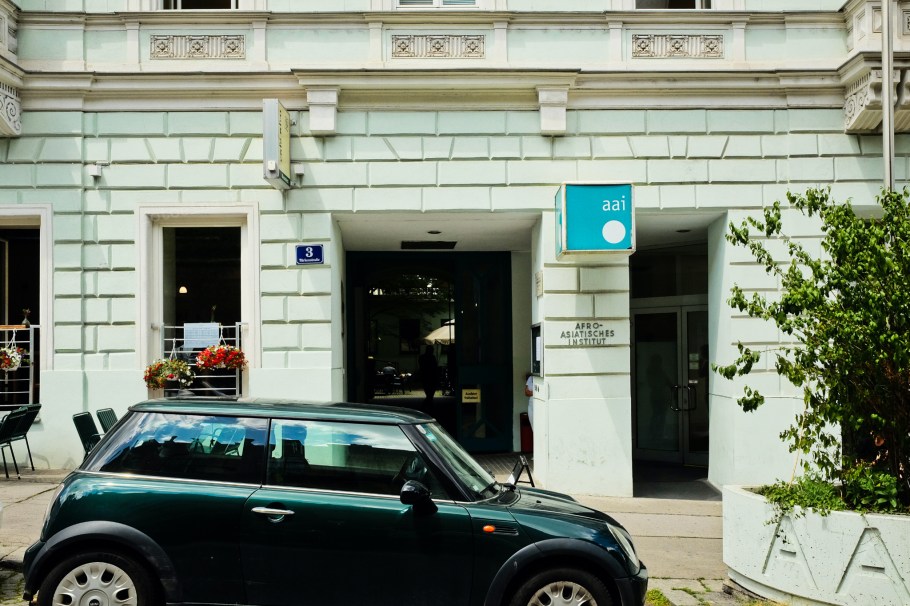
Türkenstrasse 3, former Afro-Asiatisches Institut (Afro-Asian Institute, AAI). Photo, 30 May 2022.

Café Afro: memorial plaque on the exterior wall at lower centre-left. Photo, 30 May 2022.

Memorial plaque to university’s former institute of physics. Photo, 30 May 2022.
GEDENKTAFEL (English translation below)In diesem Hause befanden sich von 1875 bis 1913 die Physikalischen Institute der Universität Wien.
Hier wirkten:Josef Loschmidt, 1821–1895, Größe der Moleküle
Josef Stefan, 1835–1893, Strahlungsgesetz
Ludwig Boltzmann, 1844–1906, Entropie und Wahrscheinlichkeit
Franz S. Exner, 1849–1926, Luftelektrizität
Stefan Meyer, 1872–1949, Radioaktivität
Egon von Schweidler, 1873–1948, Radioaktives Zerfallsgesetz
Friedrich Hasenöhrl, 1874–1915, Masse-Energie-Beziehung
Lise Meitner, 1878–1968, Kernspaltung
Viktor F. Hess, 1883–1964, Kosmische Strahlung, Nobelpreis 1936
Fritz Kohlrausch, 1884–1953, Raman–Spektren
Erwin Schrödinger, 1887–1961, Wellenmechanik, Nobelpreis 1933Gewidmet von Mitgliedern und Freunden der Österr. Physikalischen Gesellschaft anlässlich ihres fünfzigjährigen Bestehens im Jahre 2000.
MEMORIAL PLAQUEThe University of Vienna’s Institute of Physics was located at this spot from 1875 to 1913. The institute’s researchers included:
Josef Loschmidt, 1821–1895, sizes of molecules
Josef Stefan, 1835–1893, radiation law
Ludwig Boltzmann, 1844–1906, entropy and probability
Franz S. Exner, 1849–1926, electricity in the atmosphere
Stefan Meyer, 1872–1949, radioactivity
Egon von Schweidler, 1873–1948, law of radioactive decay
Friedrich Hasenöhrl, 1874–1915, mass-energy relationship
Lise Meitner, 1878–1968, nuclear fission
Viktor F. Hess, 1883–1964, cosmic radiation, Nobel Prize 1936
Fritz Kohlrausch, 1884–1953, Raman spectra
Erwin Schrödinger, 1887–1961, (quantum-) wave mechanics, Nobel Prize 1933Dedicated by members and friends of the Austrian Physical Society on its 50th anniversary in 2000.
Döbling apartment (19.)
Döblinger Wohnung
The apartment building at Grinzinger Strasse 70 in the city’s 19th district was home to Dr. Olga Ehrenhaft-Steindler and Dr. Felix Ehrenhaft. As visitor to Vienna between 1927 and 1931, Albert Einstein stayed with the Ehrenhafts in this building. Additional guests of the Ehrenhafts included other physicists Niels Bohr, Arthur Compton, Robert Millikan, Auguste Piccard, Max Planck; as well as composer and author Alma Mahler-Gropius.

Building where Einstein stayed with the Ehrenhafts, between 1927 and 1931. Photo, 26 May 2022.

Building where Einstein stayed with the Ehrenhafts, between 1927 and 1931. Photo, 26 May 2022.
Döbling cemetery (19.)
Döblinger Friedhof
Located in the city’s 19th district, Friedhof Döbling is an active cemetery with area spanning about 5 hectares (12 acres) and a “population” of over 6000 graves. Olga Ehrenhaft-Steindler, her husband Felix, and Felix’s 2nd wife, Bettina, are all buried in the same grave: group i1, row G2, number 20.
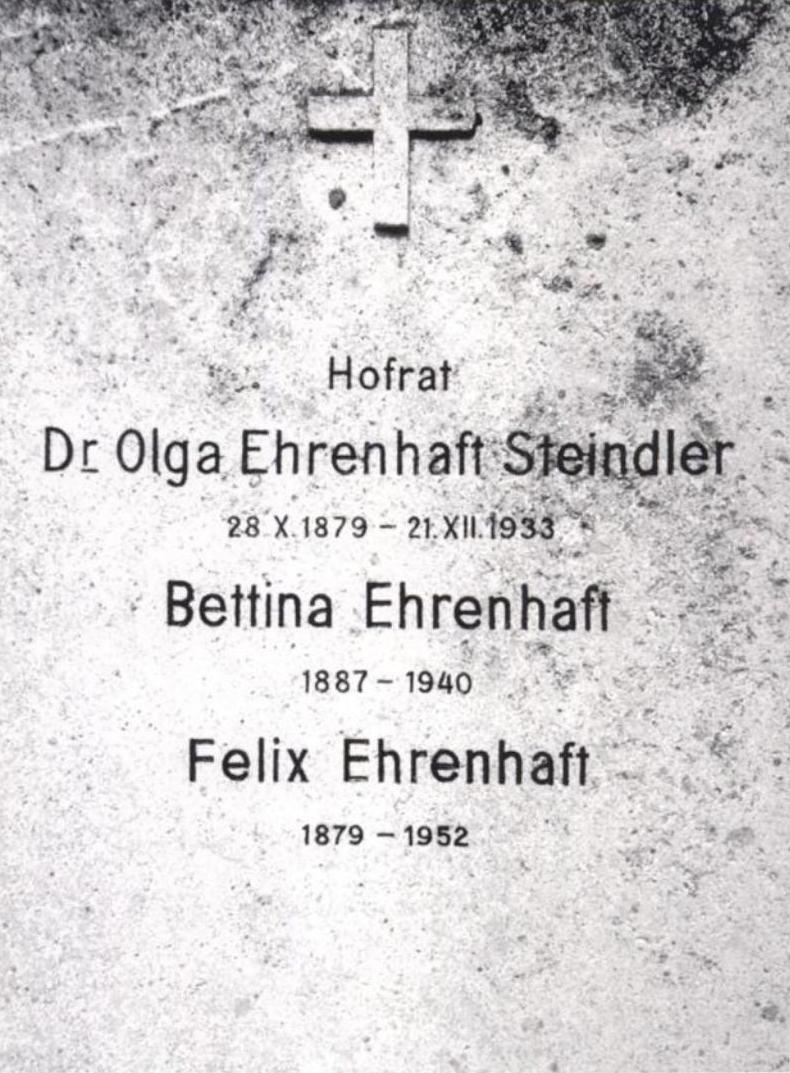
Original headstone for Ehrenhafts in Döbling cemetery; OES was awarded “Hofrat” in 1931. Image by J. Braunbeck from his 2003 book “Der andere Physiker: das Leben von Felix Ehrenhaft”.

Ehrenhafts’ grave, with broken headstone. Photo, 21 May 2022.
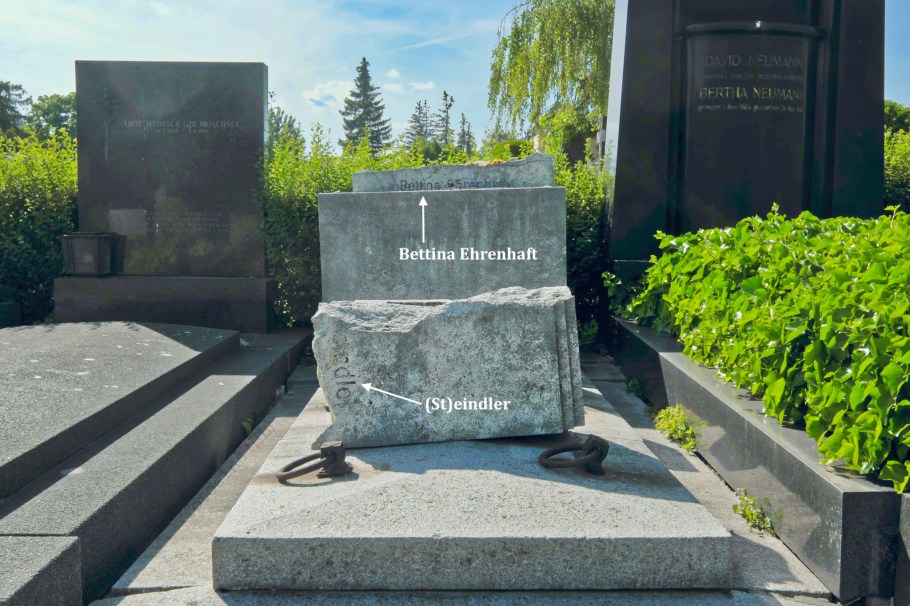
Broken headstone: “Bettina Ehrenhaft” was Felix’s 2nd wife after OES’ death; the fragment in the foreground contains the word “(St)eindler”. Photo, 21 May 2022.
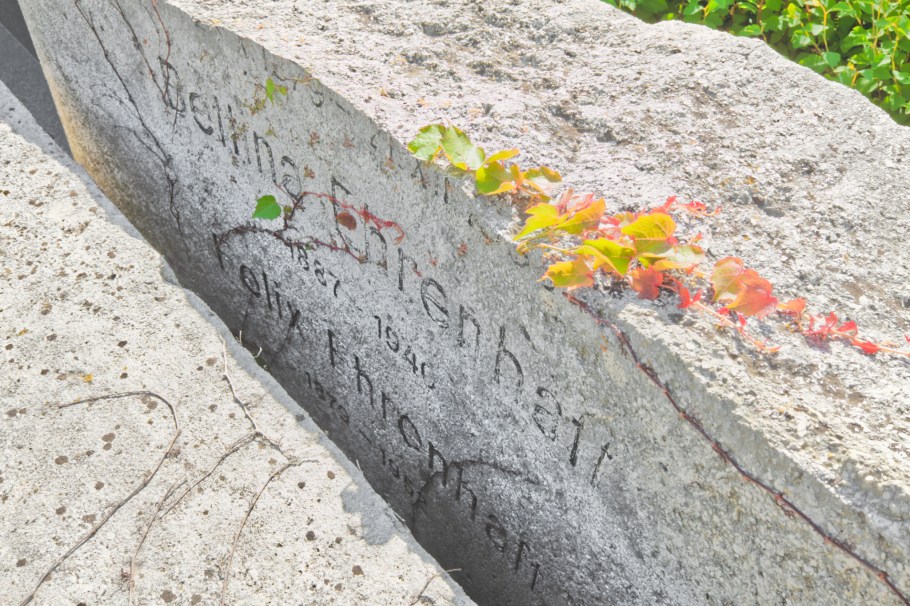
Broken headstone; 5 lines of inscribed text are visible in the primary fragment. Top line: “(28.) X. 1879 – 21. XII. (1933)”, corresponds to the dates of Olga Ehrenhaft-Steindler’s birth and death on 28 Oct 1879 and 21 Dec 1933, respectively. 2nd and 3rd lines: “Bettina Ehrenhaft, 1887 – 1940” (Felix’s 2nd wife). 4th and 5th lines: “Felix Ehrenhaft, 1879 – 1952”. You can compare this photo on 21 May 2022 with the image above of the original intact headstone.
Ehrenhaft-Steindler plaza (9.)
Ehrenhaft-Steindler-Platz
Just south of the present-day physics institute is a plaza named after OES. There’s no descriptive signage about OES, but there’s signage to the right/east for Boltzmanngasse (after Ludwig Boltzmann). The city of Vienna assigned the naming of the public square in 2017.
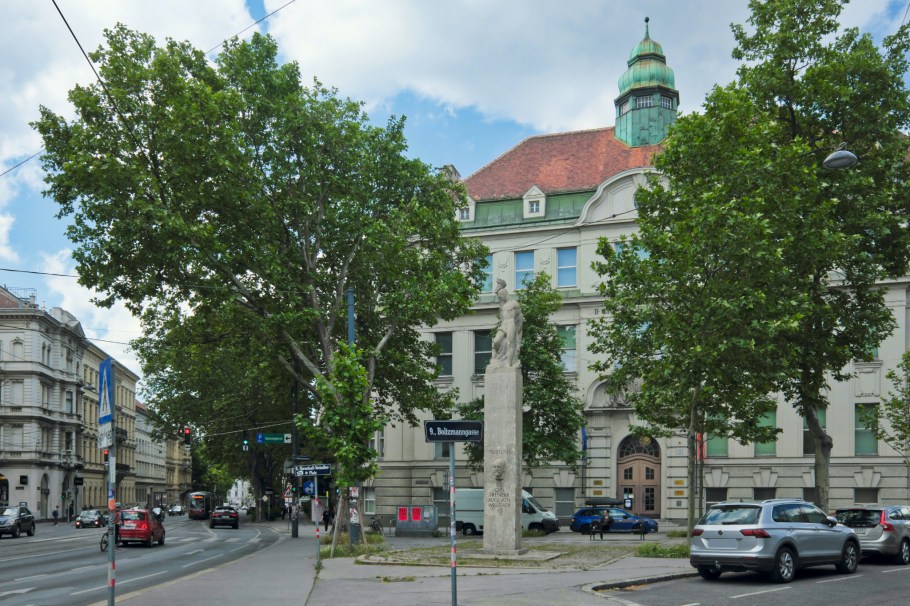
Ehrenhaft-Steindler-Platz. Photo, 30 May 2022.
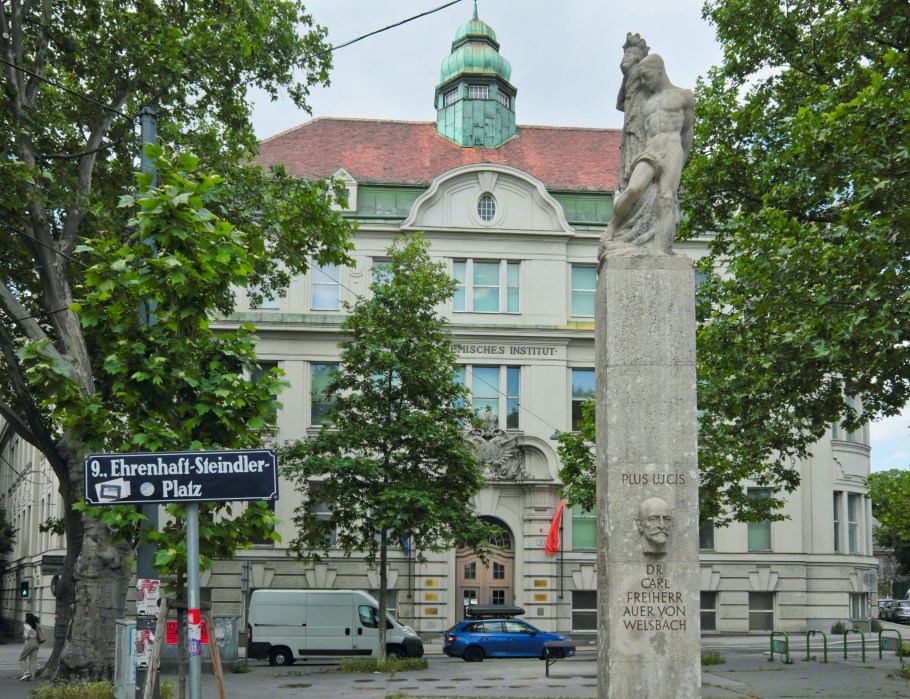
Ehrenhaft-Steindler-Platz in the 9th district. In the foreground at right is a memorial column to Carl Freiherr Auer von Welsbach. In the background at centre is the University of Vienna’s Institute for Organic Chemistry. Photo, 30 May 2022.
Municipal Education Centre (1.)
Pädagogikum (Pädagogium)
This building by architect Heinrich Ferstel was opened in 1870 as the city’s Education Centre and the nation’s Teacher Training Institute. At this location, Marianne Hainisch established in 1892 the Mädchengymnasium des Vereins für Erweiterte Frauenbildung, one of the very 1st all-girls secular school in Vienna, Austria, and German-speaking Europe. Ehrenhaft-Steindler taught at this school in 1903–1904, shortly after achieving her physics doctorate and her teaching qualifications.

Wiener Pädagogikum in the 1st district. Photo, 13 May 2023.
Public Girls’ Secondary School (2.)
Öffentliches Mädchenlyzeum
In 1907, Olga Ehrenhaft-Steindler founded the Öffentliches Mädchenlyzeum (public girls’ secondary school) at Stephaniestrasse 4 in the city’s 2nd district. Ehrenhaft-Steindler would also serve as the school’s first principal/director from 1907 to 1911. Today, the location is now Hollandstrasse 4 and the site of the Collegium Hungaricum cultural centre since 1999.
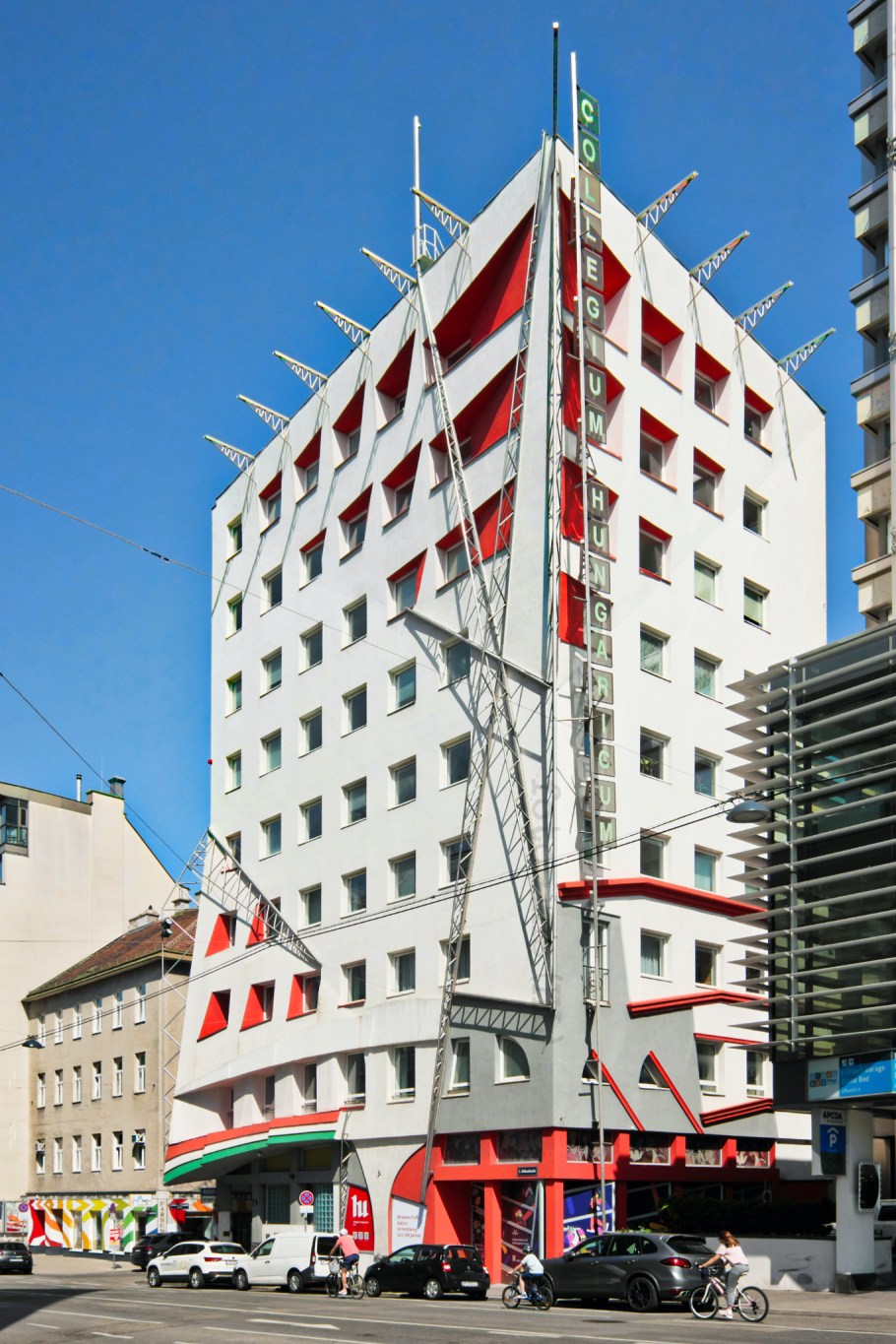
Collegium Hungaricum, address: Hollandstrasse 4. Photo, 27 May 2023.
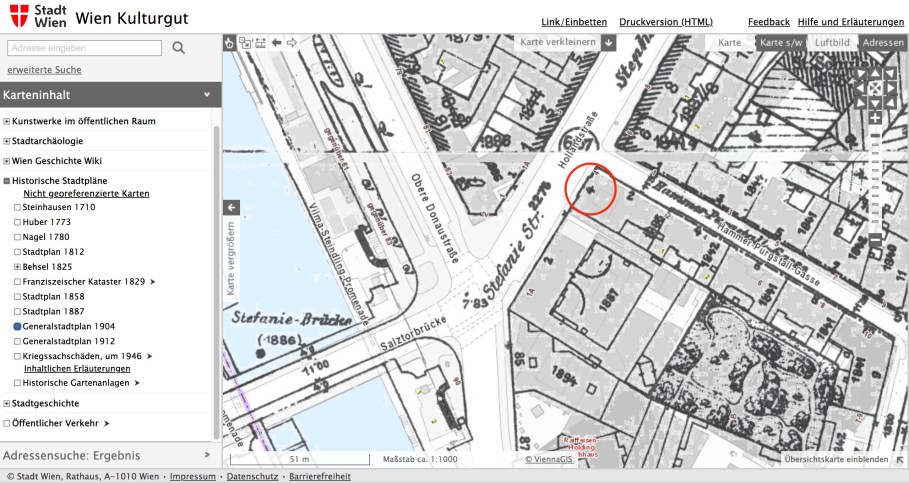
A map of the modern city is overlaid with a city map from 1904. Enclosed in an open red circle is the location for Stephaniestrasse (Stefaniestrasse) 4, corresponding to today’s Hollandstrasse 4 and the Collegium Hungaricum cultural centre. Stadt Wien Kulturgut.
VBS Schönborngasse (8.)
Vienna Business School, Schönborngasse 3–5
After her Ph.D., OES established two schools to further education opportunities for young women. In 1907, OES founded a public secondary (high) school for young women in the city’s 2nd district. In the same year, OES founded a business school for young women, Wiener Handelsakademie für Mädchen (Vienna Commercial Academy for Girls), at Schönborngasse 3–5 in the city’s 8th district. OES also managed this school as its first Director, becoming one of the first women to serve as school principal in the city. In 1925, the Vienna Merchants’ Association took over the school’s operation as “Handelsakadmie der Wiener Kaufmannschaft.” Today, the location serves as one branch of the Vienna Business School.
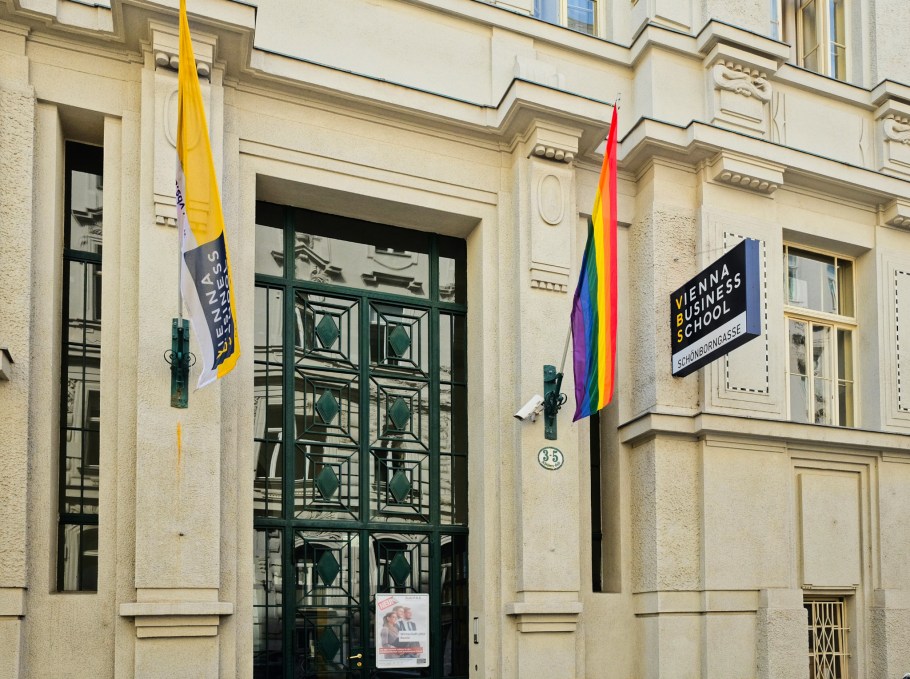
VBS Schönborngasse. Photo, 16 May 2022.

Left: VBS; right: Schönborngasse, facing north. Photo, 16 May 2022.
Women with doctorates from Univ. Vienna, 1897–1923
Verzeichnis promovierter Frauen an der Universität Wien, 1897–1923
As part of a huge wave of construction along the city’s new Ringstrasse (ring road), the University of Vienna’s primary building designed by architect Heinrich Ferstel in the Neo-Rennaissance style opened to the public in 1884.
Today, the University of Vienna’s digital archives contain a book with a compiled list of women awarded doctoral degrees by the university from 1897 to 1923. The image below shows the book’s first page with an entry for Dr. Olga Steindler, who on 22 May 1903 became the first woman awarded a Ph.D. (doctorate degree) in the field of physics at the University of Vienna. At the time, individual fields of study for doctorates were not shown with advanced degrees granted only by two faculties: the faculty of medicine (“med.”) and the faculty of philosophy (“phil.”).

List of women awarded doctoral degrees from the imperial and royal University of Vienna (Verzeichnis über diejenigen Damen, welche an der kaiserlichen und königlichen Universität Wien zu Doctoren promoviert wurden), 1897–1923. Indicated with a thick arrow is the row listing for Dr. Olga Steindler.
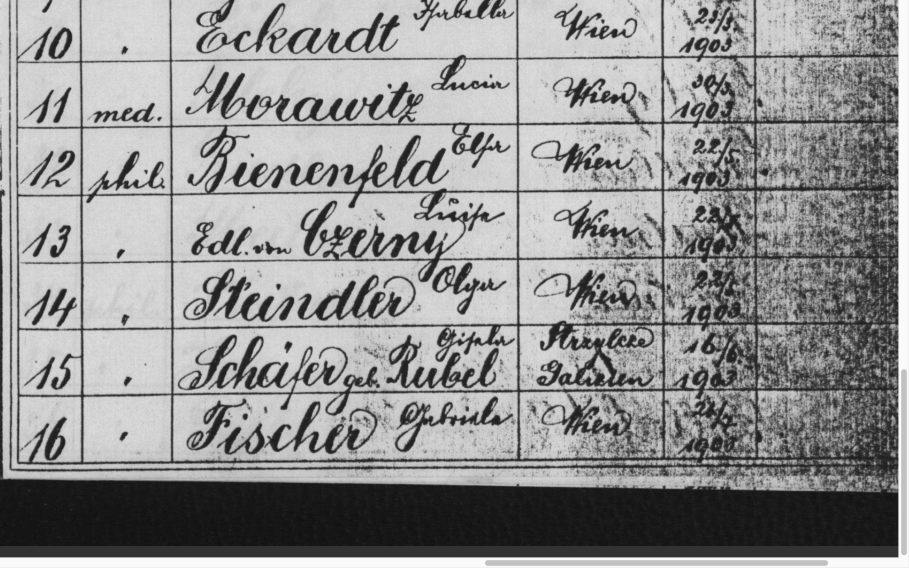
Row number 14: Dr. Olga Steindler (from Vienna), awarded her Ph.D., phil. on 22 May 1903, five months before her 24th birthday.
Excerpt from OES’ doctoral dissertation
Dr. Steindler’s Ph.D. dissertation had the title “Über die Temperaturcoeffizienten einiger Jodelemente (On the temperature coefficients of iodine-like elements)“; she performed and managed her research with advisors Dr. Franz Exner and Dr. Ludwig Boltzmann, both at the University of Vienna’s Physics Institute. I learned she had been investigating a variety of electrochemical cells formed by combining the halogen iodine (I) with various metallic elements including aluminum (Al), cadmium (Cd), magnesium (Mg), mercury (Hg), silver (Ag), and zinc (Zn). With experiments over a broad range of temperatures, she subsequently derived the temperature coefficients of electrochemical cells (from ACS publications). I found a short description in German within the scientific journal Beiblätter zu den Annalen der Physik from 1904; see image below.

O. Steindler, Beiblätter zu den Annalen der Physik (Inserts for the Annals of Physics), volume 28, pages 130–131, 1904. The reference to “Wien Ber.” is most likely an abbreviation for “Sitzungsberichte der Kaiserlichen Akademie der Wissenschaften”.
O. Steindler.“Über die Temperaturkoeffizienten einiger Jodelemente.” (English translation below)
“Die elektromotorische Kraft (EMK) von Elementen, bei denen sich in einem Kohlentiegel festes Jod befand, in welches das betreffende Metall, ein Thermometer und ein Kohlenstück als zweite Elektrode eingeschmolzen war, wurde mit Hilfe eines Quadrantenelektrometers bei Temperaturen unter 0. Grad bis fast 100. Grad bestimmt. Unter Zugrundelegung der von Thomson bestimmten Bildungswärmen wurde der Temperaturkoeffizient nach der Helmholtzschen Gleichung berechnet und folgende Übereinstimmung erhalten. (Datumstabelle oben) Die Abweichung bei dem Hg-Elemente rührt wahrscheinlich von der gleichzeitigen Bildung des HgJ2 und HgJ in unbekanntem Verhältnis her.”
“On the temperature coefficients of some iodine elements.”
“The electromotive force of elements with solid iodine in a carbon crucible, in which the metal in question, a thermometer, and a piece of coal as second electrode were melted, was determined by means of a quadrant electrometer at temperatures from 0°C to almost 100°C. Using the heats of formation determined by Thomson, the temperature coefficient (of the electrochemical cell) was calculated using the (Gibbs-)Helmholtz equation; agreement was obtained for most elements. (Data table above) The discrepancy in the value for mercury, Hg, is probably due to simultaneous formation of mercuric iodide 2 (HgI2) and mercuric iodide 1 (HgI) in unknown proportions.”
Sources (German language only)
• Bischof, B., “Physikerinnen: 100 Jahre Frauenstudium an den Physikalischen Instituten der Universität Wien” (Wien: Eigenverlag, 1998). Available from the University of Vienna’s archives: <https://phaidra.univie.ac.at/detail/o:397940> [accessed Mar 2023].
• Braunbeck, J., “Der andere Physiker: das Leben von Felix Ehrenhaft” (Wien: Technisches Museum, 2003), p. 132. Available from archive.org: <https://archive.org/details/bub_gb_W8GVSqSvSTYC> [accessed Mar 2023].
• Keintzel, B. & Korotin, I., “Wissenschafterinnen in und aus Österreich: Leben-Werk-Wirken” (Wien: Böhlau Verlag, 2002). Available from the OAPEN Foundation: <https://library.oapen.org/handle/20.500.12657/33432> [accessed Mar 2023].
• Österreichisches Biographisches Lexikon (Austrian Biography Lexicon): <https://www.biographien.ac.at/oebl/oebl_S/Steindler_Olga_1879_1933.xml> [accessed Mar 2023].
• Österreichische Nationalbibliothek (Austrian National Library), Frauen in Bewegung 1848–1938: <https://fraueninbewegung.onb.ac.at/node/1494> [accessed Mar 2023].
• Stadt Wien (City of Vienna), Wien Geschichte Wiki: <https://www.geschichtewiki.wien.gv.at/Olga_Ehrenhaft-Steindler> [accessed Mar 2023].
• Steindler, O., Beiblätter zu den Annalen der Physik, Band 28., S. 130–131 (Leipzig: Johann Ambrosius Barth Verlag, 1904). Available from archive.org: <https://archive.org/details/beibltterzudena27pockgoog/mode/2up> [accessed Mar 2023].
• Universität Wien, Archiv: Verzeichnis promovierter Frauen an der Universität Wien, 1897–1923 (Chronologische Liste aller von 1897 bis 1923 an der Universität Wien promovierter Frauen, unabhängig von der Studienrichtung). Available from the university’s archives: <https://phaidra.univie.ac.at/detail/o:104996> [accessed Mar 2023].
• Universität Wien, LISE Naturwissenschaften Unterricht Mädchen. Available from the Univ. Vienna: <https://lise.univie.ac.at/> [accessed Mar 2023].
• Universität Wien, Personen: Geschichte der Universität Wien: <https://geschichte.univie.ac.at/de/personen/olga-steindler-ehrenhaft-dr> [accessed Mar 2023].
Felix Czeike’s massive 5-volume “Historisches Lexikon Wien” (1992–1997) contains an entry for Dr. Felix Ehrenhaft with a mention of his wife (Gattin), Olga. Unfortunately, there is no separate entry for Olga Ehrenhaft-Steindler within Czeike’s compilation.
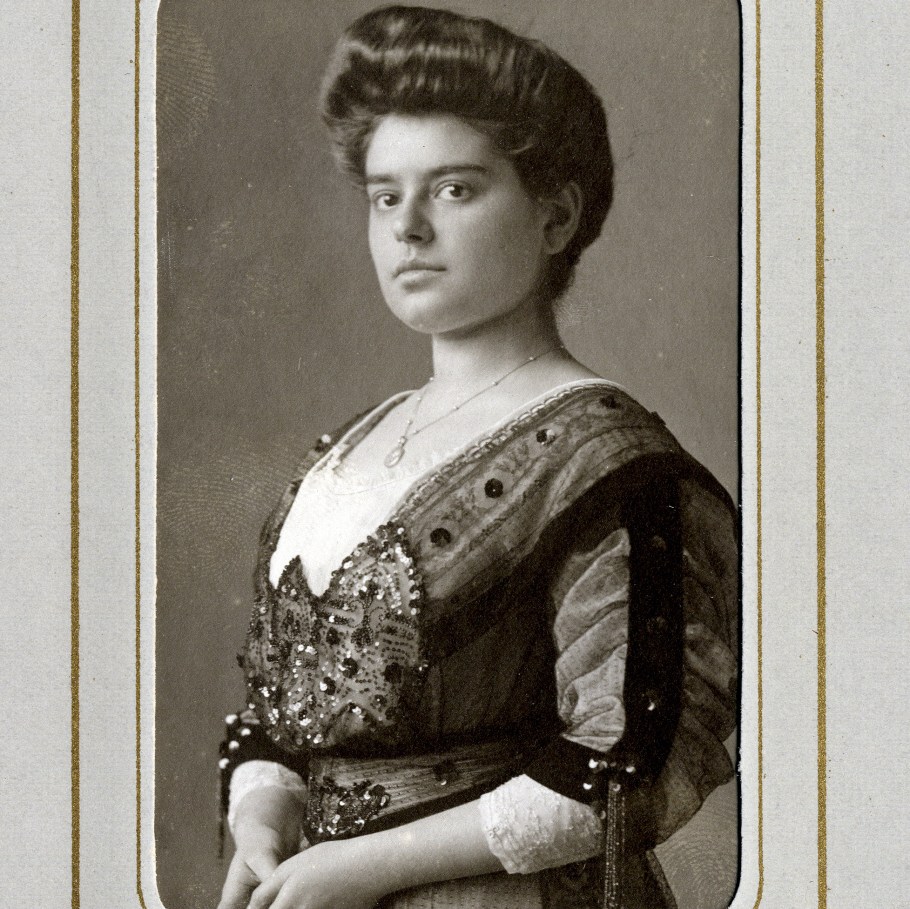
OES portrait image, c. 1908; from Österreichische Zentralbibliothek für Physik, Universität Wien (Austrian central library for physics, Univ. Vienna).
Except for images of OES, I made all remaining photos above with a Fujifilm X70 fixed-lens prime in the summers of 2022 and 2023. This post appears on Fotoeins Fotografie at fotoeins DOT com as https://wp.me/p1BIdT-mJi.
 Fotoeins Fotografie
10 Responses to “Vienna: Dr. Olga Ehrenhaft-Steindler, trailblazer & women’s advocate”
[…] • Ferstel design with building inauguration in 1870, as Municipal Education Centre (Pädagogikum) and Federal Teacher Training Institute (Bundeslehrerbildungsanstalt), at address Hegelgasse 12 / Fichtegasse 3. • At this location, Marianne Hainisch established Mädchengymnasium des Vereins für Erweiterte Frauenbildung, one of the very 1st all-girls secular schools in German-speaking Europe; school moved to Hegelgasse 19 in 1905, then to Rahlgasse 4 in 1910. • Dr. Olga Ehrenhaft-Steindler taught here at the girls’ school, 1903–1904, shortly after becoming the 1st woman to earn a doctorate in physics at the University of Vienna and achieving her teacher qualifications. I have more about Ehrenhaft-Steindler here. […]
LikeLike
[…] Währinger Strasse and lying adjacent to Ehrenhaft-Steindler-Platz is Boltzmanngasse. This small street in the city’s 9th district was renamed after Boltzmann […]
LikeLike
I am very touched to find all this information about my grandmother.
LikeLiked by 1 person
Mrs. Albert, thank you for stopping by and for your comment. I’m happy to have photographed and written about your grandmother who was a remarkable woman. As I write this, I happen to be in Vienna again, but I haven’t yet returned to Döbling Cemetery thus far to check on what’s become of the fallen/broken headstone. Thanks again!
LikeLike
I hope the city or University rectifies the matter of the tombstone, especially since my grandfather was also a noted physicist and it appears his theories about monopolar magnets is true.
LikeLike
Hi again, Mrs. Albert. I’ve been meaning to send a note to the University of Vienna and even to the Faculty of Physics about the state of your grandparents’ (broken) tombstone. According to your grandparents’ grave site listing on Vienna city cemeteries website friedhoefewien.at, the grave site has status “Grabnutzungsrecht bis: auf Friedhofsdauer”, or “Right to use the grave site until: the duration of the cemetery.” The unknown is who is responsible for repairs. I really should go back up to Döbling cemetery and check out the latest state of the grave.
LikeLike
I would be so grateful for anything you can do
LikeLiked by 1 person
Hi again, Mrs. Albert. I wanted to let you know I went back up to Döbling cemetery yesterday (Tuesday June 25), and your grandparents’ grave is basically in the same condition as it has been for the last couple of years I’ve visited; that is, the main headstone remains broken in 5 pieces. Many “grand” grave sites from the late 19th-century to about the mid 20th-century included large headstones which were “top heavy” and made of stone, both not ideal for longevity. What I’m stating is that other grave sites in Döbling cemetery (and other cemeteries around Vienna) have broken headstones tumbled over.
LikeLike
Thank you so much for following up
LikeLike
[…] teacher, and active in various women’s rights and educational associations. In 1906, Olly met Dr. Olga Steindler, and both established Verein zur Förderung der höheren kommerziellen Frauenbildung […]
LikeLike