Iris Andraschek in Vienna: telling the city who they are
For me, landmarks – a series of art works, for example – provide a network of “pins” for exploring and discovering parts of a city. That’s been my approach to Vienna’s 23 districts over the last 4 consecutive summers. Adding to the growing mind-map of memories, I’m restored by the excitement of the chase-and-find, among increasingly familiar surroundings and the frequency of new personal encounters.
Austrian artist Iris Andraschek works with photography, drawings. spatial installations, and video to explore and communicate ideas regarding cultural and societal relationships. Throughout Vienna, a number of Andraschek’s works are “visual interventions”, calling direct attention to the under-representation of women in the city’s public spaces.
Selected artworks in the capital
Each numbered item below corresponds to the numbered location in the map. The number in parentheses at the end of each list-item represents the location’s city district; e.g., (7.) is the 7th district, also known as Neubau.
- Bunter Teppich: colourful carpet (12.)
- Der Muse reicht’s — the muse has had enough! (1.)
- “Tell these people who I am”, Gisela von Camesina (7.)
- “Tell these people who I am”, Olly Schwarz (7.)
- “Tell these people who I am”, Vally Wieselthier (7.)
- Turnertempel Erinnerungsort — Turner Temple memorial site (15.)
Bunter Teppich
“Colourful carpet”, Meidlinger Platzl, 12th district
Installed in March 2023, a colourful “carpet” in the Ukrainian style is painted on a crosswalk next to Meidlinger Platzl as a sign of support for the Ukrainian community and of protest against Russian aggression.
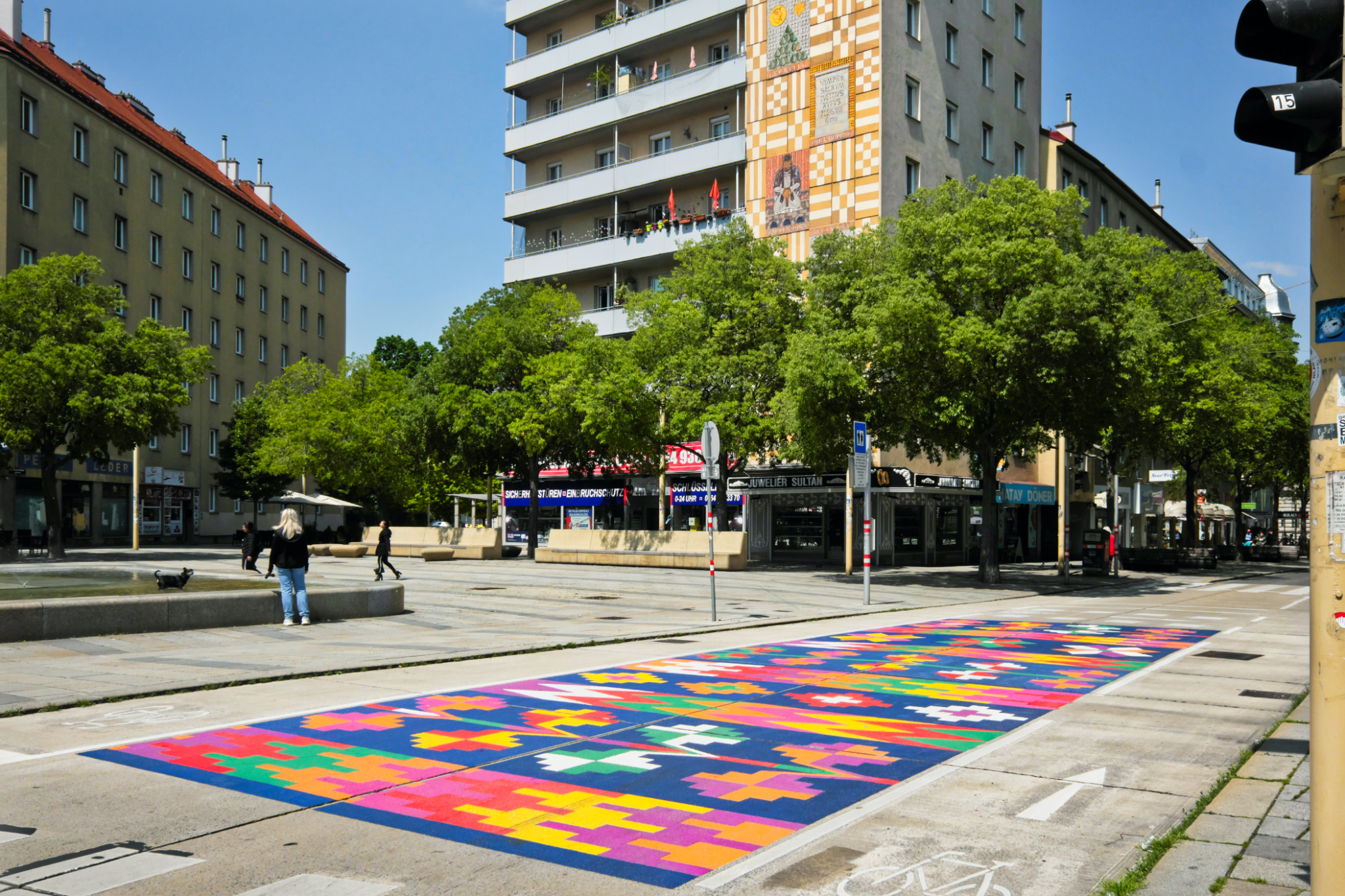
“Carpet” in Meidling. Photo, 21 May 2023.
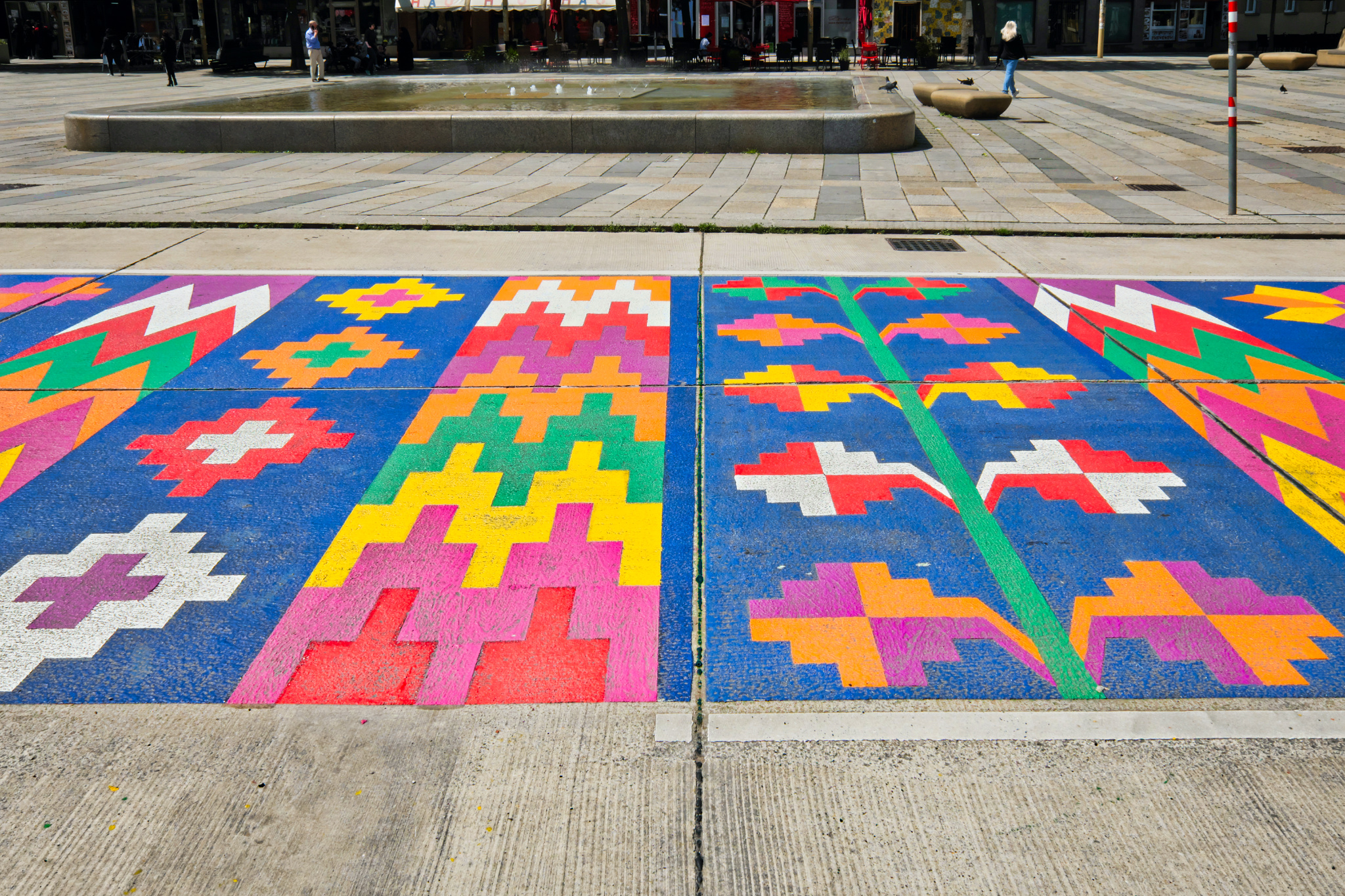
Closer examination of the “carpet”. Photo, 21 May 2023.
Der Muse reicht’s!
(The muse has had enough!)
Arkadenhof, Universität Wien, 1st district
The arcade courtyard in the main building of the University of Vienna celebrates academics who worked and taught throughout the history of the university. However, as many including Andraschek have indicated, there is a distinct lack of women represented among the memorials and plaques. For her 2009 artwork “Der Muse reicht’s!” (The muse has had enough!), Andraschek chose one of the most visible parts of the arcade to place her art piece. Across the open courtyard is a figure in a defiant pose, with their left fist raised high and directed towards the courtyard entrance. Andraschek’s aim with her artwork in conjunction with continuing dialogue within the university community is bringing awareness of the university’s historic “failure” to recognize women academics and creating solutions to memorialize women’s contributions to the university. Since 2016, new memorials include Dr. Charlotte Bühler (developmental psychology), Dr. Marie Jahoda (social psychology), Dr. Lise Meitner (nuclear physics), Dr. Grete Mostny (archaeology), Dr. Elise Richter (Romance-Latin linguistics), Dr. Olga Taussky-Todd (mathematics).
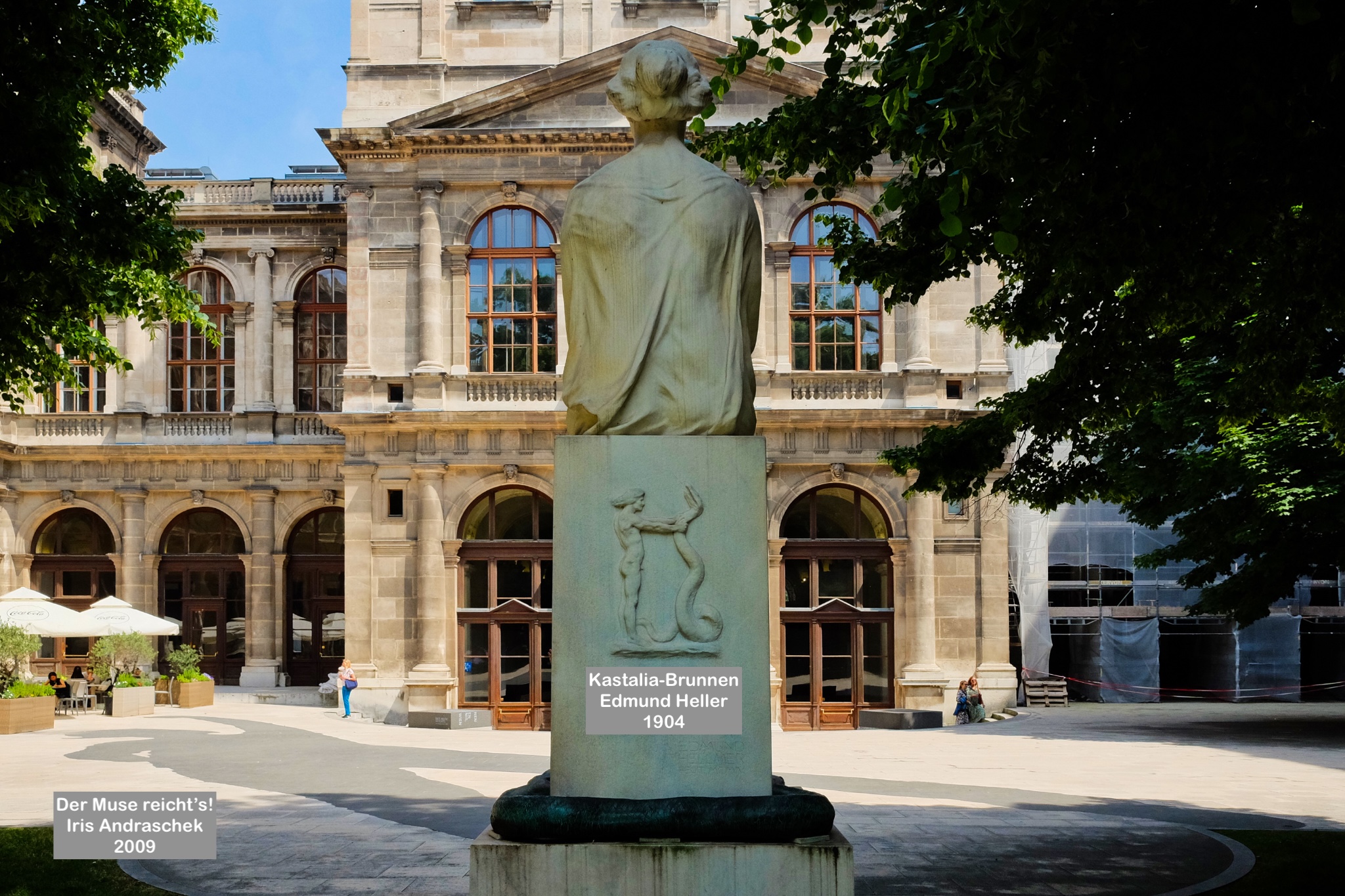
In the University of Vienna’s Arkadenhof courtyard, “Der Muse reicht’s!” lies below the Kastalia fountain. Photo, 2 June 2023.
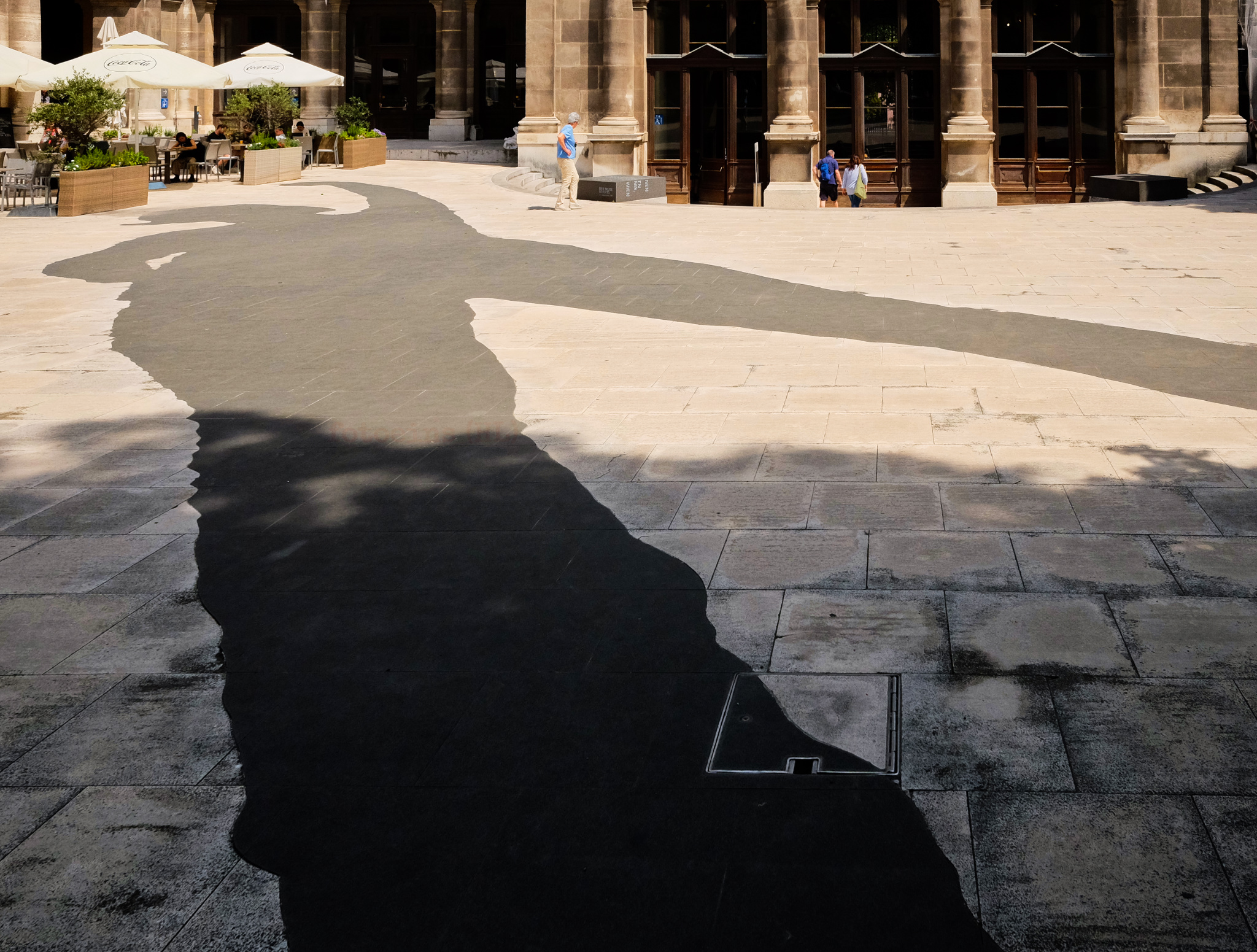
The figure on the ground is in a defiant pose, with their left fist raised high and directed towards the courtyard entrance. Photo, 2 Jun 2023.
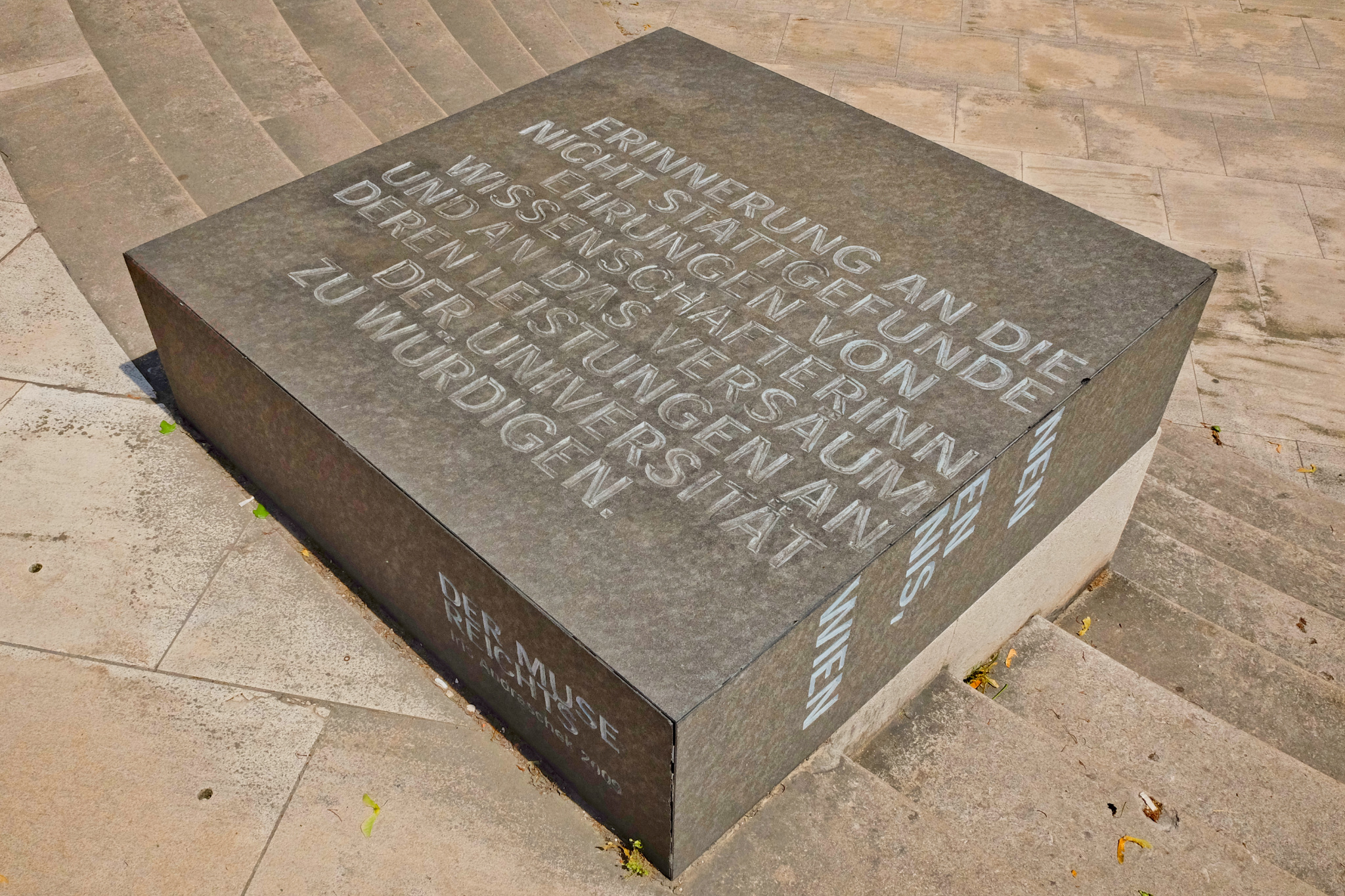
One of the pedestals: Erinnerung an die nicht stattgefundenen Ehrungen von Wissenschaftlerinnen und an das Versäumnis, deren Leistungen an der Universität Wien zu würdigen. // To the University of Vienna, who failed to honour and recognize the achievements of their women academics. “Der Muse reicht’s”, Iris Andraschek, 2009. Photo, 2 Jun 2023.
Gisela Edle von Camesina de San Vittore
Lerchenfelder Strasse 131–133, 7th district
In 2011, Andraschek produced a series of installations as “carpets inscribed” into the pavement at 3 separate locations in the city’s 7th district. Andraschek’s project “tell these people who I am” highlights three women’s stories and their contributions to Viennese history.
Born Maria Gisela Themer in 1865, Gisela Edle von Camesina de San Vittore was a pioneer in the education of women in the late 19th-century and early 20th-century Vienna. In 1884, she developed a system of teaching about business and commerce designed for Vienna’s women. In 1886, she became the first teacher in Europe to provide instruction on technology of the time, hygiene, and nursing, based on her own collected writings. She also founded in 1886 the Gisela-Frauen-Verein (Gisela Women’s Association), whose school, instruction, and texts became a blueprint for others to follow for young women in Austria and Europe. In 1892, she established in Vienna the Athenäum, a school solely for young adult women. In late 19th-century Austria, restrictions were placed on girls who wanted to attend academic high schools, and women were not permitted to attend college or university.
Gisela lived at the location Lerchenfelder Strasse 131–133; in front of the building entrance is a “memorial carpet” by Iris Andraschek. Unfortunately, recent work on the sidewalk pavement has obliterated about one-third of the artwork.
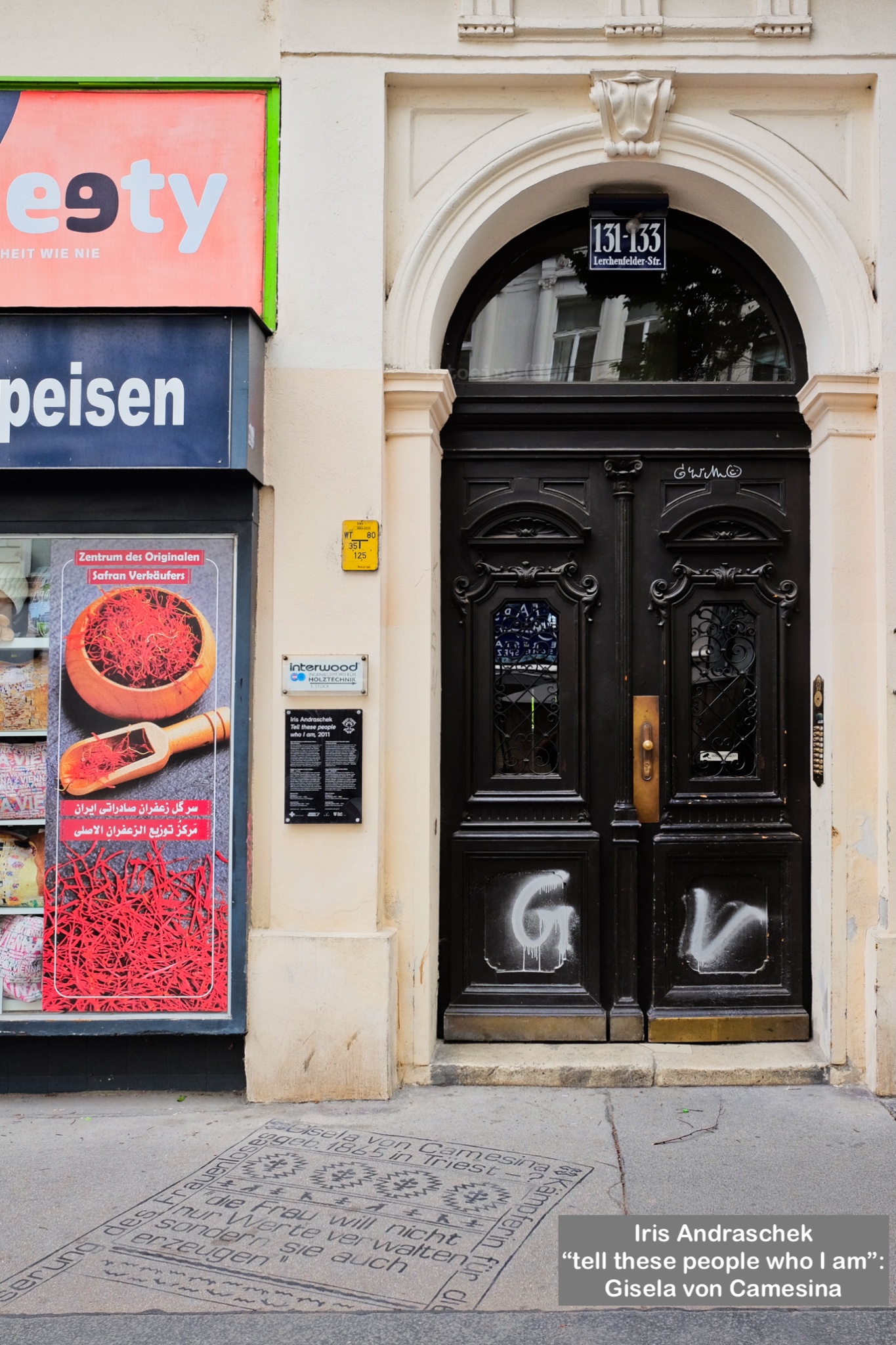
One of 3 examples of Erinnerungsteppiche (“memorial carpets”), in front of the entrance to Lerchenfelder Strasse 131–133. Photo, 2 July 2024.
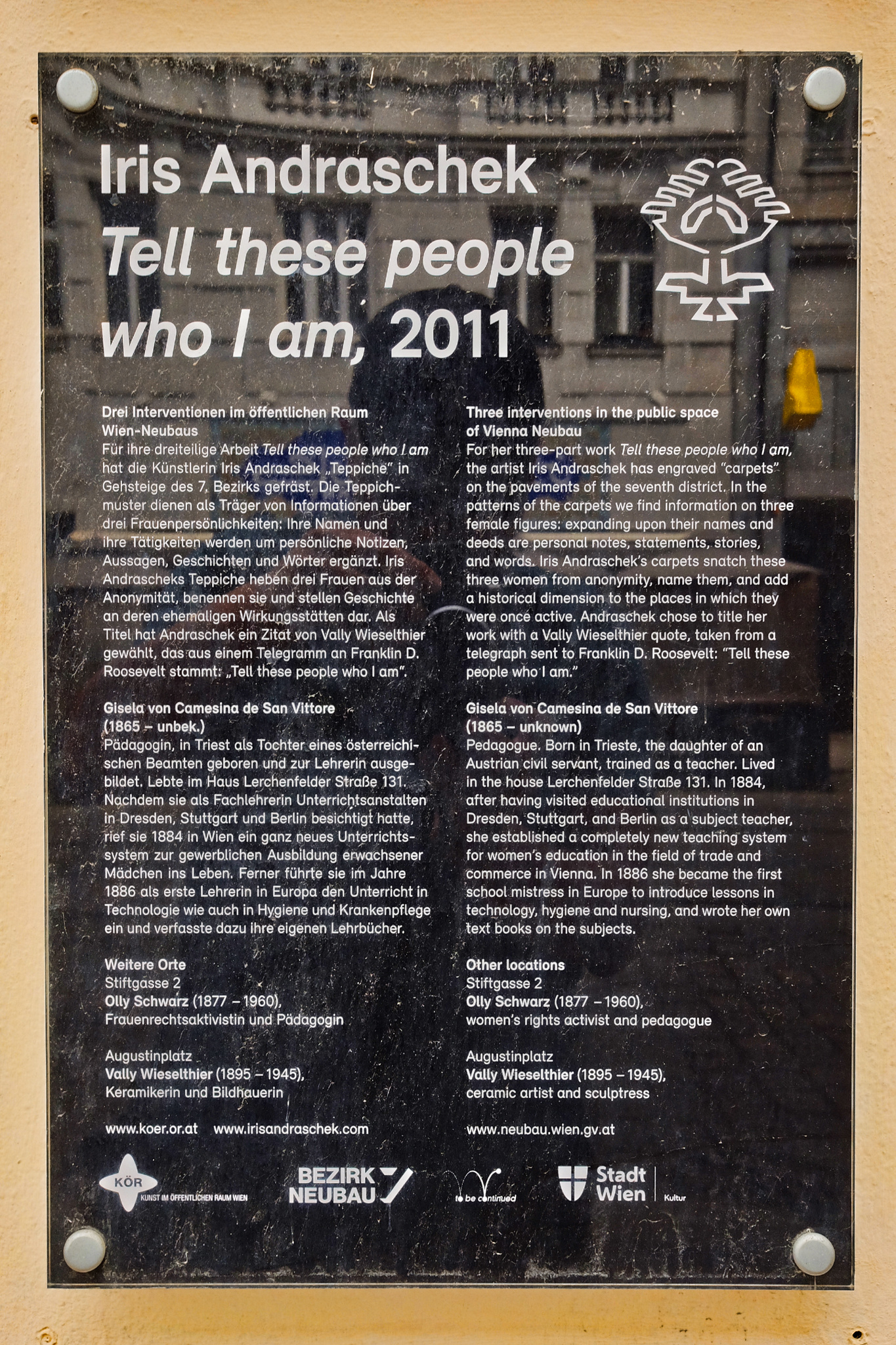
Next to the building’s front door is a plaque associated with the “memorial carpet” for Gisela von Camesina. Her date of death has been determined; see below. Photo, 2 July 2024.
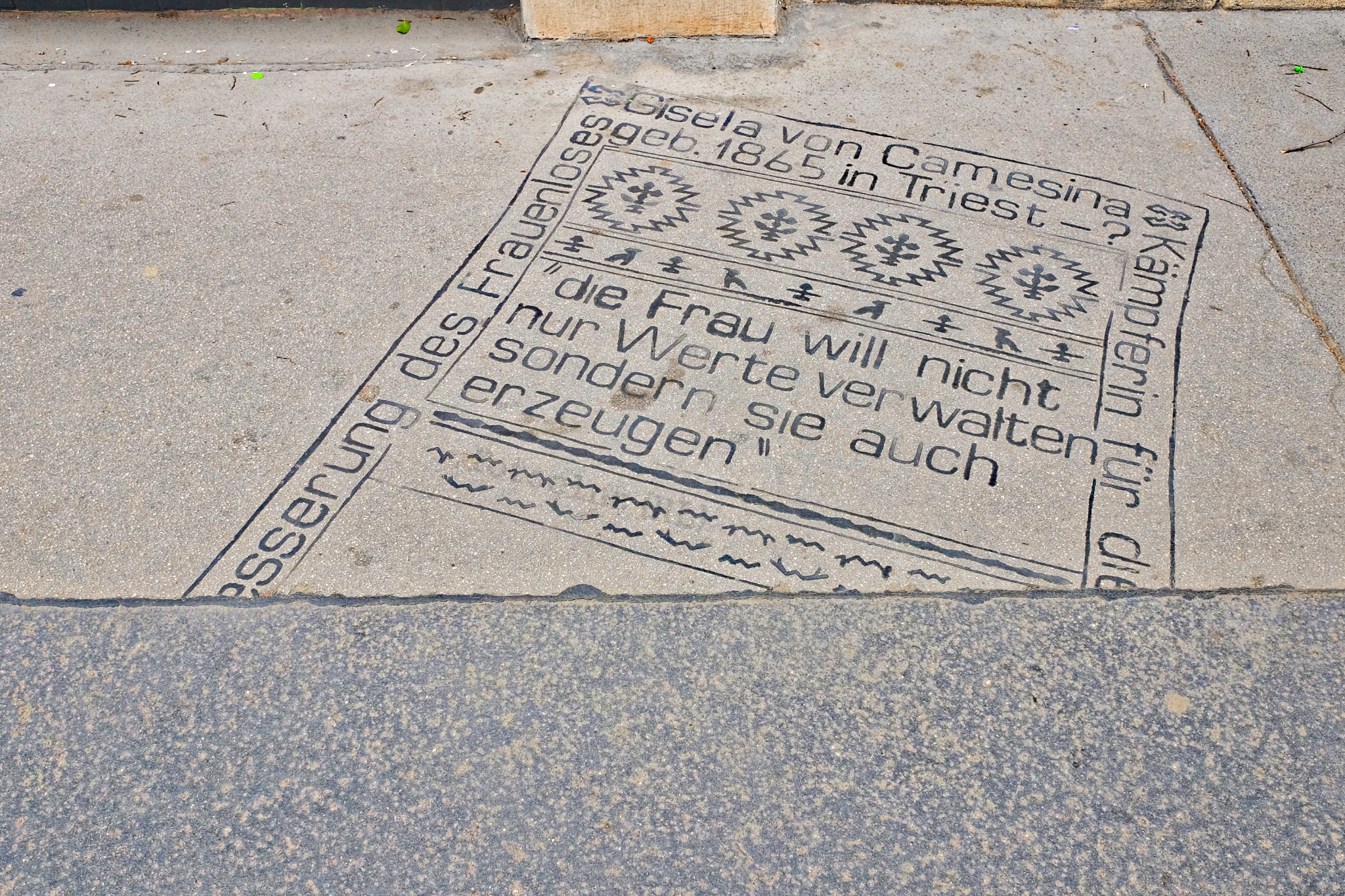
geb. 1865 in Triest – die Frau will nicht nur Werte verwalten, sondern sie auch erzeugen – Kämpferin für die Civilisation und die Verbesserung des Frauenloses. // born 1865 in Trieste – not only do women want to manage wealth, they also want to create it – fighting for advancement in and improvement of women’s lives. Unfortunately, new pavement by street works has covered the lower one-third of the “carpet”. It’s not clear whether the missing part of the carpet will be restored. Photo, 2 July 2024.
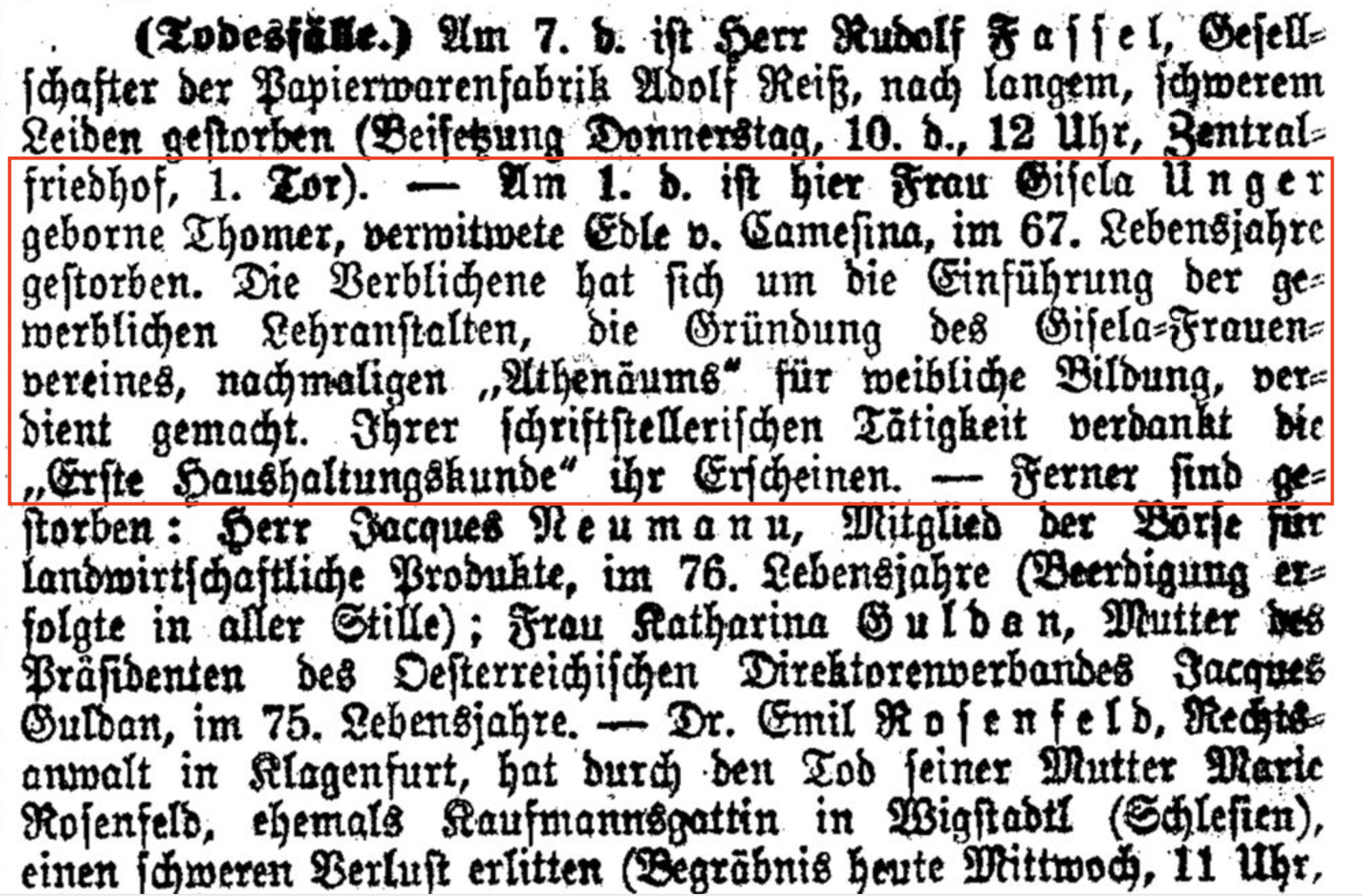
Todesfälle (obituaries), Neue Freie Presse, published 9 Dec 1931 (ÖNB ANNO).
She died in Vienna on 1 Dec 1931, according to the obituary in the newspaper Neue Freie Presse published 9 Dec 1931:
… Am 1. d. ist hier Frau Gisela Unger geborne Thomer, verwitwete Edle v. Camesina, im 67. Lebensjahre gestorben. Die Verblichene hat sich um die Einführung der gewerblichen Lehranstalten, die Gründung des Gisela-Frauen-Vereines, nachmaligen “Athenäums” für weibliche Bildung, verdient gemacht. Ihrer schriftstellerischen Tätigkeit verdankt die “Erste Haushaltungskunde” ihr Erscheinen.On the 1st of this month, Mrs. Gisela Unger, née Thomer [sic], widowed noblewoman of Camesina, died at the age of 67 [sic]. The deceased was instrumental in introducing vocational training (to women), the founding of the Gisela Women’s Association, and the “Athenaeum” school for women. The publication of “The First Guide to Housekeeping” owes its existence to her writing.
Gisela Themer and architect Oskar Unger were wedded in 1918; with their deaths in 1931 and 1972, respectively, Gisela and Oskar were buried at Vienna’s Zentralfriedhof. The architect entries for Oskar in ArchitektenLexikon and ArchInForm both state that Gisela was also “verwitwete Camesina von San Vittore” (widow Camesina of San Vittore). Unsolved questions include: when was the honorific title to noble status (Edle) given to Gisela Unger? Was she awarded the honour for her achievements? Or was she previously married to the Camesina family? (See also the entry “Gisela Unger-Camesina” on page 6 in the 24 January 1932 edition of “Das Wort der Frau”.)
Olly Schwarz
Stiftgasse 2 (Stiftskaserne), 7th district
Born Olga Frankl in 1877, Olly Schwarz was a women’s right activist, teacher, and active in various women’s rights and educational associations. In 1906, Olly met Dr. Olga Steindler, and both established Verein zur Förderung der höheren kommerziellen Frauenbildung (Association for the Promotion of Higher Education for Women in Commerce). The following year, both opened in Vienna’s 2nd city district Handelsakademie für Mädchen (Commerce Academy for Young Women), for which Steindler became academic director and Schwarz chief administrator. During World War I, Schwarz worked as nurse in the war hospital inside the Stiftskaserne (abbey barracks). In 1940, she and her husband successfully escaped Austria, eventually emigrating to Chicago in the United States.
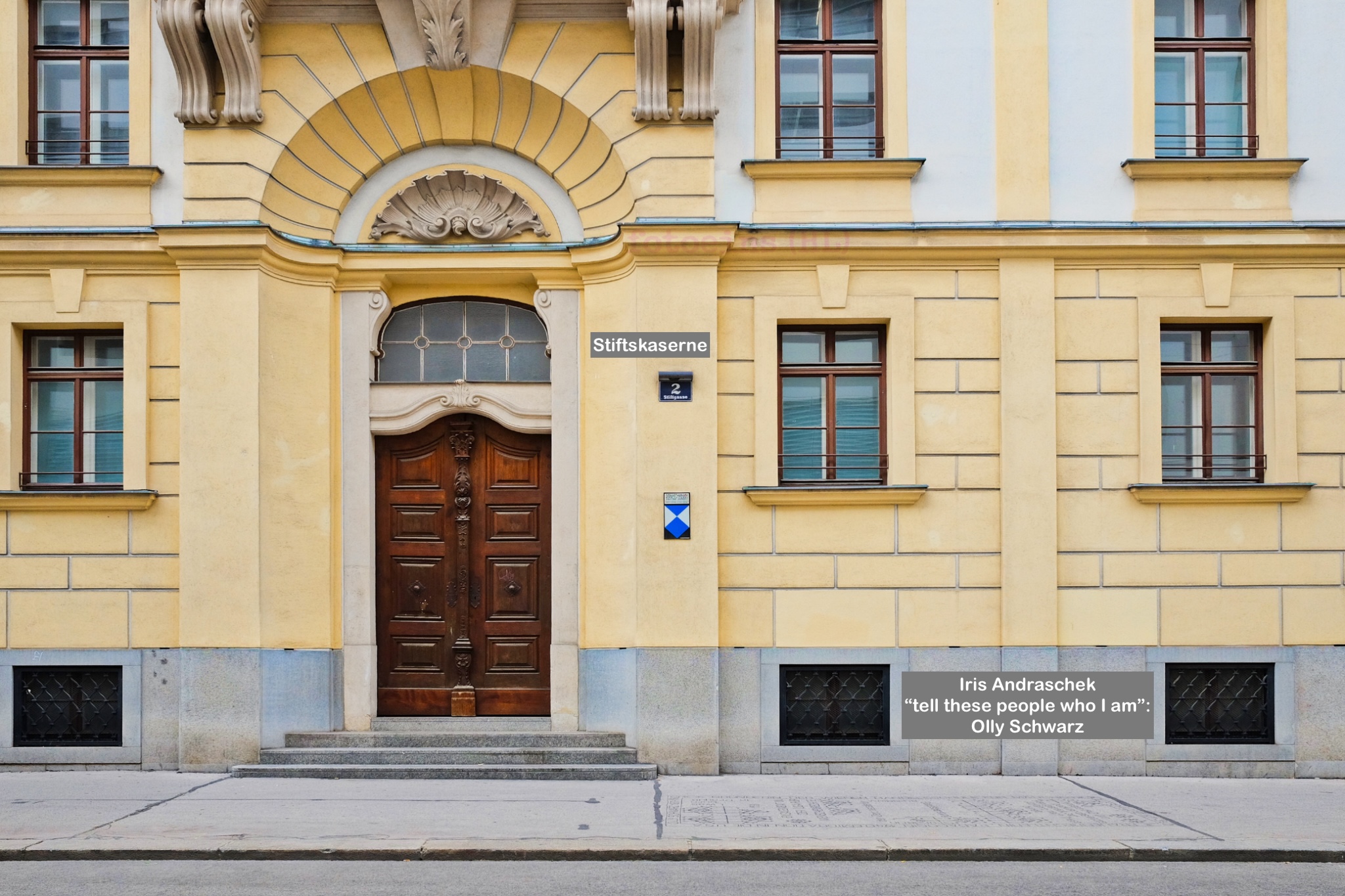
In front of the Stiftskaserne barracks is another installment of Andraschek’s “tell these people who I am” project in the 7th district. Photo, 17 June 2024.
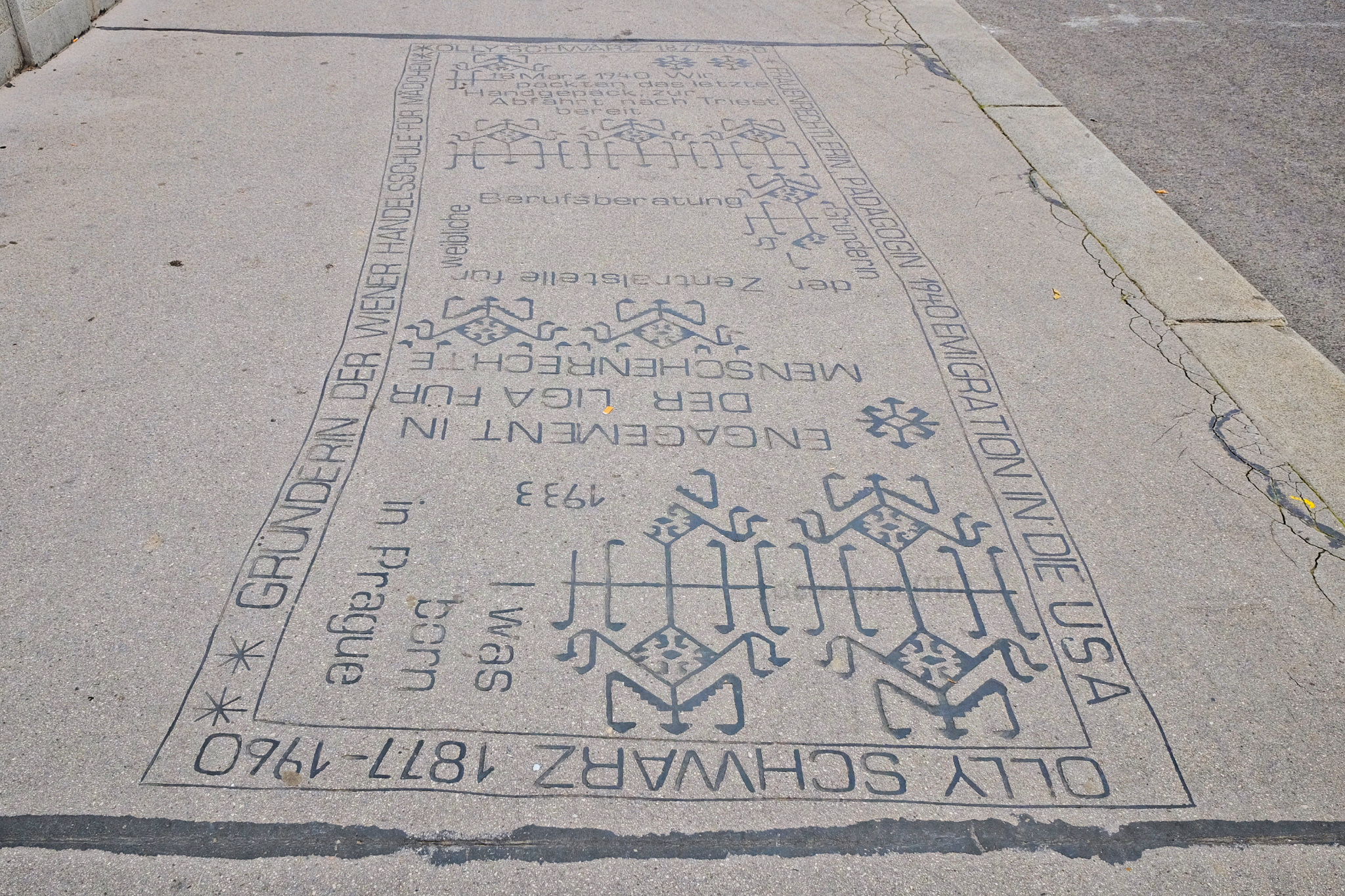
Olly Schwarz, 1877–1960. I was born in Prague. 1933, Engagement in der (österreichischen) Liga für Menschenrechte. Gründerin der Zentralstelle für weibliche Berufsberatung. // 1933, participation within the (Austrian) League of Human Rights. Founded central office, career counseling for women. Photo, 17 Jun 2024.
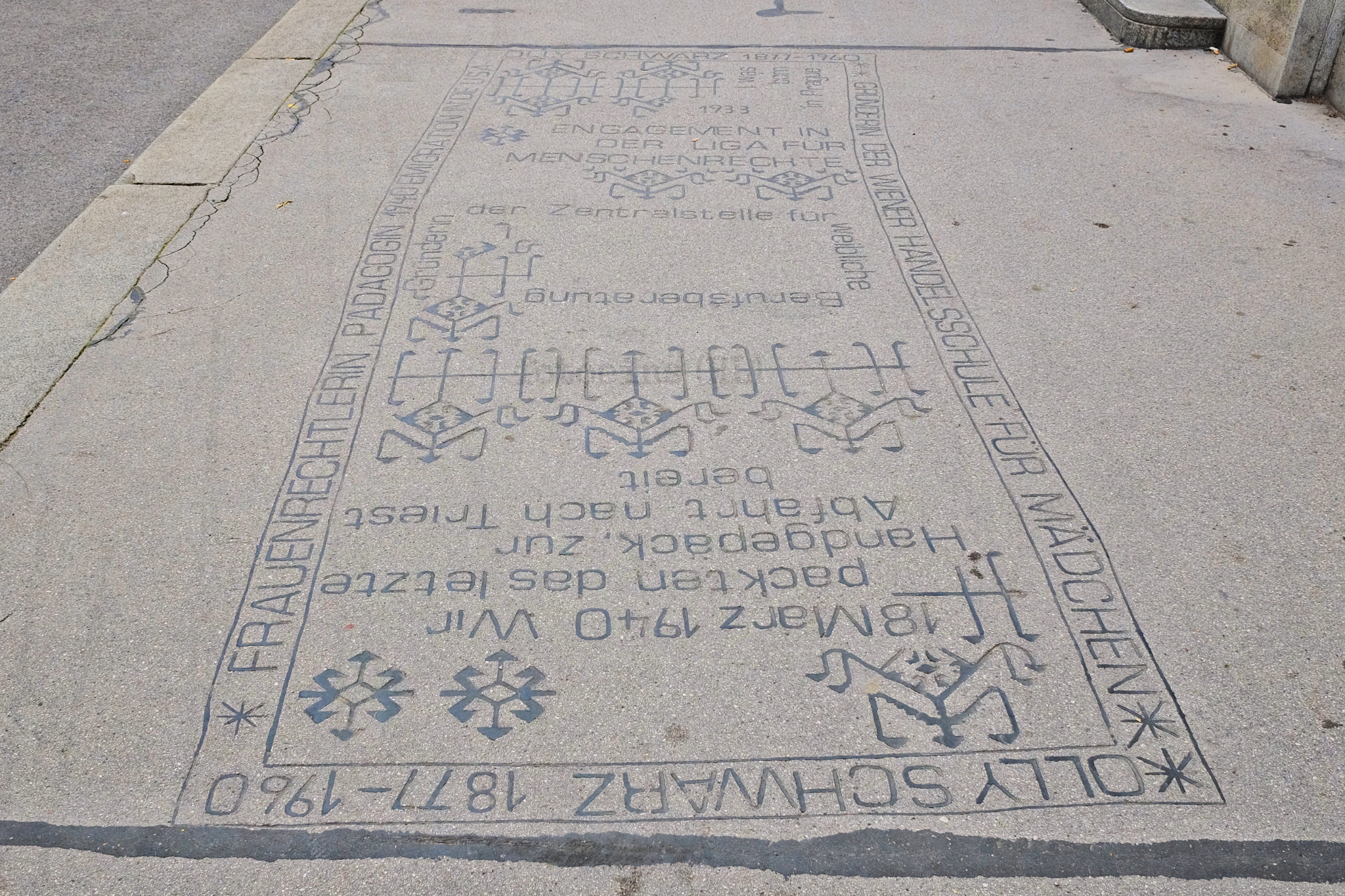
18 März 1940: Wir packten das letzte Handgepäck, zur Abfahrt nach Triest bereit. Teppich-Rahmen: Gründerin der Wiener Handelsschule für Mädchen. Frauenrechtlerin, Pädagogin. 1940 Emigration in die USA // 18 March 1940: We packed the last of our hand luggage, ready for our departure to Trieste. Carpet frame: Founder of the Vienna Business School for Young Women. Women’s rights activist, educator. 1940 Emigrated to the USA Photo, 17 June 2024.
Vally Wieselthier
Augustinplatz, 7th district
Born Valerie Wieselthier in 1895, Austrian artist Vally Wieselthier worked with ceramics, design, and sculpture. She joined the Wiener Werkstätte (Vienna Workshops) which had started in 1903 to encourage an “at home” Austrian arts-and-crafts movement. She became the lead artist in the ceramics workshop at the Wiener Werkstätte, which had once been located at Neustiftgasse 32–34 (Augustinplatz). The title of Iris Andraschek’s project comes from a line in a telegram Wieselthier sent in the late-1930s to United States’ president Franklin D. Roosevelt: “tell these people who I am.”
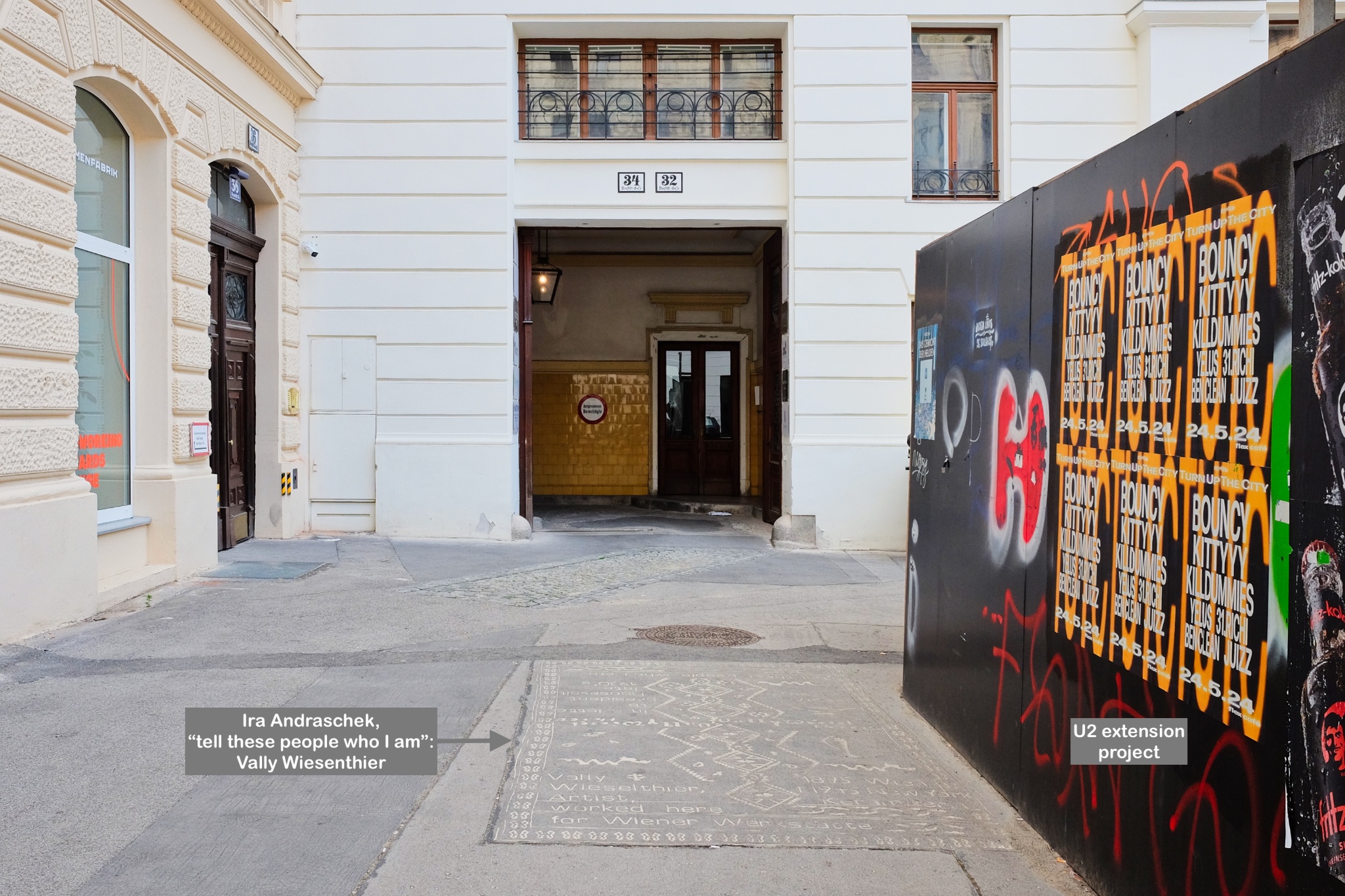
Neustiftgasse 32–34, where Josef Hoffmann and his arts and crafts workshops Wiener Werkstätte had been located. Photo, 17 Jun 2024.
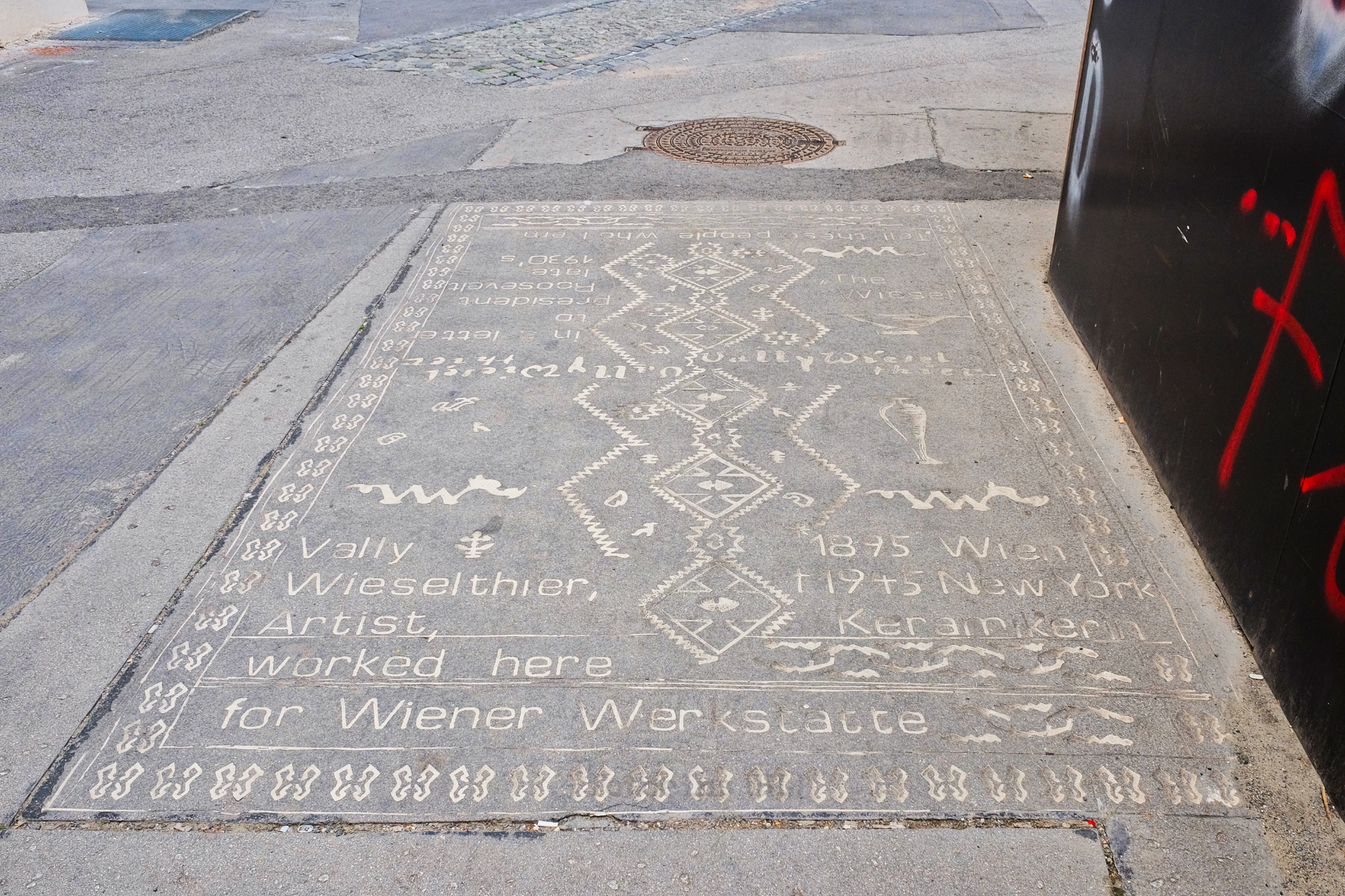
Vally Wieselthier — born 1895, Vienna; died 1945, New York — ceramics artist, worked here for Wiener Werkstätte. Photo, 17 Jun 2024.
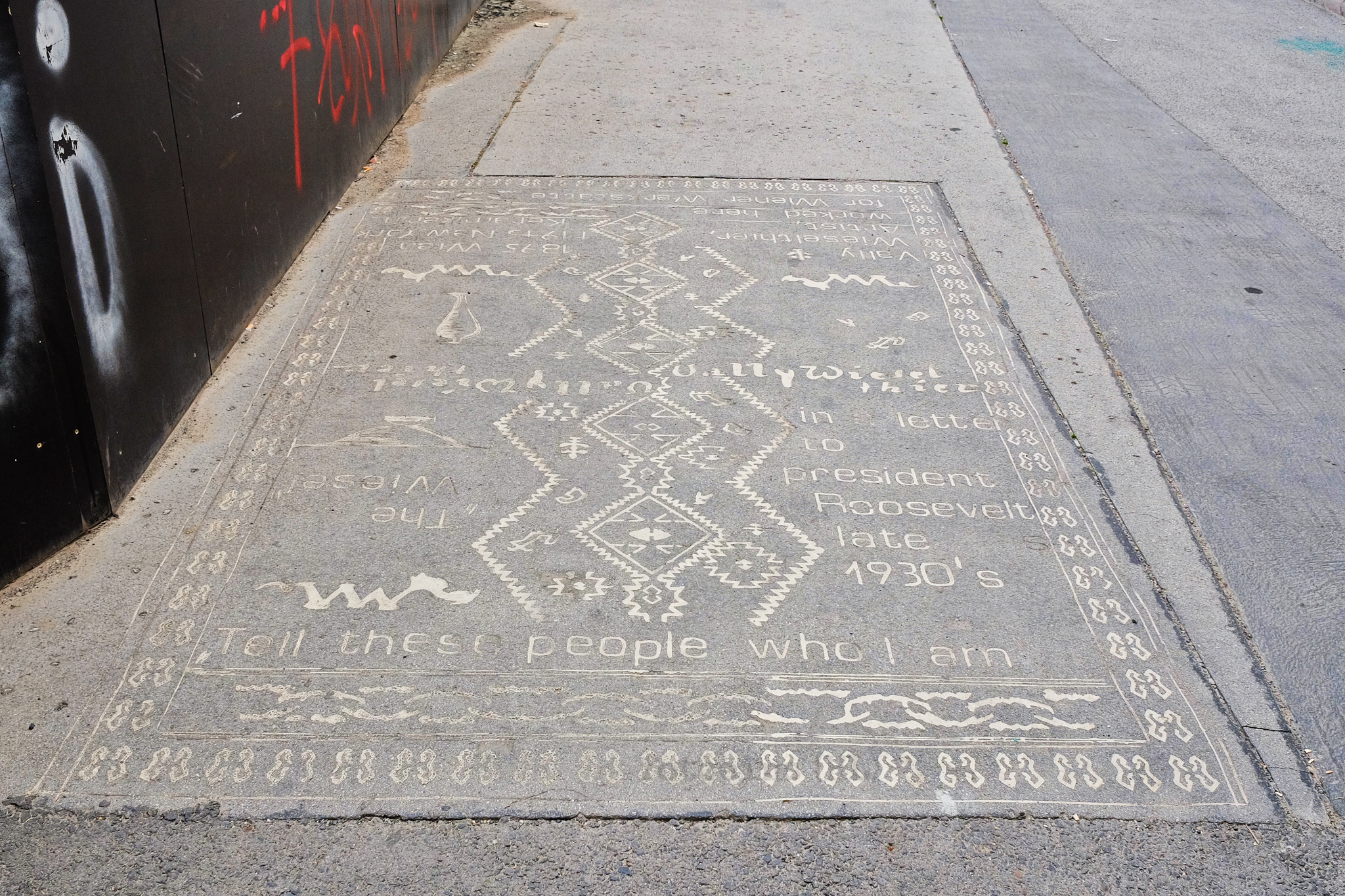
“The Wiesel”, in a letter to (U.S.) president Roosevelt in late 1930s: “tell these people who I am”. Photo, 17 Jun 2024.
Turnertempel Erinnerungsort
Moshe-Jahoda-Platz, 15th district
At the former Jewish synagogue Turner Temple destroyed during the Pogrom of 1938, artists Iris Andraschek, Hubert Lobnig, Maria Auböck, and János Kárász created a place of remembrance “Turner Temple Memory Site – Searching For A Reflexive Archaeology (2011)“. The memorial opened to the public 10 November 2011 on the 73rd anniversary of the 1938 Pogram. The “light column” at the former Turner Temple is number 18 in the city-wide memorial project Lichtzeichen Wien.

Location of former Turnertempel: at centre is the light column, at left and in the background is the memorial project installation by Andraschek and others for KÖR Wien. Photo, 17 June 2024.

Turnertempel Erinnerungsort (place of remembrance): Moshe-Jahoda-Platz. Photo, 17 June 2024.

Turnertempel Erinnerungsort (place of remembrance): Moshe-Jahoda-Platz; note on the far wall a display, which is shown below. Photo, 17 June 2024.
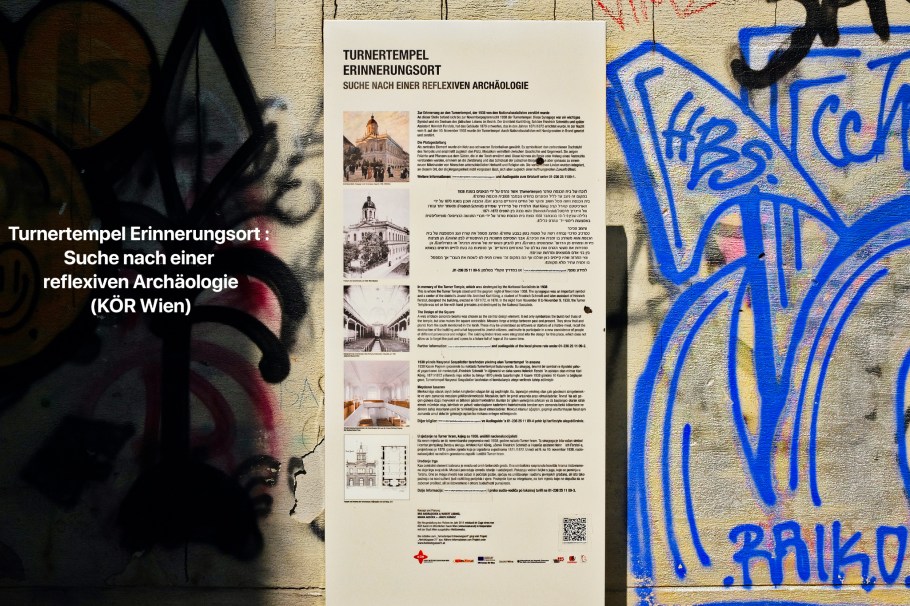
Turnertempel installation: Place of remembrance, search for a reflective archaeology (KÖR Wien). Description in German, Hebrew, English, Turkish, and Bosnian/Croatian/Serbian. Photo, 21 May 2023.

Fruits and vegetables appear in the tiled mosaic in the pavement at Moshe-Jahoda-Platz. Photo, 17 June 2024.
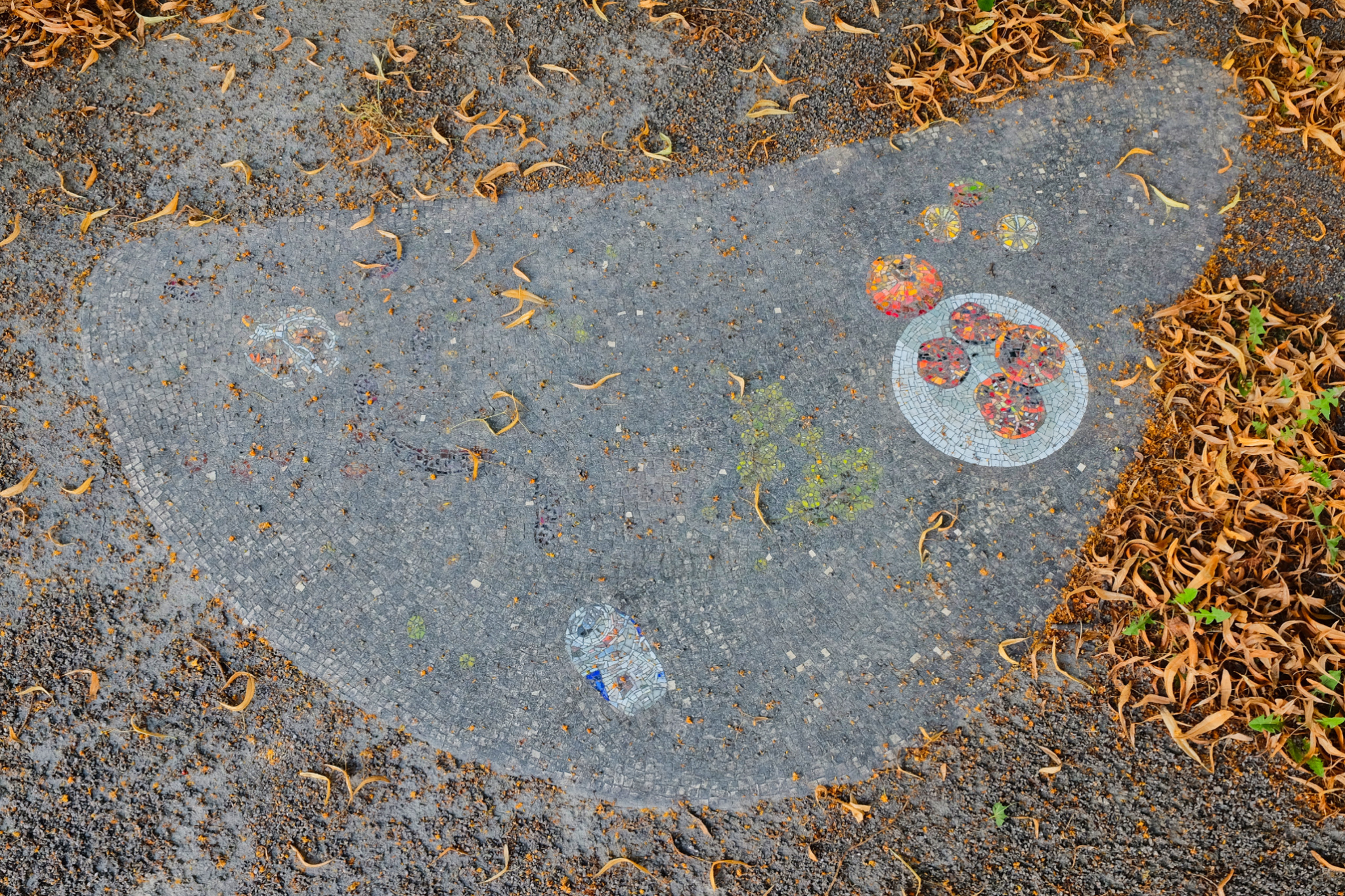
Another mosaic: more fruit at upper-right. Photo, 17 June 2024.
Additional sources
• Czeike, F., Historisches Lexikon Wien, in 6. Bänden (Wien: Kremayr & Scheriau, 1992–1997); available from Wien Bibliothek: <https://www.digital.wienbibliothek.at/wbrobv/content/titleinfo/1112764> [accessed Mar 2026].
• Österreichisiche Bibliothek: Frauen in Bewegung 1848–1938, available at <https://fraueninbewegung.onb.ac.at/> [accessed Mar 2026].
• Kunst im öffentlichen Raum (KÖR, Art in public spaces) Stadt Wien; available <https://www.koer.or.at/> [accessed Mar 2026].
• Wien Geschichte Wiki, Stadt Wien; available at <https://www.geschichtewiki.wien.gv.at/> [accessed Mar 2026].
• Wien Kulturgut, Stadt Wien; available at <https://www.wien.gv.at/kulturportal/public/> [accessed Mar 2026].
I made all images above in the summers of 2023 and 2024 with a Fujifilm X70 fixed-lens prime. This post appears on Fotoeins Fotografie at fotoeins DOT com as https://wp.me/p1BIdT-tMw. Last edit: 4 Mar 2026.
 Fotoeins Fotografie
Please leave your comments below