Nuremberg: The Landmark Trials in Room 600, 80 years on
Above: In front of the Justizpalast (Palace of Justice) at the corner of Benjamin-Ferencz-Platz and Fürther Strasse in Nuremberg, Germany.
On 20 November 1945, an extraordinary trial got under way in the German city of Nuremberg, only six months after the Nazis surrendered to the Allied nations in World War 2. For the first time in modern history, an assembled tribunal of international judges presided over trials against top leaders of a nation for crimes against peace, war crimes, crimes against humanity, and conspiracy to carry out these crimes.
What is called the “Nuremberg Trials” refers primarily to the “Major War Criminals Trial” where over 20 leaders in German Nazi high command were put on trial before the International Military Tribunal (IMT) from November 1945 to October 1946. The IMT consisted of judges from each of the four Allied nations: Great Britain, France, United States, and the U.S.S.R. Subsequently from late-1946 to 1949, 12 additional trials were held before American military tribunals to uncover and highlight the extent and depth to which additional leaders in German society supported the Nazi dictatorship.
“… The privilege of opening the first trial in history for crimes against the peace of the world imposes a grave responsibility. The wrongs which we seek to condemn and punish have been so calculated, so malignant and so devastating, that civilization cannot tolerate their being ignored because it cannot survive their being repeated. That four great nations, flushed with victory and stung with injury stay the hand of vengeance and voluntarily submit their captive enemies to the judgment of the law is one of the most significant tributes that power has ever paid to reason.”– Opening statement by Robert H. Jackson, U.S. chief prosecutor, on the second day of the Nuremberg Trials (Major War Criminals Trial), 21 November 1945; see Sources below.
The parts
- The whys, especially why go through with it?
- Memorium Nuremberg Trials
- Courtroom 600
- Cube 600
- A warning
- Where & how to go
• Sources
Why Nuremberg?
- Nuremberg as “Reichsstadt” (imperial city) served as political centre of the Holy Roman Empire and base for the Reichstag (imperial assembly) held at various times between the 13th and 17th centuries.
- Nazi leader Hitler had dreamed of reshaping Nuremberg from a once glorious Reichstadt to a new Third Reich Reichshauptstadt (empire capital) with massive show-of-might party rallies and planned construction of gigantic buildings and spaces.
- In Nuremberg, the Nazis proclaimed in 1935 the infamous Nürnberger Gesetze (Nuremberg Laws) which codified antisemitic discrimination and would create the stage for the annihilation of Europe’s Jewish population.
- Though the city was heavily damaged by Allied bombing, Nuremberg’s Palace of Justice remained relatively untouched; their courtrooms and offices provided space for what was to come.
Precedents & Principles
- Bring surviving leaders in German high command to trial; prevent an analogue of post-WW1 Versailles Treaty and avoid creating “martyrs” with summary executions as many had demanded immediately after war’s end.
- The first “international court” in world history; recorded in audio and on film, as part of the extensive documentation for historical records and education.
- Trials dispelled narrative of responsibility solely on “extraordinary character and mindset of leaders”, and revealed the shared responsibility tied with the “ordinary nature” of people.
- International governance established in 1950 fundamental principles of international law known as the “Nuremberg Principles” which laid the groundwork for the present-day International Criminal Court.
Why go through this at all?
“I understood then the need to rebuild the scaffolding of justice, the need even to create the illusion of justice. Because if you don’t create the illusion of justice, you don’t have the capacity to renew society in its aftermath. The world returns again and again to the model of Nuremberg.”– Dr. Michael Berenbaum, in M. Solly’s article for The Smithsonian Magazine; see Sources below.
(While imperfect … the trial) has come to represent the instinct for justice and the rule of law in our complicated world, and an end to impunity for mass crimes. (It was a revolution, as for) the first time in human history, the state no longer had unlimited power as a matter of international law over the citizens. For the first time there were constraints. The international criminal court exists only because of the Nuremberg trials. But for Nuremberg, we would not have had the Yugoslavia and Rwanda tribunals, the trial of (Augusto) Pinochet, or the Rohingya hearings (in 2019) at the international court of justice.”– Philippe Sands, British-French lawyer specializing in international law, in C. Baksi’s article in The Guardian; see Sources below.
Memorium Nuremberg Trials
With great anticipation and some nervous energy, I’m in Nuremberg for the first time in over 20 years. I’ve thought a lot about Nuremberg since my last visit, and there are a number of places in the city I want to explore. The documentation and information centre Memorium Nürnberger Prozesse (Memorium Nuremberg Trials) outlines and describes the reasons for the trials immediately after the end of World War 2; the key figures including defendants, legal staff, and judges; the judgements, rulings, and their legacies. The museum includes Courtroom 600 which was the site of the 1945–1946 Major War Criminals Trial.

East wing of the Palace of Justice, home for the permanent exhibition of Memorium Nuremberg Trials. Courtroom 600 is located behind the two large windows visible at upper right; see below for present-day images inside of the courtroom.
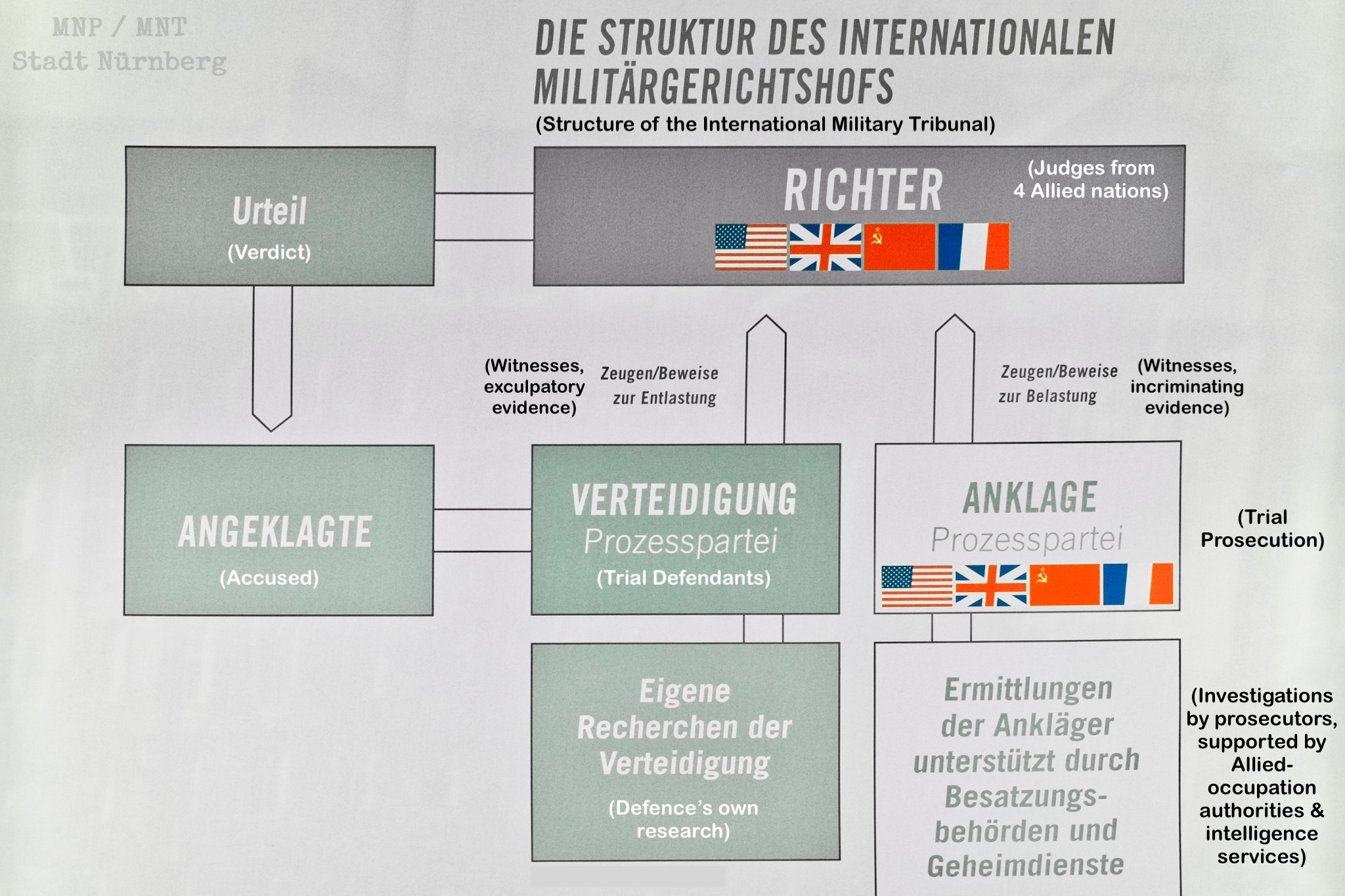
Permanent exhibition, structure of the International Military Tribunal. In this diagram, the Major War Criminals Trial begin at lower-left with the accused, and trial proceedings move counterclockwise towards the verdict at upper-left. I’ve added English translations in the diagram.
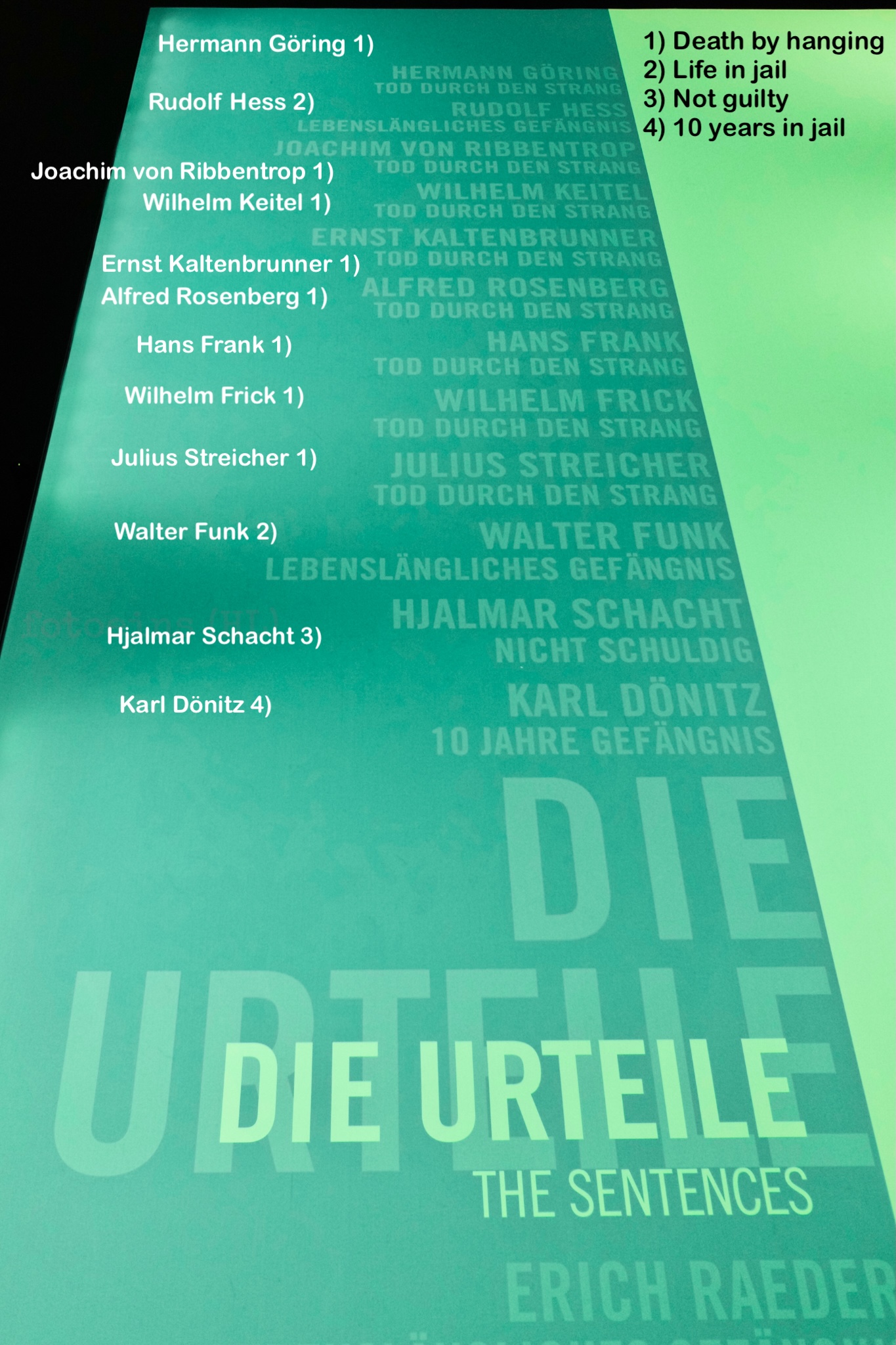
Permanent exhibition: Major War Criminals Trial, 22 defendants. Verdicts were read aloud on 1 October 1946.

Permanent exhibition: Major War Criminals Trial, 22 defendants. Verdicts were read aloud on 1 October 1946.

Permanent exhibition: digital scan of the front page of the Munich-based newspaper Süddeutsche Zeitung, special edition on 1 October 1946 with headline “Das Urteil in Nürnberg” (The Verdict in Nuremberg).

Permanent exhibition: copy of “Der Nürnberger Prozess” (The Nuremberg Trials), by Joe J. Heydecker & Johannes Leeb, published in 1958. Born in Nuremberg, Joe J. Heydecker had been one of the few German reporters to attend the Major War Criminals Trial. He and fellow reporter Johannes Leeb had contributed a series of articles about the trials for the weekly German magazine Münchner Illustrierte (Munich Illustrated). The articles formed the basis for the 1958 book, which has been subsequently published in many editions and multiple languages around the world. Photo on 31 Jul 2025 (P15).
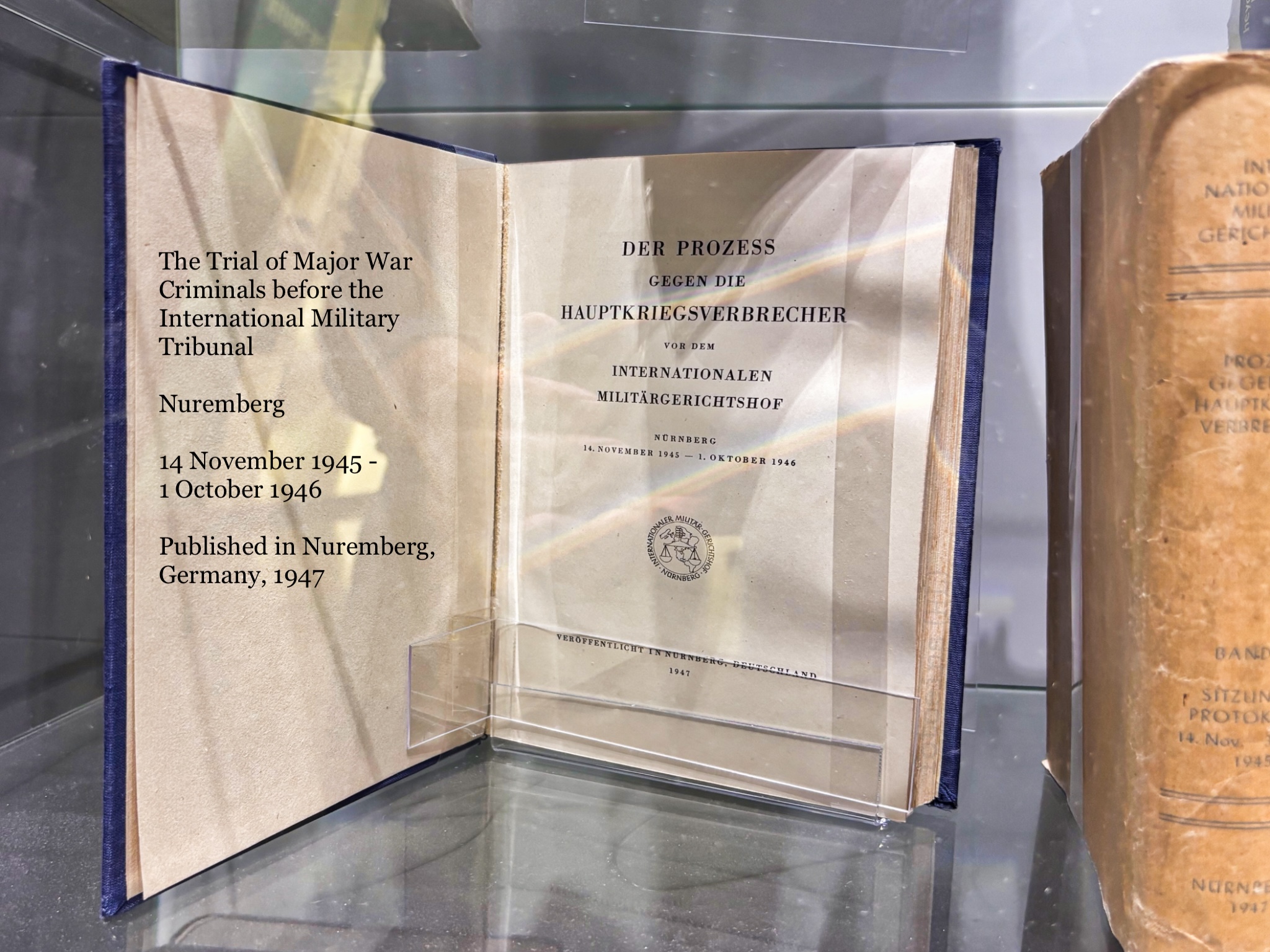
Permanent exhibition. In 1947, the International Military Tribunal published the minutes and proceedings of the Trial of Major War Criminals in 40 volumes and in 4 languages at the trial: English, French, German, and Russian. The published proceedings also included a selection of documents which were admitted as evidence during the trial. The Allied powers had requested that the entirety of the proceedings be printed, reproduced, and made available to the German public free of charge at most public libraries in the country. In full recognition of the importance of the trials at large, the request was part of a far-reaching plan to further educate the public in Germany and around the world with printed material as well as recorded audio and film of the proceedings. Today, for example, the Harvard Law School hosts online prosecution documents for a subset of the Nuremberg trials. Photo on 31 Jul 2025 (P15).
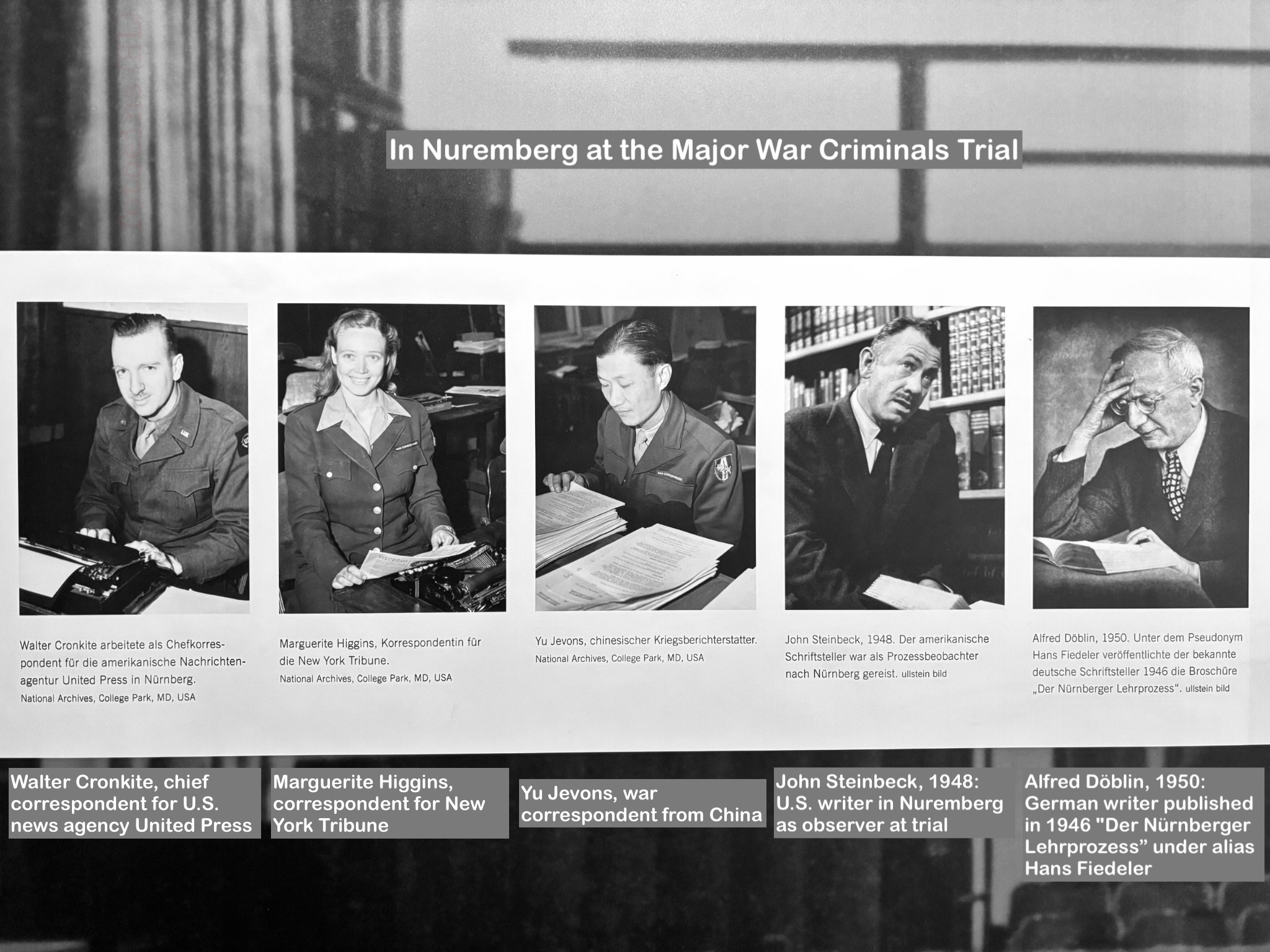
Permanent exhibition, some notable people in Nuremberg at the Major War Criminals Trial. Photo on 31 Jul 2025 (P15).
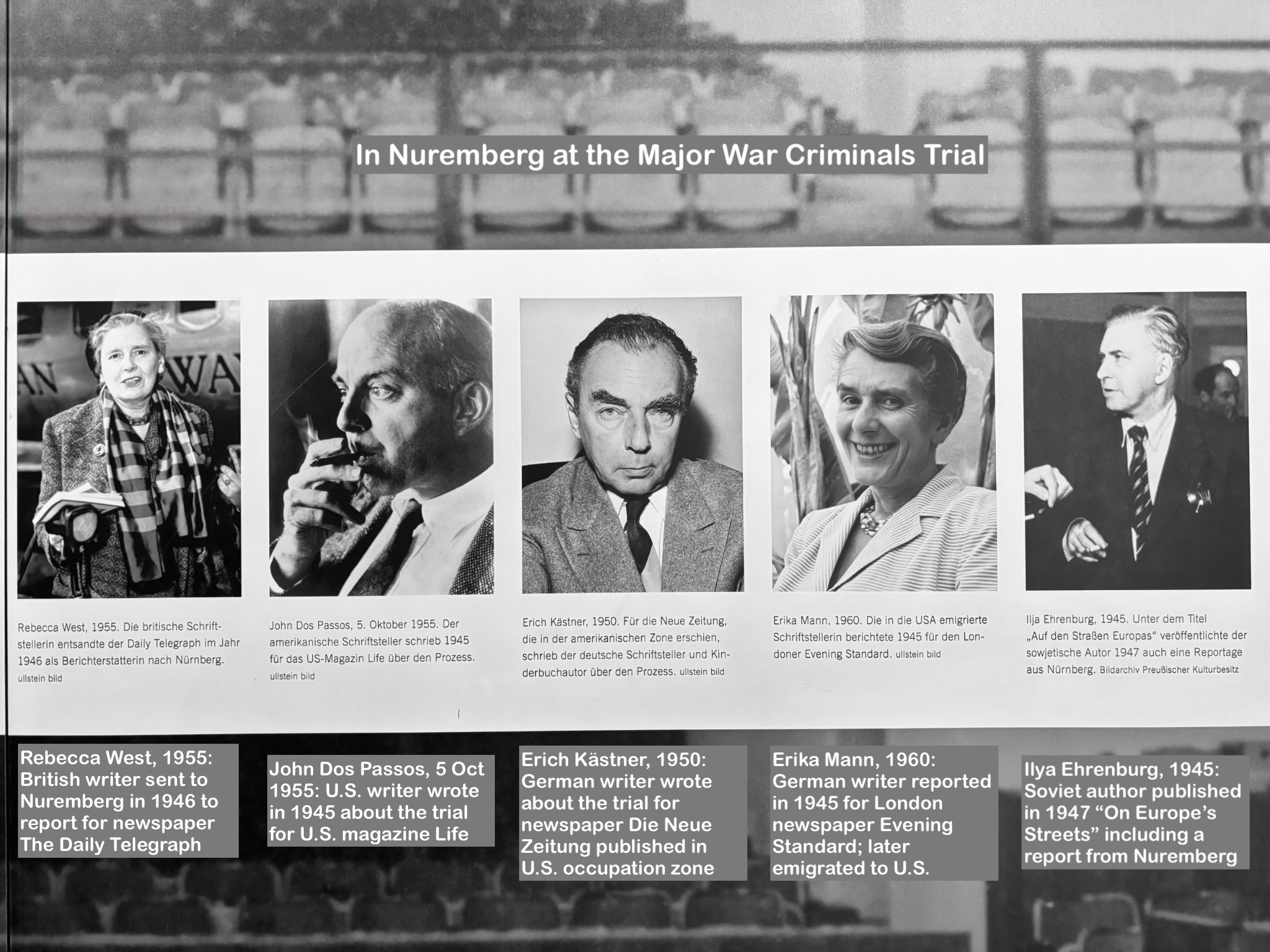
Permanent exhibition, some notable people in Nuremberg at the Major War Criminals Trial. Photo on 31 Jul 2025 (P15).

Permanent exhibition: 12 additional trials held in Nuremberg before military tribunals between 1946 and 1949. Trial proceedings were held against high-ranking judges; medical doctors; business operators; commanders in the Schutzstaffel political paramilitary force; commanders in civilian police, military staff, civil service; and diplomats. These additional trials uncovered how many and how far German leaders in civilian-, business-, and military-life endorsed the power structure and contributed to the machinery of the Nazi state.
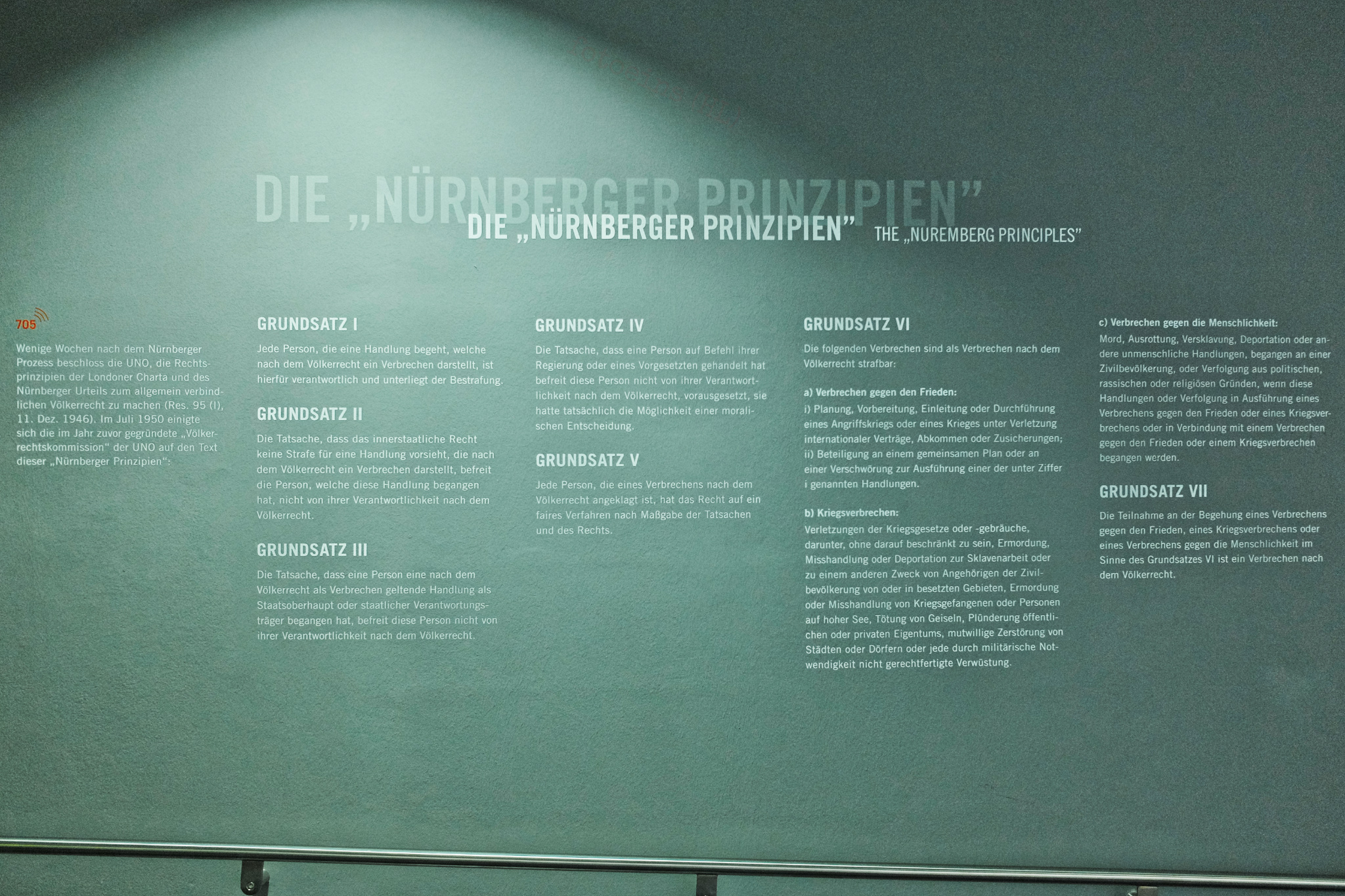
Permanent exhibition: Nürnberger Prinzipien (Nuremberg Principles) established in late-1946 and adopted in 1950; see the list in English at the International Committee of the Red Cross.
Gerichtssaal 600 (Courtroom 600)
Courtroom 600 (Gerichtssaal 600) served as the venue for the Major War Criminals Trials and subsequent trials. The courtroom continued to remain active for legal proceedings until 1 March 2020. As part of the museum’s permanent exhibition, the courtroom is now open to visitors, except on days with special events.
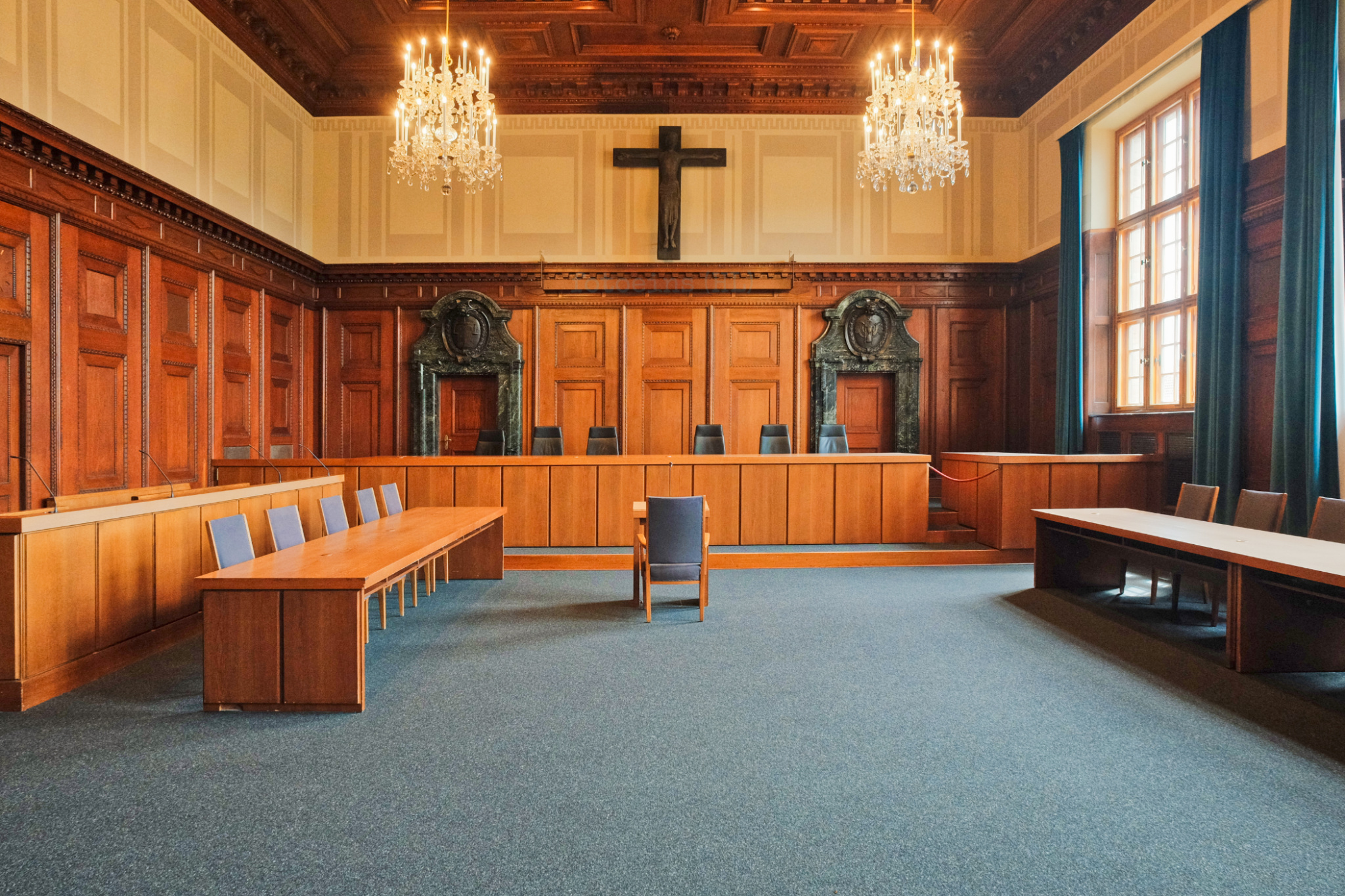
It’s a quiet cozy room now with lots of orange-brown wood, with light streaming from large windows to the side. There are “ghosts” here that history cannot erase, and a lingering sense to a remnant of energy representing a colossal clash between the stink of the wicked against the valiant tireless attempts by others to bring the worst to justice.

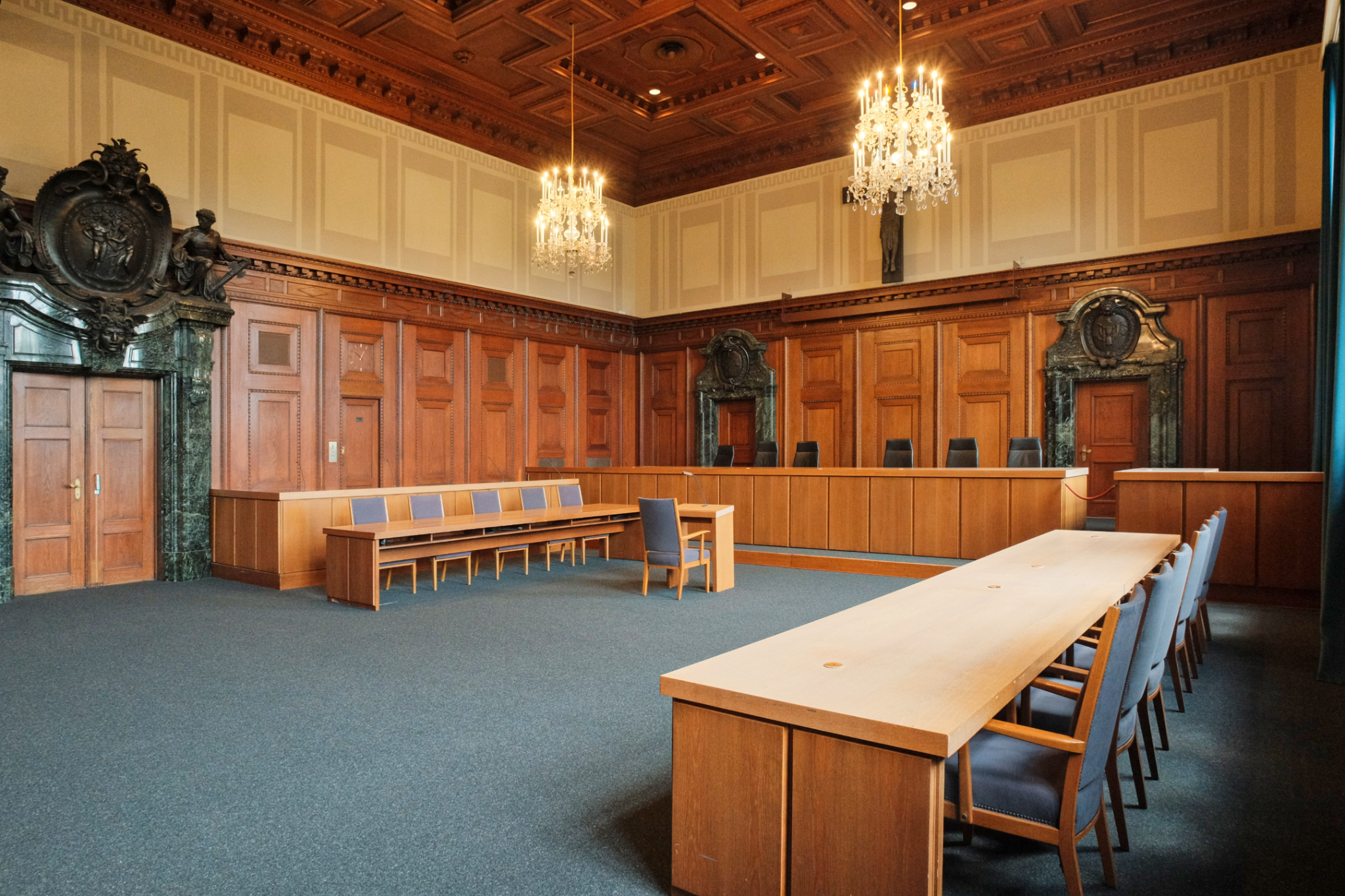
Compare this present-day view of the courtroom with the archival image below; this photo and 2 photos above on 31 Jul 2025.
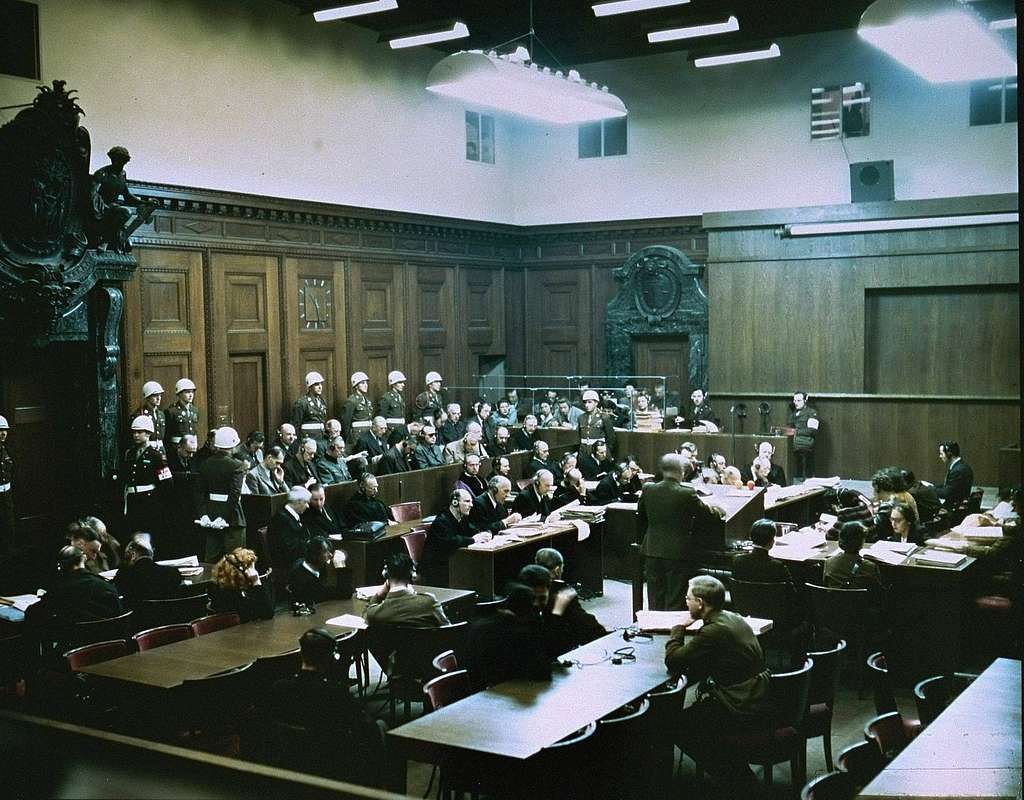
Archival photo of the courtroom on 27 Mar 1946 during the Major War Criminals Trial, courtesy of the United States Holocaust Memorial Museum. Defendants during the Major War Criminals Trial sat in the dock to the very left in front of a small door above which is a clock. International tribunal judges sat in front of the room’s large windows at right (out of view). In the background at centre were interpreters in English, French, German, and Russian; to the right is space for a large screen to display information or documentation film-roll. In the foreground sat the prosecution team composed of lawyers from each of the four Allied nations. Archival image in the open source public domain retrieved from Picryl.

Permanent exhibition, 1945/46 photograph of the courtroom from the visitors’ gallery. The accused (defendants) sat in the dock at left, with the assigned team of defence lawyers in front of them at center. Directly opposite to the right sat the presiding judges from the four allied nations. Along the bottom of the image in the foreground were the prosecution lawyers. At the back were the intepreters’ booth at upper left and the witness stand. Above were windows cut out specifically to accommodate media representatives from around the world. Very bright lights mounted on the ceiling ensured enough light for film crews to document the proceedings.
British Pathé archive highlights, “The Nuremberg Trials” (1945), 8 min 40 sec in English :
Cube 600
The museum’s temporary exhibitions are housed in a former gas station-auto repair garage at the corner of Fürther Strasse and Benjamin-Ferencz-Platz, some 75 metres (250 feet) from the main museum.

Cube600 for temporary exhibitions.

Part of the temporary exhibition: “Bildung ist Zukunft” / Education is our future. Photo on 31 Jul 2025 (P15).

Part of the temporary exhibition: map of the United States with by-state percentage of surveyed millennials who did not know 6 million Jews were killed during the Holocaust; sourced from U.S. Millennial Holocaust Knowledge and Awareness Survey, Claims Conference 2020. Photo on 31 Jul 2025 (P15).

Part of the temporary exhibition: quote by Angela Markel, from her speech as German Chancellor to Israel’s Knesset on 18 March 2008. Photo on 31 Jul 2025 (P15).
Nuremberg warning
From September 1945 to January 1946, Dr. Douglas M. Kelley served as the U.S. Army chief psychiatrist at Nuremberg. With Kelley’s promotion and return to the U.S., Dr. Leon Goldensohn replaced Kelley as chief psychiatrist in Nuremberg from January to July 1946. Both Kelley and Goldensohn had been tasked with evaluating the mental competency and psychiatric profiles of the accused at the Major War Criminals Trial. What Kelley and Goldensohn both learned from their interviews were conclusions similarly reached by philosopher and historian Hannah Arendt upon attending the Eichmann trials in 1961; that anywhere in the world, ordinary normal balanced well-educated family-oriented people can commit crimes of mass atrocity.
(Nazi officials are examples of) … people who exist in every country of the world. Their personality patterns are not obscure. But they are people who have peculiar drives, people who want to be in power, and you say that they don’t exist here, and I would say that I am quite certain that there are people even in America who would willingly climb over the corpses of half of the American public if they could gain control of the other half, and these are the people who today are just talking – who are utilizing the rights of democracy in an anti-democratic fashion.– Dr. Douglas M. Kelley, “The Nuremberg Trial,” 1946 lecture. Douglas McGlashan Kelley Archival Collection, University of California, Santa Cruz (from Dr. Guepet’s film review; see Sources below).
Sources
• Baksi, C., Landmarks in law: Nuremberg and the first trial for crimes against humanity, available from The Guardian at <https://www.theguardian.com/law/2020/dec/18/landmarks-in-law-the-first-trial-where-the-word-genocide-was-spoken> [published 18 December 2020, last access November 2025].
• Bamford, T., The Nuremberg Trial and its Legacy, available from The National WW2 Museum at <https://www.nationalww2museum.org/war/articles/the-nuremberg-trial-and-its-legacy> [published 17 November 2020, last access November 2025].
• DW (Deutsche Welle) History & Culture, about Nuremberg Trials – https://youtu.be/vy21VoWlxAs [English, accessed Nov 2025]
• DW Travel, about Nuremberg – https://youtu.be/zR6LMgOjt1w [English, accessed November 2025]
• Goldensohn, L., The Nuremberg Interviews: An American Psychiatrist’s Conversations with the Defendants and Witnesses (New York: Alfred A. Knopf, 2004).
• Guepet, H., ‘This War Ends in a Courtroom’: ‘Nuremberg’ (2025 film) and the Real Trials, available from The National World War 2 Museum at <https://www.nationalww2museum.org/war/articles/war-ends-courtroom-nuremberg-2025-and-real-trials> [published 7 November 2025, last accessed November 2025].
• Jackson, R.H., International Military Tribunal: Opening Statement for the United States of America, 21 November 1945 at the Nuremberg Trials; available on page 4 in the scanned document at <https://nuremberg.law.harvard.edu/documents/450105-opening-statement-for-the-united?mode=image&q=trial:imt+type:%22document%22> [last accessed November 2025].
• Jackson, R.H., International Military Tribunal: Opening Statement for the United States of America, 21 November 1945 at the Nuremberg Trials; audio available from the Robert H. Jackson Center’s YouTube channel at <https://youtu.be/JBwutHKoFhM> and the quoted excerpt runs from 1m10s to 2m29s [uploaded 12 Apr 2020, last accessed November 2025].
• Makamson, C., “The Grave Responsibility of Justice”: Justice Robert H. Jackson’s Opening Statement at Nuremberg, available from The National World War 2 Museum at <https://www.nationalww2museum.org/war/articles/robert-jackson-opening-statement-nuremberg> [published 20 November 2020, last accessed November 2025].
• Solly, M., The True Story Behind “Nuremberg,” a WWII Drama About Hermann Göring’s Cat-and-Mouse Game With an American Psychiatrist, available from The Smithsonian Magazine at <https://www.smithsonianmag.com/history/the-true-story-behind-nuremberg-a-wwii-drama-about-hermann-gorings-cat-and-mouse-game-with-an-american-psychiatrist-180987621/> [published 7 November 2025, last accessed November 2025].
Where & how to go in Nuremberg
• VGN: U-Bahn U1 train to station “Bärenschanze”.
• Summer (winter) hours & admission: 9(10)–18h, €7,50; check the link for the most recent update.
• Courtroom 600 is generally open during museum hours, but may be closed on specific dates for special events.
( View this location on OpenStreetMap )
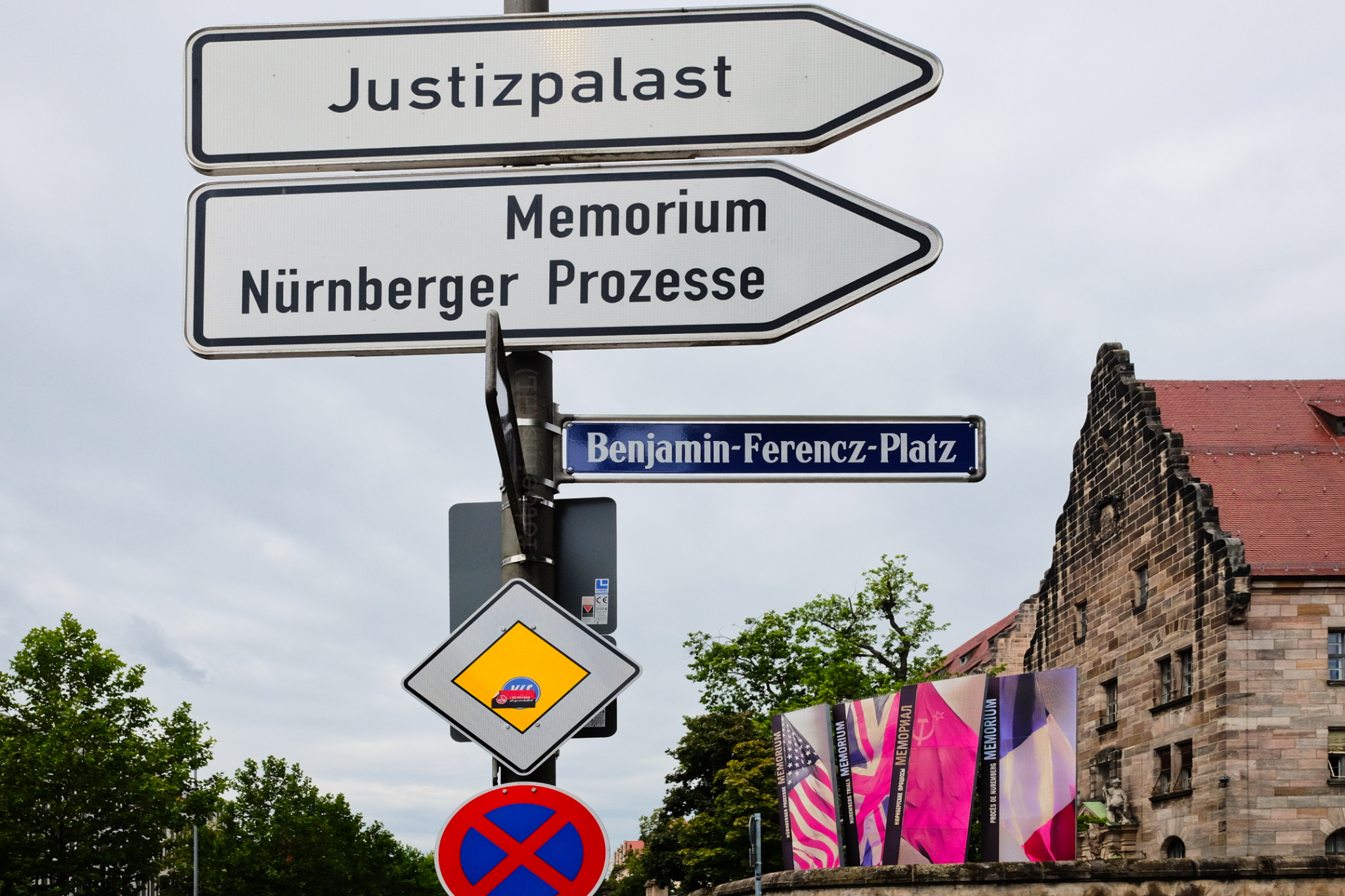
Benjamin-Ferencz-Platz at Fürther Strasse; Cube600 is just out of view at right. At age 27, American lawyer and investigator Benjamin Ferencz served as chief prosecutor who indicted over 20 Nazi Schutzstaffel officers in the follow-up trial against the Einsatzgruppen (mobile paramilitary death squads). Continuing his fight and advocacy for victims of mass atrocity, Ferencz would go on to help establish the International Criminal Court.
I received neither pre-visit support nor post-visit compensation for the present work. I have no affiliation with the 2025 film “Nuremberg”, its production and management, the film’s source material, or with the author of the source material. Except for the archival image of Courtroom 600 from Picryl, I made all other images above on 31 Jul 2025 with a Fujifilm X70 fixed-lens prime and an iPhone15 (P15). This post appears on Fotoeins Fotografie at fotoeins DOT com as https://wp.me/p1BIdT-wCt.
 Fotoeins Fotografie
One Response to “Nuremberg: The Landmark Trials in Room 600, 80 years on”
[…] • Click • Nuremberg: The Landmark Trials in Room 600, 80 years on […]
LikeLike