Vienna: Johann Strauss II, traces & places
Above: Danube river at dusk, facing southeast from Brigittenauer Sporn. Photo, 11 Jun 2022 (X70).
Vienna is a historical city of music with the likes of Beethoven, Haydn, Mozart, Schubert, and more. In the mid- to late-19th century, the Strauss family of composers created a dominant scene in Viennese waltz (Wiener Waltz). Johann Strauss II’s “An der schönen blauen Donau” (The Blue Danube) is one of the best-known compositions of classical music. The song was used famously in Stanley Kubrick’s film adaptation of Arthur C. Clarke’s novel “2001: A Space Odyssey“.
And as in the movie, the soaring feelings of hopeful anticipation during the spacecraft’s journey and docking with the spinning space station have become as routine as my arrival onto Viennese shores from the other side of the big eastern pond. I rely on Vienna to provide the gravity to maintain balance and spirit; this much has stayed true over multiple consecutive summers.
I’ve spent over 100 total days in Vienna, explored many of her streets and districts, and walked hundreds of kilometres. Efforts to immerse myself in various types of the city’s art and architecture have been accompanied by the sounds of brass horns and sweeping strings in a back-and-forth “dance” that spans the entire city. There’s new opportunity to learn about the song’s composer who was born, raised, studied, worked, and died in the Austrian capital city.
With the 200th anniversary of Johann Strauss II’s birth in 2025, the city of Vienna celebrates the occasion with a multitude of arts and culture events over the entire 2025 year.
Johann Strauss II: traces & places
b/✵ 25 October 1825
d/✟ 3 June 1899
I’ve highlighted some of the locations where Johann Strauss II (JS2) left his mark. The following is in alphabetical order, but not in chronological order. For every item, the number in parentheses at the end indicates the city district; e.g., (7.) is the 7th district, also known as Neubau. All numbered items in the list correspond to locations with the same numbering in the map below. Following the description below, the JS2 residence-timeline goes something like: birth house on Lerchenfelder Strasse, Taborstrasse, Praterstrasse, Hietzing, Wieden unti his death.
- Birth house on Lerchenfelder Strasse (7.)
- Church at the Court (1.)
- City’s central cemetery (11.)
- Danube, from Nussberg (19.)
- Diana ballroom (2.)
- District Museum Leopoldstadt (2.)
- Dommayer (13.)
- Hietzing residence (13.)
- Lutheran city church (1.)
- Music Society of Vienna (1.)
- Praterstrasse residence: Wien Museum (2.)
- Salmannsdorf family villa (19.)
- Schottengymnasium grammar-secondary school (1.)
- Stadtpark: Johann Strauss II memorial statue (1.)
- State Opera (Opera House) (1.)
- Taborstrasse family residence (2.)
- Theater by the Vienna river (6.)
- TU Vienna (Polytechnic Institute) (4.)
- Volksgarten café pavilion (1.)
- Wieden: Johann-Strauss-Gasse 4, death house (4.)
- Wieden: Johann-Strauss-Gasse 10 (4.)
- Zögernitz casino: House of Strauss (19.)
• “An der schönen blauen Danube” (The Blue Danube): visualization by Stephen Malinowski, 2016.
• Sources
Birth house (7.)
Geburtshaus: Lerchenfelder Strasse 15
In 1825, Johann Strauss I and his wife Maria Anna (née Streim) moved into the building known as “Zur goldenen Ente” (The golden duck) at address Lerchenfelder Strasse 15. Later that October, their son Johann Strauss II was born in this residence. In 1834 when JS2 was 9 years old, the entire Strauss family moved to an apartment on Taborstrasse. The building at Lerchenfelder Strasse 15 was subsequently demolished in 1890, and the building in its place today (2024) was completed between 1890 and 1892 (Wien Kulturgut). A memorial plaque appears on the exterior wall on the 1st floor above ground.
The present-day building is under private ownership and not open to the public, but at least the view from street-level is freely available. Public transport with Wiener Linien: bus 13A to stop Piaristengasse, bus 48A to stop Kellermanngasse, or tram 46 to stop Auerspergstrasse.
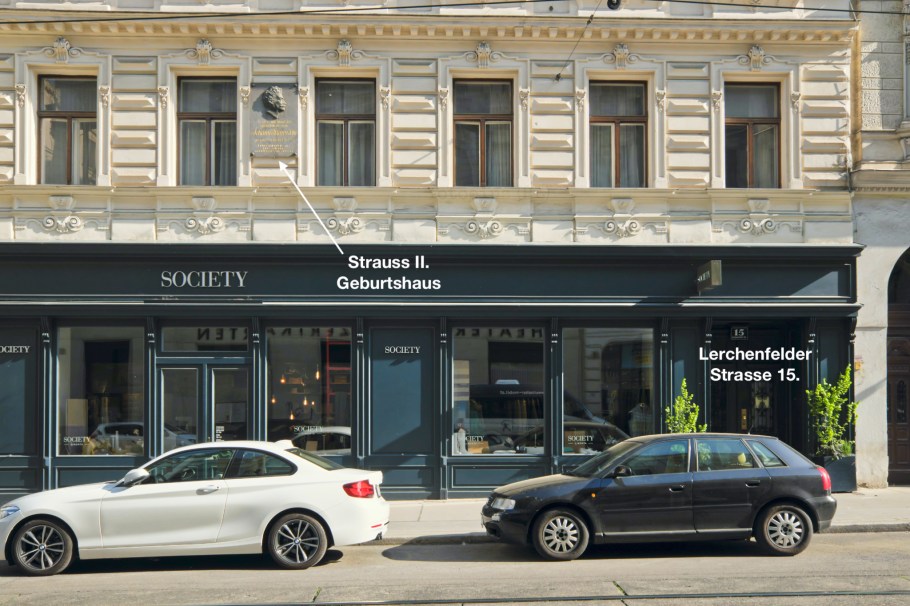
Present-day Lerchenfelder Strasse 15 in Vienna’s 7th district. Photo, 16 May 2022 (X70).

“An dieser Stelle stand das Geburtshaus von Johann Strauss Sohn: geb. am 25. Oktober 1825. Seinem Ehrenmitglied der Wiener Männergesangverein.” (At this location was the building where Johann Strauss II was born on 25 October 1825. Honorary member of the Vienna Men’s Choral Society.) Photo, 16 May 2022 (X70).

Shown at centre in this sketch drawing is the building “Zur goldenen Ente” (The golden duck) in the 7th district (“VII. B.”, for “7. Bezirk”) at Lerchenfelder Strasse 15; the building was demolished in 1890 (“demoliert 1890”). Fritz Racek, from “Johann Strauss: Zum 150. Geburtstag. Ausstellung der Wiener Stadtbibliothek, 22. Mai bis 31. Oktober 1975.” (Wien: Wiener Stadtbibliothek, 1975). Original ink drawing by Ludwig Wegmann; mentioned in “Deutsch-österreichisches Künstler- und Schriftsteller-Lexikon” (Vienna: Hermann Kosel, 1902). Image and information from Wikipedia.
Church at the Court (1.)
Kirche am Hof
Despite objections by and without the knowledge of his father, JS2’s mother Anna supported and financed his early music education. An important teacher had been Joseph Drechsler: organist, composer, instructor, conductor, and music director at various churches in Vienna, including the Kirche am Hof from 1823 to 1845. In this interval, Drechsler accepted JS2 as one of his students. With his composition of the gradual “Tu qui regis totum orbem“, JS2 passed his course examination at the Kirche am Hof on 4 August 1844, only a couple of months shy of his 19th birthday.
The public is free to enter and wander the open plaza; surrounding the plaza are various buildings both public and private. Public transport with Wiener Linien: U-Bahn U1 or U3 line to station Stephansplatz, or U-Bahn U2 line to station Schottentor.

Kirche am Hof – 20 May 2018 (X70).
City’s central cemetery (11.)
Zentralfriedhof
Buried in the city’s central cemetery are various members of the Strauss family including:
• Johann Strauss I (father)
• Anna Strauss (mother, née Streim)
• Johann Strauss II, 1825–1899
• Josef Strauss, 1827–1870
• Eduard Strauss, 1835–1916
Entry to all parts of the central cemetery is free of charge, but note their opening hours depending on the time of year. Public transport with Wiener Linien: U-Bahn U3 to end station Simmering, then tram 11 or 71 to stop “Zentralfriedhof, 2. Tor”.
Elsewhere, mezzo-soprano and JS2’s 1st wife, Henrietta “Jetty” Treffz Chalupetzky (1818–1878), and Johann II’s sisters Anna (1829–1903) and Therese (1831–1915) are buried in a single grave in Hietzing cemetery. Johann Strauss III, son of Eduard Strauss and nephew of JS2, is buried in Grinzing cemetery.

Zentralfriedhof Wien: Johann Strauss II (✵ 1825–1899 ✟) and his 3rd wife Adele (née Deutsch, ✵ 1856–1930 ✟). Photo, 20 May 2018 (X70).
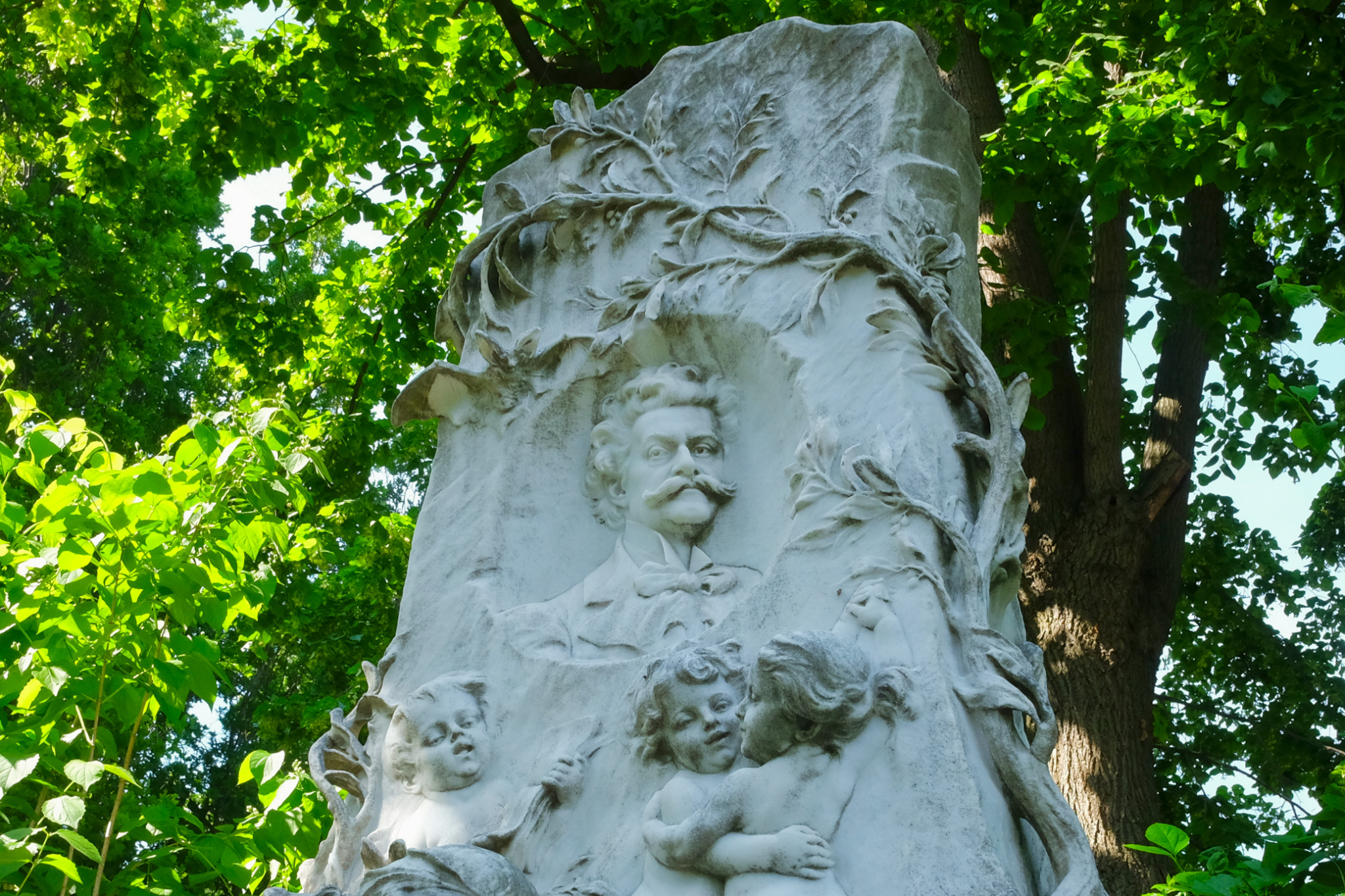
The visage of Johann Strauss II at centre stares out for all time. Photo, 20 May 2018 (X70).

Partial music-family portrait: shown in this image from left to right, respectively, are Johann Strauss II (JS2), family friend and competitor Joseph Lanner, Johann Strauss I (dad JS1), Eduard “Edi” Strauss, Josef “Pepi” Strauss, and Anna Strauss (mum). Anna and Therese, two daughters of JS1 & Anna, are buried in Hietzing cemetery. Photo, 14 Jul 2025 (X70).
Danube, from Nussberg (19.)
View of the river from northern hills
The Danube river itself isn’t blue and more like a murky brownish-green from all that silt and mud content, but on a summer morning, I’ve gone up into the foothills and vineyards for an obstructed view that includes plenty of greens and blues. Throughout the city are views of four water bodies with the name Danube.
Public transport to the view seen below: ÖBB S-Bahn S40 train to station Nussberg or Wiener Linien tram D northbound to penultimate stop “Nussberg S”. Then, walk uphill on Greinergasse, Hackhofergasse, then Eichelhofstrasse to Eichelhof, and beyond to the rest of the Nussberg ridgeline. This forms a part of the city’s hike trail “Stadtwanderweg 1.”

Summer morning in Vienna’s vineyards: a view of the Danube river and a part of the city skyline. Photo, 13 Jul 2024 (P15).
Diana ballroom (2.)
Dianasaal, Dianabad: Obere Donaustrasse 93–95
By the mid-19th century, the Dianabad (Diana public baths) in Vienna’s Leopoldstadt district had established itself as an important communal baths facility and as community centre. In the winter, the largest swimming pool was emptied, covered, and reutilized as a ballroom called the Dianasaal (Diana Hall) where concerts and other public events took place. The ballroom is where JS2’s composition “An der schönen blauen Donau” (The Blue Danube) was played for the first time to the public on 15 February 1867. For the 70th anniversary of the debut, a commemorative plaque was installed in the Dianabad in 1937; this plaque is now in the collection of the District Museum Leopoldstadt. Between 1866 and 1867, JS2 composed “The Blue Danube” in the residence he shared with his wife, Jetty, on Praterstrasse.
Since 1969, the address of the former Diana baths is an office building and home to IBM Österreich (IBM Austria). Additional commemorative plaques have appeared, but I’ve two key questions. (1) What happened to the 1975 commemorative plaque on the 150th anniversary of Johann II’s birth? (2) After the 4th version of the Diana baths were closed in October 2020, what happened to the 2017 commemorative plaque on the 150th anniversary of the debut of “The Blue Danube”?
The IBM Austria headquarters is not open to the public, and the Diana baths are closed. What remains are the free views from the streets outside the IBM building and across the Danube canal. Public transport with Wiener Linien: U-Bahn U1- or U4-line to station Schwedenplatz, or tram 2 to stop Marienbrücke.
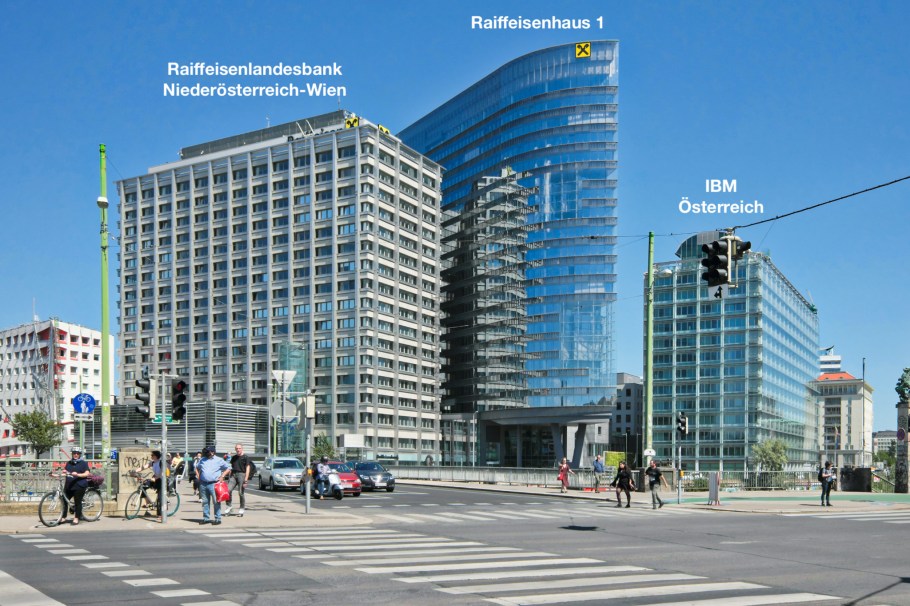
East-facing view from the south end of Salztorbrücke. Where the Diana baths once stood, the headquarters for IBM Österreich are at address Obere Donaustrasse 93–95. Photo, 31 May 2022 (X70).

Facing northeast from the Freda-Meissner-Blau Promenade on the southwest shore of the Danube canal; seen here, the water flow is left to right. The present-day location of the headquarters for IBM Austria is at Obere Donaustrasse 93–95. Photo, 11 Jun 2023 (X70).

Watercolour painting of the Diana baths at right, dated 1810–1820. This view faces west-northwest near what is now the address Obere Donaustrasse 95. Wien Museum inventory number 250514: “2., Obere Donaustraße 93–95 – Dianabad”, artist unknown, c.1810–1820″ (CC BY 4.0).
District museum Leopoldstadt (2.)
Bezirksmuseum Leopoldstadt: Karmelitergasse 9
Each of Vienna’s 23 city districts has its own district museum with their own collection of memorabilia, objects, and photographs which encapsulate the district’s history. In the 2nd district, the Leopoldstadt museum includes in their collection a plaque commemorating the 70th anniversary of the public debut of “The Blue Danube” in the Diana ballroom.
While there is no admission charge, please note the unusual opening hours for the District Museum Leopoldstadt: Wednesdays 16h to 1830h, and Sundays 10h to 13h; closed on school- and statutory-holidays. The district museum is less than 200 metres from the Strauss’ family Taborstrasse residence on the other side of Karmeliterplatz. Public transport with Wiener Linien: U-Bahn U2 line to station Taborstrasse, tram line 2 to stop Karmeliterplatz, or bus line 5A to stop Karmeliterplatz.

“An dieser Stelle, im alten Dianasaale, erklang, gesungen vom Wiener Männergesang-Verein, am 15. Februar 1867 zum Erstenmal der Walzer `An der schönen blauen Donau’ von Johann Strauss (Sohn). Johann Strauss Gesellschaft / Dianabad-Aktien-Gesellschaft / 15 February 1937.” Here in the former Diana Hall, Johann Strauss II’s waltz ‘The Blue Danube’ was performed by the Vienna Men’s Choir for the first time to the public on 15 February 1867. Johann Strauss Society / Diana Baths Company / 15 February 1937. Photo, 31 May 2023 (X70).
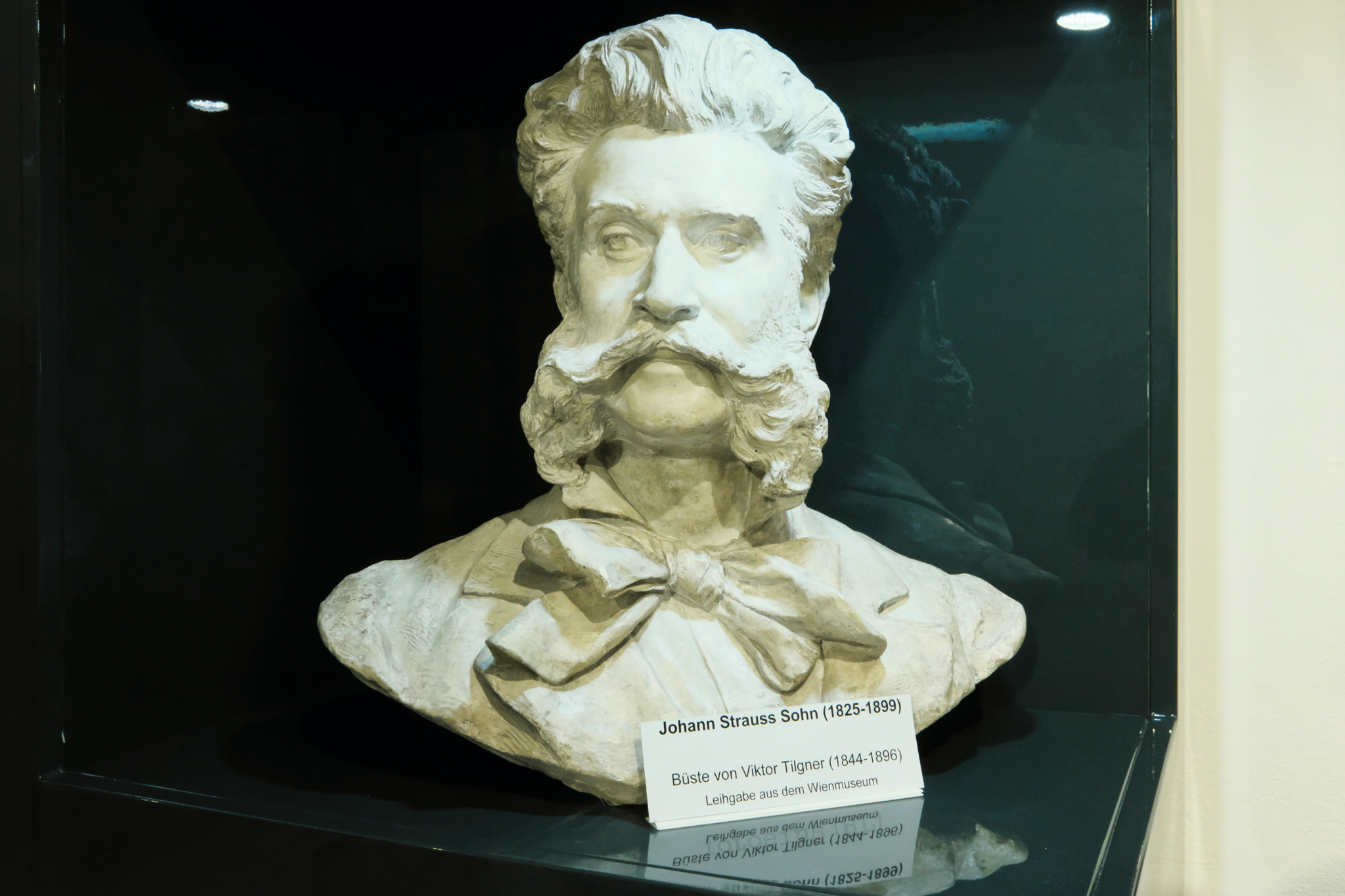
Bust of Johann Strauss II, by sculptor Viktor Tilgner; on loan from Wien Museum. Photo, 31 May 2023 (X70).
Dommayer casino (13.)
now, Konditorei Oberlaa Café Dommayer; Dommayergasse 1
Ten days shy of his 19th birthday, JS2 and his orchestra made their public debut at Casino Dommayer on 15 October 1844. An interesting sidebar is that his father Johann Strauss I had tried to prevent his son from conducting his own group of musicians (to prevent competition!), and had threatened to never play at Dommayer or any other institution which hosted his son. The present-day café is next to the small Johann Strauss Platz with a memorial dedicated to him by the Julius Meinl coffee manufacture and retail company in 1999.
The building is home to an actively operating café for “Kaffee und Kuchen” (coffee and cake). Public transport with Wiener Linien: U-Bahn U4 line to station Hietzing; then, tram 10, 52, or 60, to stop “Dommayergasse”. Alternatively, walk 0.6 km (about 10 minutes) southwest from Hietzing station to Café Dommayer.
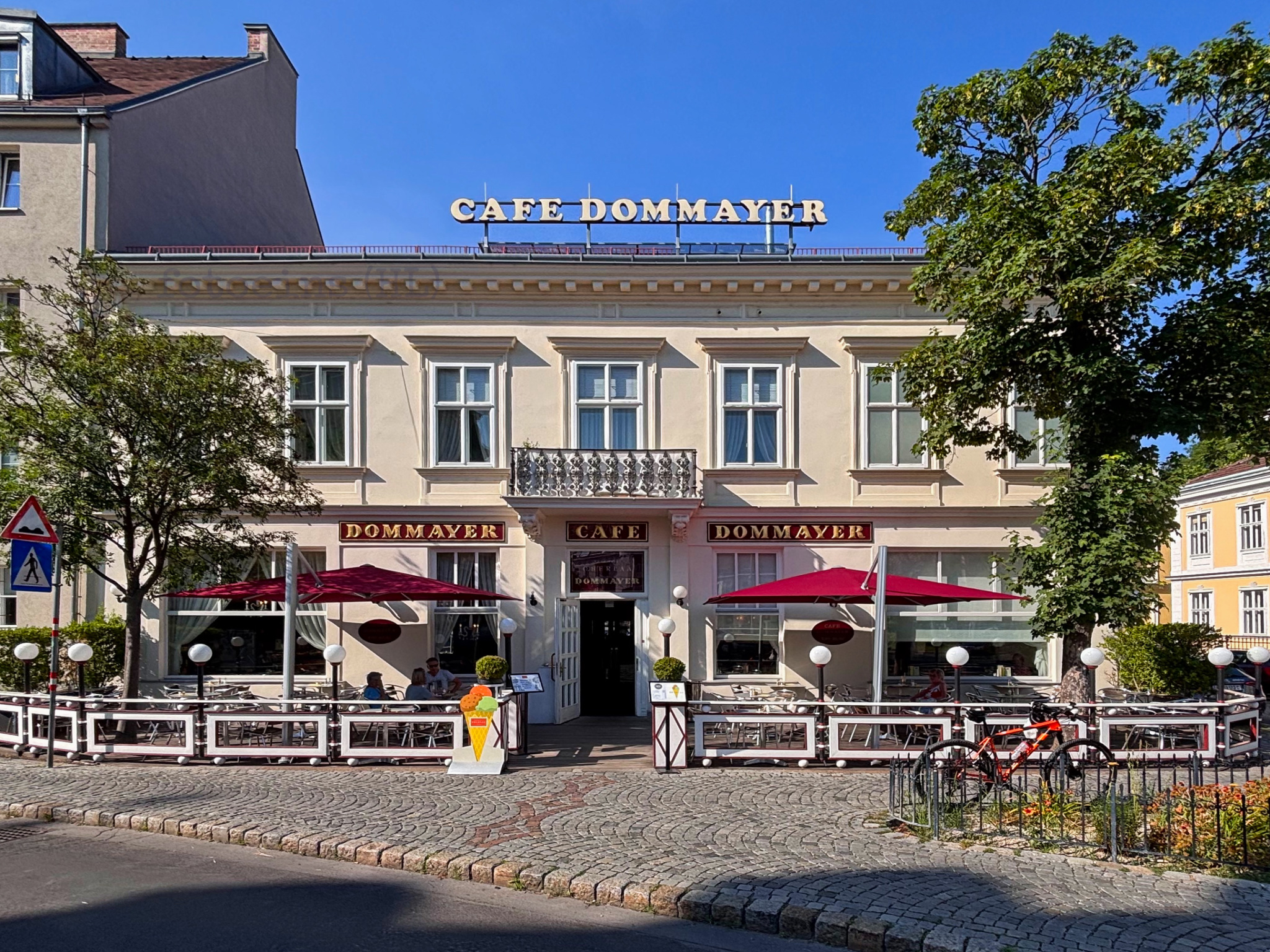
Cafe Dommayer in Vienna Hietzing. Photo, 5 Jul 2025 (P15).

Johann-Strauss-Platz (street sign) in the 13th district, dedicated by the people of Hietzing. Photo, 5 Jul 2025 (P15).

Johann Strauss Denkmal. Memorial caption: born 1825, died 1899. Johann Strauss. His path to world fame began here in Hietzing. May 1999, dedicated by Julius Meinl. Photo, 5 Jul 2025 (P15).
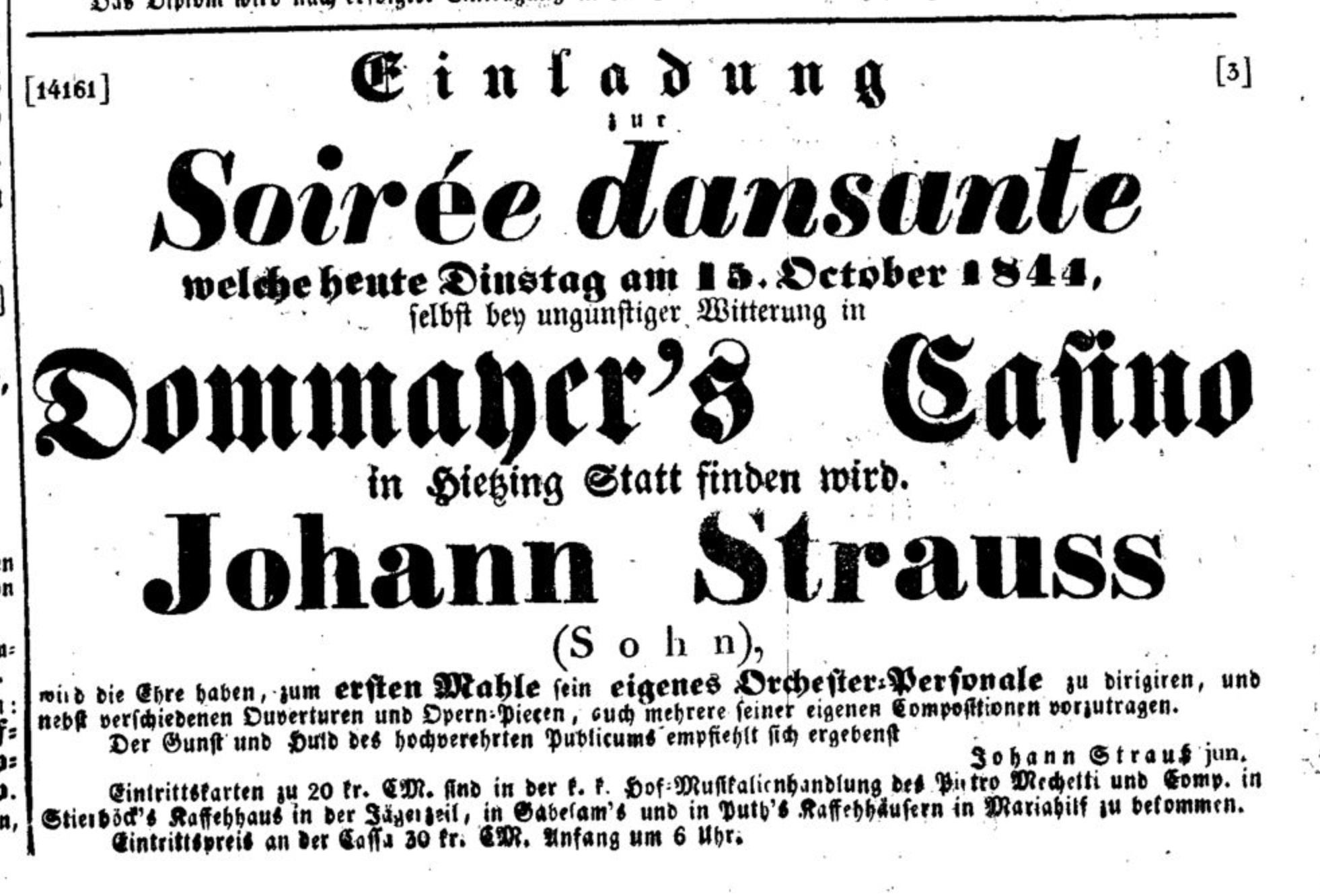
Advertisement on page 8 of Viennese newspaper Wiener Zeitung on 15 October 1844 for a “night of dance” (Soirée dansante) conducted by Johann Strauss II (ANNO at Austrian National Library).
Hietzing residence (13.)
Maxingstrasse 18
In 1868, JS2 purchased in Hietzing this villa on what was then Hetzendorfer Strasse, and by 1870 he lived here for a time. Johann and his wife Jetty moved here permanently in 1874. It’s at this Hietzing location where Johann II also composed the operetta “Die Fledermaus” (The Bat), which got its opening debut at the Theater an der Wien in 1874. His wife Jetty died here on the night of 8–9 April 1878, after which Johann II had the building sold and moved to a villa in the Wieden district. Jetty is buried in Hietzing cemetery nearby.
There is no public entry, as the property is under private ownership. The only view of the building is out in front from the street. Public transport with Wiener Linien: U-Bahn U4 line to station Hietzing; then bus 56A, 56B, 58A, or 58B to stop Tiroler Gasse. The Schönbrunn palace and park are across the street.

Johann Strauss II residence from 1870 to 1878; a black arrow points to a memorial plaque on the outside wall. Photo, 19 May 2023 (X70).

Memorial plaque: “Between 1870 and 1878, Johann Strauss II lived in this house, where he created the immortal composition ‘Fledermaus’. Vienna Schubert Association 1934.” Photo, 19 May 2023 (X70).
Lutheran city church (1.)
Lutherische Stadtkirche (Augsburger Bekenntnis), Dorotheergasse 18
After JS2 died in his Wieden residence on 3 June 1899, his body was brought to this church on 6 June for the funeral and consecration, before the long procession to burial in the city’s Zentralfriedhof. The Todesanzeige (obituary) appeared in the city newspaper Neue Freie Presse on the day of his funeral.
The church is open daily to the public from about 9am to 6pm. Public transport with Wiener Linien: U-Bahn U1 or U3, to station Stephansplatz; tram 1, 71, D to stop Schwarzenbergplatz.
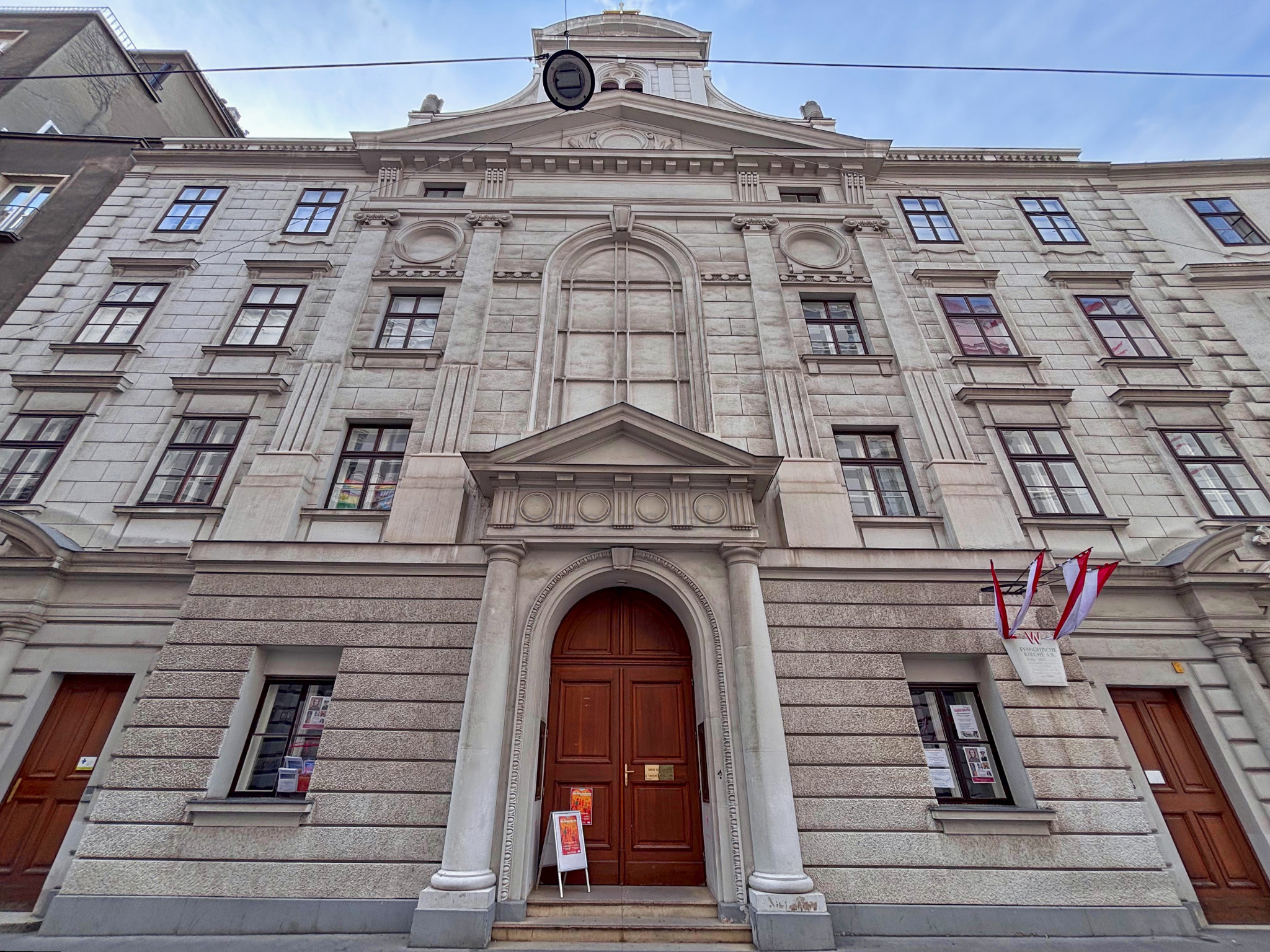
Lutheran city church, exterior. Photo, 6 Jul 2025 (P15).
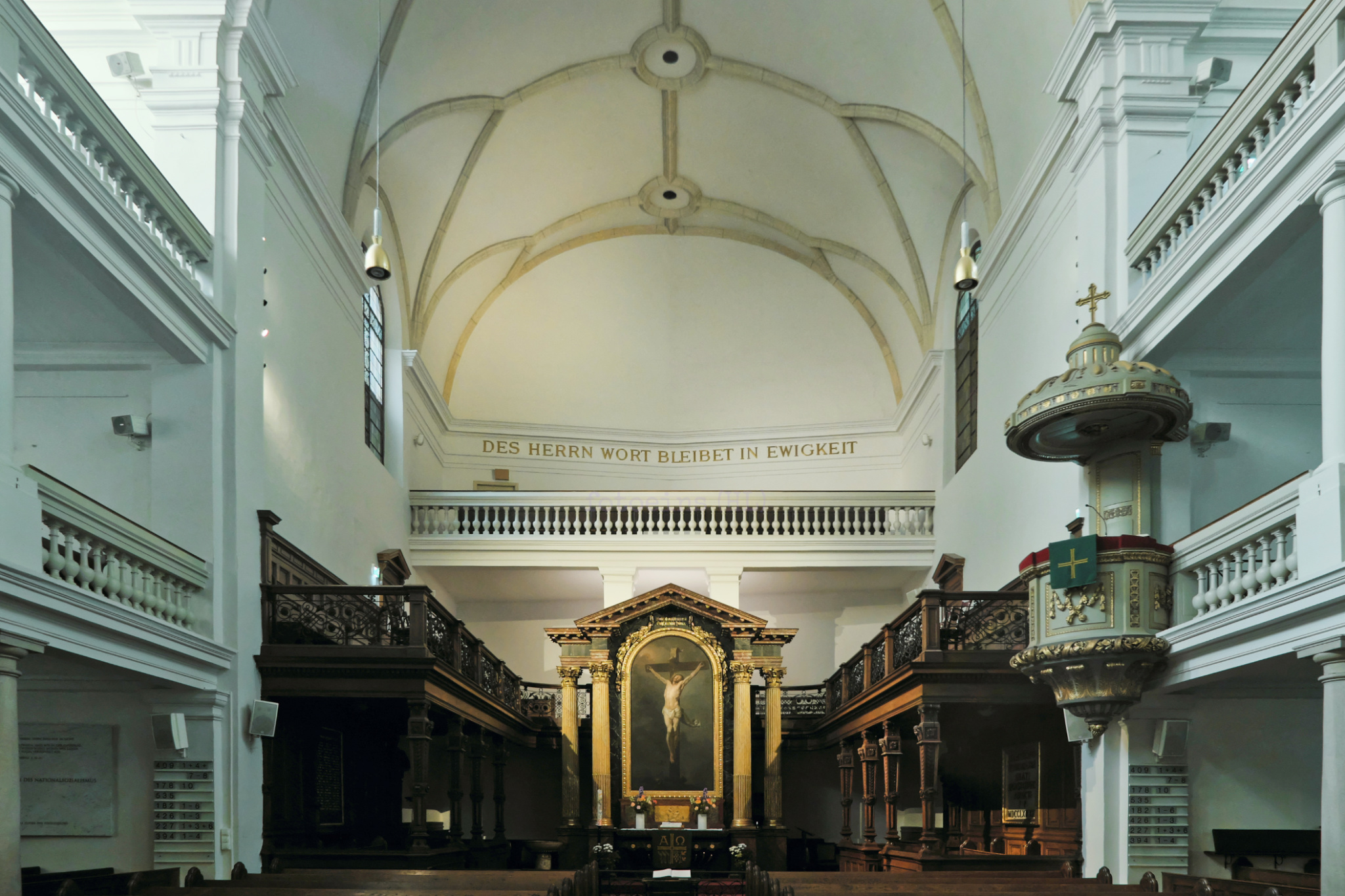
Lutheran city church, interior. Photo, 6 Jul 2025 (X70).
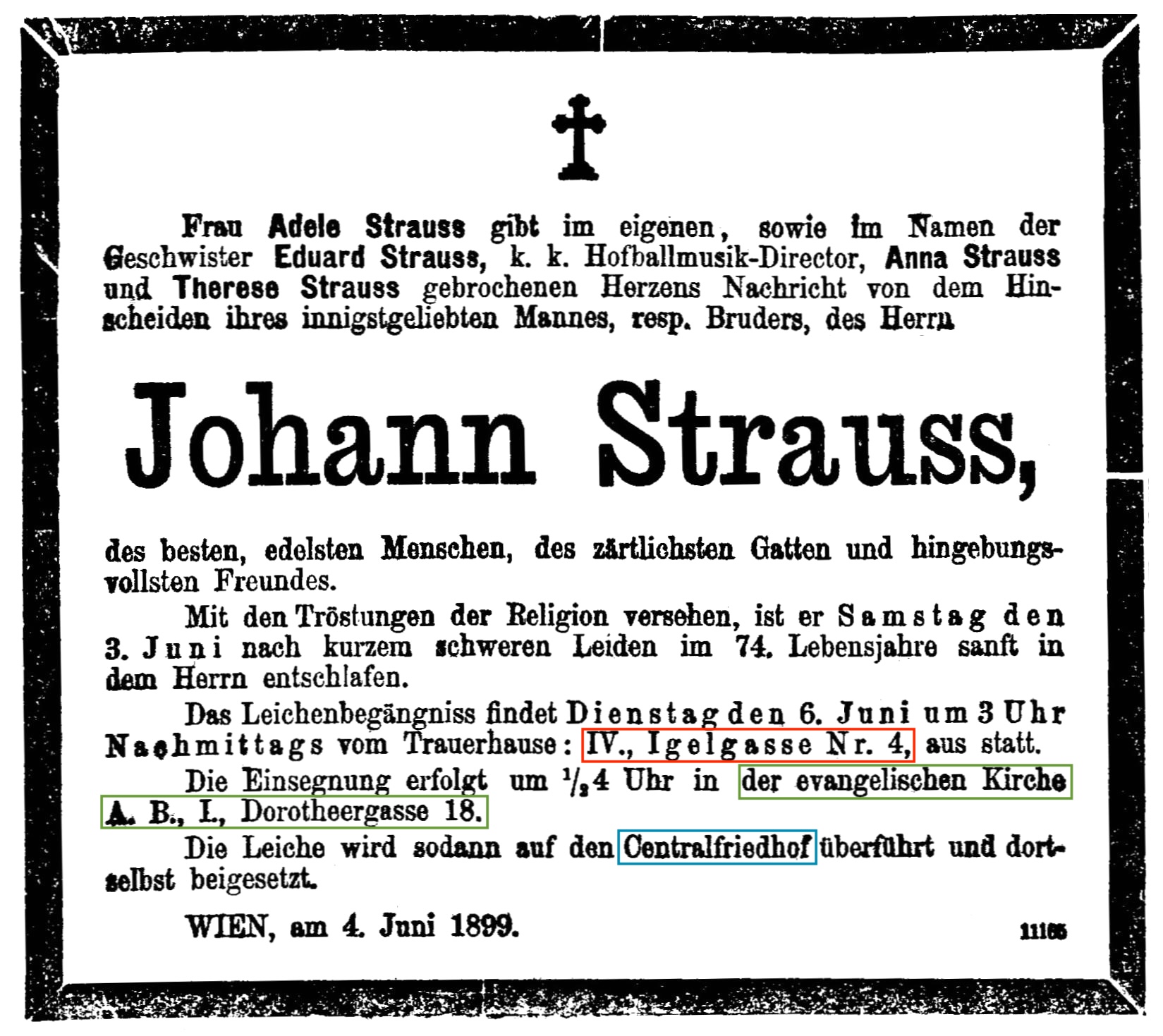
Todesanzeige (obituary) for Johann Strauss II in the Viennese newspaper Neue Freie Presse, submitted on 4 June and published on 6 June 1899, the day of his funeral and consecration services (ANNO at Austrian National Library). The notice states the death of the 74-year old on 3 June 1899. I’ve highlighted: in red, the place where he died and where his funeral took place; in green, Protestant church of the Augsburg confession where the consecration service took place; and in blue, the cemetery to where his remains would be taken later that day.
Music Society of Vienna (1.)
Musikverein Wien
As part of the overall development on the inner city’s Ringstrasse (Ring Road), Viennese architect Theophil Hansen designed in the neoclassical architectural style the Musikverein building which received its official imperial inauguration in January 1870. Only two weeks later on 15 January 1870, Johann Strauss II conducted the first official ball in the venue, including his waltz-composition specifically for the event: “Freut euch des Lebens!” (Enjoy life!, op. 340). On 22 April 1873, Johann II debut his waltz “Wiener Blut” (Vienna Blood, op. 354) at the Musikverein, conducting the house-orchestra Vienna Philharmonic for the first time.
Since 1924, the building’s Great Hall is home to the annual New Year’s Day concert performed by the Vienna Philharmonic. The song-list varies annually, but typically includes two standard Strauss-waltz numbers: dad Johann I’s “Radetzky March” and son Johann II’s “The Blue Danube”.
The Musikverein offers guided tours for a fee in either German or English. Public transport with Wiener Linien: U-Bahn U1, U2, or U4 line to station Karlsplatz; tram 1, 71, D to stop Schwarzenbergplatz.

Musikverein in afternoon light. Photo, 2 Jul 2025 (P15).
Praterstrasse residence (2.)
Praterstrasse 54 (Wien Museum Johann Strauss Wohnung)
In 1863, JS2 married former opera singer Jetty Treffz. Johann II moved out of the family home on Taborstrasse, and in 1864, he and his new wife moved into their new apartment at Praterstrasse 54. They lived in an apartment spanning one-half of the entire 1st floor above ground until 1874 when they moved to Hietzing into a villa Johann II purchased in 1868. Today, the city’s museum occupies a part of their former apartment on Praterstrasse; the remainder of the floor is private property.
Within this apartment between 1866 and 1867, JS2 wrote “The Blue Danube” (op. 314), which got its public debut not far from here at the Diana ballroom.
The public can visit the Wien Museum: Johann Strauss II Wohnung with admission charge. Public transport with Wiener Linien: U-Bahn U1 line to station Nestroyplatz.

Praterstrasse 54, ground-floor: Café 3/4-Takt (three-quarter time) which is the time-signature for “The Blue Danube”. A commemorative plaque in black on the building’s outer wall appears at upper-left. Photo, 22 May 2022 (X70).

Memorial plaque on the first floor above ground, at Praterstrasse 54. Photo, 22 May 2022.

Praterstrasse 54: inside the apartment in the first floor above ground is the apartment where Johann Strauss II and his wife Jetty lived. Today, the space is a museum operated by Wien Museum. Photo, 22 May 2022 (X70).

Jetty Treffz and Johann Strauss II: portrait photo by Julius Gertinger, c. 1870. Wien Museum Online Sammlung inventory number 76069/276.
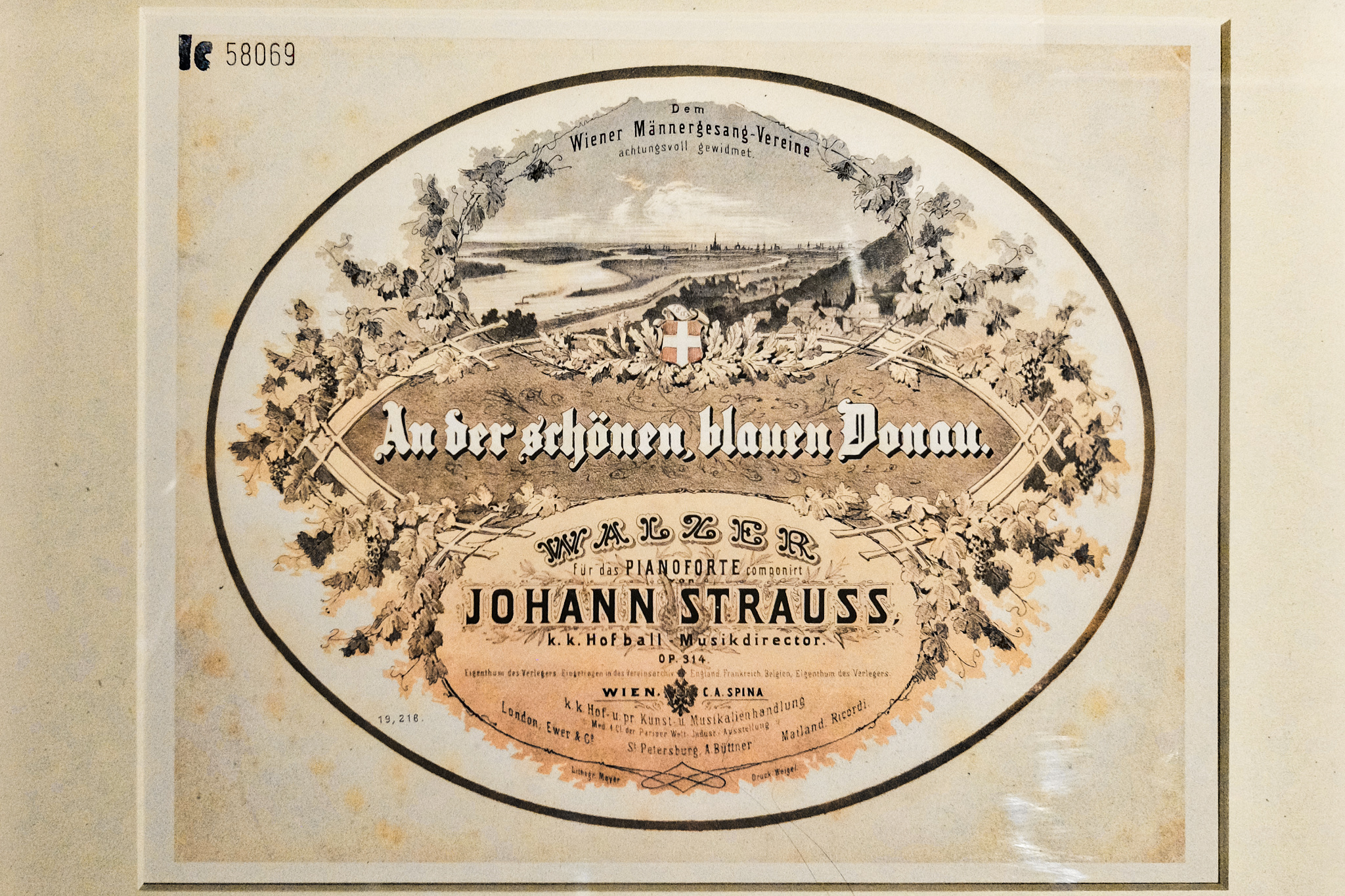
“An der schönen blauen Donau” (The Blue Danube): title page of sheet music for piano, which Viennese publishers C.A. Spina issued to the public for sale on the same day as the public premiere of the waltz on 15 February 1867 at the Diana ballroom. Reproduction from the Musiksammlung at Wienbibliothek im Rathaus. Photo, 22 May 2022 (X70).

Handwritten accompaniment for choral version (introduction) of “The Blue Danube”: reproduction of Johann Strauss II autographed version. Photo, 22 May 2022 (X70).
Salmannsdorf family villa (19.)
Dreimarksteingasse 13
The maternal grandfather of JS2 owned a house in the village of Salmannsdorf, about 8 km northwest from Vienna’s city centre. Strauss’ immediate family spent the summers of 1829 to 1832 here at this location, and it’s also where Strauss II composed his first waltz “Erste Gedanke” (First Thought) months shy of his 6th birthday in 1831.
The former villa is now private property and not open to the public. The chapel across the street may be open at other times. Public transport with Wiener Linien: take bus 35A to its terminus stop “Salmannsdorf”, and walk the rest of the way uphill on Sulzweg and Dreimarksteingasse.

Strauss family villa at address Dreimarksteingasse 13 in Salmannsdorf. Photo, 9 Jul 2025 (X70).

Memorial plaque (Gedenktafel) on the outside wall of the former Strauss family villa: “Here a great musician known as Master Strauss composed his first waltz which graced this house.” Photo, 9 Jul 2025 (X70).
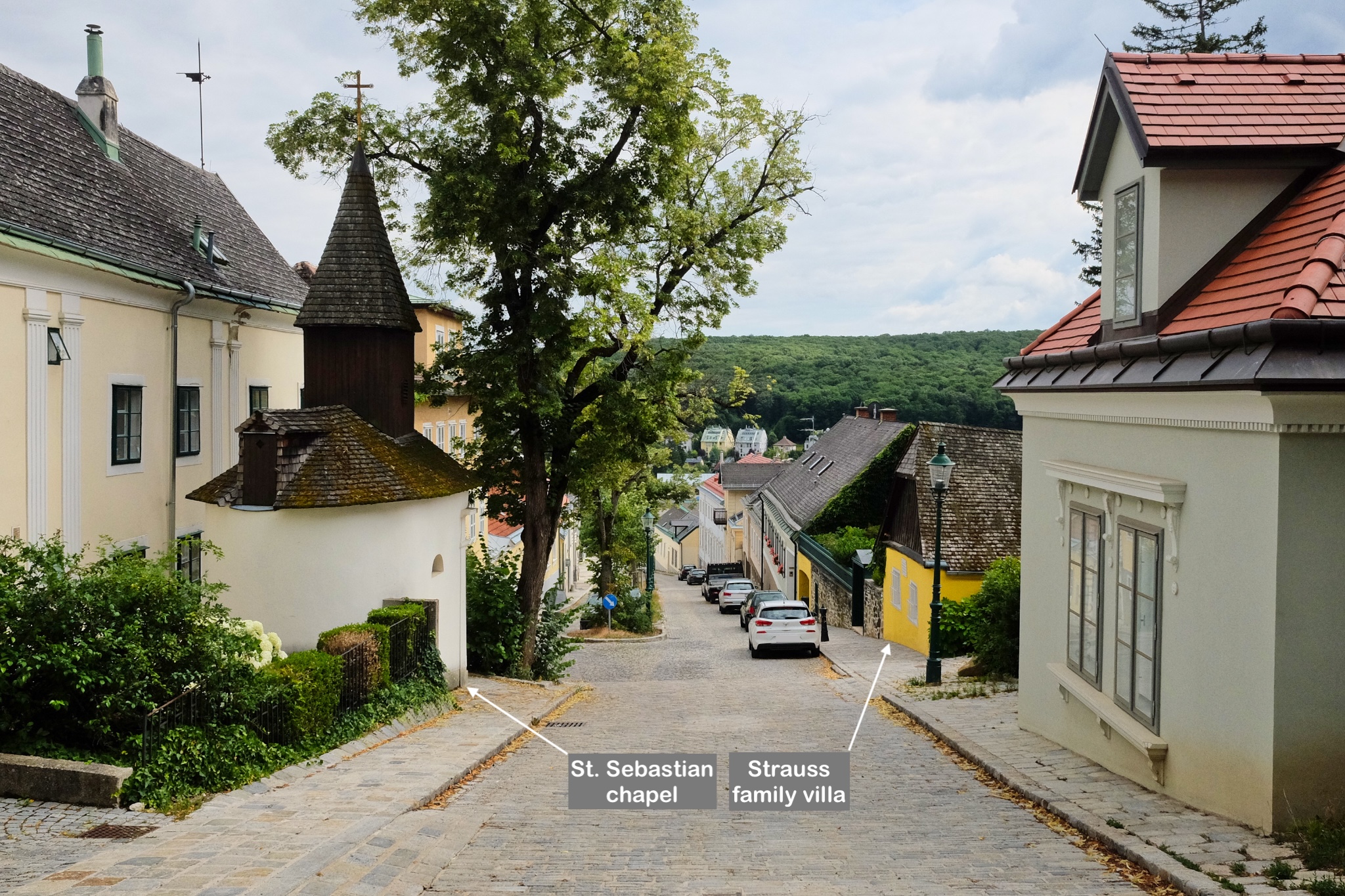
Salmannsdorf: St. Sebastian chapel, Strauss family villa. Photo, 9 Jul 2025 (X70).
Schottengymnasium grammar-secondary school (1.)
Schottenstift (Scots monastic foundation)
JS2 attended the Schottengymnasium grammar- and secondary-school from age 11 to 15; that he lasted four full years is frankly amazing because he was only interested in composing and playing music. Verbal strife with the school’s teacher proved too much, and the school finally expelled Johann II in 1840. Both he and his brother Josef eventually enrolled in the imperial and royal polytechnic institute.
The public is free to enter and wander through the Schottenstift foundation, but generally, buildings are not open to the public. Public transport with Wiener Linien: the nearest U-Bahn station is Schottentor on the U2 line. Schottentor is also served by trams 1, 37, 38, 40, 41, 42, 43, 44, 71, and D.

Intersection of Freyung and Schottengasse: Scots foundation (former school inside), Scots Church at right. Photo, 16 Jun 2024 (P15).
Stadtpark (1.)
Johann Strauss II memorial statue
In 1921, the city of Vienna unveiled to the public a gilded memorial statue of Johann Strauss II, created by sculptor Edmund Hellmer. The memorial statue had originally been in the planning for over 20 years. With regilding in 1991 for a new shine, the golden Strauss statue may well be one of the city’s most popular attractions.
The Stadtpark (city park) is free to enter for the public at all times. Public transport with Wiener Linien: U-Bahn U4 line to station Stadtpark.
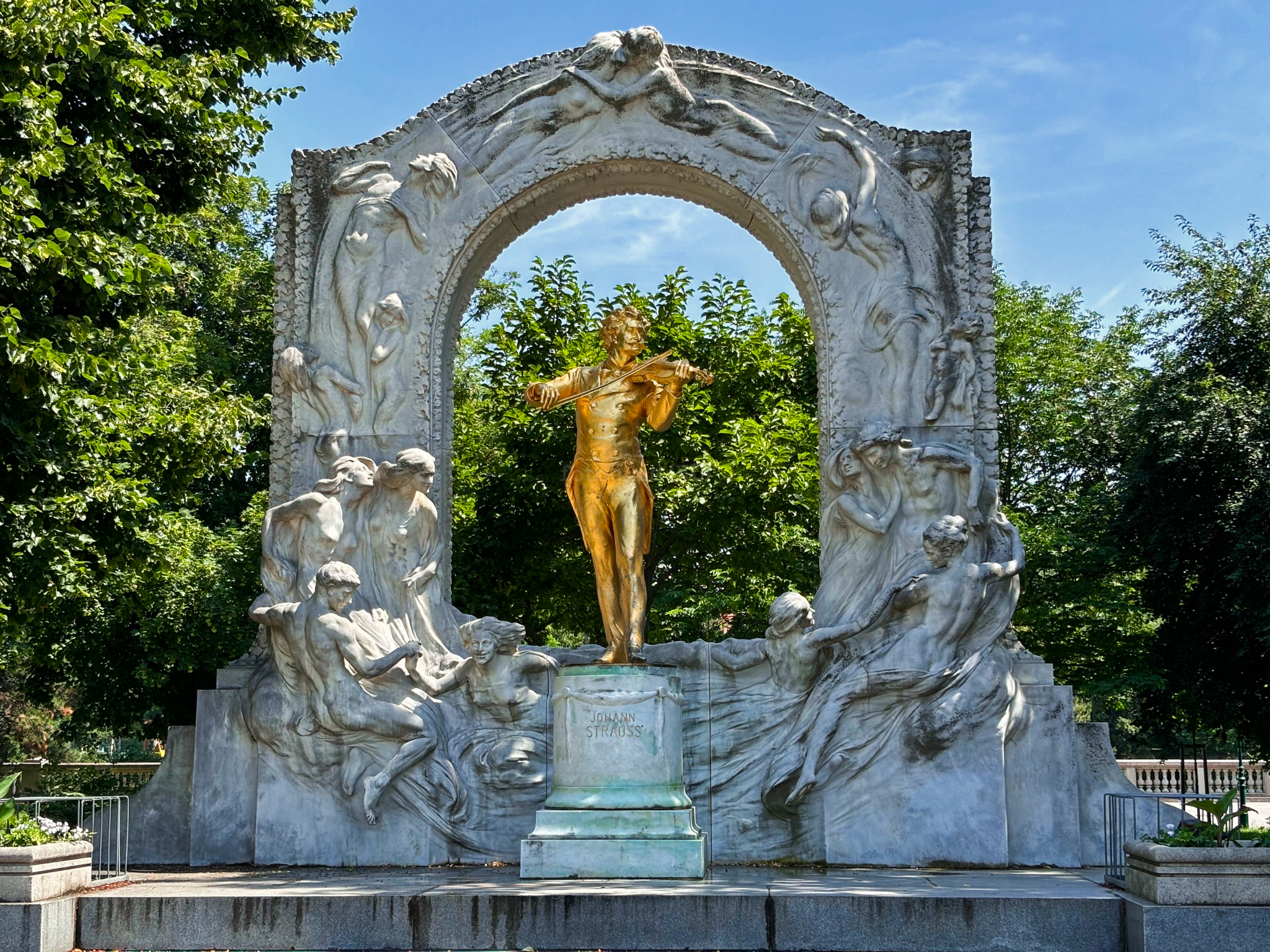
In the southern half of the city’s Stadtpark is the gilded memorial statue dedicated to composer Johann Strauss II. Photo, 19 Jun 2024 (P15).

Johann Strauss II. Photo, 19 Jun 2024 (P15).
State Opera, Opera House (1.)
Staatsoper
On 22 May 1899, JS2 conducted a special matinee performance of “Die Fledermaus” at the State Opera House on the Ringstrasse. That would be his final appearance in public, and death would arrive almost two weeks later at his residence on Igelgasse with his 3rd wife Adele by his side.
The Opera House is open daily for public guided tours. Public transport with Wiener Linien: U-Bahn U1, U2, or U4 line to station Karlsplatz; or tram 1, 2, 71, or D to stop Oper/Karlsplatz.

State Opera House (Staatsoper) at dusk. Photo, 21 Jun 2024 (X70).
Taborstrasse family residence (2.)
Taborstrasse 17 in Leopoldstadt
For over 50 years, the Strauss family lived on the first floor in the three-storey building called “Zum goldenen Hirsch” (The Golden Stag), known also as Hirschenhaus (House of the Stag). The Strauss family moved here in 1834 when JS2 was 9 years old. Eduard Strauss was born in the apartment a year later in 1835, and was also the final member of the Strauss family to move out in 1886. The building was subsequently demolished in 1911.
The present-day building is private property, but the views are free to the public from the street. The Taborstrasse residence is less than 200 metres from the Leopoldstadt district museum at the opposite side of Karmeliterplatz. Public transport with Wiener Linien: U-Bahn U2 line to station Taborstrasse, tram line 2 to stop Karmeliterplatz, or bus line 5A to stop Karmeliterplatz.
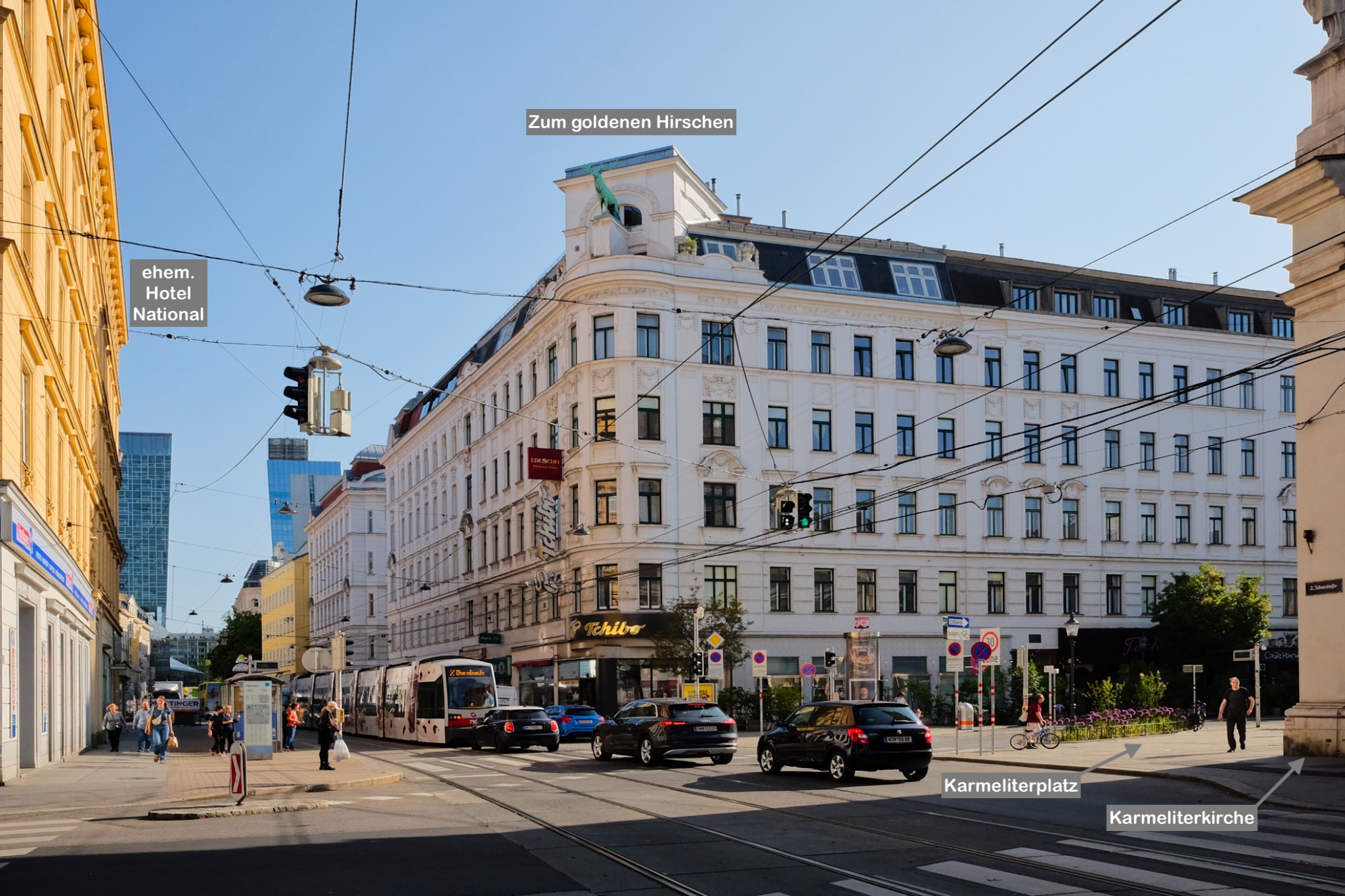
View southwest to Taborstrasse 17, formerly Zum goldenen Hirschen (The golden stag) at centre. At left is the former Hotel National. Photo, 27 May 2023 (X70).

Mounted at the top of Taborstrasse 17 is a large copper stag’s head, seen here at top-centre. Photo, 27 May 2023 (X70).

Photograph by August Stauda, dated 1898: the view faces southwest to the building at Taborstrasse 17. Wien Museum inventory number 76613/57: “2., Taborstraße 17 – Hirschenhaus”.
Theater by the Vienna river (6.)
Theater an der Wien
JS2’s wife Jetty and Theater an der Wien artistic director Maximilian Steiner (%) persuaded a reluctant Johann II to write operettas for the theater. Several of JS2’s operettas received their premieres at Theater an der Wien: “Indigo und die 40 Räuber” (Indigo and the Forty Thieves) in 1871, “Die Fledermaus” (The Bat) which he wrote in 1874 at the Hietzing residence, “Cagliostro in Wien” (Cagliostro in Vienna) in 1875, “Das Spitzentuch der Königin” (The Queen’s Lace Handkerchief) in 1880, “Der Zigeunerbaron” (The Gypsy Baron) in 1885, and “Die Göttin der Vernunft” (The Goddess of Reason) in 1897. The theater is also famous for its connections to composers Beethoven, Lehár, and Schubert; and to the aspiring Viennese actor Hedwig Kiesler, who later became Hedy Lamarr in Hollywood.
Theater an der Wien is open during performances and occasionally for guided tours. Public transport with Wiener Linien: U-Bahn U1, U2, or U4 to station Karlsplatz; bus 59A to stop Bärenmühldurchgang.
(%) Maximilian Steiner’s son, Gabor Steiner, became a theater director and leased the Kaiserwiese parcel of land on which the Prater’s Riesenrad (Giant Ferris Wheel) was constructed in 1897. Maximilian Steiner’s grandson, Max Raoul Steiner, composed music for film and stage in Hollywood, producing over 300 film scores, earning him a total of 24 Academy Award nominations and 3 “Oscar” wins.
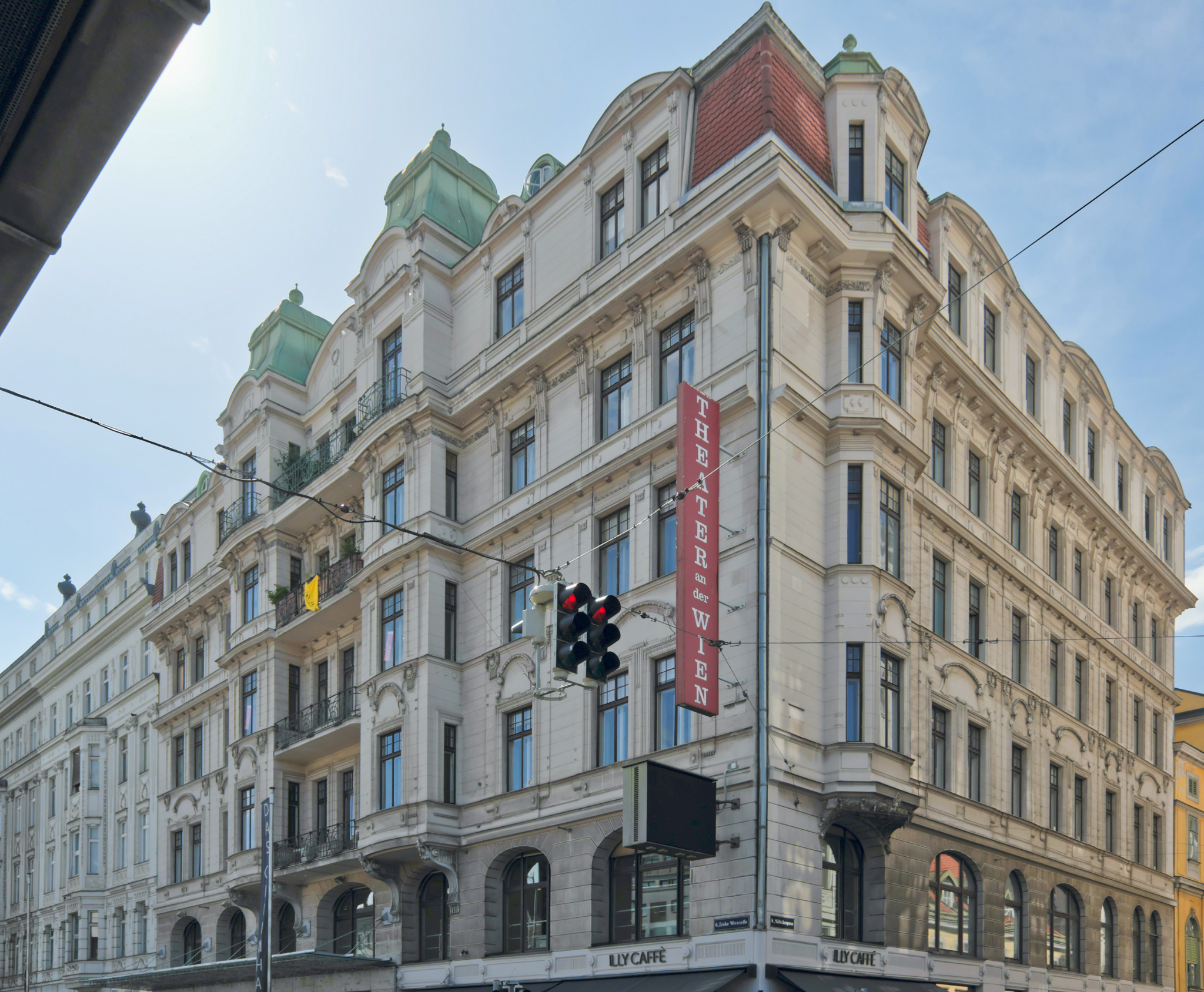
Theater an der Wien, from Linke Wienzeile. Photo, 22 May 2022 (X70).
TU Vienna / Polytech. Institute (4.)
Present: Technical University of Vienna, Technisches Universität Wien.
Formerly: Imperial & Royal Polytechnical Institute, kaiserlich-königliches Polytechnisches Institut.
After his expulsion from the Schottengymnasium school in 1840, JS2 enrolled in the imperial and royal polytechnic institute, where following his father’s wishes, the young man was supposed to avoid music and take up commerce and accounting instead, for future employment as bank clerk. On the sly, Johann II took lessons in violin and music, much to his father’s frustration and fury. On the other hand, his younger brother Josef, who was a talented musician but wanted nothing to do with music as a career, enrolled in 1841 at the polytechnic institute to study mechanical engineering and at the Academy of Fine Arts to study drawing, design, and architecture.
The Imperial and Royal Polytechnical Institute operated between 1815 and 1872, after which the institution changed to the Technical University with approval to grant doctoral degrees in 1901.
The public can wander through the grounds of the Technical University of Vienna, but the view below is from Karlsplatz next to the Karlskirche. Public transport with Wiener Linien: U-Bahn U1, U2, or U4 line to station Karlsplatz.

Primary building of TU Wien (Technical University of Vienna) at Karlsplatz. Labelled are commemorative plaques to the Strauss brothers and to Antonio Vivaldi who was buried in a pauper’s grave at the former cemetery which predated the polytechnical institute. The exact location of Vivaldi’s grave remains unknown. Photo, 18 May 2022 (X70).
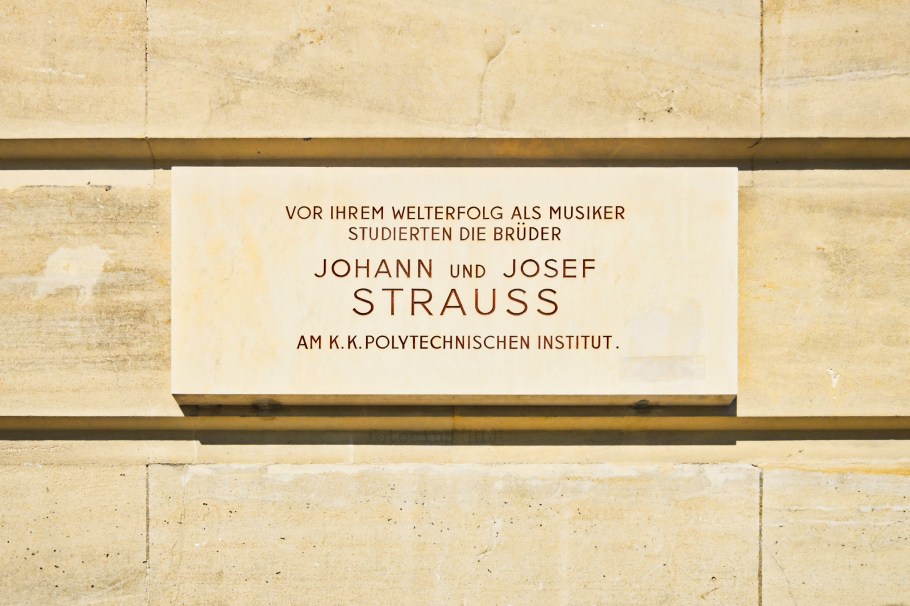
Memorial plaque: “Vor ihrem Welterfolg als Musiker studierten die Brüder Johann und Josef Strauss am kaiserlichen und königlichen Polytechischen Institut.” (Before their success worldwide as musicians, brothers Johann and Josef Strauss studied at the Imperial and Royal Polytechnic Institute.) Photo, 18 May 2022 (X70).
Volksgarten café pavilion (1.)
Volksgarten park
In the city’s Volksgarten (People’s Garden) park, Johann Strauss I and Joseph Lanner held concerts in the park’s pavilion. Later, Johann Strauss II as head of the touring orchestra would play here 7 October 1849 in the building’s Kolonadensaal (Colonnade Room). In the 1950s, Oswald Haerdtl converted the building to a dance café.
Public transport with Wiener Linien: U-Bahn U2 or U3 line to station Volkstheater; tram 1, 2, 46, 49, 71, or D to stop “Ring, Volkstheater”.
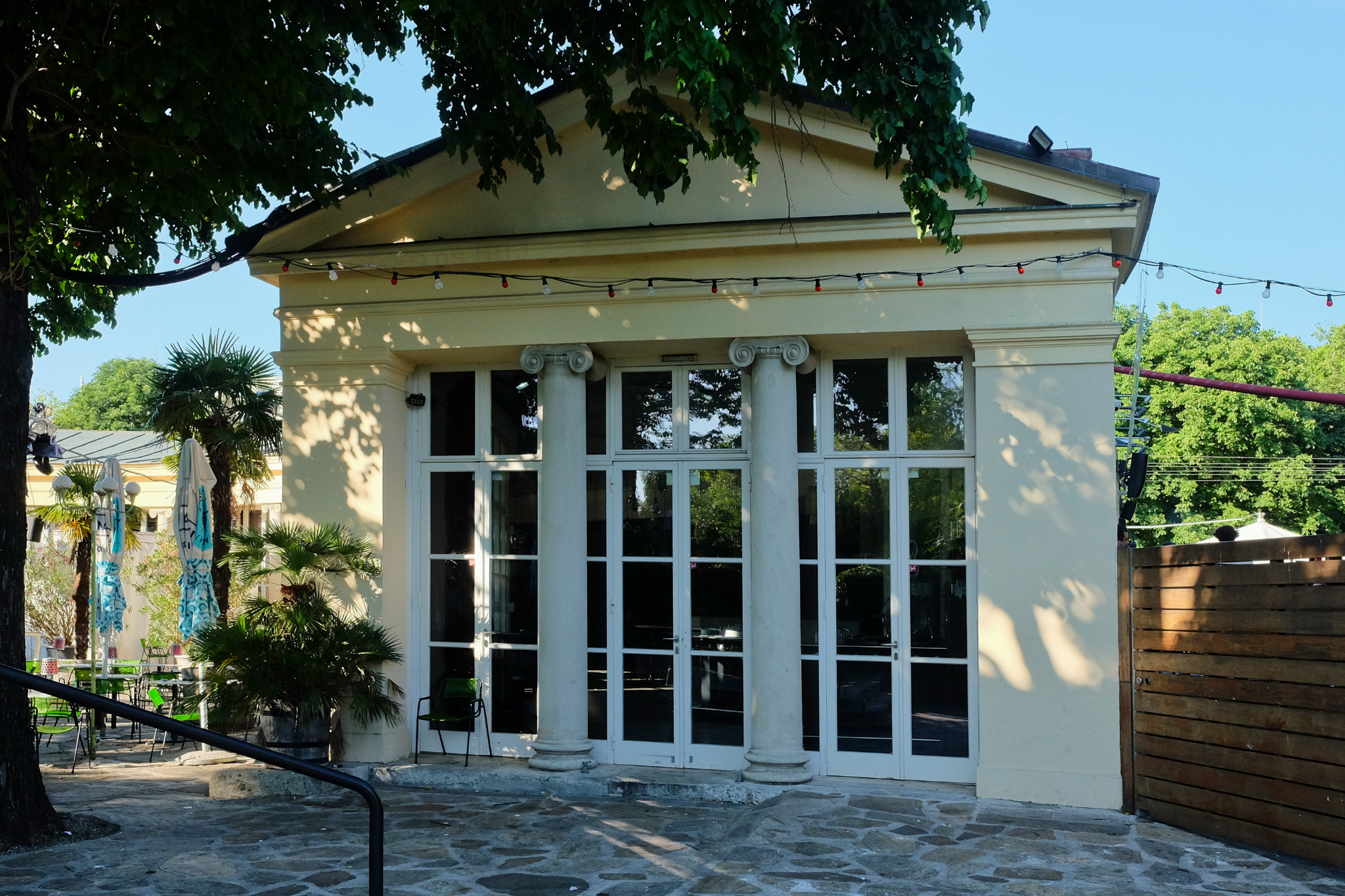
Northeast corner of the Volksgarten pavilion. Photo, 6 Jul 2025 (X70).
Wieden: Johann-Strauss-Gasse 4 (4.)
Final residence on Igelgasse, until his death in 1899
In 1878, JS2 moved from Hietzing to a two-storey palace here at Igelgasse 4, where he stayed until his death in 1899. One month after his death, the city of Vienna renamed the street from Igelgasse to Johann-Strauss-Gasse in his honour. Heavily damaged in 1944 from bombing in World War 2, the structure was subsequently demolished. A post-war building was constructed in the mid-1960s with the present-day street-address Johann-Strauss-Gasse 4, where a memorial plaque dedicated to Strauss II appears on the outside wall.
As private apartments and residences, the present-day building is not open to the public, but the view seen below is from Johann-Strauss-Gasse. Public transport with Wiener Linien: bus 13A to stop Johann-Strauss-Gasse; tram 1, 62, or Badner-Bahn (Wiener Lokalbahnen) to stop Johann-Strauss-Gasse.
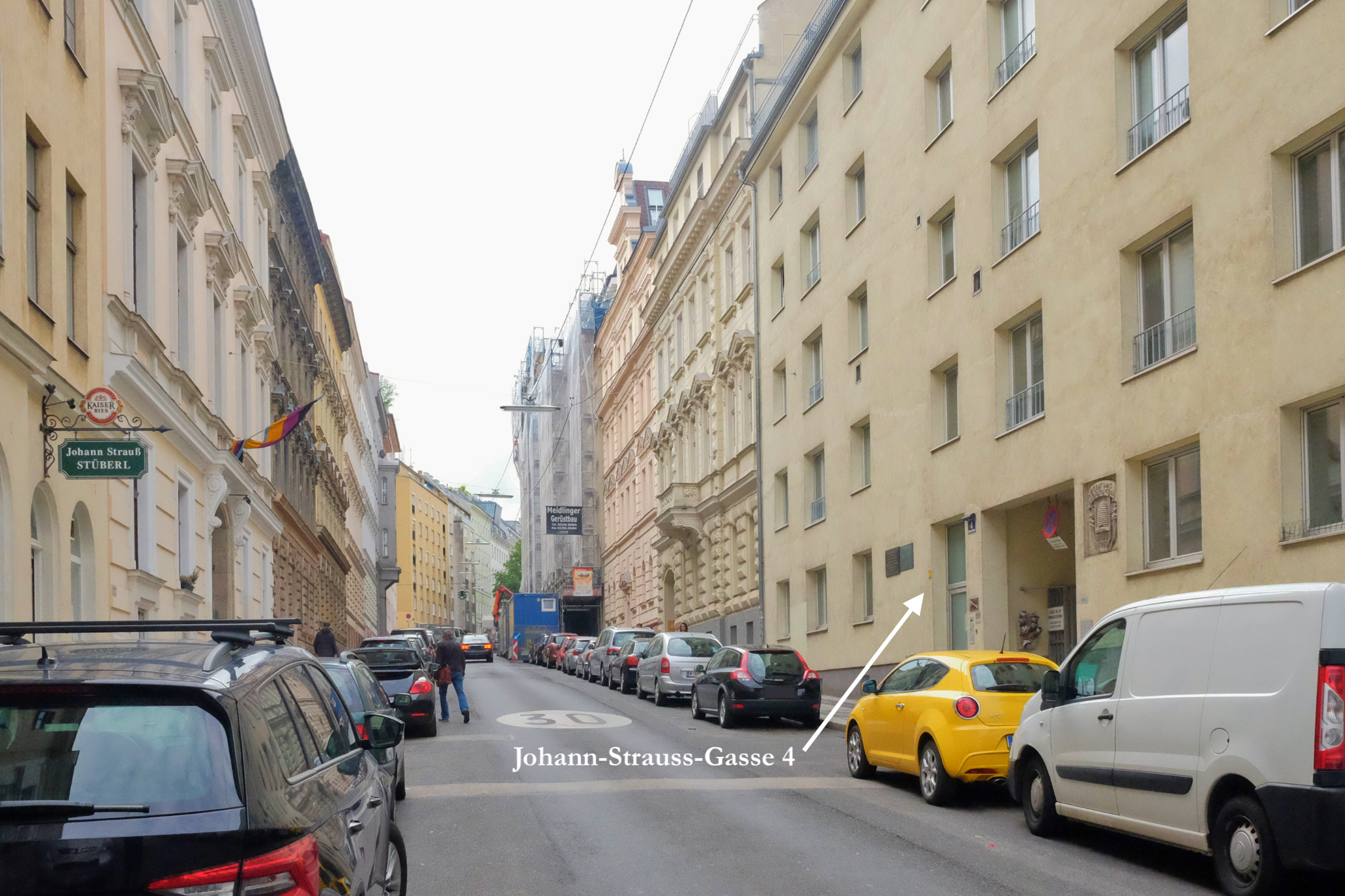
Johann-Strauss-Gasse 4. Photo, 16 May 2018 (X70).
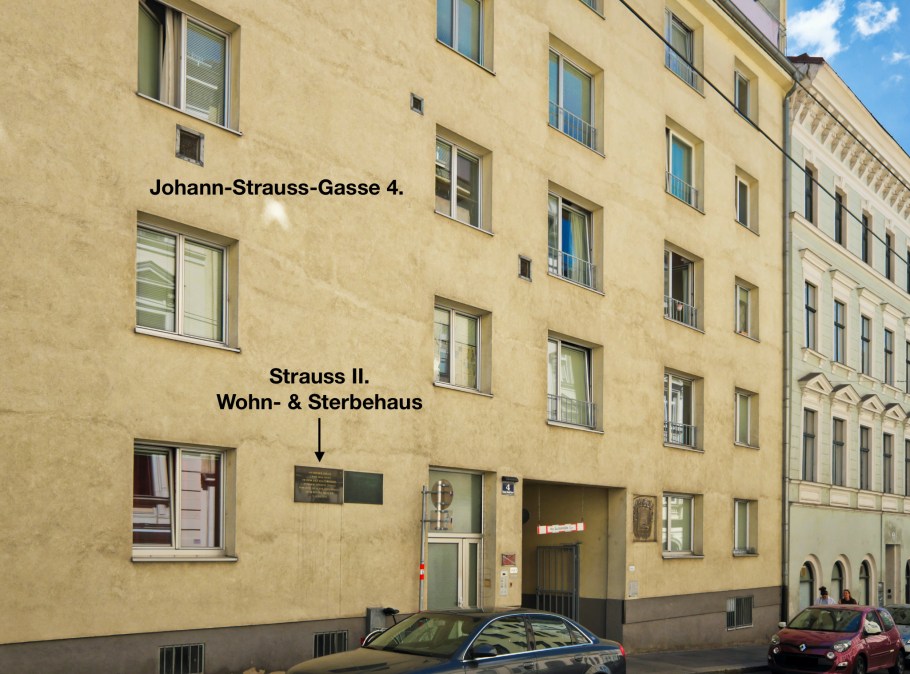
Johann-Strauss-Gasse 4: location where Strauss II lived from 1878 until his death in 1899. The present-day building is post-war construction in the 1960s. Photo, 22 May 2022 (X70).

Johann-Strauss-Gasse 4: location where Strauss II lived from 1878 until his death in 1899. The city of Vienna plaque at right states the present-day building is mid-1960s construction after the previous building was destroyed in World War 2. Photo, 22 May 2022 (X70).
Wieden: Johann-Strauss-Gasse 10 (4.)
Slightly uphill and about 100 metres from JS2’s final residence (above) is a display mounted on the outside wall of the apartment building at address Johann-Strauss-Gasse 10. The artpiece shows the opening musical notes to his famous waltz number “The Blue Danube” in 3-4 time, honouring his 21 years in the neighbourhood.
As private apartments and residences, the present-day building is not open to the public, but the view seen below is from Johann-Strauss-Gasse. Café Vitrine at street-level is open to the public for a sip and a bite. Public transport to stop Johann-Strauss-Gasse: Wiener Linien with bus 13A, tram 1, or tram 62; Wiener Lokalbahnen with the Badner-Bahn tram-train.
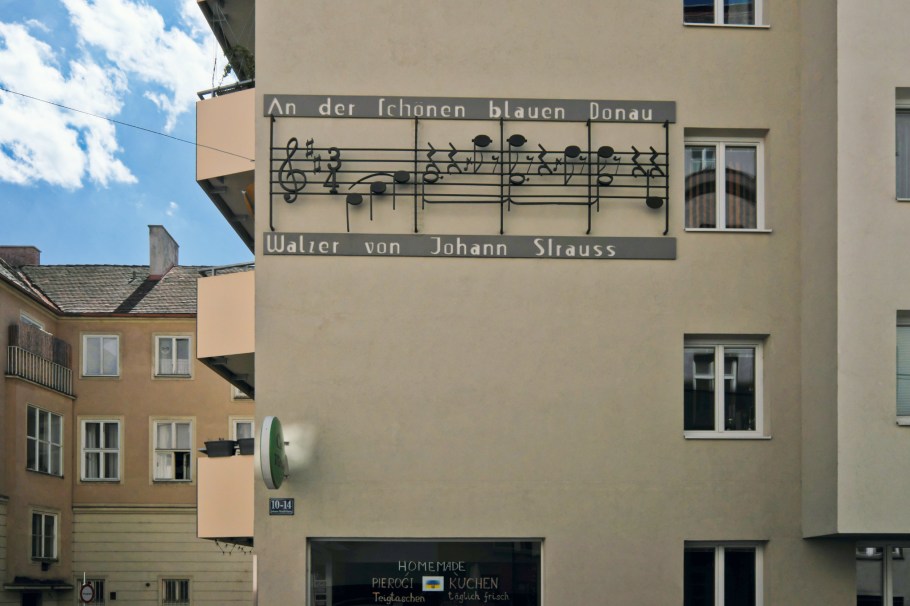
On the wall of the building at Johann-Strauss-Gasse 10 are the opening notes to “The Blue Danube” in 3–4 time. Photo, 22 May 2022 (X70).
Zögernitz casino (19.)
House of Strauss, Döblinger Hauptstrasse 76
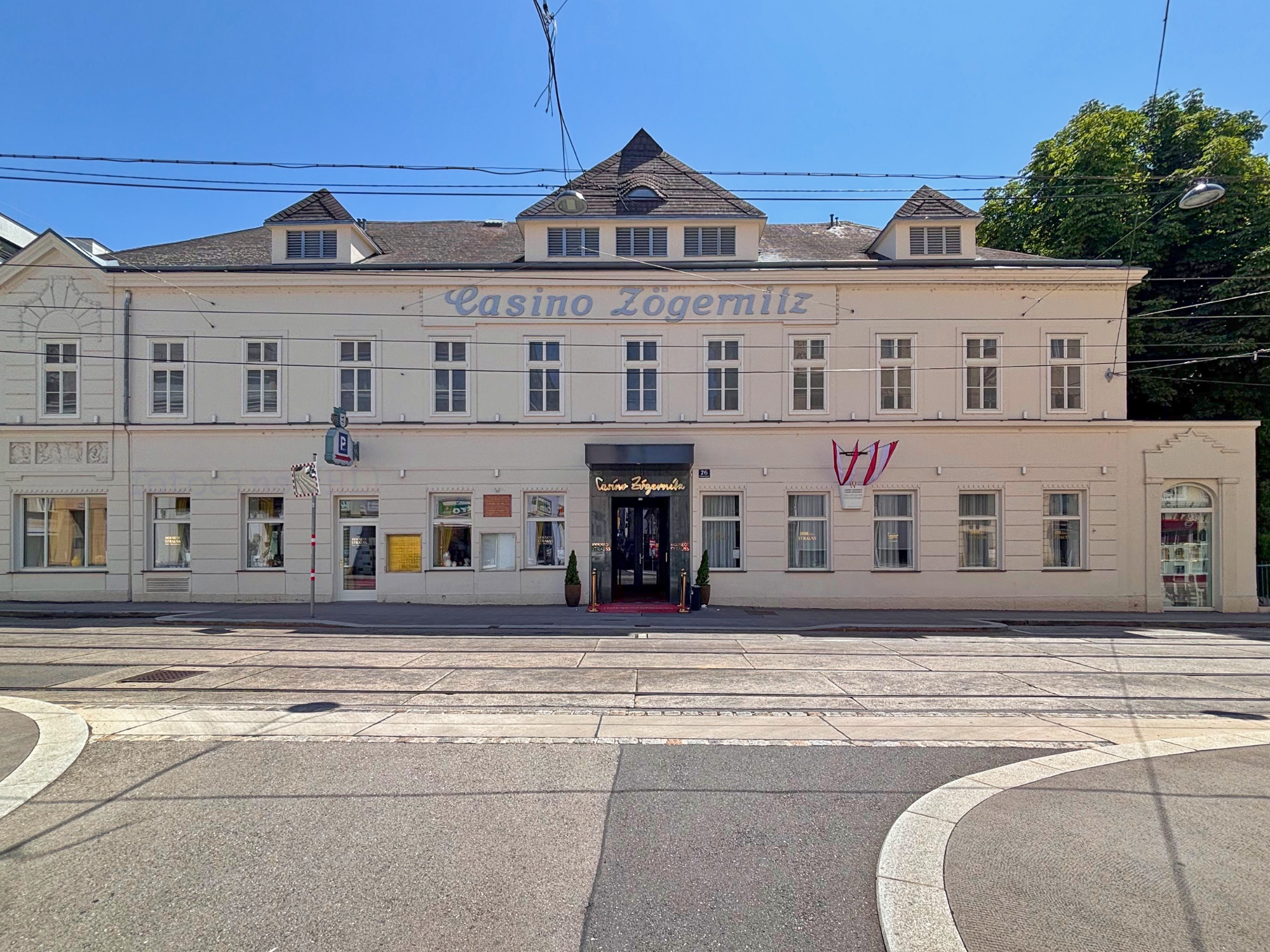
Döblinger Hauptstrasse 76: Casino Zögernitz, now House of Strauss. Photo, 13 Jul 2025 (P15).
Inside House of Strauss: Strauss-Saal (Strauss Hall), facing the front stage. Photo, 13 Jul 2025 (P15).
An der schönen blauen Donau
Walzer op. 314, by Johann Strauss II
9m33s visualization by Stephen Malinowski, 2016.
Sources
• ANNO Historische Zeitungen und Zeitschriften (Austrian Newspaper Online), Österreichische Nationalbibliothek; available at <https://anno.onb.ac.at/> [accessed Jan 2026].
• Austria Forum, Technische Universität Graz; available at <https://austria-forum.org/> [accessed Jan 2026].
• Czeike, F., Historisches Lexikon Wien, in 6 Bänden (Wien: Kremayr & Scheriau/Orac, 2004); available from Wien Stadtbibliothek: <https://www.digital.wienbibliothek.at/wbrobv/content/titleinfo/1112764> [accessed Jan 2026].
• Kunst & Kultur in Wien, Hedwig Abraham; available at <http://www.viennatouristguide.at/index.htm> [accessed Jan 2026].
• Österreichisches Musiklexikon Online, Österreichische Akademie der Wissenschaften; available at <https://www.musiklexikon.ac.at/> [accessed Jan 2026].
• Strauss II biography, Wiener Institut fü Strauss-Forschung; available at <https://www.johann-strauss.at/en/forschung/biografien/jss/> [accessed Jan 2026].
• Strauss in 4. Akten, WeltRentner; available at <https://weltrentner.com/strauss-in-vier-akten/> [accessed Jan 2026].
• Strauss in Vienna, Visiting Vienna; available at <https://www.visitingvienna.com/footsteps/johann-strauss/> [accessed Jan 2026].
• Suchet, J., The Last Waltz: The Strauss Dynasty and Vienna (New York: St. Martin’s Press, 2015).
• Wien Geschichte Wiki, Stadt Wien; available at <https://www.geschichtewiki.wien.gv.at/Wien_Geschichte_Wiki> [accessed Jan 2026].
• Wien Museum Online Sammlung: available at https://sammlung.wienmuseum.at/ [accessed Jan 2026].
• Wiener Stadtspaziergang – auf den Spuren von Johann Strauss, ReiseErinnerung; available at <https://reiseerinnerung.bplaced.net/johann-strauss-jahr-stadtspaziergang/> [accessed Jan 2026].
Except for images from Wikipedia and Wien Museum’s online digital collection, I made all other images above in the summers of 2018, 2022, 2023, 2024, and 2025, with a Fujifilm X70 fixed-lens prime (X70) and an iPhone15 (P15). This post appears on Fotoeins Fotografie at fotoeins DOT com as https://wp.me/p1BIdT-nc7. Last edit: 3 Jan 2026.
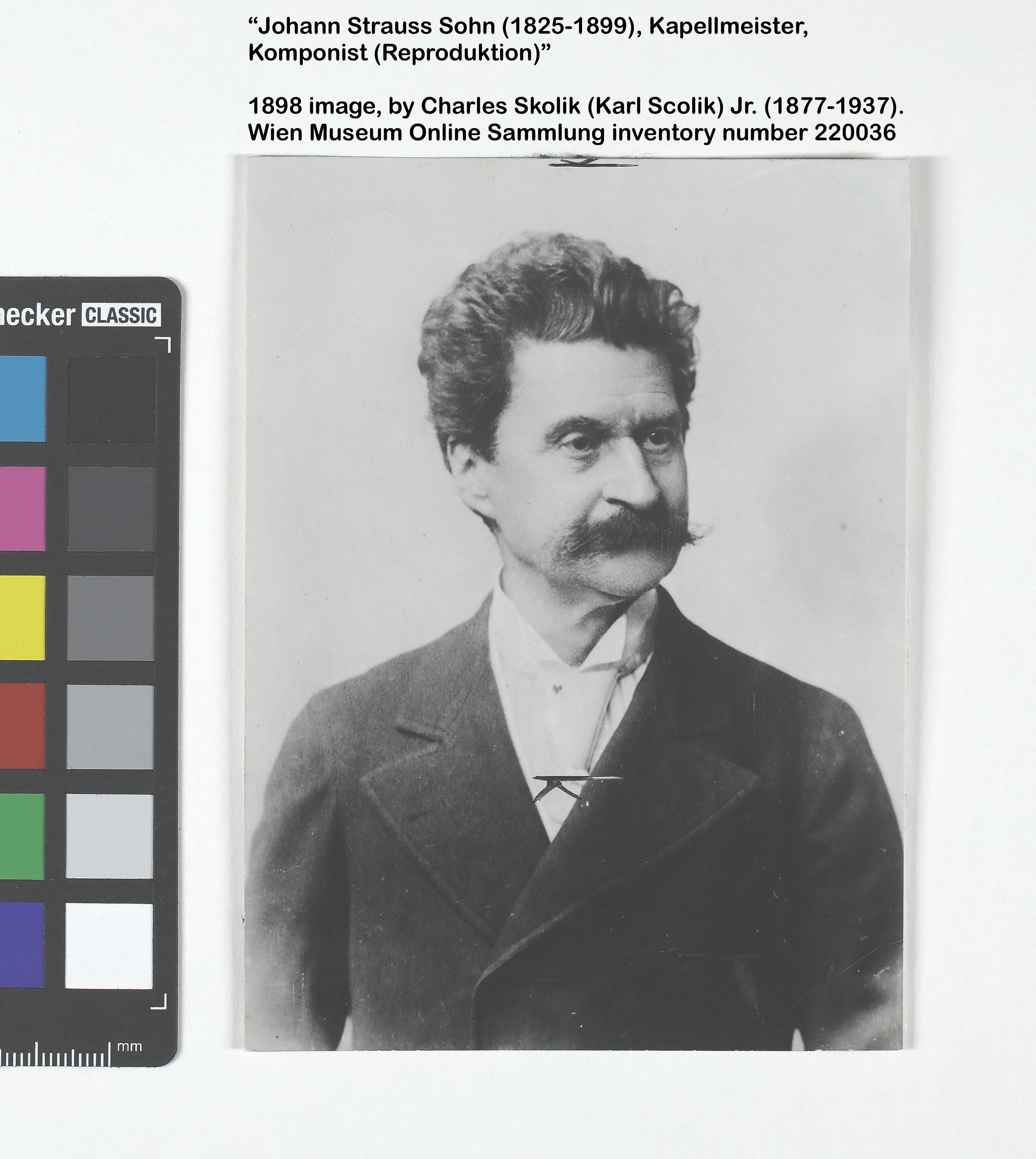
Johann Strauss II: photo by Charles Scolik (Karl Skolik), 1898 print. Wien Museum Online Sammlung inventory number 220036.
 Fotoeins Fotografie
Please leave your comments below