Vienna: Heinrich Ferstel’s architectural legacy
Above/featured: Entrance into the Ferstel Passage (Ferstelpalais, Herrengasse 14). Photo, 2 Jun 2023 (X70).
The following structures in the city of Vienna share something (and someone) in common:
• Café Central,
• the University of Vienna,
• Votive Church, and
• the Museum for Applied Arts.
These buildings were all designed by Viennese architect Heinrich Ferstel. His architectural works left a deep and lasting impression on the city and her residents. What follows is a brief life summary and highlights from a number of his projects.
• born/✵ 7 Jul 1828 – died/✟ 14 Jul 1883.
• One of many architects contributing to the development of Vienna’s “Ringstrasse.”
• 1843–1847: student at Imperial & Royal Polytechnic Institute.
• 1850: completed studies at Architekturschule der Akademie der bildenden Künste (Architectural School, Academy of Fine Arts) under Carl Rösner, Eduard van der Nüll, August Sicard von Sicardsburg.
• 1866: appointed Professor of Architecture at Polytechnic Institute; subsequently, dean 1866–1870; rector 1880–1881 after institute became the Technical University in 1872.
• 1872: founded the Cottageverein (Cottage Association) for the construction of English-style family homes in the Währing district.
… Prolific Austrian architect. He (Ferstel) designed the twin-towered Gothic Revival Votivkirche (1856–1882) and various other Historicist buildings, including the vast Italian Renaissance Revival University (1873–1884) in Vienna. Much of his important work (where the influence of Semper is often clear) was done for the area adjoining the Ringstrasse, but he also designed many buildings throughout the Austro-Hungarian Empire. An advocate of housing reform, he admired English low-density developments, which influenced the Cottageverein (Cottage Association), Vienna (1872–1874), responsible for building small single-family houses. Ferstel also promoted the laying out of the Türkenschanzpark, a public park on English lines (from 1883) …— from “A Dictionary of Architecture and Landscape Architecture”
Ferstel structures in the capital
I examine a number of Ferstel’s architectural works in Vienna, for which the interested visitor can follow in the city. While ordered alphabetically, the following list is neither complete nor exhaustive. The number in parentheses following every list-entry is the district number; e.g., (9.) is the 9th district, known also as Alsergrund.
- Alserbachpalais (9.)
- (Erstes) Chemisches Institut (9.)
- Cottage Vereinshaus (18.)
- Friedhof Grinzing (19.)
- Haus Hollitzer (9.)
- Kleinmariazeller Hof (1.)
- MAK, Museum für angewandte Kunst (1.)
- Mechitaristenkirche (7.)
- Pädagogikum / Pädagogium (1.)
- Palais Erzherzog Ludwig Viktor (1.)
- Palais Ferstel (1.)
- Palais Wertheim (1.)
- Schottenkirche (1.)
- Sommervilla (19.)
- Technische Universität Wien (4.)
- Türkenschanzpark (18.)
- Universität für angewandte Kunst (1.)
- Universität Wien, Hauptgebäude (1.)
- Votivkirche (9.)
- Votivkirche: Ferstel bust (9.)
- Wasagymnasium (9.)
- ZAMG (Geosphere Austria, 19.)
• Sources
Alserbachpalais
Alserbachstrasse 14–16, 9th district
• Alserbach palace at north end of Liechtensteinpark; also known as the Sommerpalais (summer palace) for the Liechtenstein family.
• Designed by Ferstel and constructed in the historical Neo-Renaissance style; inaugurated 1875.
• This palace was located near the Alserbach (Alser creek) whose flow has since been buried under the modern city.
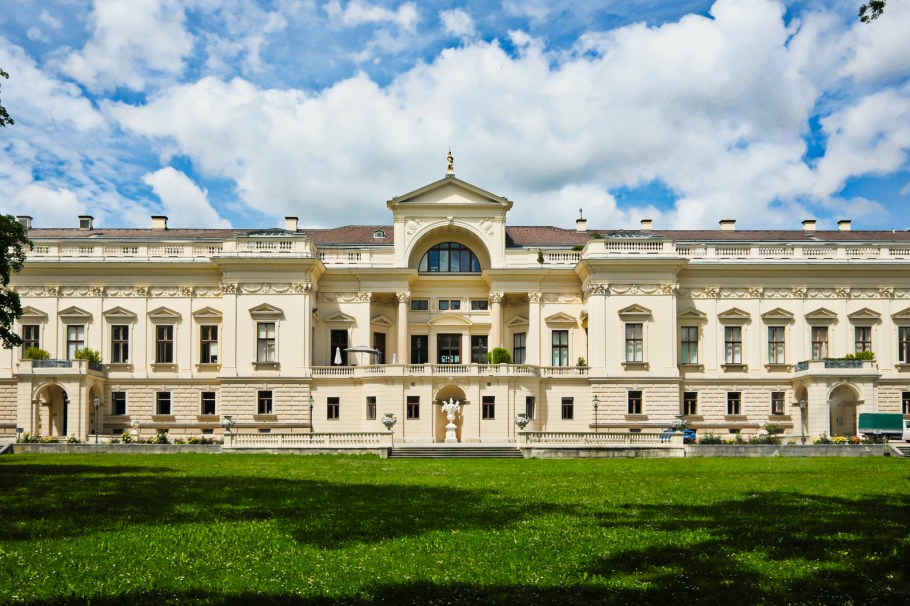
Alserbachpalais under early-afternoon illumination. Photo, 24 May 2023 (X70).
(Erstes) Chemisches Institut
Währinger Strasse 10, 9th district
• Designed by Ferstel; 1869–1872 construction opposite Ferstel’s Votivkirche (Votive Church).
• Home to University of Vienna’s Institutes of Chemistry and Pharmacy, from 1872 to 2004.
• From 2004, Medical University of Vienna’s Institute of Medical Chemistry and Pathobiochemistry (Institut der medizinischen Chemie und Pathobiochemie).
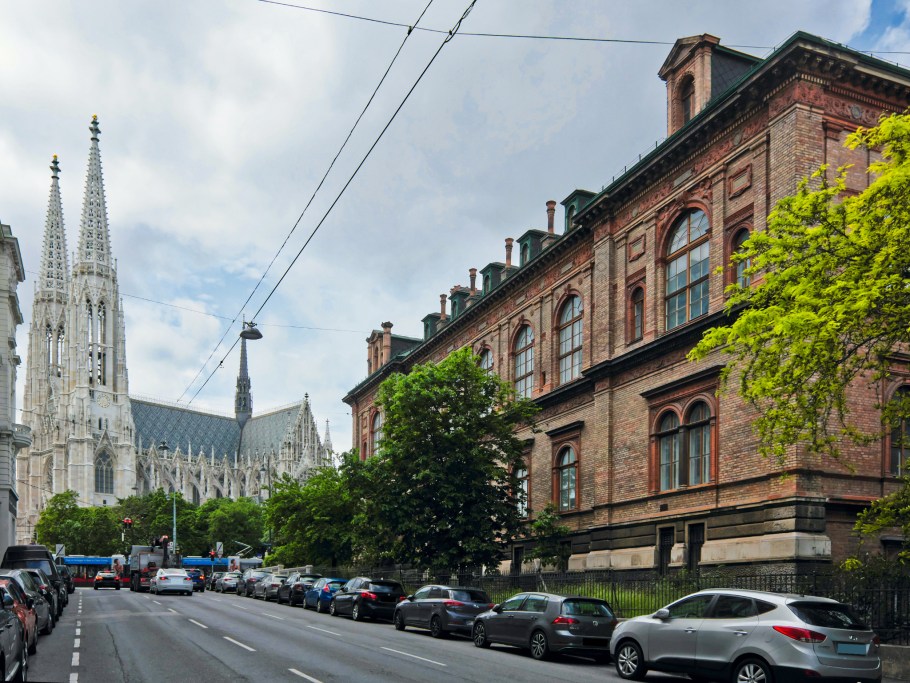
Southwest on Hörlgasse towards Währinger Strasse: at left and right, respectively, are Ferstel’s Votive Church and Ferstel’s Chemistry Institute. Photo, 24 May 2023 (X70).
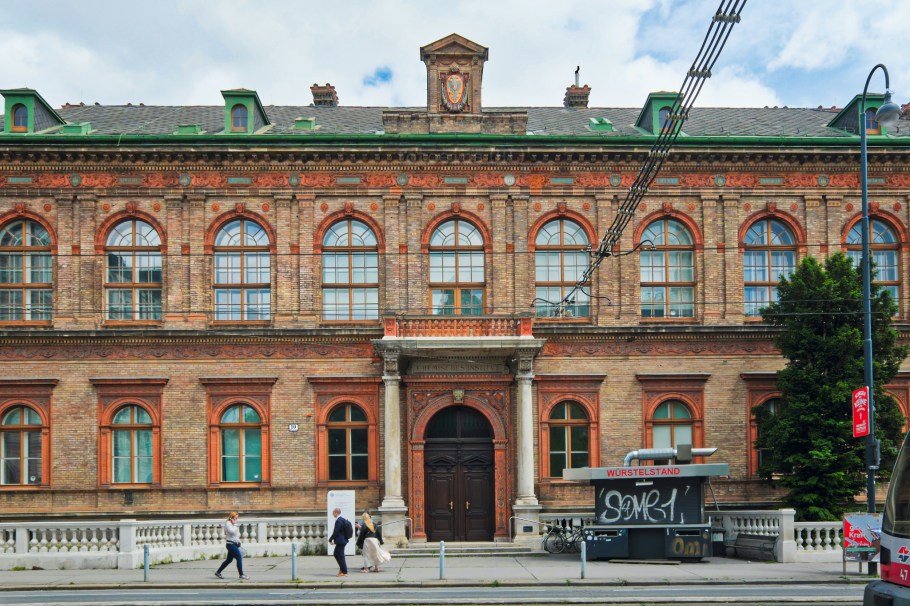
The building is now home to the Institute of medical chemistry for the Medical University of Vienna. Photo from Währinger Strasse, 24 May 2023 (X70).
Cottage Vereinshaus
Weimarer Strasse 50, 18th district
• 1872 co-founder, Wiener Cottage Verein (Vienna Cottage Association)
• Established “cottage quarter” (Cottageviertel) in Währing-Döbling to present late-19th century housing solutions and a new type of Engish-style “garden city”.
• Clubhouse and association headquarters building (Cottage Casino Verein) by Ferstel, opened December 1874 at Carl-Ludwig-Strasse 32, which is now Weimarer Strasse 50.
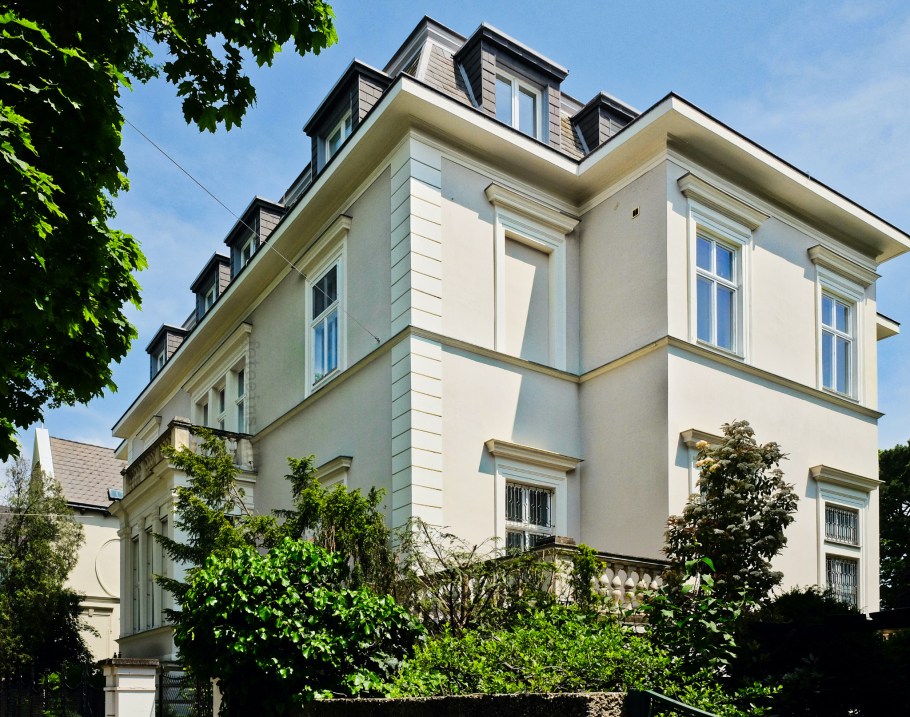
Cottage Association headquarters building, by Ferstel. Photo, 20 May 2023 (X70).
Friedhof Grinzing
An den langen Lüssen 33, 19th district
• Ferstel-designed family mausoleum, location in Grinzing cemetery: group MA, number 46.
• Also in Grinzing cemetery: Thomas Bernhard, Heimito von Doderer, Gustav Mahler, Alma Mahler-Werfel, Carl Moll, August Sicard von Sicardsburg.
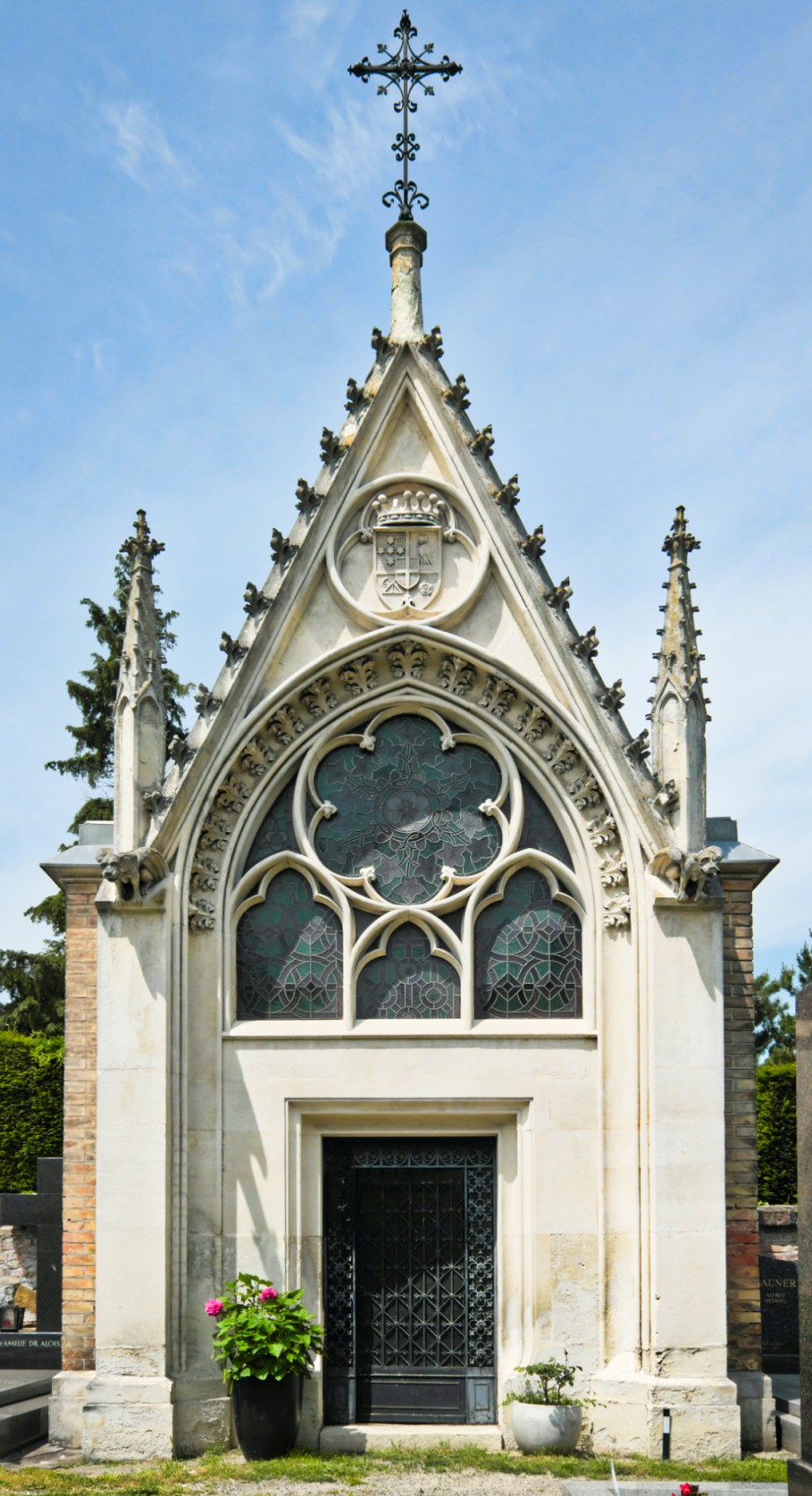
Ferstel family mausoleum. Photo, 30 May 2023 (X70).
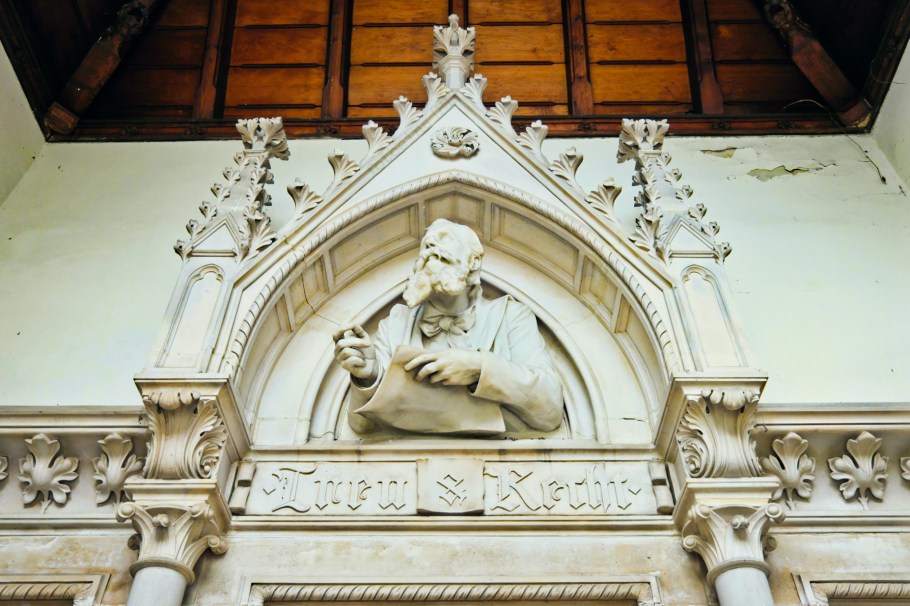
Inside the mausoleum: “Treu & Recht” (faithful and fair), below a bust of Heinrich Ferstel. Photo, 30 May 2023 (X70).
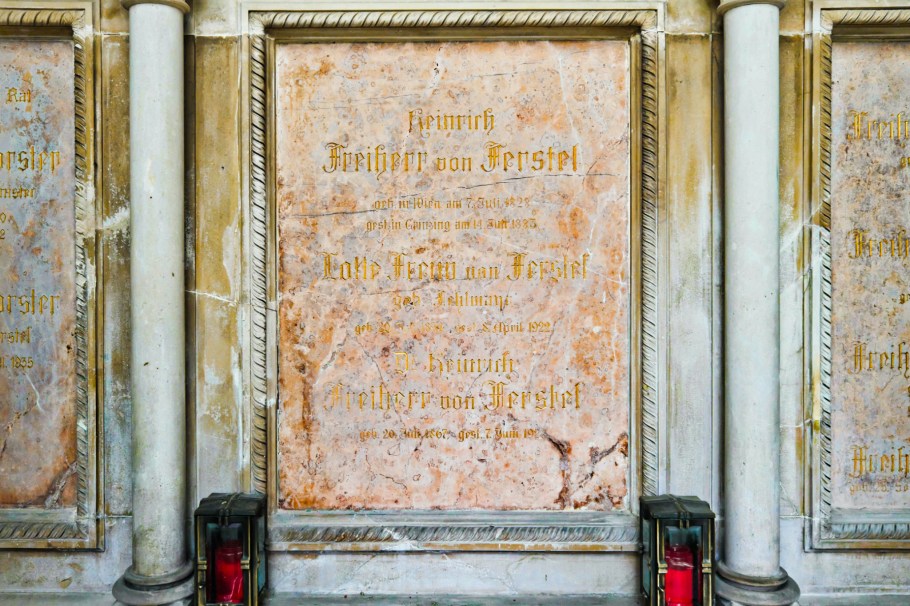
Inside the mausoleum: Heinrich Ferstel (1828–1883) buried here. Photo, 30 May 2023 (X70).
Haus Hollitzer
Ferstelgasse 2, 9th district
• Alternate address: Rooseveltplatz 10
• Design (with Karl Köchlin), construction, & completion: 1880–1881.
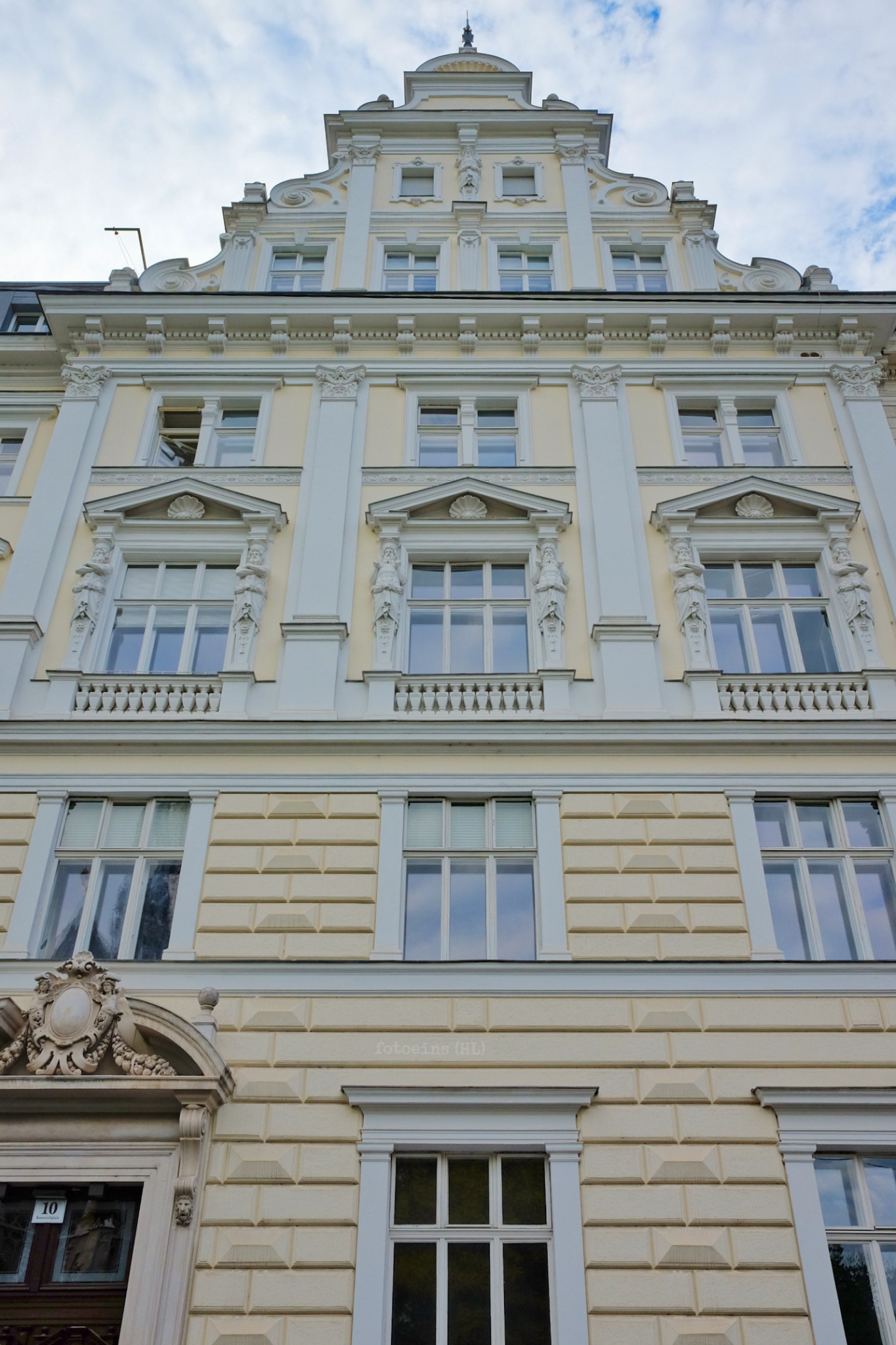
Haus Hollitzer, from Rooseveltplatz. Photo, 13 Jun 2024 (X70); compare this image with Ferstel’s design sketch.
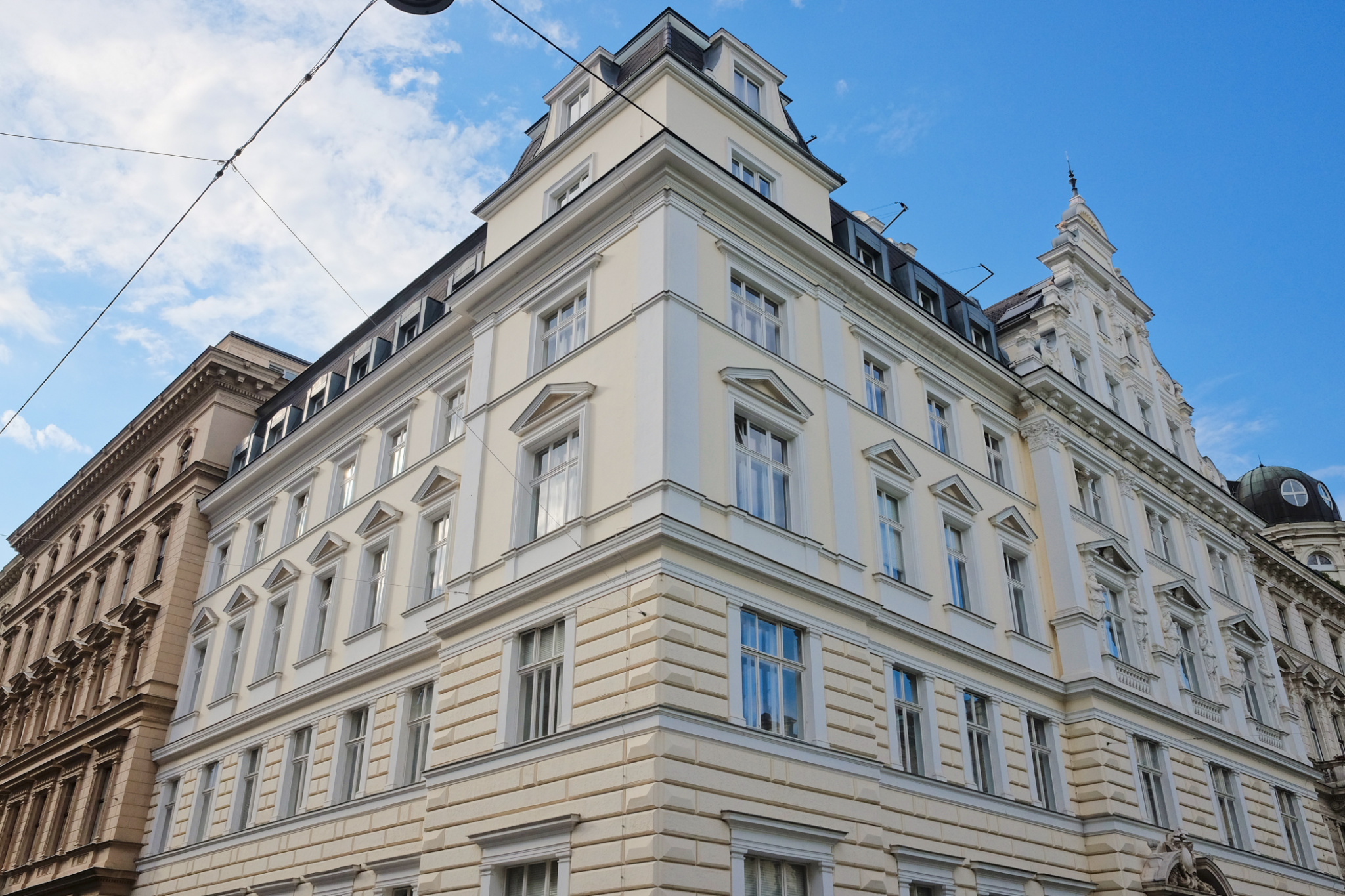
Haus Hollitzer, from Rooseveltplatz. Photo, 13 Jun 2024 (X70); compare this image with Ferstel’s design sketch.
Kleinmariazeller Hof
Johannesgasse 6, 1st district
• 1786–1877: former Annakloster (Johannesgasse 4) home to Academy of Fine Arts.
• Academy’s architecture school took up 4th floor in Kleinmariazeller Hof next door at Johannesgasse 6. Kleinmariazeller Hof building also home to Hofkammerarchiv (Imperial Court Archive).
• 1850: Ferstel completed architectural studies with Rösner, van der Nüll, Sicardsburg.
• 1877: Academy of Fine Arts eventually moves into their own building (by T. Hansen) at Schillerplatz.

In the early- to mid-19th century, the Kleinmariazeller Hof building had been home to the Imperial and Royal Court Chamber Archive (k. k. Hofkammerarchiv) and the Academy of Fine Arts’ Architecture School (Architekturschule der bildenden Künste). Today, the Grillparzerhaus at Johannesgasse 6 is home to the Austrian State Archive (Österreichisches Staatsarchiv) and the Literature Museum (Literaturmuseum). Photo, 10 Jun 2023 (X70).
MAK, Museum für angewandte Kunst
Stubenring 5, 1st district
• Museum for applied arts.
• Designed by Ferstel in the Florentine-Tuscan Renaissance style
• Inaugurated 1871 as Kaiserlich-Königliches Österreichisches Museum für Kunst und Industrie (Imperial-Royal Austria Museum for Art and Industry); one element of historicism architecture on the Ringstrasse.

The MAK – 13 Jun 2023 (X70).

“Tuesday evenings, half-price”. Photo, 13 Jun 2023 (X70).
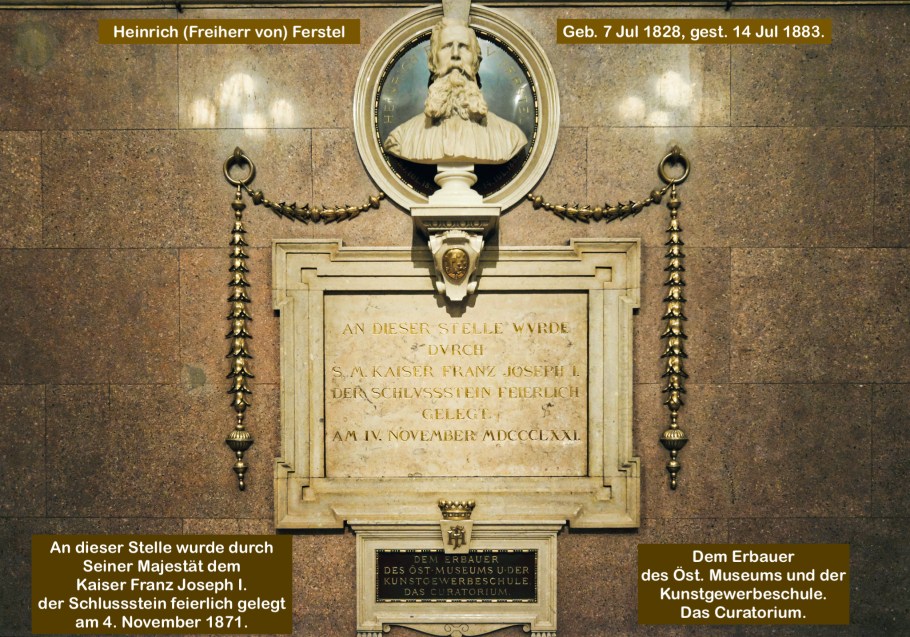
Main stairwell inside the MAK: the final stone was laid by Kaiser Franz Joseph I on 4 November 1871. Photo, 13 Jun 2023 (X70).
Mechitaristenkirche
Neustiftgasse 4, 7th district
• Church for the Armenian Mekhitarist community in Vienna.
• Front altar piece designed by Heinrich Ferstel and built by Josef Leimer, 1874.
• My visit to the museum and church
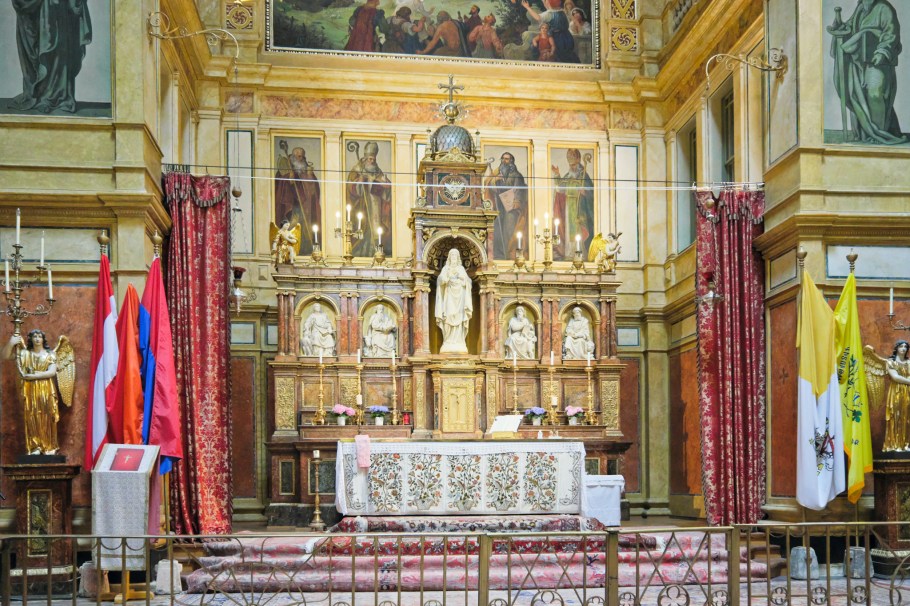
Mekhitarist church front altar: altarpiece with little dome capped by a crucifix, designed by Heinrich Ferstel and built by Josef Leimer in 1874. Photo, 25 May 2022 (X70).
Pädagogikum / Pädagogium
Hegelgasse 12, 1st district
• Ferstel design with building inauguration in 1870, as Municipal Education Centre (Pädagogikum) and Federal Teacher Training Institute (Bundeslehrerbildungsanstalt), at address Hegelgasse 12 / Fichtegasse 3.
• At this location, Marianne Hainisch established Mädchengymnasium des Vereins für Erweiterte Frauenbildung, one of the very 1st all-girls secular schools in German-speaking Europe; school moved to Hegelgasse 19 in 1905, then to Rahlgasse 4 in 1910.
• Dr. Olga Ehrenhaft-Steindler taught here at the girls’ school, 1903–1904, shortly after becoming the 1st woman to earn a doctorate in physics at the University of Vienna and achieving her teacher qualifications. I wrote about Ehrenhaft-Steindler here.

Northwest corner of Hegelgasse and Fichtegasse: building for municipal education centre. Today, the building is home to a city high school for arts and music in the 1st district. Photo, 13 May 2023 (X70).
Palais Erzherzog Ludwig Viktor
Schwarzenbergplatz 1, 1st district
• Archduke Ludwig Victor palace, directly opposite Palais Wertheim.
• Building design by Ferstel with 1866 inauguration; 1st building established on Schwarzenbergplatz after 1857 imperial decree to demolish the city’s inner wall.
• Today, the building is home to the Burgtheater Kasino as rehearsal and performance space.
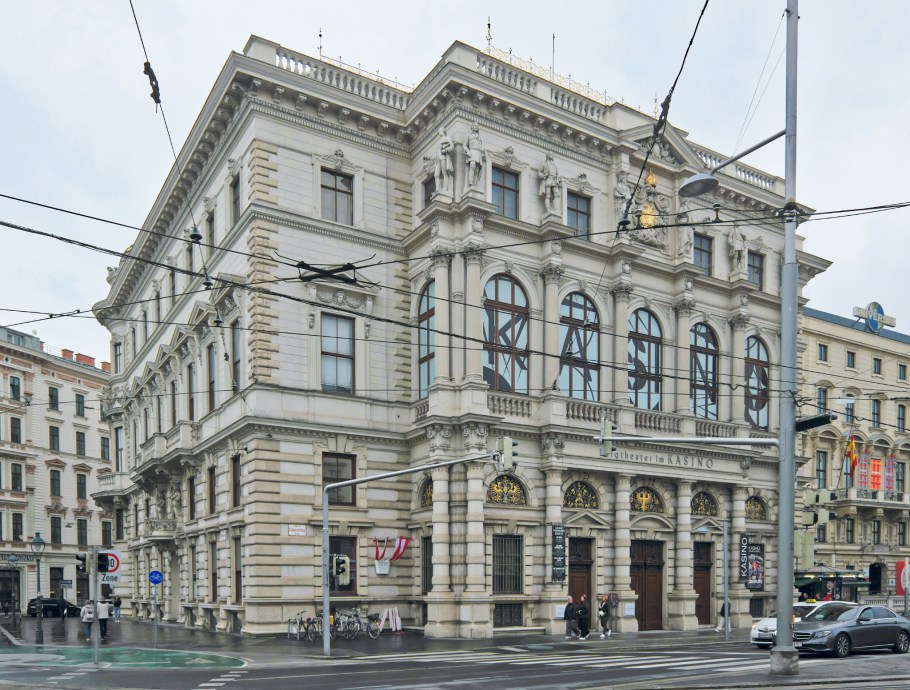
Southeast corner of Schwarzenberg and Schubertring, opposite Palais Wertheim. Photo, 13 May 2023 (X70).
Palais Ferstel
Strauchgasse 4, 1st district
• Ferstel-designed “palace” in the late-romantic historicism style, inspired by time spent in Italy.
• Inaugurated 1859 as Bank- and Stock Exchange Building; housed the seat of the Austro-Hungarian National Bank.
• Café Central moved into their ground-floor spot in 1876.
• Between Herrengasse and Freyung is the beautiful interior Ferstel Passage, including Donaunixenbrunnen (Danube mermaid fountain, 1861) by Heinrich Ferstel & Anton Fernkorn.
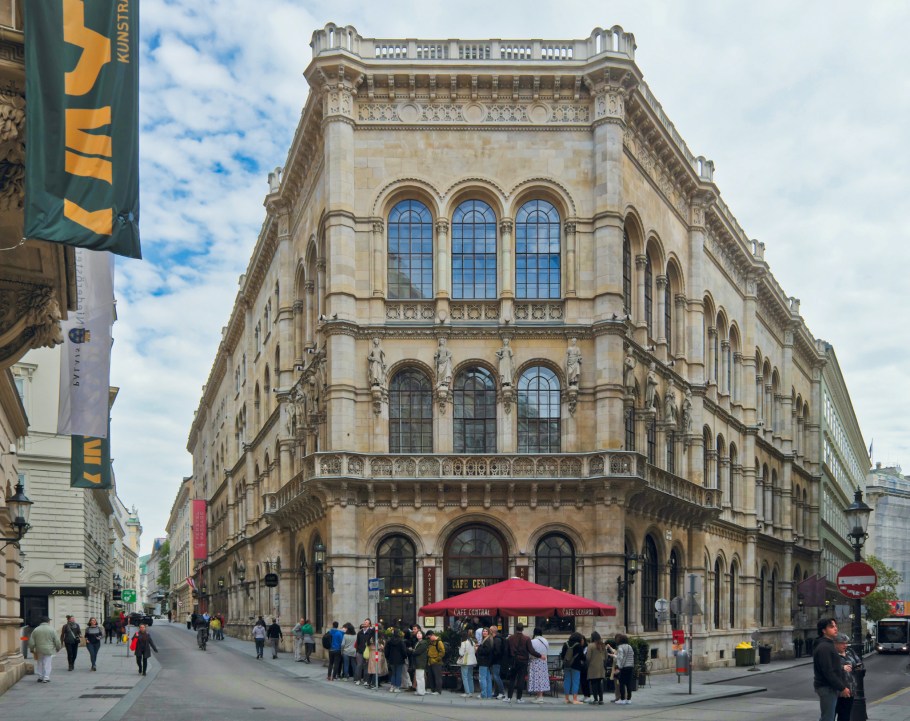
Facing north from Herrengasse; Palais Niederösterreich is just beyond the left-edge of the frame. Photo, 19 May 2023 (X70).
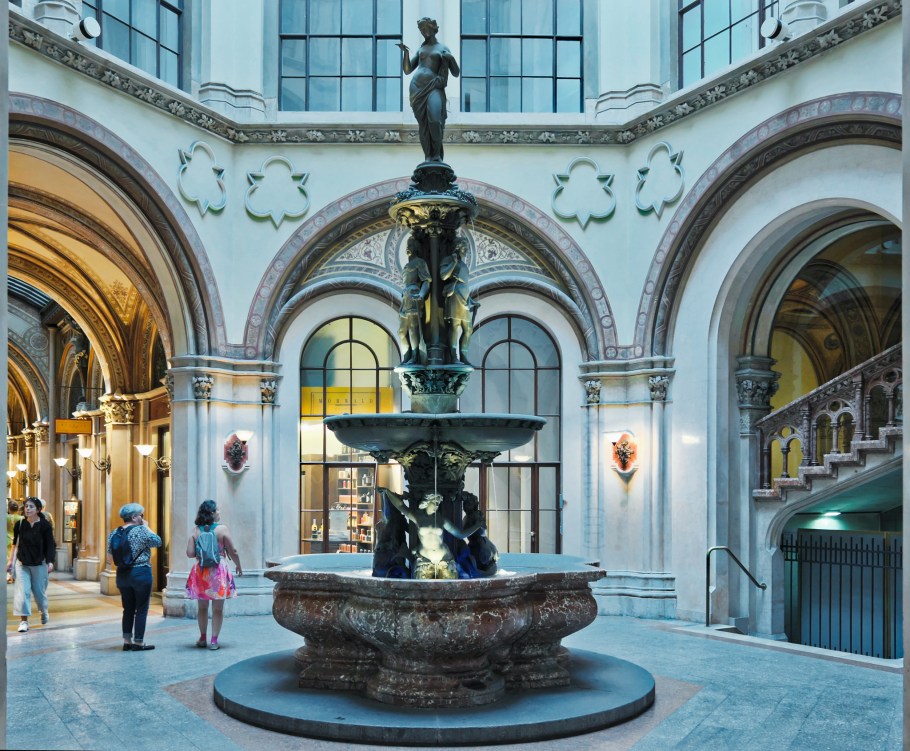
Donaunixenbrunnen (Danube mermaid fountain): “Entworfen von Heinrich Ferstel, ausgeführt von Anton Fernkorn; 1861. Den unteren Teili des Brunnens bilden drei Nixen, darüber drei Berufe, die an der Donau angesiedelt sind (Fischer, Schiffsbauer, Kaufmann), und an der Spitze das Donauweibchen. Von Fernkorn stammen auch die beiden Reiterstandbilder (Prinz Eugen, Erzherzog Karl) am Heldenplatz.” (Designed by Heinrich Ferstel, constructed by Anton Fernkorn; 1861. The lower part of the fountain is made up of three mermaids, above which are three professions based on the Danube — fishing, ship-building, merchant — at the top is the Danube, represented by a woman. The two equestrian statues on Heldenplatz (Prince Eugen, Archduke Karl) are also by Fernkorn.) Photo, 2 Jun 2023 (X70).
Palais Wertheim
Canovagasse 1a, 1st district
• Wertheim palace, directly opposite Palais Erzherzog Ludwig Viktor.
• Designed by Ferstel, building inaugurated 1868.
• Today, the building houses meeting- and event-space.
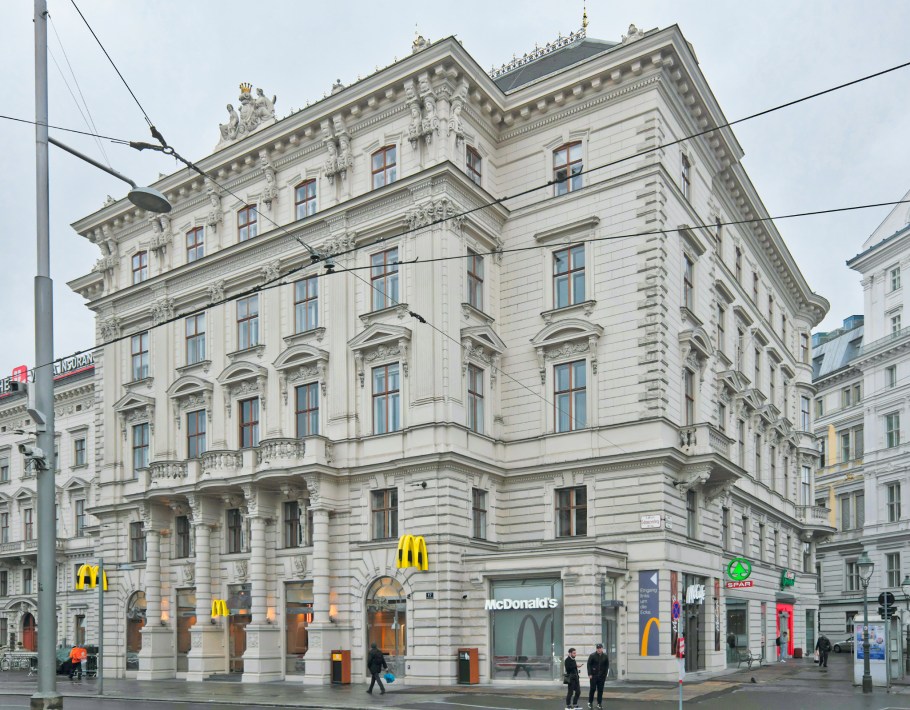
Southwest corner of Schwarzenberg and Kärntner Ring, opposite Palais Viktor. Photo, 13 May 2023 (X70).
Schottenkirche
Freyung 6, 1st district
• Schottenkirche (Irish Church): first Romanesque church consecrated in 13th-century, present appearance 17th-century Baroque.
• Inside the church is a central high-altar by Ferstel, inaugurated in 1883 on the 200th anniversary of the 2nd Ottoman Siege of Vienna.
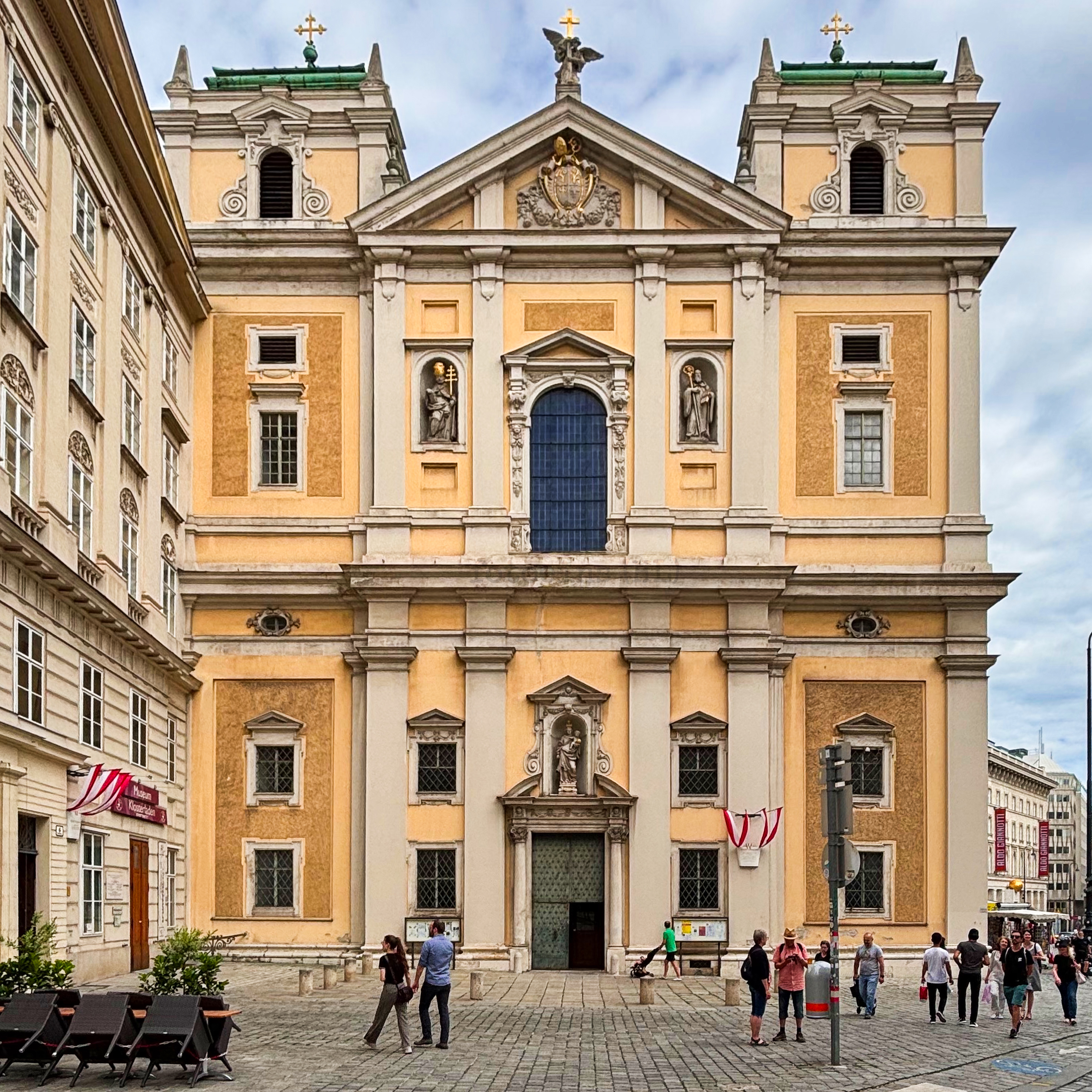
Schottenkirche (Irish Church). Photo, 16 Jun 2024 (P15).
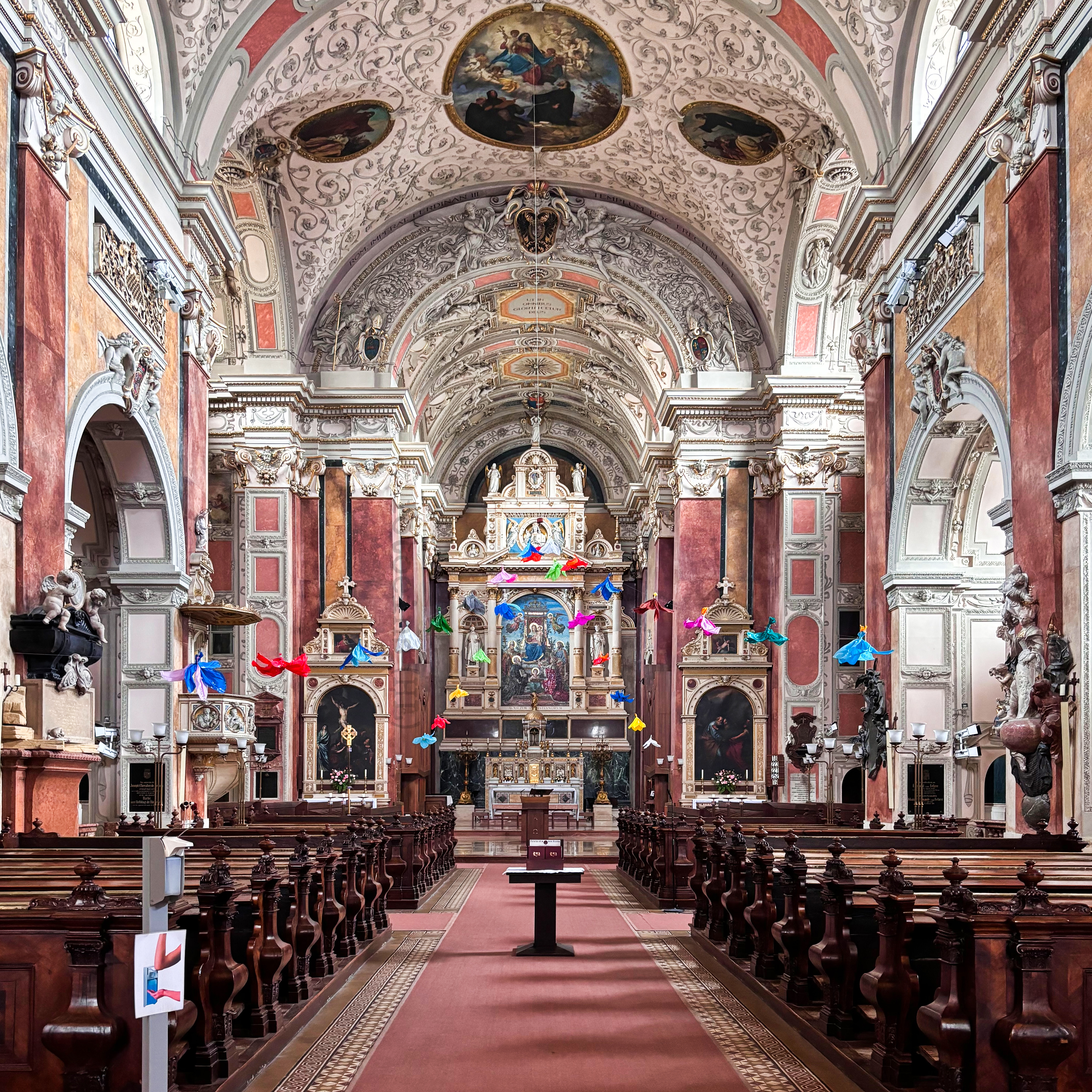
Only the atrium area is open to the public with no further general access into the nave or the rest of the church. Photographed from the atrium, in the background is a central high-altar designed by Ferstel and inaugurated in 1883 on the 200th anniversary of the successful repulsion of the 2nd Ottoman Siege of Vienna. Photo, 16 Jun 2024 (P15).
Sommervilla
Himmelstrasse 45, 19th district
• Alternate address: Strassergasse 36.
• 1863 summer residence built for his family, in the style of a neo-Gothic brick villa.
• When I arrived, the basement door opened to a couple who were doing some summertime cleaning. I said hello, told them I’d come up to see Ferstel’s summer residence, and I had the pleasure of chatting with them (Ferstel’s relatives!).
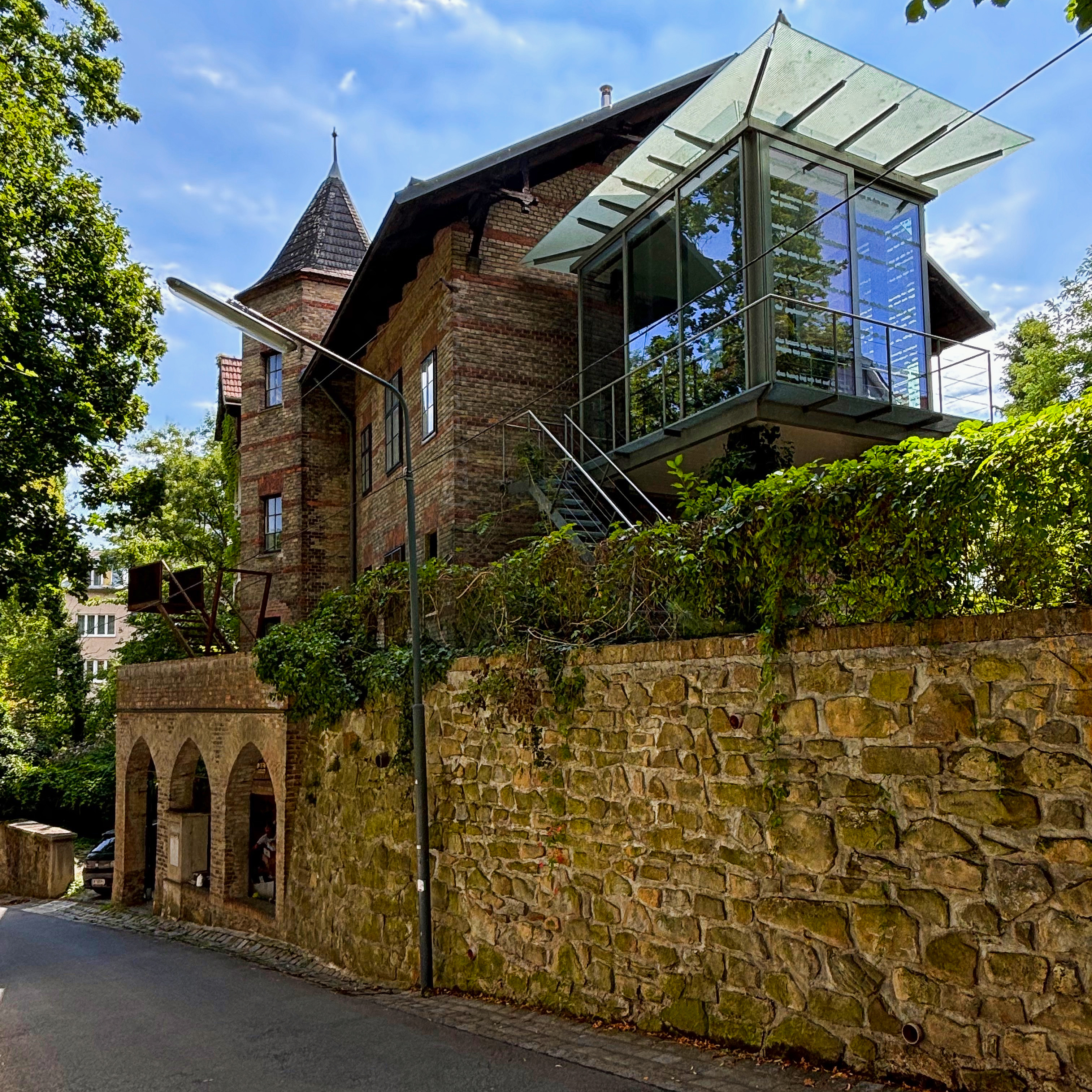
Ferstel family summer villa, facing east. Photo, 13 Jul 2024 (P15).
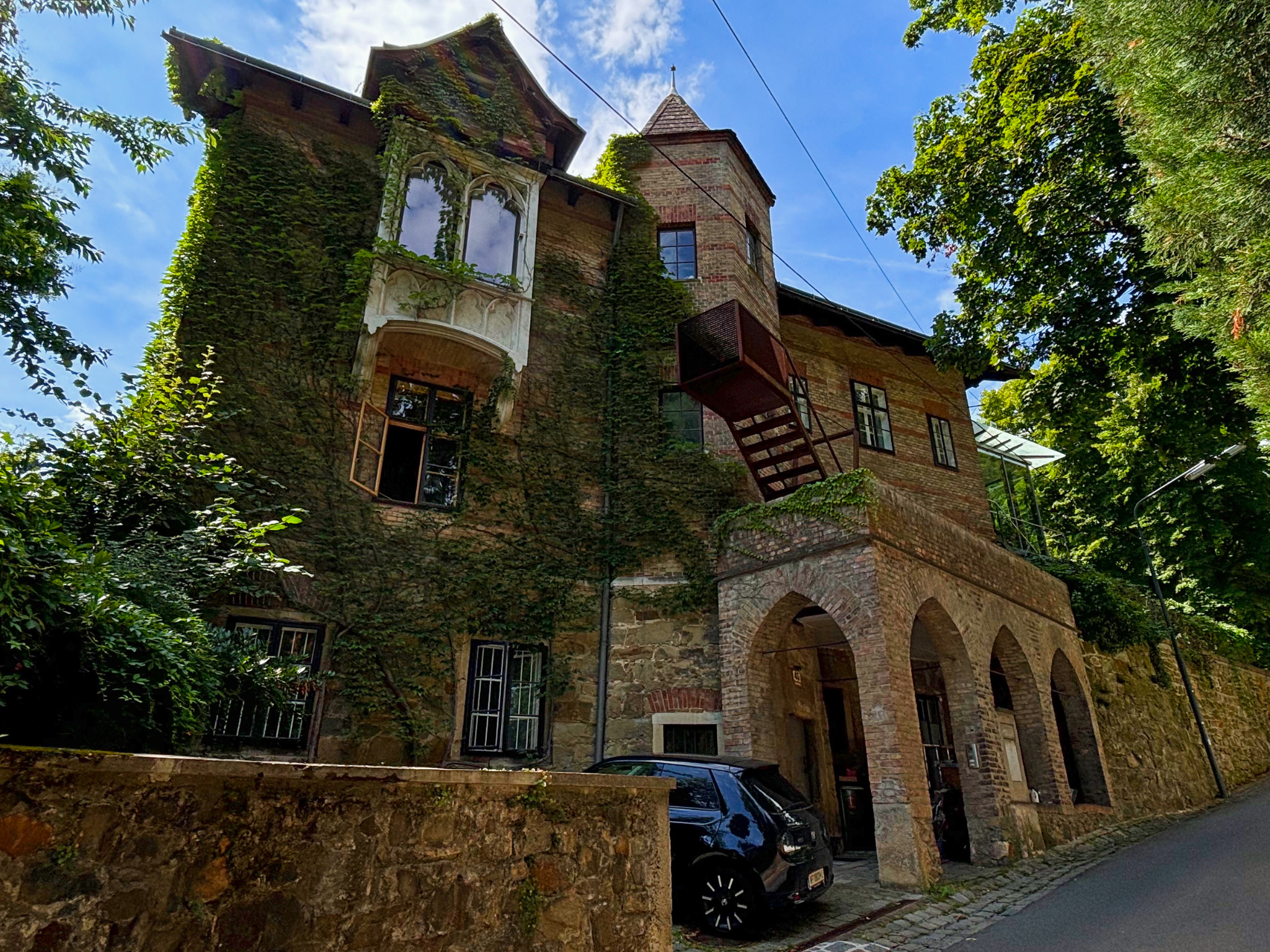
Ferstel family summer villa, facing south. Photo, 13 Jul 2024 (P15).
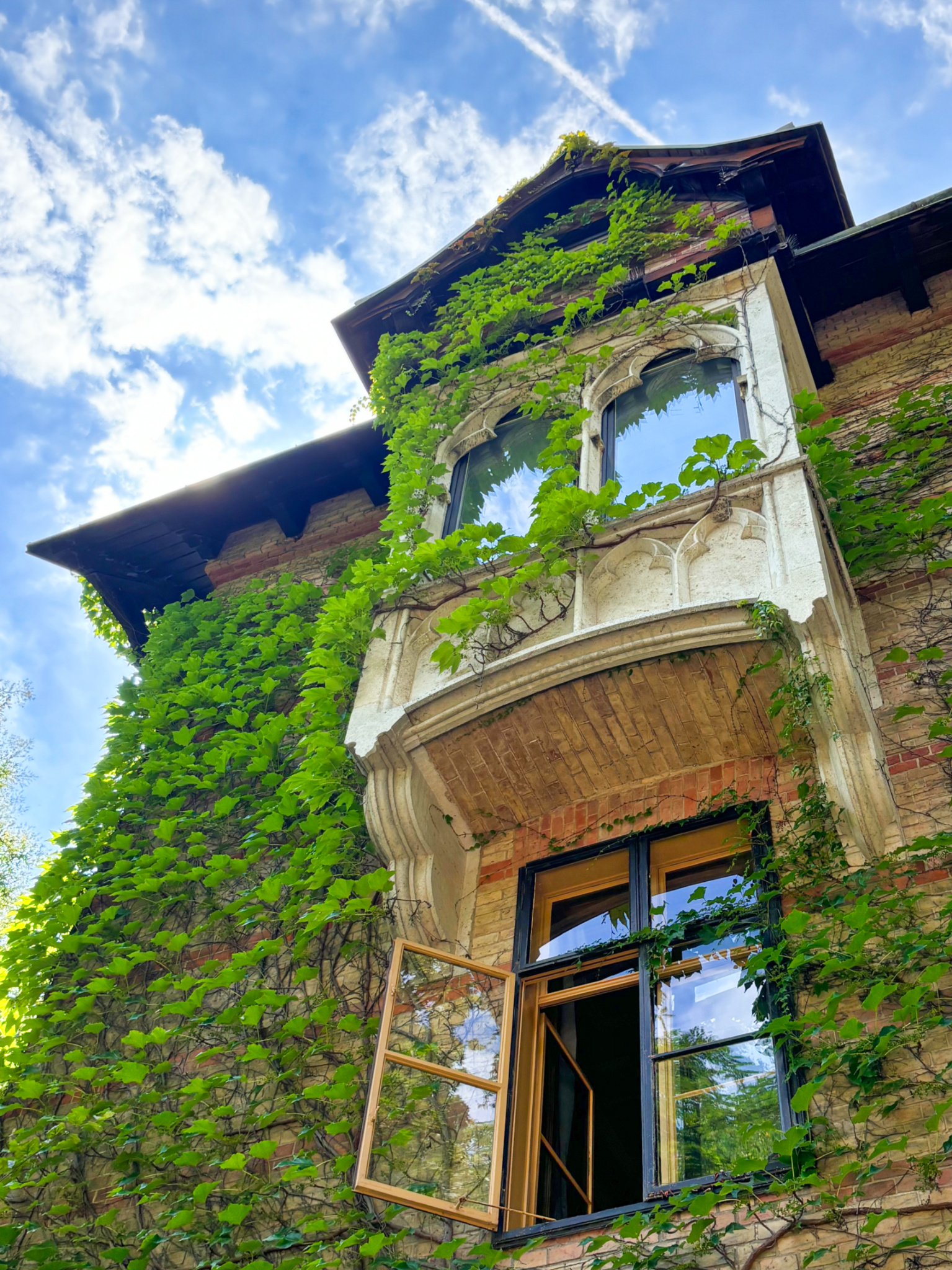
Ferstel family summer villa, upper-floor exterior detail. Photo, 13 Jul 2024 (P15).
Technische Universität Wien
Karlsplatz, 4th district
• University of Technology, 1872–present; formerly called Imperial & Royal Polytechnic Institute, 1818–1872.
• Ferstel student at Polytechnic Institute 1843–1847; years later, he returned as professor, and subsequently fulfilled roles as dean and rector.
• Ferstel honoured with memorial bust by sculptor Artur Kaan in 1903.
• In addition to Ferstel, the institution’s many alumni include: Fritz Lang, Christian Doppler, Josef Frank, Friedrich Schey von Koromla, Moriz von Kuffner, Oskar Marmorek, Eduard van der Nüll, Friedrich Ohmann, August Sicard von Sicardsburg, Camillo Sitte, Josef Strauss, Richard Zsigmondy.
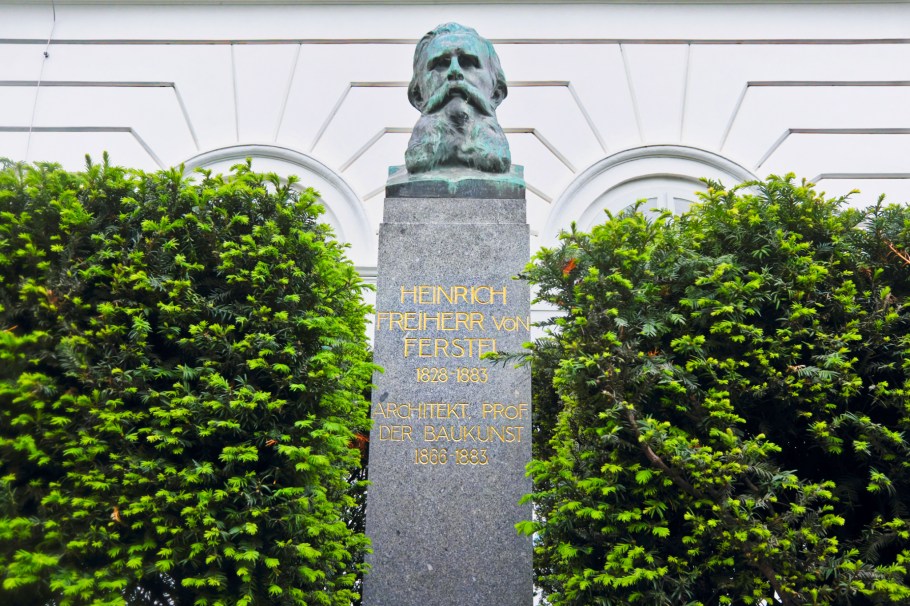
Ferstel bust memorial (Artur Kaan, 1903), in front of the Technical University’s main building at Karlsplatz. Photo, 14 May 2023 (X70).

Technical University: neoclassical building designed by Andreas Fischer & Joseph Schemerl von Leythenbach. Photo, 15 May 2022 (X70).
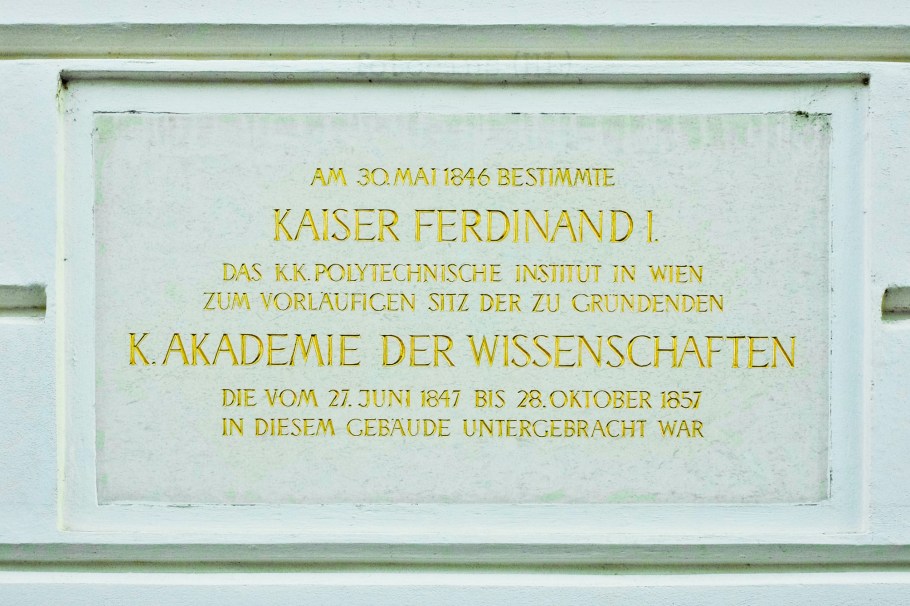
Formerly: Imperial and Royal Polytechnic Institute, Imperial Academy of the Sciences. Photo, 15 May 2022 (X70).
Türkenschanzpark
Hasenauerstraße Türkenschanzpark, 18th district
• 1883: Ferstel suggests construction of a city park in the northern suburbs. Unfortunately, he dies later that summer.
• 30. September 1888: Emperor Franz Josef opens the park in a official ceremony.
• Many memorials, including the Memorial to Ukrainian Cossacks (who supported Vienna during the 1683 siege of the city by the Ottoman empire) and the Yunus Emre Memorial Fountain as a symbol of the modern enduring relationship between Austria and Turkey.
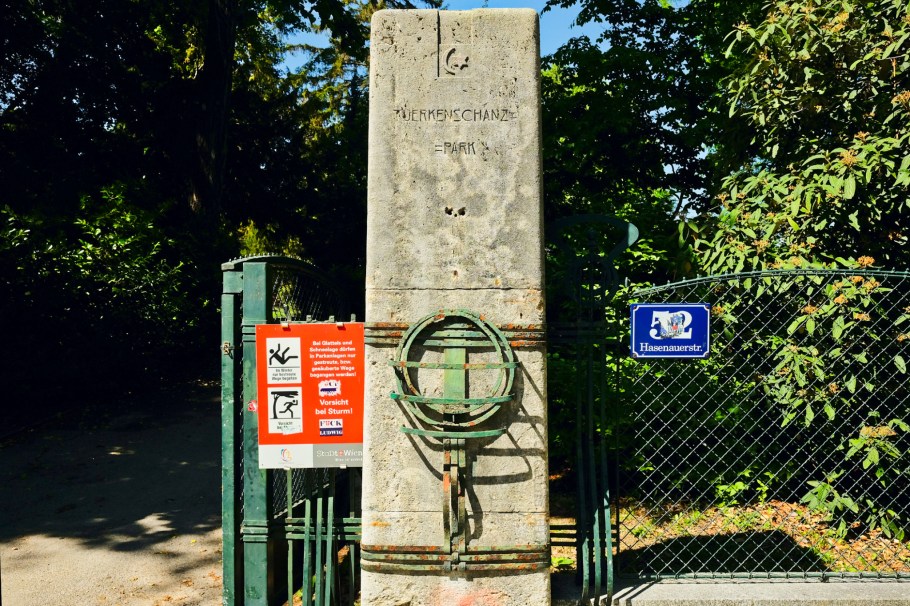
Stone pillar at one of the southern gates into Türkenschanzpark. Photo, 21 May 2022 (X70).
Universität für angewandte Kunst
Oskar Kokoschka-Platz 2, 1st district
• University of Applied Arts, adjacent to the Museum of Applied Arts.
• Designed by Ferstel; building inaugurated 1877 as Kunstgewerbeschule (School of Arts and Crafts).
Photo, 13 May 2023 (X70).
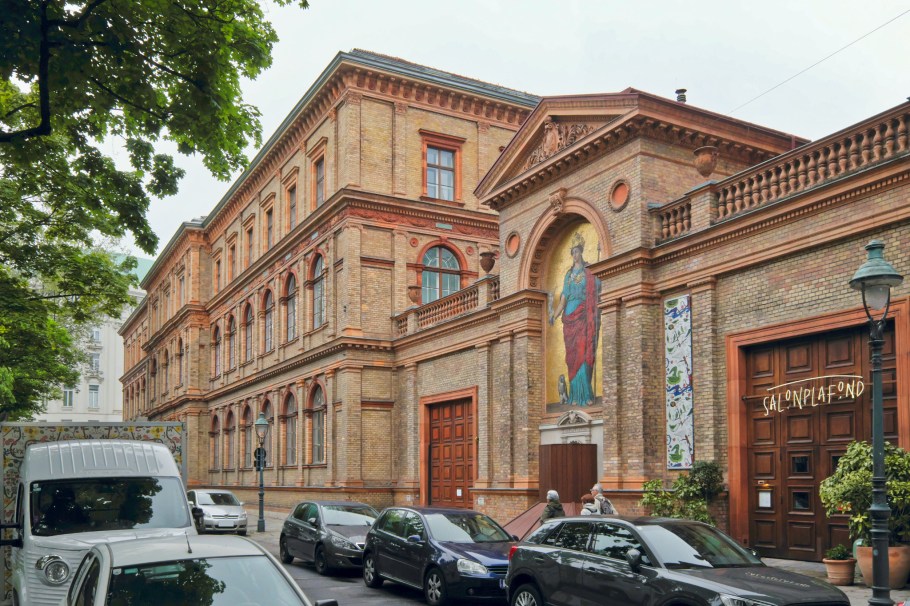
Facing east from Stubenring. Photo, 13 May 2023 (X70).
Universität Wien, Hauptgebäude
Main building at Universitätsring 1, 1st district
• University of Vienna’s main building.
• Ferstel-designed building constructed in Neo-Renaissance style and inaugurated 1884; a piece of historicist architecture on the Ringstrasse.
• Ferstel honoured with memorial bust near the Grosser Festsaal (Great Auditorium).
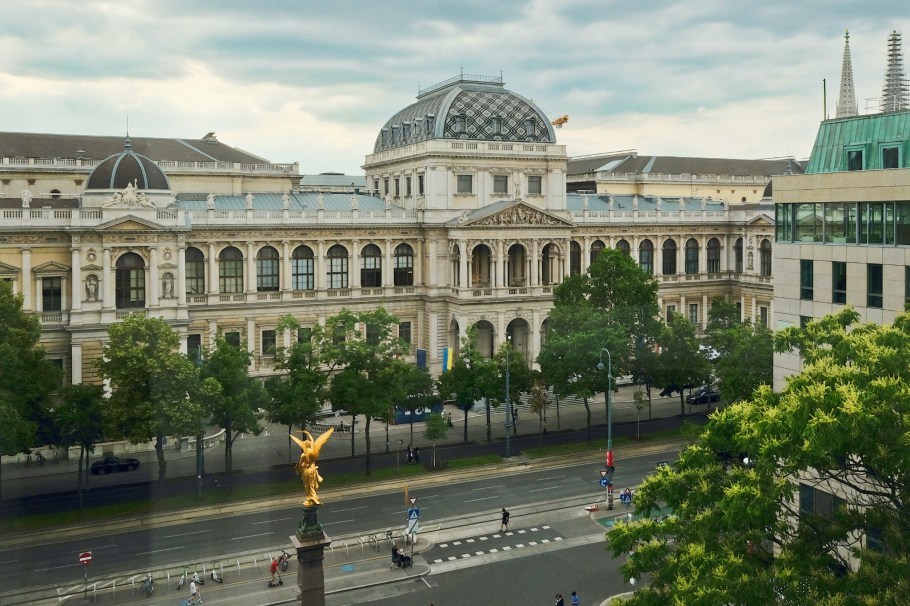
Universität, from Wien Museum Beethoven-Pasqualtihaus; at lower left is the top of the Liebenberg memorial. Photo, 5 Jun 2022 (X70).
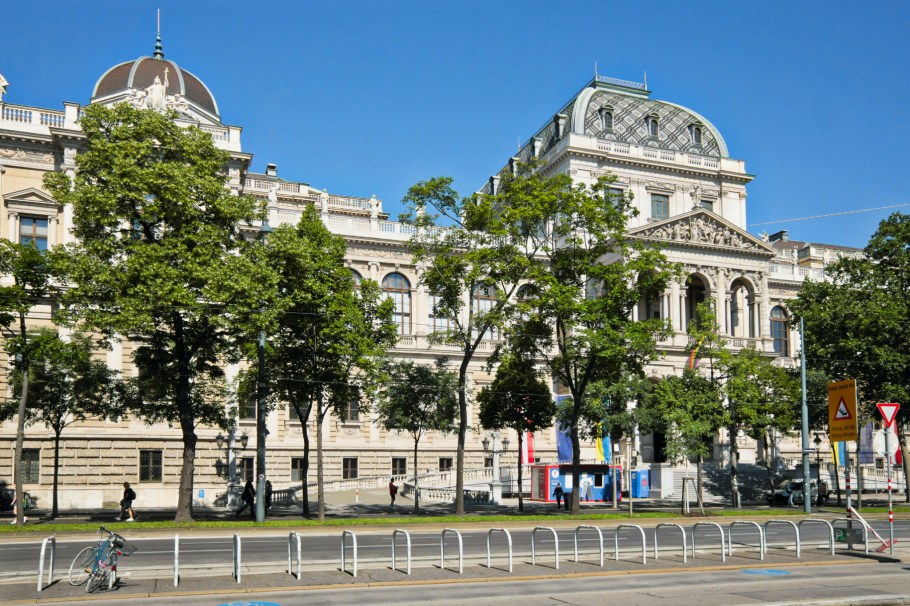
Universität, in morning light from Universitätsring. Photo, 11 Jun 2022 (X70).
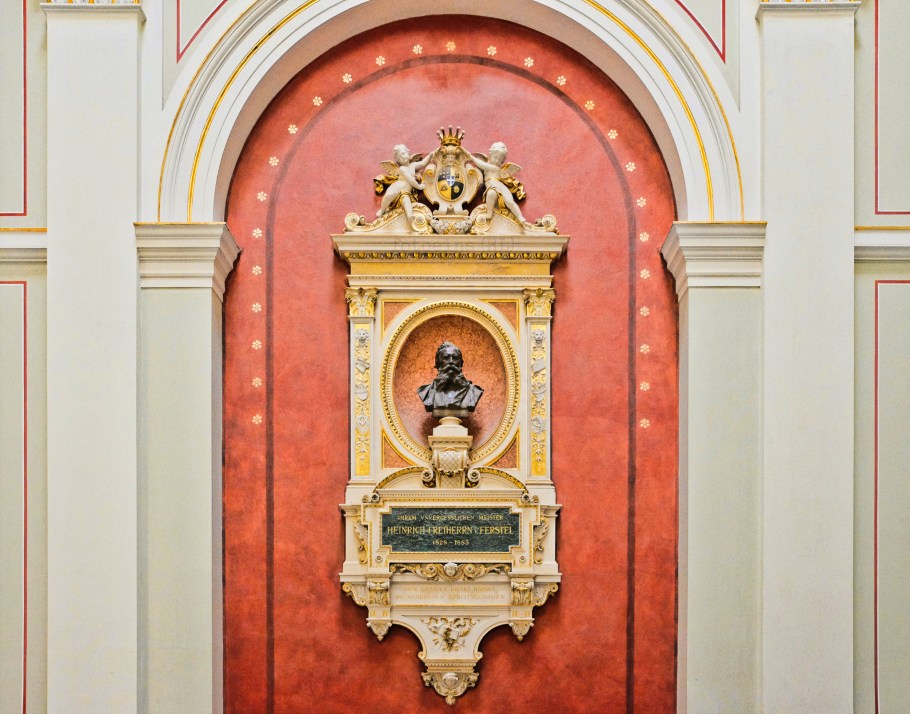
In front of the Grosser Festsaal (Grand Ballroom) is the 1886 Ferstel memorial in bronze by Austrian sculptor Viktor Tilgner. Photo, 11 Jun 2022 (X70).
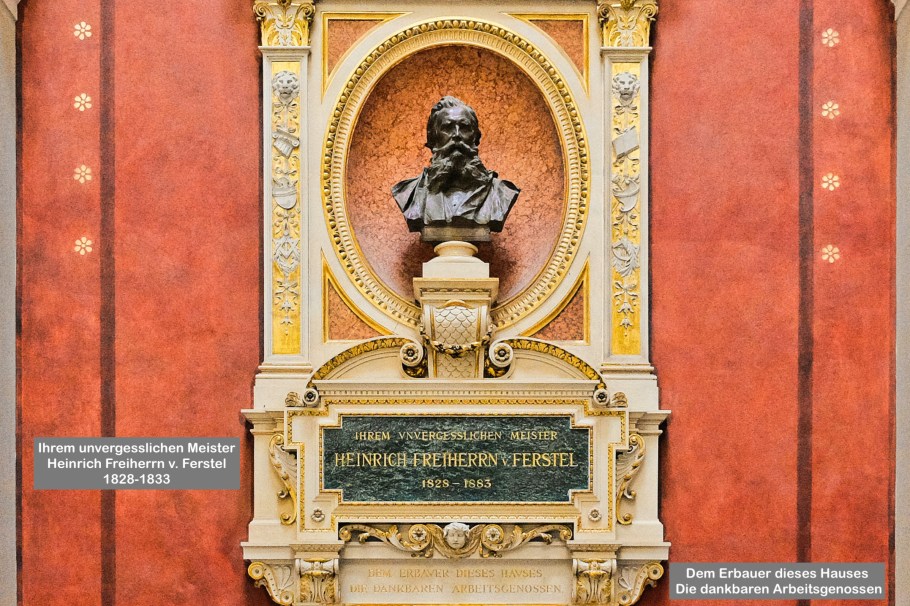
Inscription: “(In honour of the) unforgettable master – Heinrich Freiherrn v. Ferstel – 1828–1833 / To the builder – (From your) grateful colleagues.” Photo, 11 Jun 2022 (X70).
Votivkirche
Rooseveltplatz, 9th district
• Votive Church, in the French neo-Gothic style.
• 27-year-old Ferstel won the architectural competition in 1855; project construction began in 1856.
• Inaugurated 1879, a piece of historicist architecture on the Ringstrasse (Ring Road).
• Nicknamed the “Ringstrassendom” or Ring Road Cathedral. Is “Fersteldom” also appropriate?
• Foundation stone sculpted in spring of 1856 by Jewish artist Mosche Mordechai Schnitzer using a rock from the Mount of Olives in Jerusalem; arranged for transport to Vienna by Ludwig August Frankl, archivist and secretary for Vienna’s Jewish community (Stadt Wien, 2015)
• Opposite the church and across the street is Ferstel’s Chemisches Institute (Institute of Chemistry).
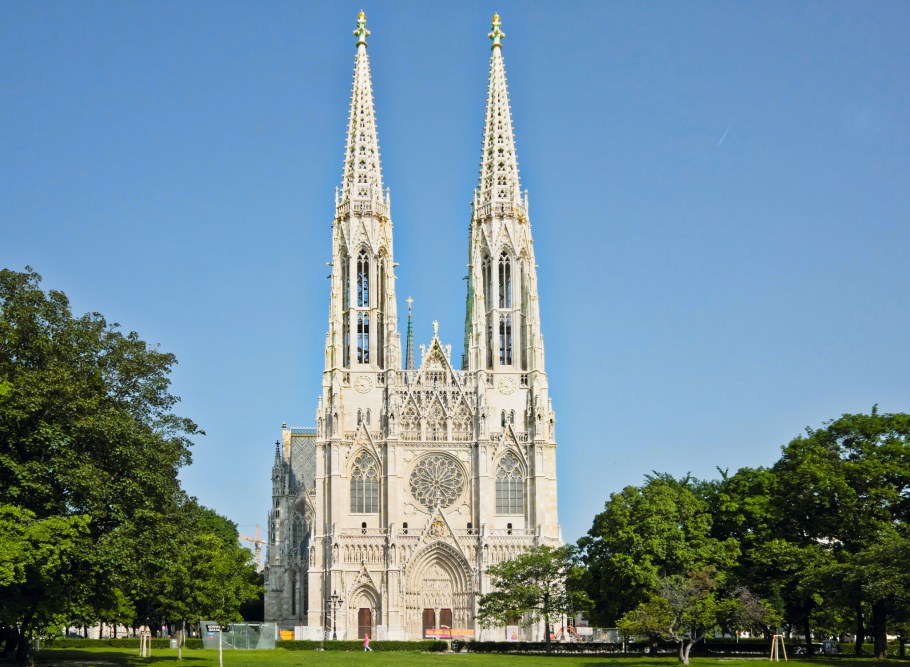
Votivkirche in morning light. For size comparison, there’s a pedestrian in pink at lower-centre. Photo, 28 May 2023 (X70).
Votivkirche: Ferstel bust
Rooseveltplatz, 9th district
• Near the southwest transept by the central nave is a two-level pulpit made from marble.
• Underneath the pulpit is a bust of architect Heinrich Ferstel, made by Austrian sculptor Viktor Tilgner.
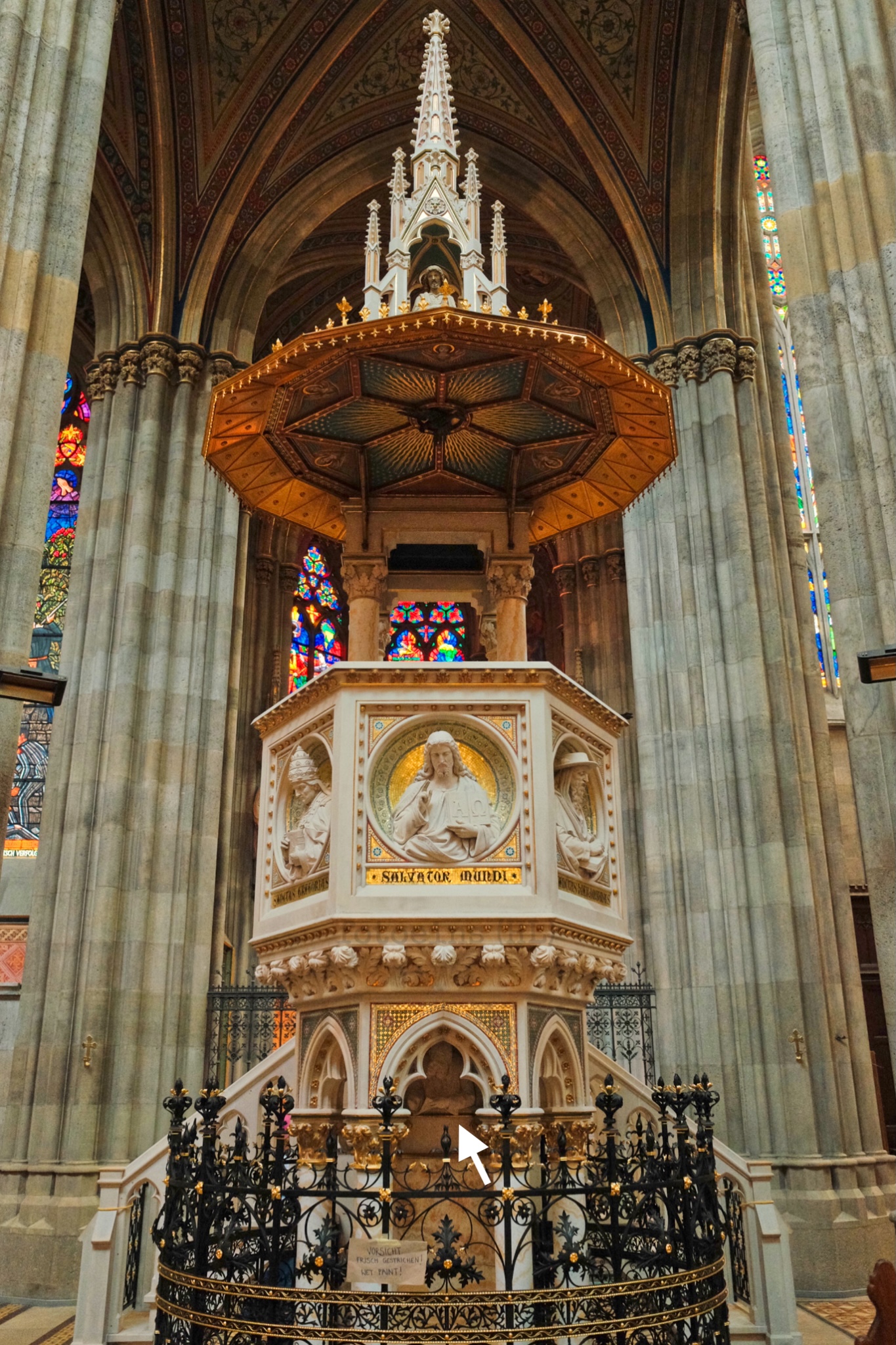
Votivkirche: marble pulpit. The central panel is the Christ-figure as “Salvator Mundi” (Saviour of the World), holding a book with Greek capital-letters Alpha & Omega (Α & Ω). An arrow indicates a shadowy figure underneath, shown with greater clarity below. Photo, 13 Jun 2024 (X70).
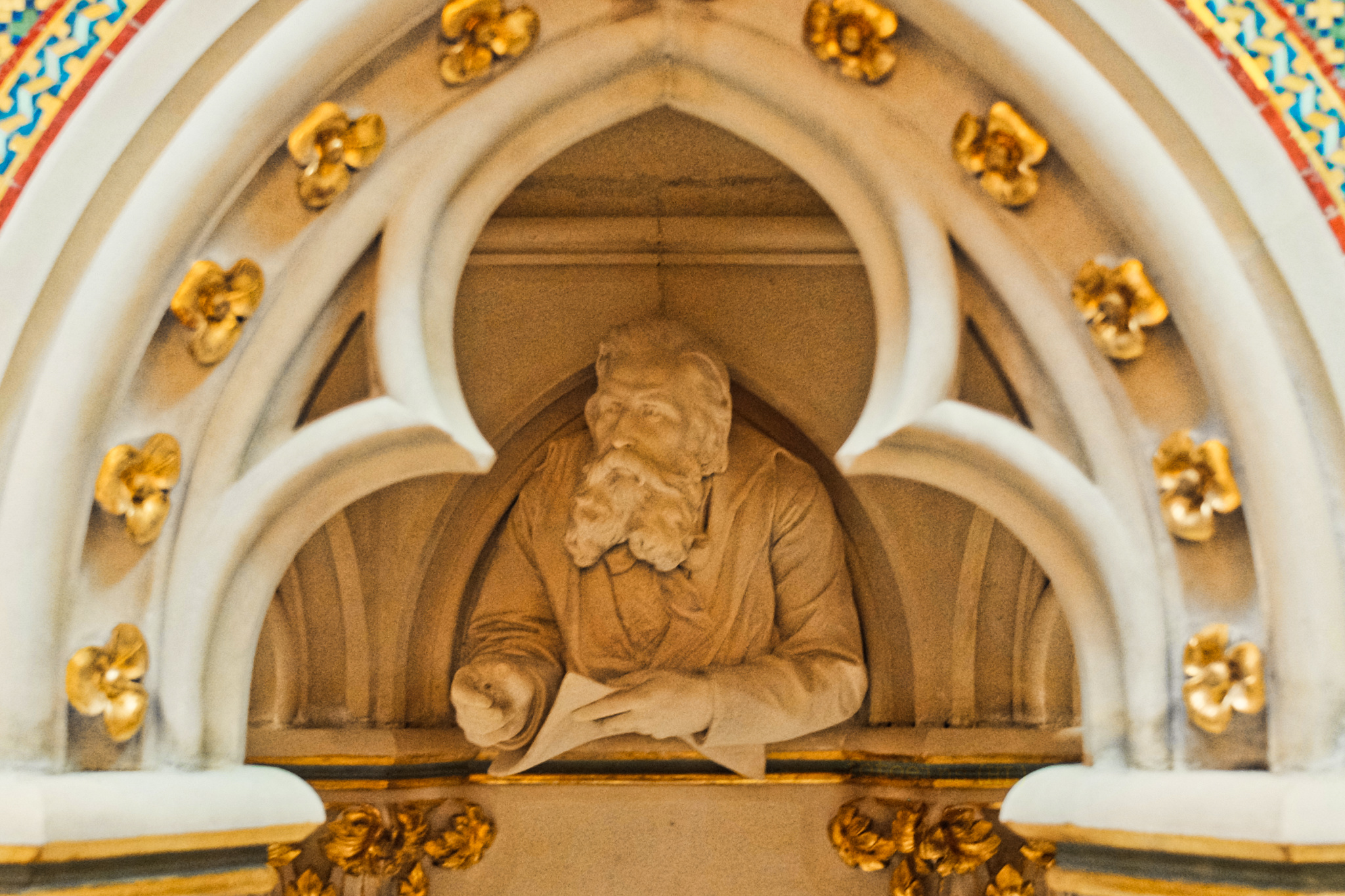
Underneath the marble pulpit is a bust of Heinrich Ferstel, made by sculptor Viktor Tilgner. Photo, 13 Jun 2024 (X70).
Wasagymnasium
Wasagasse 10, 9th district
• Secondary school, at address Wasagasse 10.
• Ferstel-designed building opened 1871 as “k.k. Real- und Obergymnasium im IX. Bezirke” (imperial and royal middle- and upper-high school in the 9th district); also called Maximiliansgymnasium.
• Writer Stefan Zweig attended this school, 1892–1900.
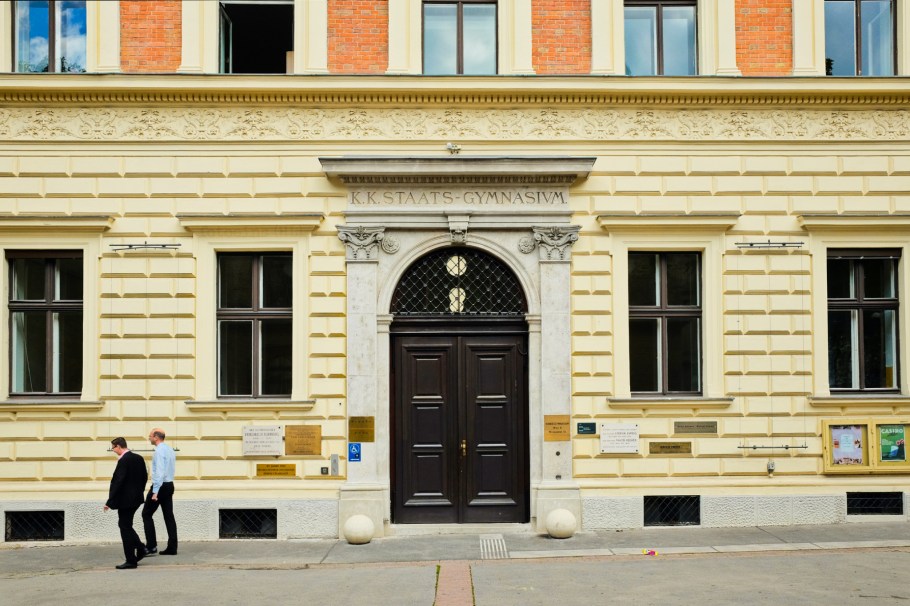
Gymnasium Wasagasse: “kaiserliches königliches Staats-Gymnasium”. Photo, 30 May 2022 (X70).
ZAMG (Geosphere Austria)
Hohe Warte 38 and 40, 19th district
• Geosphere Austria: home of Zentralanstalt für Meteorologie und Geodynamik (ZAMG), state meteorological and geophysical service for Austria.
• Julius-Hann-Haus at Hohe Warte 38, designed by Ferstel and completed 1882.
• Max-Margules-Haus next door at Hohe Warte 40, likely also designed by Ferstel and completed 1883.
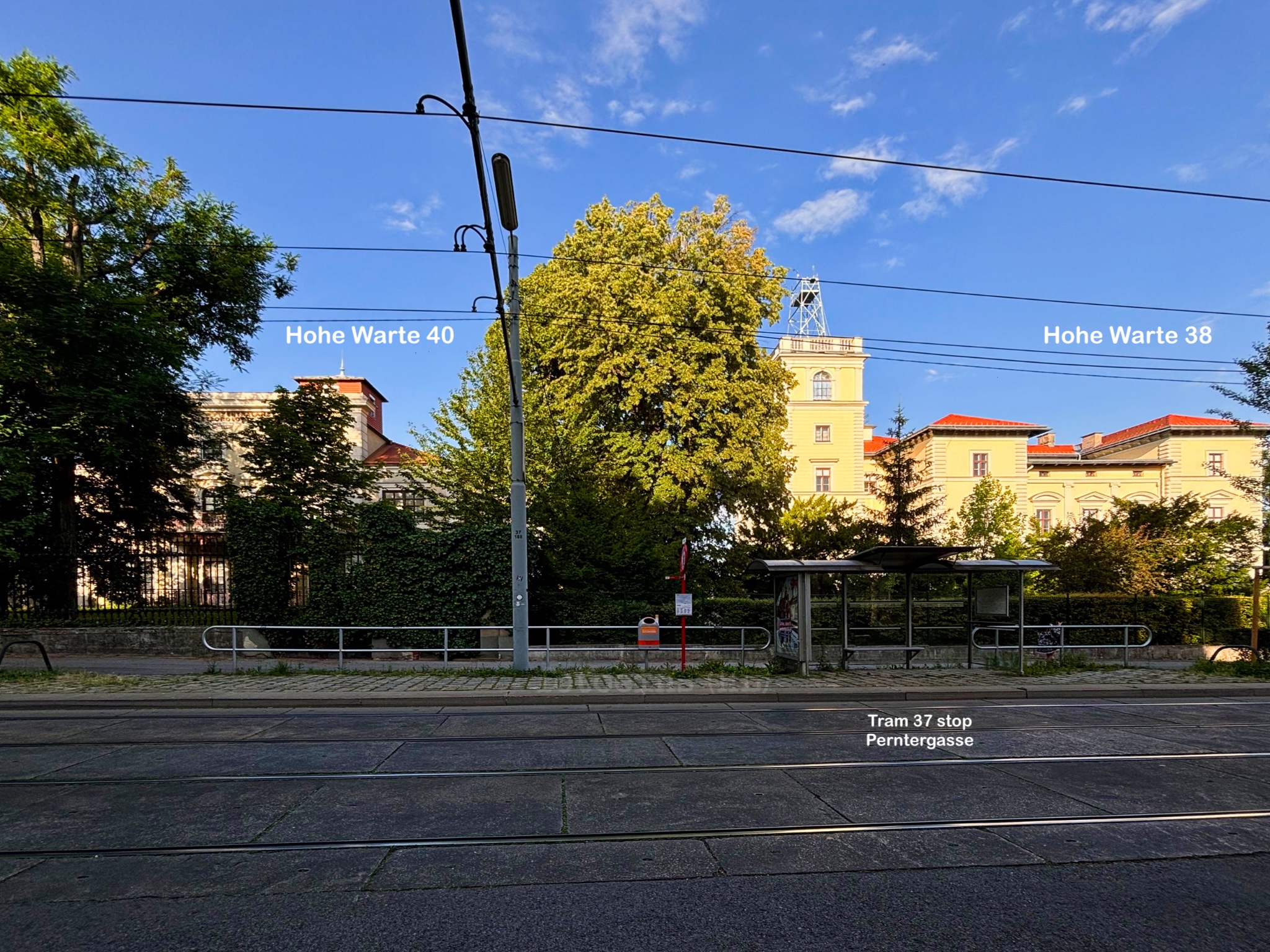
Left: Max-Margules-Haus at Hohe Warte 40. Right: Julius-Hann-Haus at Hohe Warte 38. Photo, 22 Jun 2024 (P15).
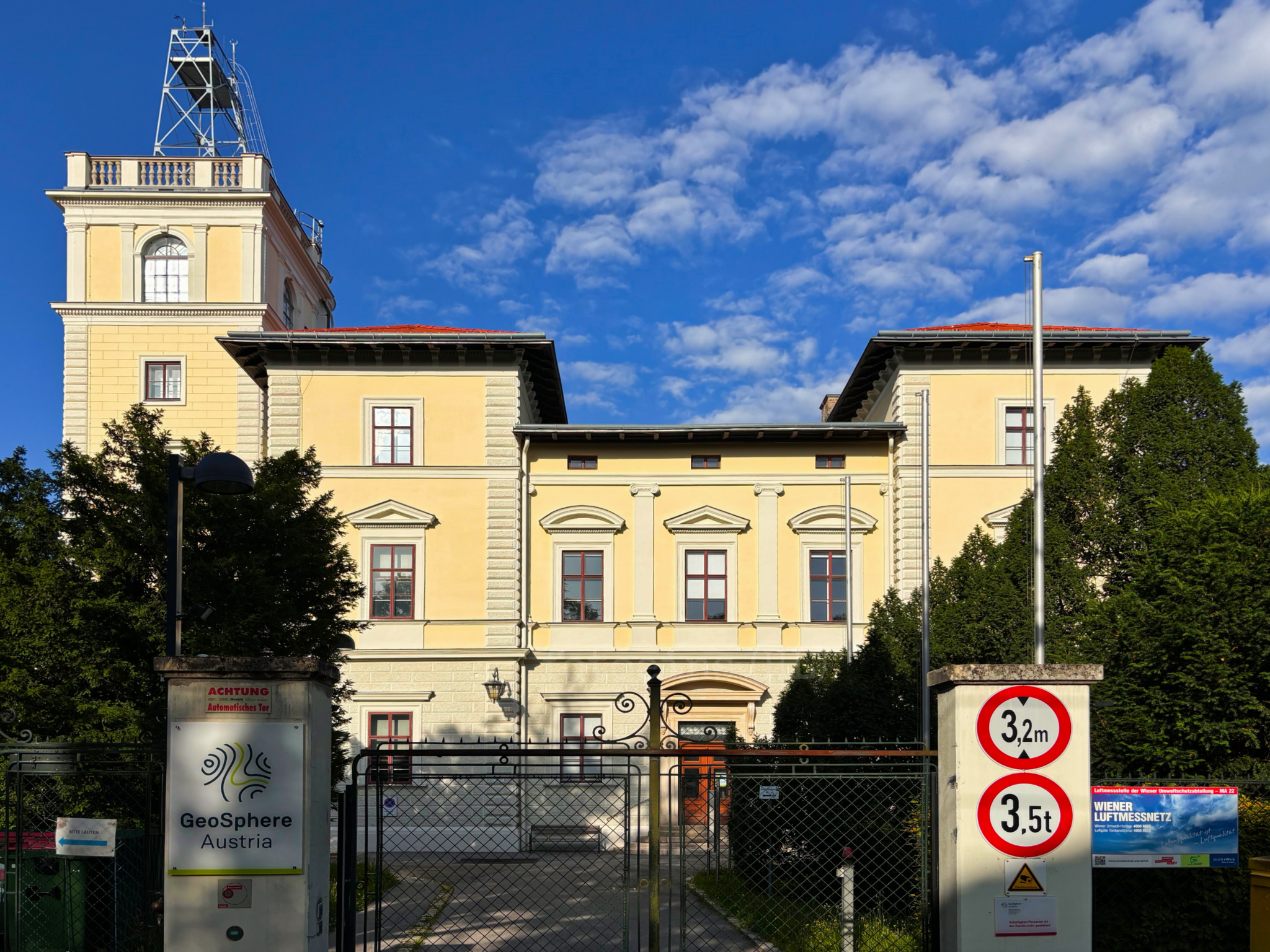
Hohe Warte 38: Geosphere Austria, and home of the ZAMG. Photo, 22 Jun 2024 (P15).
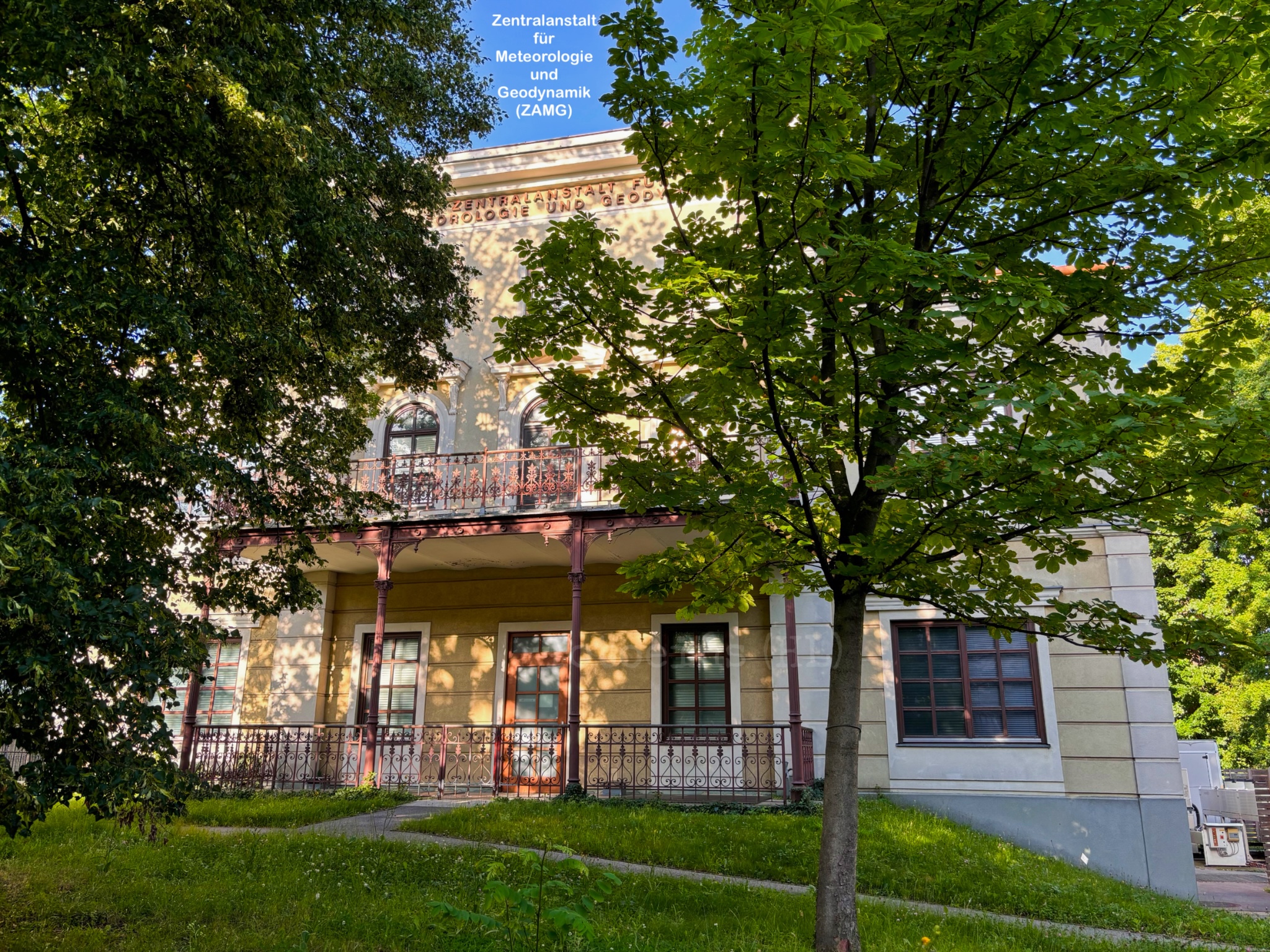
Lettering at the top of the building at Hohe Warte 38: “Zentralanstalt für Meteorologie und Geodynamik” (ZAMG). Because the grounds are not open to the public, this partly obstructed view is from Hohe Warte street. Photo, 22 Jun 2024 (P15).
Sources
• Architektenlexikon Wien 1770–1945; available at <https://www.architektenlexikon.at/de/1051.htm> [accessed Feb 2026].
• Curl, J. S., A Dictionary of Architecture and Landscape Architecture, 2nd edition (Oxford: Oxford University Press, 2006).
• Czeike, F., Historisches Lexikon Wien, in 6 Bänden (Wien: Kremayr & Scheriau/Orac, 2004); available from Wien Stadtbibliothek: <https://www.digital.wienbibliothek.at/wbrobv/content/titleinfo/1112764> [accessed Feb 2026].
• Harrer-Lucienfeld, P., Wien, seine Häuser, Geschichte und Kultur. 2.Band, 1.Teil (Wien: Stadt Wien, 1952). Available online at WStLA / Wienbibliothek im Rathaus <https://www.digital.wienbibliothek.at/wbrobv/content/titleinfo/2278312> [accessed Feb 2026].
• Sarnitz, A. (ed.), Architecture in Vienna (Wien: Springer-Verlag, 1998).
• Smith, D.J.D., Only In Vienna: Guide to Unique Locations, Hidden Corners, and Unusual Objects, 4th edition, (Only In Guides/The Urban Explorer; New York: Simon & Schuster, 2015).
• Wehdorn, M., Vienna: A Guide to the UNESCO World Heritage Sites (Wien: Springer-Verlag, 2004).
• Wien Geschichte Wiki, Stadt Wien (adminstrative departments MA8 & MA9); available at <https://www.geschichtewiki.wien.gv.at/> [accessed Feb 2026].
• Wien Kulturgut: Architektur → Gebäudeinformationen; available at <https://www.wien.gv.at/kulturportal/public/> [accessed Feb 2026].
I made all images above with a Fujifilm X70 fixed-lens prime (X70) and an iPhone15 (P15) in the summers of 2022, 2023, and 2024. This post appears on Fotoeins Fotografie at fotoeins DOT com as https://wp.me/p1BIdT-pJF. Last edit: 6 Feb 2026.
 Fotoeins Fotografie
6 Responses to “Vienna: Heinrich Ferstel’s architectural legacy”
[…] building by architect Heinrich Ferstel was opened in 1870 as the city’s Education Centre and the nation’s Teacher Training […]
LikeLike
[…] his family lived in this house in the Cottage Quarter in the city’s 18th district. Architect Heinrich Ferstel co-founded the Wiener Cottage Verein (Vienna Cottage Association) in 1872 to establish within the […]
LikeLike
[…] admiring the villas and mansions, and marveling over how architect and neighbourhood co-founder Heinrich Ferstel had intended the target audience to be mid- to upper-class families in the late 19th-century. It […]
LikeLike
[…] wrote previously about the legacy of one of the Vienna Ringstraße architects Heinrich Ferstel. Hans Gasser’s statues appear on one of Ferstel’s well-known “palaces” in the inner […]
LikeLike
[…] to the Ringstraße is the University of Vienna main building by Heinrich Ferstel and inaugurated in 1884. Erwin’s youthful gaze is part of the university’s display of its […]
LikeLike
[…] • b/✵ 7 Jul 1828 – d/✟ 14 Jul 1883. • One of the “Ringstrasse” architects; e.g., Votivkirche, Universität. • Heinrich Freiherr von Ferstel (Ferstl) family mausoleum: group MA, number 46. • Click • Ferstel’s architectural legacy in Vienna here. […]
LikeLike