Seattle: Licton Springs indigenous landmark
This is “líqtəd”, commonly known today in Seattle as Licton Springs.
This place is the city’s first indigenous landmark.
In a corner of Licton Springs Park, a couple of wood bridges cross over small creeks. Despite encroachment by urbanization over many decades and the pressure of being squeezed between Aurora Avenue and the Interstate-5 freeway, the water flow has essentially continued from the time before white/European colonization. Four springs and their emergent creeks flowed south into what is now called Green Lake. One of these springs, the “iron sulphur spring”, remains visible with its outflow merging downstream with a larger creek, as iron-oxide mud stains the ground red. The word “líqtəd” in the Lushootseed language means “red paint”. A recently installed cement ring-collar provides some protection around the spring as an attempt to preserving this historic location. As sacred site once used for medicinal and cultural activity, the Duwamish people camped and built sweat lodges near these springs; they bathed in the mineral-rich waters and used the brightly coloured mud to make paint. The second main spring, “white magnesium spring” at the park’s southern end, is no longer visible after having been capped under another existing pond.
On 16 October 2019, the city of Seattle’s Landmarks Preservation Board approved the designation of the indigenous Duwamish site. Licton Springs Park received official historical recognition as the city’s first indigenous landmark.
Red “líqtəd”
The following is direct from “An Atlas of Indigenous Seattle”, the 2017 book by Coll Thrush and Nile Thompson (and maps by Amir Sheikh):
líqtəd (LEEQ-tud), “red paint”.Licton Springs bears one of Seattle’s few modern place-names derived directly from Whulshootseed, the southern Seattle-area dialect of Lushootseed in the group of Coast Salish indigenous languages. People came here to the springs to collect clay, which was baked and mixed with tallow to create red paint. The area was one of the properties owned by David Denny (re. from the Denny group who landed at Alki in 1851); the area was once a health spa which eventually became a residential suburb accessible by streetcar. The rust-red springs are still visible today in Licton Springs Park.
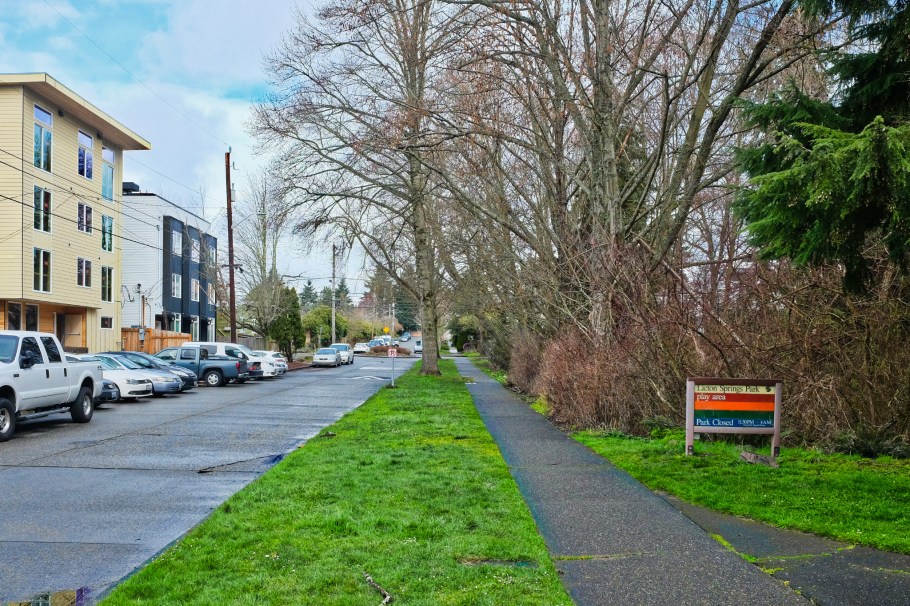
West side of the park: facing north on Ashworth Avenue North.
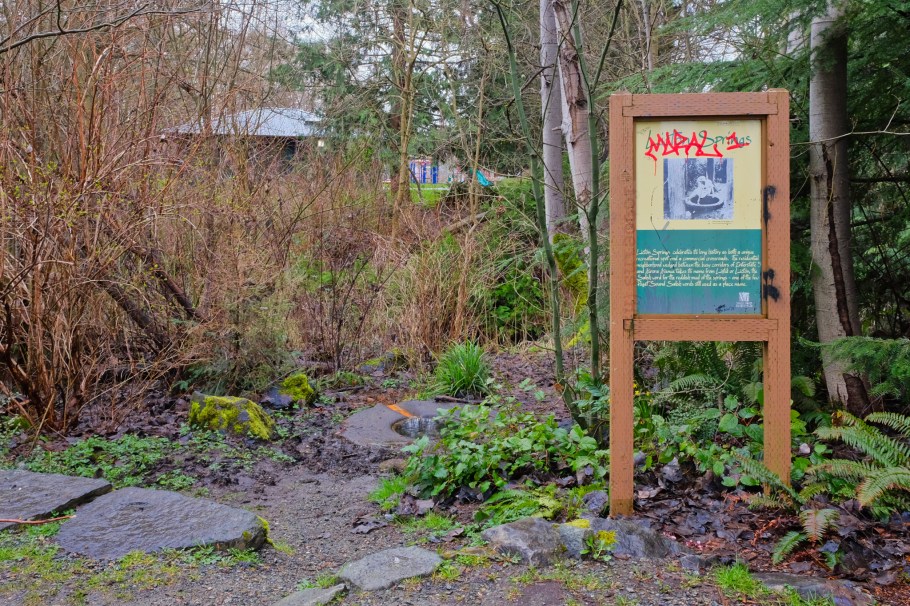
The iron sulfur spring appears on the ground at lower-centre. In the background are the park’s restrooms and children’s playground.
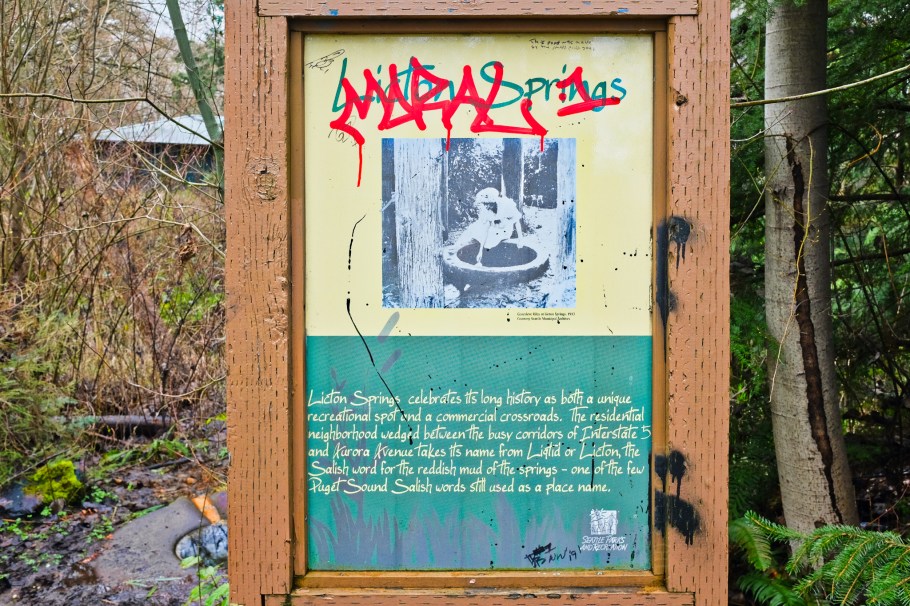
“Licton Springs celebrates its long history as both a unique recreational spot and a commercial crossroads. The residential neighborhood wedged between the busy corridors of Interstate 5 and Aurora Avenue takes its name from Liqtid or Licton, the Salish word for the reddish mud of the springs – one of the few Puget Sound Salish words still used as a place name.” (Seattle Parks and Recreation)
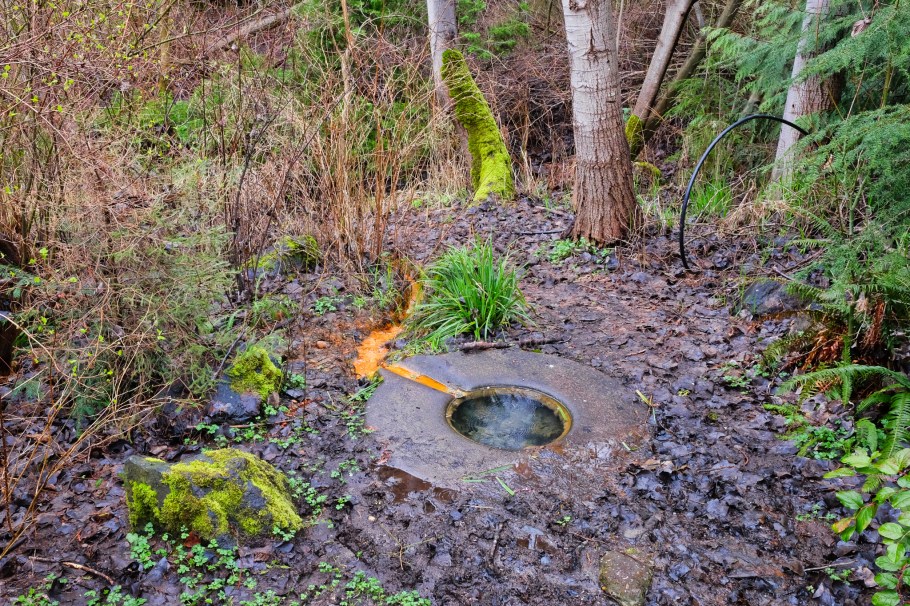
The iron sulfur spring, a.k.a., “red” spring, with cement collar (IG).

Above the red spring.
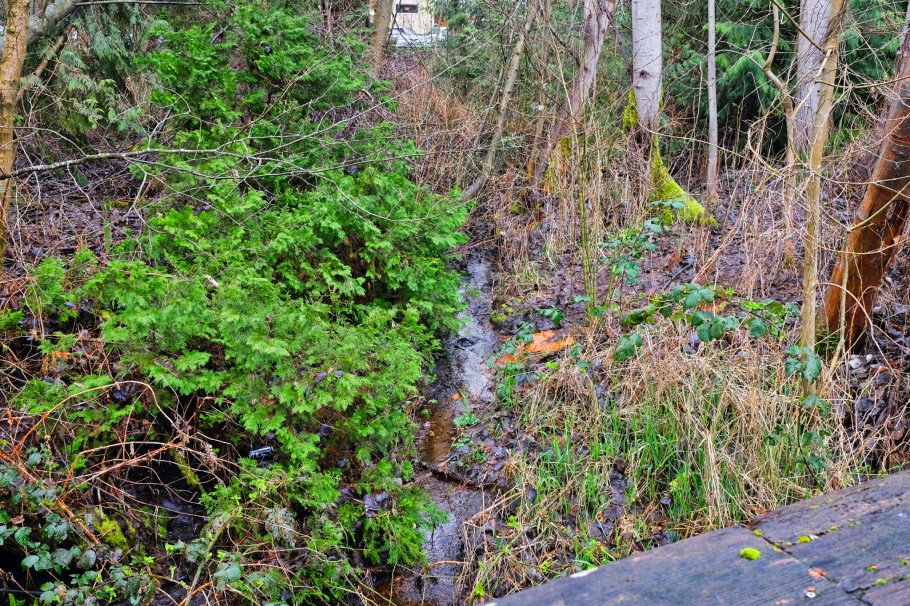
Red mud and spring water flow down into an adjacent creek which heads south towards Green Lake.
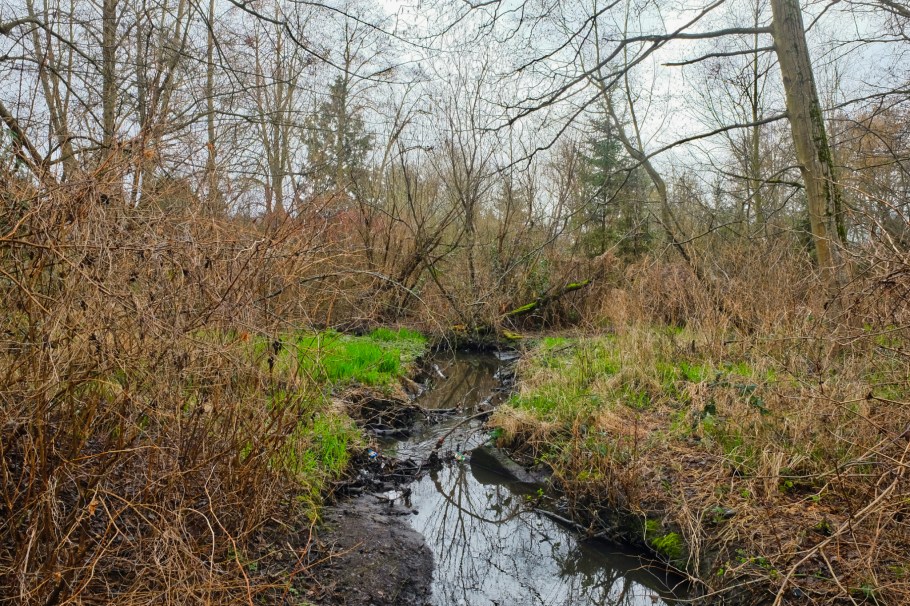
Facing south: forested wetlands in the park, surrounding the creek and squeezed by urban encroachment.
Directions
With King County Metro public transport, the RapidRide E-Line bus between downtown Seattle and Aurora Village Transit Center makes a stop at “Aurora Ave N & N 95th St”. From the bus stop, it’s a short 10-minute walk east to Licton Springs Park, operated and maintained by the city of Seattle. The “red/iron” spring is in the northwest corner of the park.
Dr. Coll Thrush is an associate professor of history at the University of British Columbia in Vancouver, and I’ve drawn much from his book Native Seattle: Histories from the Crossing-Over Place (Seattle: Univ. Washington Press, 2017). Also, Hidden Hydrology provides additional description about the wetland area, and what’s been lost to ongoing urban development.
I visited the ancestral lands of the Duwamish (Dxʷdəwʔabš) People. I made all photos above on 7 March 2020 with a Fujifilm X70 fixed-lens prime. This post appears on Fotoeins Fotografie at fotoeins DOT com as https://wp.me/p1BIdT-mwu.
 Fotoeins Fotografie
Please leave your comments below