My Frankfurt: Berlin Airlift Memorial, planespotting at FRA
Above/featured: Taxiing “behind” the memorial is Finnair A350-900 (A359) with oneworld livery. In summer 2022, Lufthansa’s Eurowings Discover delivered flights between Germany and North America with “wet-leased” Finnair Airbus A359s. Photo, 14 Jun 2022.
The city of Frankfurt am Main is known as: gateway into Europe for the city’s international airport; the country’s financial capital nicknamed “Main-hattan;” the city where German parliamentary governance and federalism got their start with the first freely-elected parliament for all German states in 1848; the home of Grüne Sosse and Ebbelwoi, the local savoury speciality and apple wine, respectively.
But the history shortly after World War 2 tells of an important connection between the cities of Frankfurt and Berlin.
Post-war Berlin was a landscape of occupied zones by American, British, French, and Soviet forces, a partial reflection of similar occupation in post-war Germany. Over a dispute about what monetary currency would be used, Soviet forces in eastern Germany blocked all road, rail, and water access into western Berlin on 25 June 1948. In one of the largest aircraft operations in peacetime history, the United States and United Kingdom began airlifting vital food and fuel supplies from their airbases in western Germany to over 2 million residents in west Berlin. Among the three airfields in western Berlin, Tempelhof became a key centre for critical supplies for almost one full year.
The Soviets allowed western forces to fly solely in three narrow air corridors from western Germany, over Soviet-controlled eastern Germany, and into Berlin. Inbound flights to Berlin along the southern corridor began from the area around Frankfurt am Main. The Rhein-Main Air Base (1945–2005) operated as a hub for US Air Forces as “gateway” into Europe; the base occupied the southern side of Frankfurt Airport and served as essential staging point during the Berlin Airlift operation. On 12 May 1949, Soviet forces reopened road and rail access into western Berlin, ending the blockade.
After countless flights in and out from Frankfurt, I visited the Berlin Airlift Memorial next to Frankfurt airport, as well as the planespotting area.

1948 map of Germany, north at top. 3 approved “corridors” for the Berlin airlift from Western Germany over Soviet-controlled Eastern Germany and into western Berlin. North corridor: primarily inbound from Hamburg area (HH) to West Berlin. Central corridor: primarily outbound from western Berlin towards Hannover area (H). South corridor: primarily inbound to western Berlin from the Frankfurt area (F). The three airfields in western Berlin were Gatow, Tegel, and Tempelhof. Source: Miller 1998; with labels added for clarity.

On approach to an airfield in west Berlin during the airlift operation, a U.S. Air Force Douglas C-54 Skymaster makes a candy-drop, seen as tiny parachutes below the tail of the plane. Aircrews dropped candy to children during the Berlin Airlift as part of Operation “Little Vittles”. Source: National Museum of the US Air Force, photo 050426-F-1234P-01, c. 1948 to 1949.
Central station to airlift memorial

Frankfurt Hauptbahnhof or central station: the morning’s S7 departure is from track 3. This photo and photos below, 14 Jun 2022.
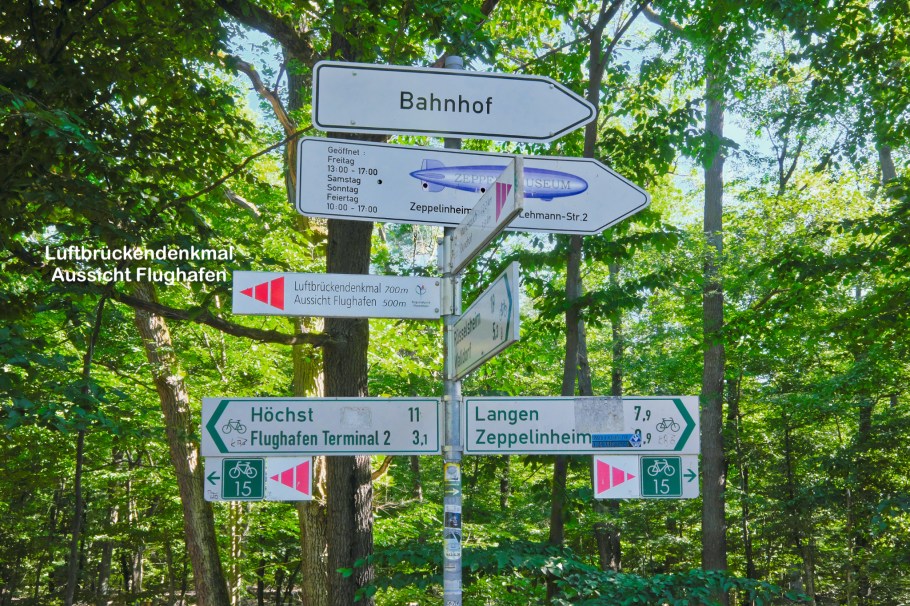
Signage on forest path: left to the spotting area and airlift memorial; right to Zeppelinheim Bahnhof (station).

Pedestrian bridge over Autobahn A5, facing northwest to Frankfurt airport’s terminals 1 and 2 (FRA T1, T2) and the Taunus mountains in the background. This spot is 9 km south-southwest from Frankfurt city central station.
Luftbrückendenkmal
Airlift Memorial
The memorial next to Frankfurt Airport first opened in 1985; a redesign for improved public access and restoration of two planes (now on site) gave way to reopening in 2008 on the 60th anniversary of the airlift. The memorial’s central structure is a 20-metre tall curved white-cement block with 3 upward “prongs”, representing the 3 approved flight corridors between West Germany and West Berlin. The monument is a replica of the version by Eduard Ludwig at Berlin’s former Tempelhof airport in 1951.
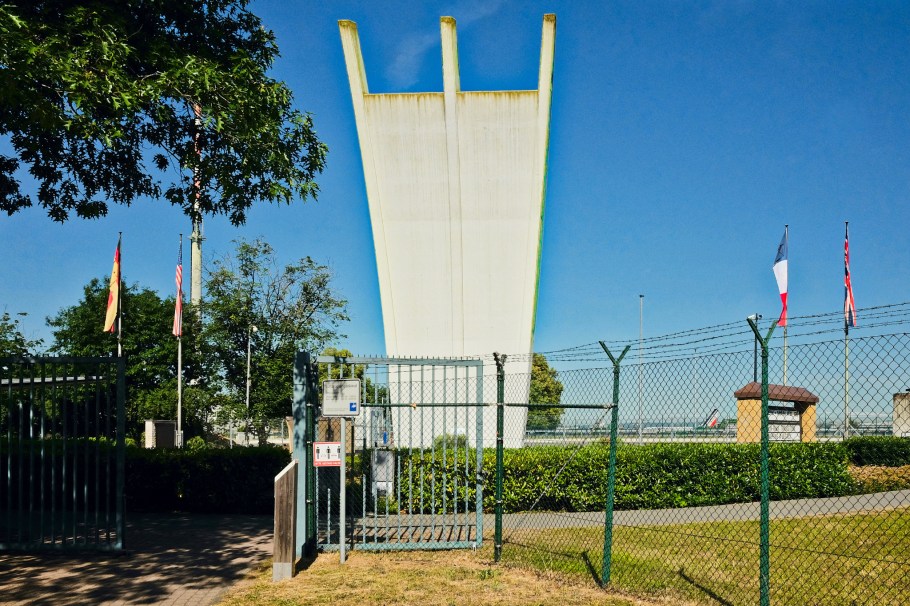
Memorial entrance: flags representing Germany, United States, France, and the United Kingdom flank the memorial’s central structure.

Memorial entrance: about the airlift (Luftbrücke), provided by Regionalpark Rhein-Main.

Memorial entrance: about the airlift memorial (Luftbrückendenkmal), provided by Regionalpark Rhein-Main.

Meilenstein (milestone), complete with the Berlin bear.

Memorial’s central structure; a visitor at front provides scale against the 20-metre block. The 3 upward “prongs” at top represent the 3 approved air corridors over Soviet-controlled east Germany into west Berlin.
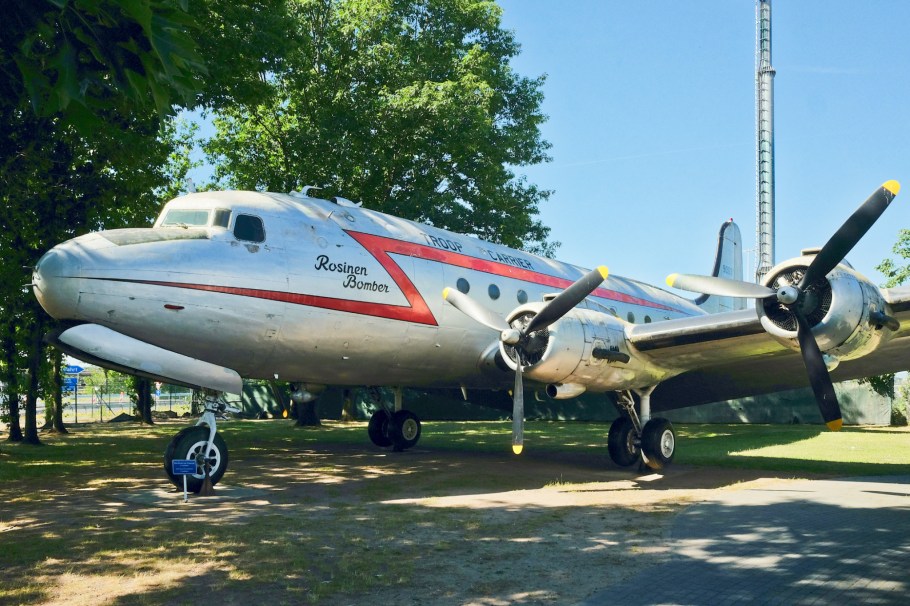
“Rosinenbomber” (raisin/candy bomber), Douglas C-54E Skymaster 44-9063.

Douglas C-54E Skymaster 44-9063.

“The Berlin Train”, Douglas C-47A Skytrain/Dakota (DC3) USAF 349081.

Douglas C-47A Skytrain/Dakota (DC3) USAF 349081.

Former Berlin Wall: L-shaped concrete wall-segment from the “Grenzmauer 75” series produced in the mid-1970s: height 3.6 metres (11.8 feet), width 1.2 metres (3.9 feet), thickness 0.1 metre (4 inches), weight 2750 metric tons (2976 US tons). The “foot” took up an area 2.5 square metres (27 square feet).

USAF Rhein-Main Air Base, US Air Forces Europe.
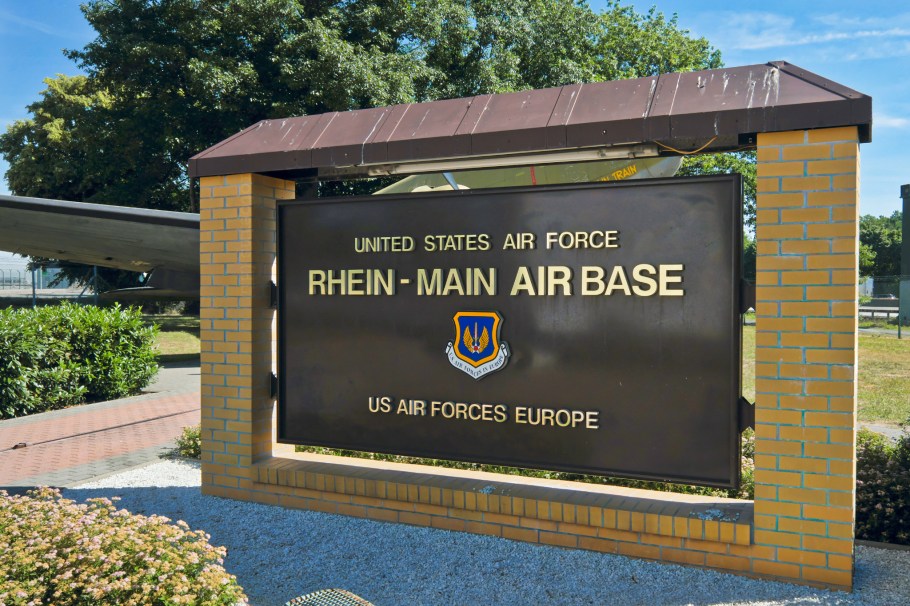
USAF Rhein-Main Air Base, US Air Forces Europe.
Aussichtsplattform Zeppelinheim
Spotting area
The Zeppelinheim/Neu-Isenburg observation area is located “landside” at the east end of the airport, just south of runway 25L/7R, and outside of the airport’s security fence for open public access. Also visible to the airport’s north are Terminals 1 and 2, as well as construction for the new Terminal 3 to the south.

A Tuesday morning in mid-June.
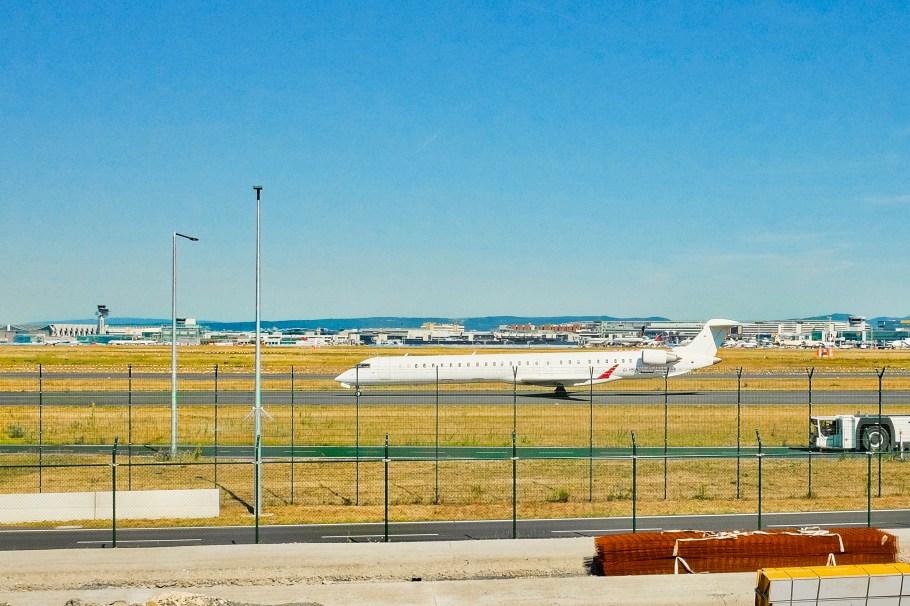
Hibernian Airlines, EI-HBA, MSN19020, Bombardier CRJ-1000, 2009. The airport’s new Terminal 3 is visible in the background at left.
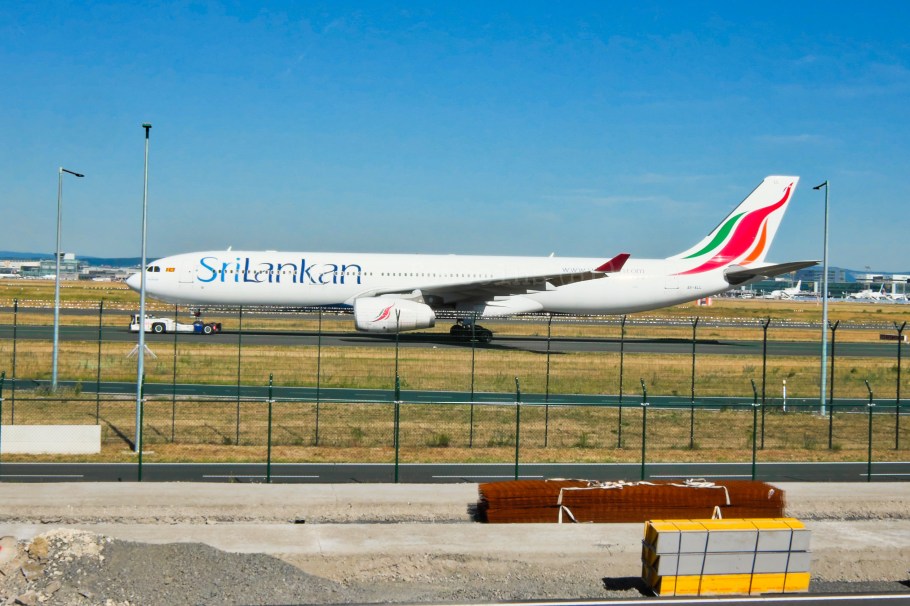
Sri Lankan Airlines, 4R-ALL, MSN1564, Airbus 330-343E, 2014.

Condor Airlines, D-AIYC, MSN975, Airbus 330-243, 2008.

Lufthansa Boeing 747: post-takeoff climb phase.

Spotting the spotters.
Sources
• American War Memorials’ detailed description of the airlift memorial.
• Berliner Morgenpost, for more info graphics (in German) about the airlift on the 70th anniversary in 2019.
• Luftbrückendenkmal-Geschichte, Luftbrücke Frankfurt-Berlin 1948–1949 e.V.
• Miller, R. G., To Save A City: The Berlin Airlift 1948-1949, for the U.S. Air Force History and Museums Program, 1998.
• National Museum of the United States Air Force: image identifier (VIRIN) 050426-F-1234P-012, gallery at <https://www.nationalmuseum.af.mil/> [accessed Sep 2023; also Wiki].
• Die Reise Eule (The Travel Owl), about plane-spotting locations around FRA (in German).
Notes & Directions
With public transport, S-Bahn Rhein-Main trains on the S7 route go between Frankfurt am Main Hauptbahnhof (central station) and Zeppelinheim station at hourly frequency (12-minute ride one-way). Leaving Zeppelinheim station on foot, there’s a flat dirt path heading west through the forest. After about 750 metres (10 minutes), the forest path leads to a pedestrian bridge over the A5 Autobahn (highway / motorway). Across the bridge is a public area to observe the comings, goings, and aircraft movements at FRA Airport; the spotting area is just south of the eastern end of runway 25L/7R. From the observation area, a paved path leads south about 250 metres to the airlift memorial. The memorial’s operating hours are 8am to 5pm October to March, and 8am to 8pm April to September. Both memorial and spotting area are free of charge.
Except for two images labelled “Source:”, I made all other pictures above on 14 Jun 2022 with a Fujifilm X70 fixed-lens prime. This post appears on Fotoeins Fotografie at fotoeins DOT com as https://wp.me/p1BIdT-owW.
 Fotoeins Fotografie
One Response to “My Frankfurt: Berlin Airlift Memorial, planespotting at FRA”
[…] the southeast periphery of Frankfurt Airport, the Berlin Airlift Memorial is accessed “landside” from Zeppelinheim. The two planes on display are: 43-49081 […]
LikeLike